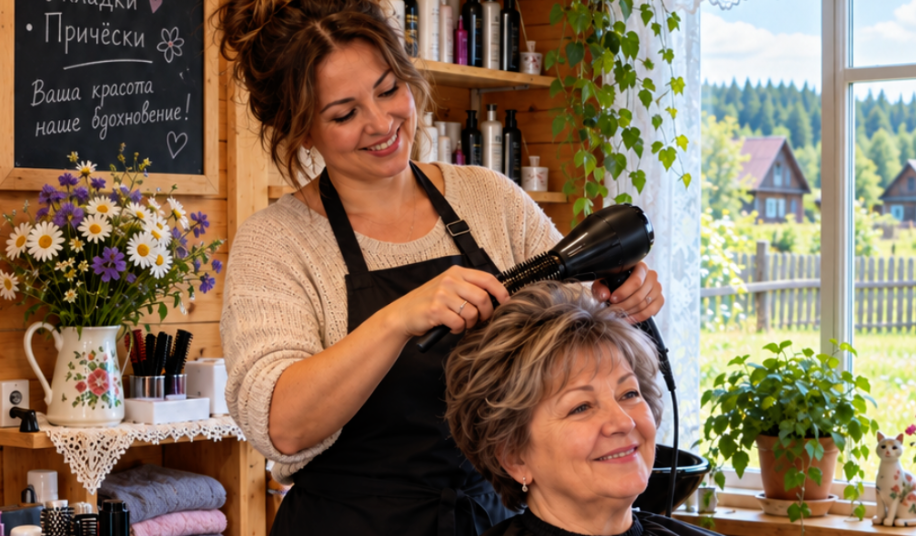
A Hairdresser Opened a Salon in a Remote Village. The Women Started Coming for Something Other Than Haircuts…
Marina told her husband that they were moving to the village sometime in mid-April.
At first, Oleg thought he had misheard her. Then he assumed his wife was joking. But when he realized she was completely serious, he became angry.
“Do you even understand what you’re suggesting? Leaving the city? Our apartment? What about your clients? Your job at the salon?”
Marina remained calm.
“The salon doesn’t belong to me. It has an owner, and I’ve been working there for almost nothing for six years. But Grandma’s house is standing empty in the village. We won’t have to pay rent for it. And most importantly, it’s ours. Ours, Oleg. Do you understand? Our own house.”
Her grandmother’s house stood in a village right on the riverbank. It took about four hours to get there, and part of the journey was along a badly damaged gravel road.
Marina remembered the place perfectly from childhood.
It was a sturdy log house with a spacious veranda and three windows facing the street. Her grandmother had died three years earlier, and the house had remained empty ever since. Only a neighbor, Aunt Vera, came by about once a month to open the windows and air out the rooms.
Oleg resisted the idea for almost two weeks.
He argued, gave reasons, and tried to convince his wife to abandon the plan.
Eventually, however, he gave in.
He truly loved Marina—deeply and steadily—even though by nature he was entirely a city person.
Oleg worked as a heating engineer and was accustomed to thinking in numbers, drawings, formulas, and precise calculations.
Marina was his complete opposite.
Easygoing and impulsive, she could suddenly make a decision that had never even crossed her mind the day before.
Perhaps that was exactly what had captivated him about her in the first place.
In May, the couple moved.
The first thing that struck Oleg was the silence of the village.
It was nothing like the nighttime silence of the city, which always seemed temporary and slightly uneasy.
Here, the silence was real—thick and dense, almost like cotton.
There were only three streets and around forty households. A small old shop with a faded, peeling sign. A crooked bus stop.
Most of the residents were elderly.
Young people were gradually leaving: some moved to large cities, some found work in the district center, and others went even farther away.
Oleg began repairs almost immediately.
The roof needed fixing, the porch had to be restored, the wiring checked, and the pipes dealt with.
Meanwhile, Marina chose the front room for herself.
When her grandmother was alive, it had been considered the formal sitting room. Guests were received there, the whole family gathered there, and tea parties were held there on holidays.
The room was spacious and very bright. Three large windows looked directly onto the village street.
Marina stood in the middle of the room, looked around, and said confidently:
“This is where my salon will be.”
She had brought the necessary equipment with her.
She managed to buy an almost-new salon chair from her former employer for half its original price. Marina also brought a large illuminated mirror, shelves for her tools, and a special hair-washing sink.
Oleg installed the plumbing, fitted a water heater, and redid the necessary wiring.
By the middle of June, everything was ready.
Marina hung a simple sign above the porch:
“Hairdresser. Marina.”
The village watched.
People looked through their windows, peered over fences, sat on benches near their gates, and discussed the unexpected novelty.
A hair salon?
Here?
Who could possibly need one in a village where the only shop closed at four in the afternoon and the last bus left around six?
The first customer appeared only on the third day.
It was Granny Zina, who lived on the next street.
She was about seventy, thin and wiry, with lips habitually pressed together.
And she did not particularly need a haircut.
What brought her there was simple curiosity.
She wanted to see with her own eyes what the city woman had done with the room that used to belong to her grandmother.
Marina opened the door warmly.
“Come in. Sit here.”
Granny Zina carefully lowered herself into the salon chair and raised her eyes toward the large mirror.
For several moments, she simply stared at her reflection.
Perhaps ten years had passed—maybe even longer—since she had seen herself like this: full-length, under bright, even lighting, in a large mirror.
At home, she had only a small old mirror in the bathroom, clouded with age. In the mornings, she gave herself a quick glance and immediately got on with her chores.
But here, everything was visible.
The gray strands.
The wrinkles.
The small spots on her skin.
Every feature of her aging face.
Granny Zina studied herself for a long time and then unexpectedly said quietly:
“So this is what I look like now… I hadn’t even noticed.”
Marina stepped behind her and gently ran her fingers through the woman’s hair.
“What shall we do?”
The old woman shrugged.
“I don’t know, dear. Just cut it somehow. As long as it doesn’t fall into my eyes.”
Marina spent about forty minutes with her.
But she did much more than an ordinary haircut.
She washed her hair, trimmed it carefully, dried it, and gave it a light styling.
All the while, Granny Zina watched herself in the mirror.
And then, unexpectedly, she began to talk.
First about her husband, who had died eight years earlier.
Then about her son, who lived far away and called his mother about once a month.
She talked about her daughter-in-law, who had never liked village life.
She complained about the vegetable garden, which became harder to manage every year.
Then she began talking about the nights.
About those long hours when you lie alone in the house, listening to the silence around you.
And little by little, it begins to feel as though the entire enormous world has simply forgotten that you exist.
Marina listened.
She did not try to give advice.
She did not interrupt.
She did not offer routine words of sympathy.
She simply worked with her scissors and occasionally nodded in understanding.
Cut gray hair fell quietly to the floor.
When everything was finished, Granny Zina got up from the chair but did not leave immediately.
She looked closely at her reflection one more time.
Then she asked:
“How much do I owe you?”
“Two hundred.”
Granny Zina turned toward Marina in surprise.
“Only two hundred? In the city they’d charge several times more for work like this.”
Marina smiled.
“That’s the city. Here, we’re at home.”
The very next day, Granny Zina returned.
This time she was not alone—she brought a neighbor with her.
Another day later, two women came at once.
By the end of the first week, Marina already had eight regular customers.
By the end of the month, there were so many visitors that she had to start a separate appointment book and schedule people by time.
That was when Marina finally understood why the women were coming.
It was not really for the haircuts.
Of course, they did get their hair cut.
They covered their gray hair, got perms, and asked for styling.
But none of that was the most important thing.
The most important thing was something entirely different: in Marina’s little salon, the women could talk.
About husbands who drank. About grown children who rarely remembered their parents. About illnesses, small pensions, and the ever-rising cost of firewood. About old dreams that had once seemed possible but had later been abandoned. And, of course, about loneliness—long, heavy, clinging to a person like dampness soaking into old walls.
Gradually, Marina’s salon became almost like a confessional.
The women themselves began calling these visits “our therapy.” At first they said it jokingly, but with time the joke began to sound completely serious.
Marina only smiled.
She did not consider herself a psychologist.
She was an ordinary hairdresser.
She simply knew how to listen.
And the ability to truly listen to another person is far rarer than it seems. Sometimes it is more valuable than the ability to create a flawless haircut or knowing dozens of coloring techniques.
In the city, people paid specialists considerable sums simply for the opportunity to spend an hour talking about what troubled them.
Here, the women paid Marina two hundred for a hairstyle and received something far more necessary along with it—the chance to finally speak openly.
And Marina listened.
To the postwoman and the schoolteacher.
To the saleswoman from the village’s only shop and the librarian.
To young women and elderly ones.
To cheerful women and those who had almost lost hope.
Over several months, she heard dozens of stories about love, betrayal, hope, loss, and unfulfilled dreams.
And gradually her little salon looked less and less like an ordinary business.
So what was it becoming?
A refuge?
A shelter?
Perhaps simply a place where a person was truly noticed and heard.
Not everyone understood that, however.
Oleg was the first to bring it up.
One evening, the couple were drinking tea when he suddenly said:
“Listen, I did some calculations. At your prices and with the number of customers you have, you’re working almost without profit. You spend an hour and a half on each woman. In the city, you could serve three customers in that time. Marina, this isn’t really a business anymore. It’s turning into charity.”
Marina looked at him calmly.
“So what if it is charity?”
Oleg spread his hands.
“Then it would be easier to close the salon and open a tea room. The result would be the same: women come, drink tea, and talk.”
“No. It wouldn’t be the same at all.”
“What’s the difference?”
Marina thought for a moment.
“When someone comes to a tea room, she comes as a guest. But here… here a woman remains herself. She sits in front of a large mirror and has to look at her own reflection. There’s nowhere to hide. She sees herself as she really is—tired, getting older, sometimes unhappy. And for some reason, that makes it easier to start talking. Everything she has kept inside for so long starts coming out on its own.”
Oleg still did not understand what his wife was trying to explain.
He was used to thinking differently.
Numbers, formulas, diagrams, and calculations were logical and understandable to him. He could easily explain how pipes, water heaters, electrical wiring, and voltage worked.
But he did not know how to understand the subtle movements of a woman’s soul.
The village men did not understand what was happening either.
“Why do our women keep going to Marina?” they grumbled. “What can they possibly talk about for two hours in a hair salon?”
One day, Granny Zina finally snapped:
“About you fools. About how you don’t even notice your own wives.”
After that answer, the men fell quiet.
There was nothing to argue with.
The problem came from an entirely unexpected direction.
Valentina Pavlovna, the head of the local administration, stepped into the salon one day, but not because she wanted a new hairstyle.
She had come to conduct an inspection.
The moment she entered, she demanded:
“Show me your documents. Registration, permits, tax declarations.”
Marina calmly produced everything required.
She had no intention of breaking the law, so she had completed all the necessary paperwork in advance.
Valentina Pavlovna spent a long time carefully examining the documents, her thin lips pressed together disapprovingly.
Eventually, she was forced to admit:
“Everything is properly registered here. But…”
Marina looked at her questioningly.
“But what?”
“People are talking around the village. They say you’ve turned this place into some kind of women’s club rather than a hair salon. Your customers sit here for hours. They tell you things that really ought to stay inside their families.”
Marina replied calmly:
“Valentina Pavlovna, my job is to cut people’s hair. If a customer wants to talk while I’m cutting her hair, that is her right. I don’t deliberately question anyone. I simply listen.”
“And in doing so, you destroy families.”
“I do nothing of the kind.”
“Women come here, pour their hearts out, then go home and repeat to their husbands what they said here. And then the arguments and scandals begin.”
Marina placed her scissors on the worktable.
“I’ve been working here for four months. Not one family quarrel has happened because of me. But I can tell you what really has happened during that time. Granny Zina finally went to a doctor about her constant headaches. Before that, she had endured them for two years without telling anyone. Klava from across the river left a husband who had been beating her for five years. Everyone around her knew about it but preferred to stay silent. Nastya, the young teacher, wanted to quit the school because she was convinced she wasn’t good enough at her job. We talked, and she decided to stay. So tell me, Valentina Pavlovna—what is that? Destroying families, or helping people?”
The head of the administration remained silent for a long time.
Marina was already expecting another complaint.
But suddenly Valentina Pavlovna walked over to the chair and sat down.
“Cut my hair,” she said quietly. “I haven’t managed to get around to it for six months. I never have the time.”
Marina said nothing.
She simply picked up the scissors.
For the first ten minutes, they sat in almost complete silence.
Then Valentina Pavlovna unexpectedly began to talk.
About her son, who was serving under contract.
About her sick husband.
About how difficult it was to be responsible for practically the entire village—for the roads, the water supply, heating, the gradually emptying houses, and the school where fewer and fewer children remained.
She also admitted that she had not slept properly for several years.
Marina listened.
As always.
When the haircut was finished, Valentina Pavlovna remained seated for a long time in front of the mirror, carefully studying her reflection.
Finally, she asked:
“How much?”
“Two hundred.”
The woman placed the money on the shelf.
Near the door, she suddenly stopped and turned around.
“You know, Marina… perhaps you’re right after all. Maybe a place like this really is necessary. Not so much for the haircuts, but… for the chance to talk.”
Then she left.
And the very next day, she sent three new customers to Marina—women from remote farms who rarely came into the village.
By winter, the salon was open every day.
So much snow fell that in some places the drifts almost reached the roofs. The road to the district center was cleared about once a week, sometimes even less often.
But the women still came to Marina.
They walked through deep snow, pushed through blizzards and early winter darkness simply to spend an hour in her chair.
And talk.
One day, the door opened and a woman Marina had never seen before entered.
She looked about forty-five.
She was extremely thin, with deep dark shadows beneath her eyes. An old jacket hung loosely from her body as though it were several sizes too large.
The woman carefully sat down in the chair and immediately said:
“I don’t need my hair cut. I just… I need to talk to someone. They told me you know how to listen.”
Marina put down her scissors.
She pulled over an ordinary chair and sat beside her.
“I’m listening.”
The woman talked for almost two hours.
Her son was dying of cancer in the district hospital.
For the past six months, she had practically lived between his hospital room and her own house.
Her husband could not cope with what was happening and had left.
And she had been left completely alone with her fear, guilt, and helplessness.
There was no one to whom she could even say aloud what frightened her most.
Marina held the woman’s hand.
And listened.
She did not interrupt.
She did not try to find the right words.
She simply remained beside her.
When the woman finished speaking, she looked up at Marina with reddened but now dry eyes.
“How much do I owe you?”
Marina shook her head.
“Nothing.”
“But I…”
“You didn’t have a haircut.”
The woman slowly nodded and stood up.
At the door, she stopped.
“Yegor. My son’s name is Yegor. If you can… just think of him sometimes.”
Marina replied:
“I will.”
And she really did.
Every day.
In the spring, the woman appeared at the salon again.
She looked a little different now.
Still tired.
Still older than her actual age.
But there was something new in her expression.
Perhaps peace.
Or maybe acceptance.
Perhaps both at once.
She said quietly:
“He’s gone. A month ago. I… I just wanted to thank you.”
Marina pointed to the chair.
“Sit down.”
The woman obediently sat.
“Today I’m finally going to cut your hair. You need it. It’s time to slowly start taking care of yourself too.”
The woman’s name was Galina.
She allowed Marina to wash her hair, trim it carefully, and style it.
When everything was finished, Galina looked at her reflection.
And for the first time in many months, she smiled.
“Thank you,” she whispered.
This time, Marina accepted payment.
Not because she particularly needed the money.
But because it was important for Galina to pay.
For at least that one hour, she needed to feel like an ordinary woman again—someone who had come to an ordinary hair salon to have her hair done.
Not a mother drowning in grief.
Just a customer.
And paying for the haircut was another small step back toward life.
After Galina left, Marina remained alone in the empty salon for a long time.
Soft spring light poured through the three windows.
On one shelf stood a jar of homemade jam—another gift from a grateful customer.
Someone had attached a card to the mirror that read:
“To Marina, with gratitude.”
The walls that had once been completely bare were now covered with small keepsakes.
Dried flowers.
Children’s drawings.
Short notes.
Little gifts from people who had once sat in that chair.
Marina looked at them and remembered what she had wanted when she and Oleg decided to move here.
She had planned to create her own business.
She had dreamed of becoming independent.
She wanted her own workplace, the freedom to make her own rules, and the chance to stop depending on anyone else.
She had wanted to escape the cramped city salon where every minute had a price and every visitor was seen primarily as another transaction.
Marina had thought she was building a business.
But she had received much more.
Instead of an ordinary business, Marina had gained an entire village of women willing to trust her with their most painful and private thoughts. She had heard countless stories that made her heart contract and then seemed to put it back together piece by piece.
Most importantly, she understood that her work was truly needed.
Not only because the women looked more polished and beautiful after leaving her hands, but because beside Marina they finally felt that someone heard them.
Gradually, Marina understood one more simple truth: there were an astonishing number of people around who desperately needed to speak.
They did not always need advice.
They were not asking for judgment, condemnation, or pity.
Sometimes a person simply needed someone to listen attentively.
That was what the village women had taught Marina.
And in return, she could give them only what she herself had: her time, her attention, and the ability to remain silent when no words were needed.
Oleg still did not fully understand what exactly was happening in the room with the large mirror and salon chair.
But gradually, he stopped talking about profit and calculations.
He saw the jars of homemade jam that women brought his wife.
He noticed the cards and children’s drawings on the walls.
Most importantly, he saw the customers’ faces.
The women often entered the salon looking exhausted and burdened.
And they left as though they had become a little lighter.
One evening, Oleg walked over to his wife, kissed her on the temple, and simply said:
“Keep doing what you’re doing. We’ll manage somehow.”
And they did.
By summer, Marina’s salon no longer seemed unusual to anyone.
It had simply become part of local life—as familiar as the shop, the administration building, or the bus stop.
One day, an unfamiliar young woman of about twenty-two came into Marina’s salon.
She had a backpack over her shoulders and a voice recorder in her hand.
“Are you Marina?”
“Yes.”
“I work for the district newspaper. May I talk to you for a while?”
They sat down right there in the salon.
The young woman began asking questions.
Why had Marina decided to move here? How had she come up with the idea of opening a salon in a village? What did her customers talk to her about? Was it true that she helped people? And was it really true that she had once saved a woman from suicide?
Marina answered calmly until she heard the last question.
Immediately, she became wary.
“Who told you about the suicide?”
The journalist looked slightly embarrassed.
“People are talking. About the woman who lost her son. I was told that you saved her.”
Marina shook her head.
“No. I didn’t save anyone. She saved herself. I simply… happened to be there at the right moment. I listened to her. That’s all.”
The young journalist looked carefully at Marina.
“But that isn’t a small thing. Truly listening to someone is already a great deal.”
Marina thought about it and nodded.
“Yes. Perhaps it is.”
Two weeks later, the article appeared in the newspaper.
It was titled:
“The Hairdresser Who Listens.”
After the article was published, Marina’s phone began ringing much more often.
People called from neighboring villages, the district center, and even large cities.
Journalists appeared. Bloggers contacted her. Someone even offered to arrange a television feature.
Marina refused them all.
She explained to Oleg:
“What kind of celebrity could I possibly be? I’m an ordinary hairdresser. I cut people’s hair. Everything else… somehow just happened by itself.”
But deep down, Marina understood perfectly well that none of it had happened by itself.
It was the result of her own choices.
She could have finished every haircut in forty minutes and immediately called in the next customer.
She could have raised her prices.
She could have created exactly the same kind of conveyor belt that she herself had once escaped from.
But she did not.
Every day, Marina chose people over maximum profit.
And that seemingly small choice, repeated dozens and then hundreds of times, gradually transformed the tiny village salon into a place that could never have been written into any business plan in advance.
One evening, Granny Zina came to see her again.
By then, she had long since become a regular customer.
She came every month, always on the first Tuesday.
Marina began cutting her hair as usual but quickly noticed that the woman was unusually quiet that day.
“Zina, what happened?”
Granny Zina did not answer for a long time.
Then she finally said:
“My son called me. He’s planning to visit. With his wife. For the first time in three years.”
Marina was delighted.
“That’s wonderful news!”
“It is… But do you know what else he said? He told me, ‘Mom, you look different in the photos. Like you’ve gotten younger.’”
Granny Zina turned her head toward Marina.
There were tears in her eyes.
“It’s because of you. Because I come here. And it isn’t only about the haircuts, though they’re nice, of course… It’s because someone listens to me here. I feel like at least one person cares what happens to me. And when you understand that… a person changes. Not even on the outside. Inside.”
Marina could not help herself.
She hugged Granny Zina right beside the chair, still holding the scissors in one hand.
“Zina, you’re a wonderful woman. You were one long before you ever met me.”
Granny Zina smiled.
“Maybe so. But somehow, when I’m around you, I become even better.”
Marina thought that no one had ever said anything more beautiful to her in her entire life.
The little salon still stands on the quiet village street, its familiar sign gently swaying above the porch.
Women walk through its door every day.
Some are very young.
Others are already elderly.
Some cheerful.
Others sad.
Some carry real tragedy with them.
Others worry about small things that, at that particular moment, seem enormously important.
They sit in the salon chair.
They raise their eyes to their reflection.
And they begin to talk.
And Marina listens.
Of course, she is still a hairdresser.
She cuts hair, gives perms, colors it, dries it, and styles it.
But the most important part of her work turned out to be both simpler and more difficult than any professional technique.
Marina knows how to truly hear another person.
And in a world where far too many people want to speak and far too few are willing to listen carefully, perhaps that ability is one of the most necessary of all.