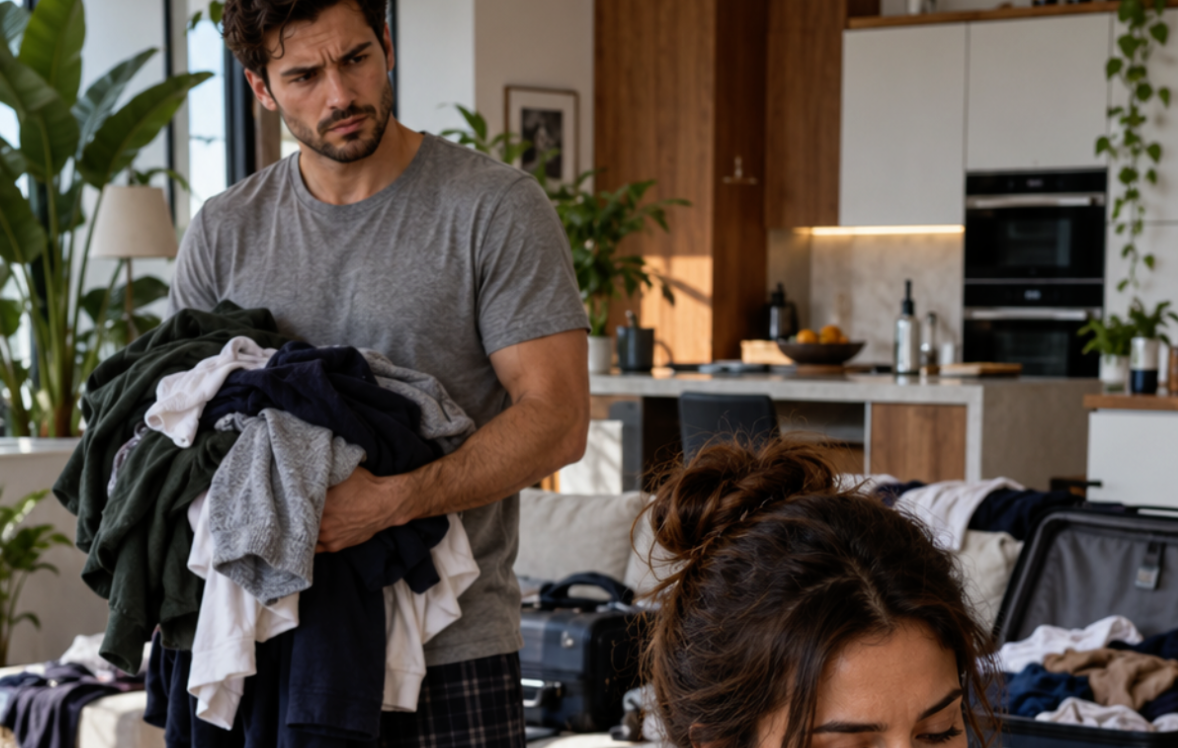
My Husband Decided to Divorce Me Without Moving Out. A Week Later, He Realized That Living Separate Lives Under the Same Roof Could Be Very Uncomfortable
Gennady said it on Sunday afternoon while Lyuda was washing the dishes.
“I want a divorce,” he said in the same tone he normally used when asking her to change the TV channel.
Lyuda turned off the water but didn’t turn around. During that pause, her husband apparently had enough time to think she hadn’t heard him.
“I heard you,” Lyuda said, as though she had read his mind. “Pass me the towel.”
He handed it to her. She dried her hands, hung the towel on its hook, and only then looked at him—but somehow past him, the way people look at a train schedule.
“And when are you planning to move out?”
“Why should I move out? It’s a three-room apartment. I’ll stay in the study. People live like that. It’s normal.”
“People live like that,” Lyuda repeated expressionlessly.
“Well, what else am I supposed to do? Rent some dump for thirty thousand?”
Lyuda placed the sponge on the edge of the sink and walked out of the kitchen without answering.
Gena stood there for another minute, listening to the silence, and decided that everything had gone surprisingly smoothly.
They had been married for seventeen years.
The apartment belonged to Lyudmila. She had inherited it from her grandmother—a three-room apartment near Akademicheskaya, with high ceilings and squeaky parquet flooring in the hallway.
Gennady wasn’t officially registered there, but from about the third year of their marriage, he had started considering the apartment partly his because he had replaced the pipes in the bathroom and installed a new balcony door.
His job was technical, not particularly difficult, and his salary was average but stable.
Lyudmila worked as an accountant at a clinic, and for the past five years she had been financially supporting her mother in a care home outside Moscow, which took a significant portion of her salary.
Gennady knew about the money and periodically remarked that her mother could have lived with them if Lyuda weren’t such a convenient daughter for her brother, who contributed absolutely nothing.
Gennady had been thinking about divorce for about four months, ever since Oksana from the purchasing department had appeared at work.
She laughed at his jokes and once told him he looked like an actor from some TV series, although she couldn’t remember which one.
Oksana was twelve years younger than him. She rented a one-room apartment in Butovo and, so far, had never asked him for anything.
Gennady considered that the most important sign of genuine, powerful feelings.
He hadn’t yet told Oksana that he had announced the divorce to his wife. He wanted to settle into his new way of life first and then tell her properly, perhaps over dinner in a restaurant.
Monday began normally.
Gena got up as usual and went into the kitchen, but the kettle was cold.
Lyuda had already left for work, and there was no cup waiting for him, no sandwiches, not even sliced cheese on a plate.
He opened the refrigerator and discovered that the food had been strangely rearranged.
Lyuda’s containers occupied the upper shelf, each one labeled with a marker. On the bottom shelf were a packet of butter, three eggs, and a piece of sausage that looked as though it had about one day left to live.
At first, Gennady didn’t understand what had happened.
Then he noticed a note held to the refrigerator with a magnet:
“Your shelf is the bottom one. Everything else is mine.”
He read it twice, snorted, and decided not to react.
He fried the eggs, dirtied the frying pan, washed it, and wiped the table.
All of this took twenty minutes, and he was late for work.
At the office, Oksana asked why he looked so gloomy.
Gennady told her he hadn’t slept well.
He didn’t feel like explaining the details. The story about the bottom shelf in the refrigerator sounded petty and somehow ridiculous.
On Tuesday, he came home from work and discovered that the bathroom door was locked from the inside.
Lyuda was taking a shower.
He waited ten minutes, then fifteen, and finally knocked.
“Wait,” Lyuda said.
She came out forty minutes later wearing a robe and a towel wrapped around her hair. She walked past him without looking at him and closed the door to her room.
When Gennady entered the bathroom, there was no hot water. It had been shut off for scheduled maintenance, and somehow the water in the boiler had run out.
He stood under the freezing stream for four seconds, swore loudly, and grabbed his towel.
It was damp because he had forgotten to hang it up to dry, and it had been lying over a hook in his room since the previous day.
Strictly speaking, he didn’t actually have a towel of his own.
All the towels belonged to Lyuda.
He had simply never thought about that before.
That evening, he tried to watch television in the living room, but Lyuda was already sitting on the sofa with her laptop, watching some series through headphones.
When he picked up the remote and changed the channel, she silently removed one earbud and looked at him.
“What?” Gennady asked.
“We’re getting divorced,” Lyuda said. “The living room is shared. We can discuss a schedule if you want. Tonight is my turn. I got here first.”
“What turn? Have you completely lost your mind?”
“You were the one who suggested living separately. For now, this is how it works. And technically, it’s my apartment, in case you’ve forgotten,” Lyuda replied before putting her earbud back in.
He went into the study and spent the evening scrolling through news on his phone, angry about something he couldn’t quite put into words.
On Wednesday at work, Oksana invited him to lunch.
Over their business lunch, Gennady opened up and told her that he had decided to leave his wife, that their marriage had been dead and purely formal for a long time, and that he simply hadn’t had the courage to end it before.
Oksana listened, stirring the straw in her glass, and eventually asked:
“So where did you move to?”
“Nowhere yet,” Gennady said. “I’m staying in a separate room. We have a three-room apartment.”
Oksana said nothing.
She stopped stirring her straw and looked at him the way someone looks at a person who has started telling a joke but forgotten the punchline.
“It’s temporary,” Gennady added.
“Of course,” Oksana nodded and changed the subject to the upcoming office party.
He tried to bring the conversation back, but Oksana was already laughing with a colleague from the neighboring department.
Gennady finished his cutlet in silence, feeling like someone who had arrived at a party only to discover that he hadn’t actually been invited.
On Thursday, for the first time in seventeen years, Gennady went grocery shopping alone.
There was nothing left to eat. His bottom refrigerator shelf was completely empty, and he was afraid to touch Lyuda’s containers after she had silently stuck supermarket price labels on them, apparently making sure he understood exactly what everything cost.
Gennady spent forty minutes in the store.
He didn’t know what kind of butter they normally bought, what bread they ate, or what brand of coffee they used.
He bought a jar of instant coffee, a loaf of bread, sausages, and ketchup.
He stood in front of the shelves of grains for a while, chose nothing, and went to the checkout.
At home, he boiled the sausages in one of her pots.
He realized his mistake when his wife entered the kitchen that evening and said:
“Buy your own pot.”
“What do you mean, my own?”
“Any one you like. You don’t use my things anymore. You wanted a separate life, remember?”
“Lyuda, it’s a pot, not the apartment!”
“Correct. The apartment isn’t yours either, by the way, now that we’re discussing it. I’m just being too kind for the moment. Start looking for somewhere else to live.”
Gennady wanted to say something about seventeen years together and the pipes he had replaced in the bathroom, but Lyuda had already put the kettle on and turned her back to him.
There was something about the set of her shoulders that made it perfectly clear that the conversation was over.
He ate the sausages with ketchup directly from the same pot, using a fork whose ownership was uncertain, and went back to his room.
On Friday evening, Lyuda invited her friend over.
Through the wall, Gena could hear laughter, clinking glasses, and music Lyuda had never played around him because he always told her she had terrible taste.
Now her terrible taste was playing at full volume, and one of the two women was laughing so infectiously that Gennady involuntarily started listening, trying to make out what they were saying.
Fragments of conversation reached him.
“…and can you imagine, the pot…”
More laughter.
“…she stuck price tags on everything, yes…”
Gennady put on his headphones and started a podcast about investing.
Ten minutes later, he took the headphones off because there were now three people laughing in the next room—and the third voice was male.
He went into the hallway.
An unfamiliar man’s coat was hanging there.
It was dark blue and well tailored.
A pair of men’s shoes, size forty-three, stood neatly beside Lyudmila’s boots.
Gennady stood there for a while, looking at the shoes.
Then he returned to his room and called Oksana.
She didn’t answer.
He sent her a message saying that he missed her and saw that she had read it, but she didn’t reply.
A calm, low male voice came from the living room, followed by a clinking sound as though someone were pouring wine into the expensive glasses Gennady considered reserved for special occasions and usually brought out only for New Year’s and important celebrations.
He lay down on the sofa in the study and stared at the ceiling, where a yellow stain from an old leak spread across one corner.
The man left early Saturday morning.
Lyuda entered the kitchen at nine, looking fresh and wearing a new T-shirt Gennady had never seen before, and started cooking.
Meat hissed in the frying pan. Soon the kitchen smelled of garlic and rosemary.
Gennady suddenly remembered that Lyuda could cook so well that once their upstairs neighbors had actually come down to ask for a recipe.
He wandered into the kitchen as though he had simply come to get some water.
“Who was that guy yesterday?” he asked, trying to make the question sound casual.
“Tanya’s friend,” Lyuda replied without turning around. “Why?”
“No reason. It’s just that he was in our apartment, Lyuda. That’s going too far.”
“In my apartment, Gena,” Lyuda corrected him as she turned the meat over.
He filled his glass with water and left.
In the study, he drank the entire glass in one gulp and sat down at his computer.
He opened a website with apartment rental listings.
The prices were so high that he closed the tab three minutes later.
Then he opened it again, scrolled all the way down, and closed it once more.
He went into the bathroom and noticed that his toothbrush had been removed from the regular cup and placed in a cheap-looking disposable plastic cup on the edge of the sink, separate from his wife’s belongings.
His razor lay beside it on a napkin, like toiletries in a hotel.
On Sunday, exactly one week after announcing that he wanted a divorce, Gennady sat in the kitchen eating a sausage sandwich.
It was the same sausage that now smelled suspicious, but he felt sorry to throw it away.
Lyuda had gone out early that morning, dressed more carefully than usual—high heels, earrings, and perfume Gennady didn’t remember.
Or perhaps he had simply stopped noticing it long ago.
He finished the sandwich, cleaned up after himself, and sat down to calculate his expenses.
His salary was seventy-eight thousand.
The cheapest room he could rent outside Moscow was twenty thousand.
Food, if he cooked for himself, turned out to cost far more than he had expected because he bought the wrong things, in the wrong quantities, and threw half of them away.
Then there was transportation, lunches at work, his phone bill, and that stupid gym membership he hadn’t used since March.
Oksana had replied to only two of his five messages that week.
Both replies had been short, accompanied by an emoji and no questions.
Gennady washed his plate, wiped the table, and sat down on the kitchen stool that had always been his.
It was the only object in the entire apartment that he knew belonged to him with absolute certainty because he had personally brought it home from a hardware store fourteen years earlier.
The stool creaked.
Lyuda came home that evening flushed from the cold, carrying a bag from a pastry shop and a box that clearly contained cakes.
Gennady heard her put the box into the refrigerator on her shelf.
For some reason, that particular sound—the soft thud of cardboard against the plastic refrigerator wall—triggered such a sharp wave of irritation that he got up from the sofa and walked into the hallway.
“Lyuda!”
“Yes?”
“I think maybe we overreacted…”
She had already taken off her earrings and was holding them in her palm.
They were small silver earrings with blue stones, a gift from her mother from before she became ill.
Lyuda looked at Gennady.
She didn’t smile.
She didn’t frown.
She simply looked at him, and there was no anger in her eyes, no resentment, no sadness.
Instead there was something completely new, something Gennady had either never seen before or had never wanted to notice.
Peace.
Real peace, not something performed for appearances.
“No, Gena,” she said. “You didn’t overreact. For the first time in your life, you told the truth. And I’m actually grateful to you for that.”
“What do you mean?”
“Exactly what I said. For twelve years, I thought I was missing you. Turns out I’m enough for myself.”
“Lyuda, what do you mean, ‘yourself’? What kind of nonsense is that? We’ve been together seventeen years.”
“For seventeen years, I made your breakfasts, lunches, and dinners, washed your shirts, put your cup on the table, and did everything else,” Lyuda said calmly, without reproach, as if reading from a grocery list. “And in seventeen years, you never learned what kind of coffee I drink, and you never once mopped the kitchen floor.”
“I did!”
“All right, twice,” Lyuda said. “In 2014, when you spilled borscht. And last December, when you broke my cup and tried to hide it.”
Gennady opened his mouth, but there was nothing he could say.
She was correct down to the exact year.
On Monday, Gennady went to look at a room for rent in Otradnoye.
The man renting it out included a cat with the room.
The room was small, with a window facing the courtyard and striped wallpaper peeling off in places.
The cat sat on the windowsill and looked at Gennady with exactly the same expression Oksana had worn during lunch when he told her about his “separate life” in their three-room apartment.
The landlord wanted twenty-two thousand plus utilities.
Gennady returned home—or rather, to the apartment near Akademicheskaya, which he now clearly understood had never truly been his home.
He had spent seventeen years there like a man who had mistaken someone else’s comfort and effort for his own accomplishment.
Something spicy and sweet filled the kitchen with its aroma.
Lyuda was baking apple cake.
Apples and cinnamon were spread across the table, and the radio was playing the same music he had always called tasteless.
Lyuda was singing along quietly and slightly out of tune.
And she looked the way she hadn’t looked in at least ten years.
Free.
Happy.
Gena walked past the kitchen into his study, sat down on the sofa, and took out his phone.
He messaged Oksana:
“Can we meet today?”
Oksana read it a minute later.
She replied twenty minutes after that.
“I can’t today. I have plans.”
He placed his phone facedown and looked at the wall where a photograph of the two of them at the seaside used to hang.
Lyuda had taken it down on Wednesday and hadn’t put anything in its place.
Only a rectangular patch remained where the wallpaper was slightly brighter.
The rectangle looked like a window into a room that no longer existed.
On Tuesday, Lyuda placed a sheet of paper on the desk in his study.
In her neat accountant’s handwriting, it said:
“Deadline for finding new accommodation: two weeks. After that, the lock will be changed. You will not receive keys to the new lock. This is not open for discussion.”
There was a date and signature at the bottom, and the paper looked so official that Gennady seriously wondered for a while whether it was some kind of legal document.
He found Lyuda in the living room.
“What is this, an ultimatum?”
“It’s information,” Lyuda replied without looking up from her laptop. “You have fourteen days.”
“You don’t have the right to change the locks! I’m registered here!”
“You’re not registered here, Gena,” Lyuda said in the tone someone uses to explain something obvious. “You never even made it to the registration office. And that’s probably for the best.”
He didn’t remember.
Or rather, he remembered planning to do it.
But he had never gone because he was busy, then he forgot, then he couldn’t be bothered, and eventually it stopped seeming important because they were a family anyway.
“That’s cruel!” Gennady said.
“It’s practical,” Lyuda replied, closing her laptop. “Cruel would have been pretending for seventeen years that everything was fine, then announcing a divorce on a Sunday afternoon while I was washing the dishes.”
Gennady wanted to say that he hadn’t been pretending, that he really had been thinking about it, that it had been a serious decision.
But somehow the words wouldn’t arrange themselves into a sentence.
He stood in the living-room doorway with the feeling that he had already lost this apartment.
Not at the moment Lyuda wrote the note.
Much earlier.
Maybe on the day he had decided that replacing the bathroom pipes gave him a right to everything else.
He called his mother on Wednesday.
She lived in Tula and had always said that he was lucky to have Lyuda as a daughter-in-law.
What that really meant was that Lyuda sent her parcels every year for her birthday and called her on weekends—things Gena himself didn’t do.
“Mom, Lyuda and I are getting divorced.”
There was a pause.
“Are you an idiot, or did she find someone else?”
“Why am I automatically the idiot?”
“Because Lyuda is a perfectly decent woman, and you, my dear son, have always been convinced that everyone around you owes you something.”
“Mom!”
“I love you, but just think about which one of you called me last. Lyuda called me on Saturday. And when did you call? October?”
Gennady ended the call and sat for a long time holding his phone.
His mother had told him almost exactly the same thing Lyuda had, only more bluntly and in fewer words.
That made it hurt even more.
It was the kind of hurt you feel when two completely different people see the same thing while you alone see something else—and you begin to suspect that maybe the problem is with your own eyesight.
On Thursday at work, Oksana walked past his desk, smiled, but didn’t stop.
He caught up with her in the corridor.
“Oksana, maybe we could go somewhere on Friday?”
“Listen, Gena,” she said, stopping to adjust her hair. “You’re a great guy, really. But I don’t want to be the reason for someone’s divorce. It wouldn’t be right.”
“You’re not the reason. I decided a long time ago!”
“Then get divorced first, rent an apartment, sort out your life, and after that you can message me and ask me out,” Oksana said before walking away down the hallway, her heels clicking against the floor.
He returned to his desk, opened the work program, and stared at the screen for twenty minutes without doing anything until his colleague Vadim came over and asked whether everything was all right.
“I’m fine,” Gennady said. “I just have a headache.”
On Friday evening, Lyuda invited her friend Tanya over again.
Gennady lay on the sofa in the study and listened to glasses clinking in the kitchen.
Then he heard Tanya say:
“Lyuda, I haven’t seen you like this in ten years. You’ve become a completely different person.”
“I haven’t become different,” Lyuda replied, and Gennady heard her clearly because she was speaking louder than usual. “I’ve just finally been able to breathe freely, Tanya.”
Tanya burst out laughing.
Lyuda laughed too.
And suddenly Gennady understood that it was the laughter of someone who had finally been released from something.
That realization made him feel worse than he had even when Oksana had walked away from him down the office corridor.
He got up, dressed, left the apartment, and started walking down the street.
He reached the small shop on the corner, bought a beer even though he hadn’t drunk beer in five years, and sat on a bench outside the building like he had when he was twenty.
Above him, the apartment windows were glowing.
It was the apartment where he no longer lived, even though technically he was still staying there.
Through the kitchen window, he could see yellow light and the silhouettes of two women.
One of them was his wife, who in the space of a single week had transformed into a stranger—and, painfully, an obviously happy stranger.
Gennady finished his beer, crushed the can, and got up from the bench.
He had to go back.
He still hadn’t rented the room in Otradnoye.
He hadn’t saved the money for a deposit.
He hadn’t packed his things.
Everything with Oksana was uncertain.
He had argued with his mother.
And the kitchen stool—the only thing in the apartment that truly belonged to him—wasn’t even worth anything.
He climbed to the third floor, quietly opened the apartment door, and walked past the kitchen toward his study.
From behind the kitchen door, he heard Lyuda say to her friend:
“Tanya, do you know what the funniest part is? He thought he was the one leaving me.”
Gennady closed the door to the study, lay down on the sofa, and stared at the ceiling for a long time.
He looked at the yellow stain from the old leak that he had promised to paint over three years earlier.
Now he would never paint over it.
Because in twelve days, the lock would be changed, and this apartment would become nothing more than an address where he had once felt like the owner—without ever noticing that, all along, he had really been a guest.