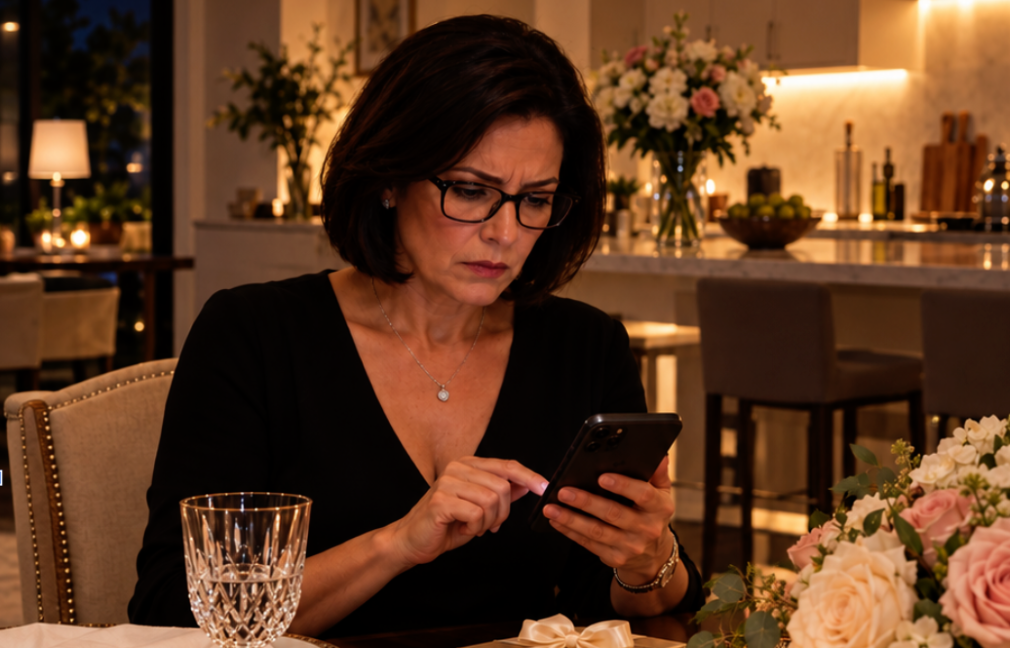
My son sent me a message: “Don’t come to my birthday celebration. My wife is against it, and we’d feel awkward.” I silently put on my glasses and canceled the restaurant booking
Four days before my son’s fortieth birthday, for the first time I carefully looked not at the menu or the total at the bottom of the page. I was looking at one line in the preliminary booking agreement:
“Customer — Natalia Sergeyevna K.”
My name had been there from the very beginning, but until that evening it had seemed like nothing more than a formality.
My phone was lying on the table beside me. The screen had already gone dark, but I still remembered Pavel’s message word for word. I didn’t feel like replying.
I took my glasses out of their case, put them on, and once again read through the restaurant documents.
There were four days left until the birthday celebration.
At first, they simply asked me not to be offended
Pavel was turning forty. He had a wife, Oksana, two daughters, a job at a construction company, and his own apartment. They lived independently, without constantly asking, “Mom, can you lend me some money until payday?” and I had always tried not to interfere in their lives.
There had never been an open war between Oksana and me either. I didn’t show up without calling, and she didn’t make complaints to my face.
During the first few years, we calmly celebrated holidays together.
Then a strange division began to appear: whenever they needed help, I was still family. But whenever guests were gathering, it became, “Maybe another time.”
In the spring, Oksana asked me to pick up my younger granddaughter from art school. She and Pavel were running late, so the girl stayed overnight at my place.
The next morning, my son came to pick her up, placed a bag of apples on my kitchen table, and thanked me.
Then, almost casually, he mentioned that Oksana’s parents, her brother and his wife, and several other relatives would be coming over that evening.
“Mom, just don’t be offended, but tonight we’re keeping it to our own circle.”
At first, I didn’t even understand why he was telling me that. Nobody had invited me, and I certainly wasn’t planning to show up at their home without being asked.
“Was I asking to come?”
Pavel hesitated.
“No. I just don’t want any misunderstandings.”
That evening, he sent me a photograph of the girls sitting at the table and wrote again:
“Thanks for helping us out.”
I decided I was imagining things and said nothing.
A month later, it was my older granddaughter’s birthday. Oksana asked me to arrive early and help prepare everything.
I brought pies, sliced fruit, arranged appetizers on serving dishes, and helped the younger girl fasten her dress.
At around four-thirty, Oksana looked at the clock.
“Natalia Sergeyevna, thank you so much. We can manage from here. The parents of her classmates will start arriving soon, and there are going to be a lot of people.”
I washed the knife I had been using, dried my hands, and went to put on my coat.
Pavel saw me in the hallway.
“You’re leaving already?”
“Am I supposed to stay?”
He looked at Oksana, who was adjusting a hair clip in our daughter’s hair.
“Mom, well… it’s mostly going to be a children’s party.”
An hour later, I received a message:
“Thanks for the help! We never would have managed without you.”
That evening, however, I saw the photographs.
Sitting at the table were Oksana’s parents, her brother, two of her friends with their husbands, and several other adults.
I didn’t ask why the party had somehow been considered “a children’s party” only when it came to me.
But after that, I stopped dropping everything whenever they called.
Pavel even noticed once.
“You used to take things more easily.”
“You used to ask for help less often,” I replied.
He smirked and changed the subject.
They chose the restaurant
Pavel first mentioned his fortieth birthday in June.
He didn’t want to celebrate at home. There would be too many guests: colleagues, friends, and relatives.
I asked him what he wanted as a gift.
“Mom, if you want to give me something substantial, help us pay for the restaurant. Then we can properly invite everyone.”
I wasn’t planning to pay for the entire banquet.
We agreed that my gift would be eighty thousand rubles, and they would cover everything above that amount themselves.
Pavel and Oksana chose the restaurant. They liked the private room and the convenient parking.
They also selected the menu themselves.
I was the one who went to complete the preliminary booking because the payment was being made with my card.
For thirty guests, the total came to approximately 138,000 rubles.
My details were entered on the booking documents.
I paid a 52,000-ruble deposit, received the receipt and a copy of the paperwork. The remaining 28,000 rubles from the 80,000 I had promised were supposed to be paid two days before the banquet, once the final number of guests had been confirmed.
Throughout the following month, Pavel kept sending me changes.
Add two seats.
Change the main course.
Ask where the screen for the photographs could be placed.
I wasn’t making any decisions for them. I simply passed their requests on to the restaurant manager.
Ten days before the celebration, I bought a dark green dress.
I tried it on at home and then carefully hung it in my wardrobe.
Two days later, Pavel came over to get the family photo album.
The host had asked for childhood photographs.
My son laughed at his old school haircut, set aside photographs of himself with his bicycle, and eventually reached the pictures from the dormitory where we had lived for several years after I divorced his father.
He selected one photograph for the slideshow and suddenly said:
“Mom, just don’t talk about the dormitory yourself at the party, okay?”
I looked up.
“What would I talk about?”
“Well, sometimes you remember how we used to live and how we didn’t have any money. Oksana doesn’t like it. And why would my colleagues need to hear about that?”
At none of his previous celebrations had I ever told strangers how many extra shifts I had worked to afford his school uniform or how carefully we had once counted every penny.
The thought had never even crossed my mind.
“Fine,” I said. “I won’t.”
He was obviously relieved that I didn’t argue. He took the photographs and left.
The following day, Oksana sent me the final seating plan.
My place was on it.
So when everything changed three days later, I knew perfectly well that it wasn’t some accidental misunderstanding.
The message arrived that evening
I came home after seven, had dinner, and took out the restaurant documents.
The manager had called that morning asking me to confirm the final number of guests.
Earlier that afternoon, Pavel had added two more people.
I sent him a message:
“So that makes 32. Should I confirm it?”
There was no reply for almost an hour.
Then my phone vibrated briefly.
“Don’t come to the birthday celebration. My wife is against it, and we’d feel awkward.”
A second message arrived immediately afterward:
“Just please don’t make a scene. We’ll get together separately afterward. Oksana thinks everyone will feel more comfortable this way.”
I typed:
“What happened?”
Pavel replied:
“Nothing specific. There’s just some tension. I don’t want arguments at my birthday.”
So I called him.
“Pasha, what arguments?”
I could hear the television in the background, and one of the girls asked him something.
My son covered the microphone for a moment, then returned to the conversation.
“Mom, don’t start now. Oksana says you’re offended with her and you’ll sit there with that expression on your face and make everyone uncomfortable.”
“What particular expression on my face got me uninvited?”
“See? You’re already being sarcastic.”
I walked over to the window and looked down into the courtyard for several seconds so that I wouldn’t say too much.
“Pavel, yesterday my name was on the seating plan. I bought a dress. I’m paying for part of the banquet. And four days before the celebration, you write to me telling me not to come because your wife has already decided what expression I’m going to have on my face?”
There was a pause.
“Money has nothing to do with this.”
“I haven’t said anything about the money yet.”
After that sentence, he went silent.
Then he suggested that I “not turn it into a tragedy” and said we could go somewhere separately after his birthday.
I ended the call, placed my phone face down on the table, and took out my glasses.
That was when I carefully read the line with the customer’s name for the first time.
Nobody at the restaurant got involved in our family dispute
The next morning, I called the restaurant manager and said that I wanted to cancel the banquet.
She checked the reservation and calmly explained:
“The booking is in your name. You’ll need to submit a written cancellation request. Accounting will calculate the refund for the deposit. If any expenses have already been incurred for your booking, those will be deducted.”
“Can’t I cancel it over the phone?”
“It would be better if you came in with the documents and receipt. We’ll officially register your request.”
After work, I drove to the restaurant.
There was no scandal with the manager.
She checked the booking number and date and printed out a cancellation form.
I read it, entered the banking details for the refund, and signed it.
“Are we releasing the private room completely?” she asked.
“Yes.”
She warned me that they would inform me of the refund amount after calculating the expenses they had already incurred.
I asked for a copy of the cancellation request stamped to confirm that it had been received, then put it into my bag along with the booking documents and receipt.
I didn’t somehow reverse a bank payment “with one click.”
I canceled the service as the customer whose name the banquet had been booked under.
When I walked out into the parking lot, I saw three missed calls from Pavel.
He called again almost immediately.
“Mom, the restaurant told me the booking was canceled. Was that you?”
“Yes.”
“Do you realize my birthday is in three days?”
“I do.”
Pavel began speaking faster.
He reminded me about the invited guests, the host, and the fact that everyone had already been given the restaurant’s address.
Then he said:
“But that was your gift. You don’t take gifts back.”
I put my handbag on the passenger seat and closed the car door.
“I’m not taking back an object that I already gave you. I’m refusing to pay for a restaurant that you yourself asked me not to come to.”
“This is revenge.”
“You can see it however you want.”
He was silent for a moment and then suddenly said:
“Oksana said you would do exactly this.”
“Then it’s strange that you didn’t book another restaurant in advance.”
After that, he hung up.
A few minutes later, Oksana sent me a long message saying that adults shouldn’t mix personal relationships with money.
She also wrote about the ruined celebration and accused me of putting Pavel in an awkward position.
I read it and didn’t reply.
That evening, my sister called me.
My son had already contacted her too.
“Did you really cancel the banquet?” she asked.
“Yes.”
“Did you tell them beforehand?”
“No. They didn’t tell me beforehand that I was no longer wanted either.”
My sister asked only one thing of me: not to turn her into a mediator between us.
I agreed.
Later, Pavel wrote that he had found another venue.
It was smaller and more expensive, so they had to remove some people from the guest list.
Half an hour later, another message arrived:
“When they refund the deposit, are you at least going to transfer the 80,000 to me? You promised it as a gift.”
I replied:
“No. I was going to pay for your birthday celebration at the restaurant. I’m no longer giving you that gift.”
He replied with one word:
“Understood.”
On Saturday, the dress stayed in the wardrobe
On the day of Pavel’s birthday celebration, I woke up early.
There were no messages from him.
I had breakfast, went to the store, and spent the day doing my usual things.
The dark green dress remained hanging in the wardrobe.
I didn’t take it out.
At around six in the evening, my sister wrote that she was on her way to the celebration and asked how I was doing.
I replied:
“I’m fine. Don’t worry.”
We didn’t exchange any more messages that evening.
Several days later, the restaurant sent me its calculations.
They confirmed some expenses, and the remainder of the deposit was refunded to my card.
I didn’t receive the entire 52,000 rubles back, but I hadn’t expected to. The booking had been canceled only a few days before the scheduled date.
A week later, Pavel called.
“Did they refund the money?”
“Part of it.”
“I see.”
He was about to end the conversation, but then added:
“Everyone had a good time anyway. Only Aunt Lida asked why you weren’t there.”
“And what did you tell her?”
Pavel hesitated.
“That you couldn’t come.”
I put the call on speakerphone and continued folding clean towels into the cupboard.
“No, Pasha. You told me not to come. If someone asks you, tell them that.”
He was silent for several seconds.
“Fine.”
Two weeks later, my younger granddaughter had her end-of-term performance.
She called me herself and asked whether I would come.
I went.
Pavel and Oksana were sitting two seats away from me.
Oksana was the first to say hello, and I returned the greeting.
We didn’t speak before the performance began.
After the concert, my granddaughter ran into the hallway carrying a folder of drawings, hugged me, and dragged me over to the display board to take photographs.
When the girls went off to change, Pavel stopped beside me.
“Mom, maybe that’s enough now?”
I fastened my handbag.
“What exactly am I doing right now?”
He looked confused.
“I mean this whole situation.”
“I’m not discussing it with anyone. I don’t come to your house unless I’m invited. What else do you want from me?”
Pavel rubbed his chin and quietly said:
“I don’t know.”
“When you figure it out, tell me.”
We left the school together.
Oksana was walking ahead with the girls, and Pavel held the door open for me.
The invitation to the next family celebration arrived as an ordinary message:
The date.
The time.
“We’d be happy if you came.”
There was no request for me to arrive early and help prepare anything.
There was no talk about them wanting to keep things “to their own circle.”
I arrived exactly at the appointed time.
The only thing I was carrying was a present for my granddaughter.
The dark green dress remained in the wardrobe, waiting for another occasion.