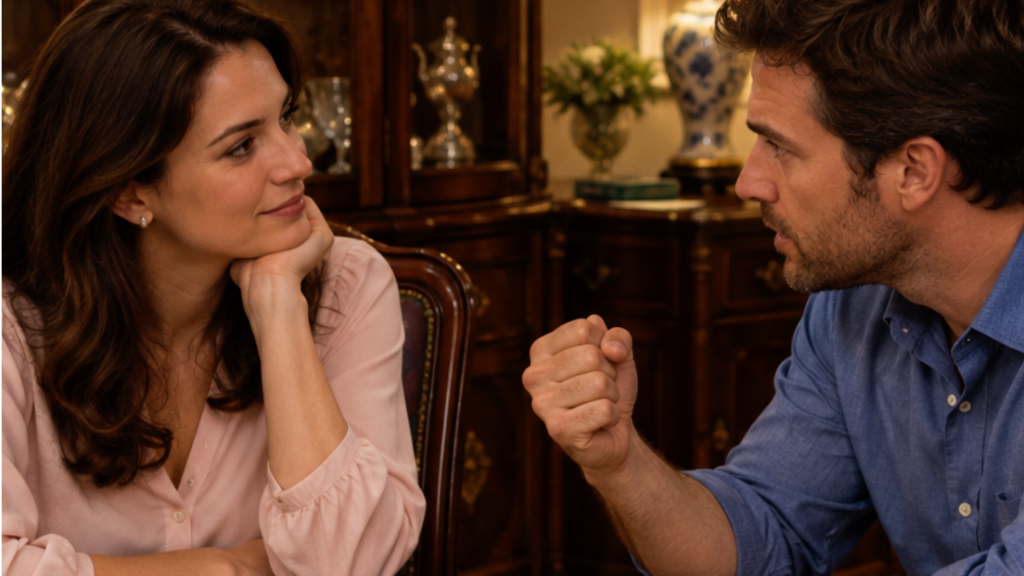
Olya’s Thursday schedule had been set since Monday. She kept a list on her phone—updated every year for the past eight years: “Kefir 1%—not 2.5%, 2.5% gives her heartburn. Lightbulb for the hallway, small base. Utility bill for electricity. Batteries for the remote. Borodinsky bread, but not pre-sliced—she thinks pre-sliced is always stale.” Olya added that last item three years ago, after her mother-in-law handed her a loaf right back in the bag and said, “I don’t eat that, give it to your pigeons.”
Olya didn’t have any pigeons. She had a job as an accountant at a construction company, a two-room apartment in Uralmash inherited from her grandmother, and a husband, Kirill, who never visited his mother on Thursdays.
“You know how she nags me,” he’d explain. “Five minutes and my blood pressure goes up. But you, you know how to handle her. You’re the diplomat in the family.”
That Thursday, the diplomat was in the checkout line, basket filled with the right kefir and non-sliced Borodinsky bread, wondering why Kirill had come home two nights running in brand new shirts. He always used to buy shirts with her, fussing in front of the mirror, asking, “Does this make me look young?” But now it was two shirts in a single week, both blue—though he used to call blue ‘the dentist’s color.’
Galina Arkadyevna didn’t open the door right away. First, she looked through the peephole for a long time, then rattled the chain, and looked again.
“You’re twenty minutes late,” she said, instead of “hello.”
“There was traffic on Kosmonavtov, Galina Arkadyevna.”
“Everyone has traffic. But Verochka’s daughter-in-law gets to her by six, no matter what—even if it snows.”
Verochka lived one floor below, and by the stories, her daughter-in-law was flawless: baked cabbage pies, washed the balcony windows, and never argued. Olya had seen her once—a thin, stressed woman, bags in both hands—and thought then she knew the reason for that look in her eyes.
Olya unpacked the groceries, changed the hallway lightbulb—standing on a stool that Galina Arkadyevna held as if she were granting a favor. She paid the electricity bill through the app, showed Galina the screen: “See, it’s paid.” Put fresh batteries in the remote.
“Kirill called,” her mother-in-law said as Olya was pulling on her boots. “He says big changes are coming for him. Do you know what he meant?”
“No,” Olya answered honestly.
Galina Arkadyevna gave her a strange look—somewhere between pity and triumph—and closed the door before Olya had even made it to the stairs.
The big changes arrived on Sunday. Kirill sat at the kitchen table, spinning a spoon in his fingers and not touching his cheese pancakes, even though they were his favorite, with raisins and vanilla.
“Olya, I’ve filed for divorce. Through the public services portal. You should get a notification.”
Olya turned off the stove. For some reason, it seemed important—that the butter shouldn’t burn.
“Can I ask why?”
“Well… It happens. People split up. We’ve been more like roommates for a long time. I met someone with whom things just… feel easy.”
“What’s her name?”
“Alina. But that doesn’t matter.”
“How old is she?”
“Twenty-six. Olya, let’s not make this an interrogation. I don’t want drama. I want things to end amicably.”
“And what does ‘amicably’ mean, exactly?”
Kirill set down his spoon and straightened up. Olya immediately recognized this move—he always sat like this when he was gearing up to say something he’d clearly practiced beforehand.
“We don’t have kids, so there’s not much to divide. The car is mine; I’ll take it, since I’m the one paying off the loan. As for the apartment… I lived here for eight years. We renovated together—the kitchen, the bathroom, the floors—it was all paid for with our combined money. I checked with a lawyer, and they told me if shared money went into the apartment and increased its value, I have a right to my share. So let’s be fair: you pay me my compensation, and we end things without going to court.”
“How much?”
“One million two hundred thousand.”
Olya laughed. The laughter was brief and not especially joyful, but it was still a laugh, and Kirill was clearly thrown off by it.
“What’s so funny?”
“Nothing, Kiryusha. You just don’t know everything about our renovation.”
“What don’t I know? I picked out the tiles!”
“You did choose the tiles. But I paid for them. Out of the savings my grandmother left me. Remember, she left me money and the apartment in her will? I put it in a separate account—I never touched it for anything else, just the renovation. Every payment for the work came from that account. The contracts with the contractors are in my name, the receipts from the building supply store—everything was paid for with that card. All the documents are in a blue folder, in the closet, on the second shelf.”
Kirill was silent. Then he asked:
“Did you plan this? Did you know eight years ago that we’d get divorced?”
“No. I’m just an accountant, Kirill. I always know where every penny comes from.”
He left that same evening. Packed two bags, took his laptop, his gaming console, and—oddly—the coffee maker, even though Olya was the only one who ever drank coffee. In the hallway, he turned around:
“By the way. My mom doesn’t know yet. About Alina, I mean. Please don’t tell her, okay? I’ll do it myself.”
“Alright.”
“And… will you visit her on Thursday? I can’t make it this Thursday.”
Olya looked at her husband—at his blue shirt, at the coffee maker tucked under his arm—and replied:
“I’ll go this Thursday.”
And she really did go—not because of Kirill, but because Galina Arkadyevna’s kefir always ran out by Wednesday, and asking a neighbor for help was beneath her mother-in-law’s dignity. The whole way there, Olya wondered how to act if Kirill had already told her everything, and finally decided to just behave as usual.
But behaving as usual didn’t work. Galina Arkadyevna opened the door right away, skipping the chain and the peephole, and her face looked as if she’d just won the lottery.
“Come in, come in,” she said almost warmly. “Take off your shoes. Would you like some tea?”
In eight years, her mother-in-law had never offered Olya tea. At first, Olya didn’t even realize the invitation was for her.
On the kitchen table were glossy brochures, filled with photos of two-story houses made of light brick, with green lawns and children’s swings.
“The ‘Sosnovy Bereg’ cottage community,” Galina Arkadyevna read out with delight. “Just twenty minutes outside the city. Gas, pavement, security. Kiryuha and Alinochka picked it out. One hundred and forty square meters, and on the first floor there’s a guest room with its own bathroom—for me.”
So he did tell her. And, apparently, he told her in a way that left her very pleased.
“Congratulations,” Olya said.
“Thank you. Don’t take offense, Olya, but you were never right for him. I always said so. You’re proper, neat—but boring. A man needs a spark. Alina, now, she’s full of life. She brought me cake—’Napoleon.’ Baked it herself. Well, maybe not herself, but she picked it out for sure.”
Olya nodded. The Napoleon cake had been sitting on the windowsill since morning, almost untouched except for a single slice missing.
“Where did the money for the house come from?” she asked. She hadn’t planned to ask, the question just slipped out.
“Well,” Galina Arkadyevna raised a finger, “it’s a family investment. I’m selling my apartment. There’s already a buyer, deposit’s paid. The money—going into the house. Alina’s mortgage is approved—she has an official salary, while you know half of Kiryuha’s pay is under the table. The down payment’s all mine. And I get to live with the kids, everything ready, fresh air. I don’t need your Thursdays anymore.”
“Wait. The house will be in Alina’s name?”
“Well, whoever takes out the mortgage, that’s whose name it’s in. What difference does it make? They’ll get married as soon as Kiryuha’s divorced from you.”
Olya put her cup down.
“Galina Arkadyevna. I’m going to say something, and you might be upset with me. If you transfer money from selling your apartment to buy a house that’s registered to someone who isn’t your family, you have no rights to it. None. No share, no residency, not even a guest room. You’ll live there only as long as the owner allows it.”
Her mother-in-law slowly straightened up.
“You’re just jealous,” she said. “I get it. You got left behind, and they’re happy. But don’t talk bad about people you don’t even know.”
“I’m not talking bad. I’m telling you how it works. At least draw up the money as a loan. Get a written receipt. Or ask for a share in the house.”
“A share!” Galina Arkadyevna threw up her hands. “What’s next—take my own son to court? That’s it, Olya. Thanks for the groceries. Leave the keys to my apartment on the stand; you won’t need them anymore.”
Olya left the keys on the stand, right next to a glossy brochure, with a smiling cartoon family and a dog on the cover.
Their divorce at the registry office happened a month later, quietly and without fanfare. Kirill showed up with a lawyer—a young guy in a tight suit, a leather folder under his arm, always checking the time. No one ever mentioned compensation for the renovations again. A week earlier, Olya had sent Kirill photos: the contract with the construction crew, bank statements showing her grandmother’s inheritance, receipts from the hardware store—all charged to the same card.
“Renovations in a pre-marital or inherited apartment paid for from the owner’s personal funds do not turn it into joint property,” she wrote to him, keeping it short. “If you want, check with the court. But you’ll have to pay for the lawyer yourself.”
Kirill had no desire to check. On the steps of the registry office, he shuffled awkwardly and said:
“Don’t hold a grudge, okay? You’re a good person. It just happened this way.”
“I don’t hold a grudge,” Olya replied. And it was almost true.
When she got home, she took down their photo from Anapa off the wall—the one where they’re both standing knee-deep in the sea, sunburned shoulders glowing red—and just stared at it, not knowing what to do. She couldn’t bring herself to throw it out since her friend had given her the frame as a gift. So she tucked it away in the dresser drawer, face-down, under her winter mittens.
Life started to feel different. Olya suddenly noticed her Thursdays were wide open. For the first two weeks, out of habit, she still went to the store on Thursday evenings and picked up her usual one-percent kefir, then just stood at the fridge unsure what to do with it. Eventually, the routine faded away. Olya signed up for swim sessions at the pool on Malysheva, bought a morning movie pass for Saturday screenings, and even went on a date with Igor from the neighboring department—the guy who had brought her homemade tangerine jam every New Year for three years. The date was sweet but bland, like sugarless tea, and Olya realized there was no need to rush.
She heard about Kirill through mutual friends. They’d bought a house in ‘Sosnovy Bereg.’ Alina was posting photos online from the second floor—views of pine trees, coffee on the windowsill, bare feet in striped socks. Kirill had grown out a beard. Galina Arkadyevna sold her two-bedroom on Vtorchermet in just three weeks—for a fast, modest sum—because, according to her, ‘the kids needed it urgently.’
Olya would listen and felt nothing. Well, almost nothing.
Then, one Wednesday in early March, at half past ten in the evening, her phone rang. The caller ID flashed: ‘Kirill.’ Olya hadn’t deleted his number—she just hadn’t gotten around to it.
“Hi, Olya. Are you awake?”
“Almost asleep.”
“Look, it’s just… there’s something, and I have no one else I can turn to.”
His voice didn’t sound the same—it was thin and uncertain, like a school kid who’d just broken a window in the teachers’ lounge.
“What happened?”
“It’s my mom. You know, we moved, and for the first month, everything was fine. But then Alina started… well, she has a strong personality. She says my mom interferes with everything—rearranging pots, inspecting the fridge, leaving comments under her social media posts saying Alina’s a bad cook. You know how my mom is.”
“Yeah, I know.”
“So, Alina said they agreed on guest visits, not permanent co-living. That it’s her house, she’s paying the mortgage, and she’s not obligated to live with her mother-in-law—even a future one. She packed up mom’s things. Now my mom’s staying on an old pullout couch at her friend Aunt Lyuda’s place. But Aunt Lyuda’s grandkids are coming for the holidays, so it’s inconvenient for her.”
Olya sat on the edge of her bed.
“And what about you?”
“What can I do? I told Alina how I felt. She told me—it’s either my mom or her. Olya, I can’t blow everything up now. We’ve set the wedding for June.”
“And what about the money? Your mom’s money from her apartment sale?”
Kirill paused.
“Well, it’s in the house. You can’t just take it out. Alina says maybe someday, when she refinances… It’s complicated.”
“So why are you calling me?”
“Olya. You have a two-bedroom. The second room’s empty—you just use it for ironing, anyway. My mom’s already used to you. You know how to get along with her. Let her stay with you for a while. It’s just temporary, until I figure something out. I’ll help with groceries—as much as I can.”
Olya listened and glanced over at the ironing board still standing in the second room by the window, the carpet rolled up in a corner, and the box of Christmas decorations. Her mind wandered back: her mother-in-law’s wedding toast, ‘The most important thing is for Kiryusha to be well-fed.’ The first New Year’s Eve together, when her salad—her own olivier—ended up in the trash because ‘the peas were the wrong color.’ The Borodinsky bread returned ‘for the pigeons.’ And every year for eight years, she was greeted at the door with, ‘You’re twenty minutes late,’ even if she arrived ahead of time.
‘Kirill,’ she said calmly. ‘Sweetheart, just a reminder: you filed for divorce. So your mother is now your responsibility.’
She was surprised at how calm her voice sounded. There was even a hint of a smirk—Olya sensed it herself and didn’t try to hide it.
‘Are you serious?’ Kirill gasped. ‘She’s an old woman! She’s sixty-eight! Don’t you feel sorry for her?’
‘I do. But do you?’
‘What does this have to do with me?’
‘Everything, Kiryusha. You were the one who convinced her to sell her apartment. You invested her money into the house under your Alina’s name. You stood there watching while Alina packed her belongings. And now you’re calling your ex-wife to pick her up? No, I’m not here to save your conscience.’
‘You really are a bitch,’ he muttered.
‘Goodnight,’ Olya replied, and hung up.
After that, she stayed awake until three in the morning. Lying there, staring at the ceiling as the shadow of a poplar’s branch flickered from the streetlight, she argued with herself. One side said: He’s getting what he deserves—let him handle it himself. The other said: But what’s his mother got to do with it? Sure, she’s difficult. Eight years, she made your life hell in little sips. But now she’s sixty-eight, on a friend’s folding bed, without an apartment or money. And her son… is like this.
By morning, the argument had ended in a draw. Olya went to work with a heavy head, telling herself she’d think more about it over the weekend.
She didn’t have to wait long. Saturday morning at ten, the doorbell rang. Still in her bathrobe, hair wet from the shower, Olya peered through the peephole and saw Galina Arkadyevna. Her ex-mother-in-law stood there on the landing in her beige coat with the astrakhan collar—kept for special occasions—holding a big checkered bag. At her feet sat a pot of violets wrapped in newspaper.
Olya opened the door.
‘Hello, Olya,’ her former mother-in-law said. Then, for the first time in eight years, added, ‘Sorry for not calling first.’
They sat in the kitchen. Galina Arkadyevna held her cup with both hands as if warming herself, though the room was perfectly warm. The big bag was in the entryway, and Olya had put the violets on the windowsill.
‘I’m not going to ask you to let me stay,’ her mother-in-law said. ‘Kirill told me you refused. You were right to refuse. I’d do the same if I were you. I don’t even know why I came. Lyuda left early to pick up the grandkids at the station, and I was just sitting there on that folding bed… I just got on the bus and rode over. I don’t even know how.’
‘Please, have some tea, Galina Arkadyevna.’
‘You once mentioned a promissory note… a share. And I kicked you out.’ She paused. ‘Tell me honestly. Is it all lost? The money?’
Olya topped off her cup with more hot water.
“I don’t know. It depends on how you gave them the money. Tell me everything from the start.”
Galina Arkadyevna told her story for a long time, losing track of details and circling back. Olya listened carefully and took notes in her notebook, the one she usually uses for the family budget. The apartment was sold for four million one hundred thousand. Of that, three million four hundred thousand was transferred to Alina — in two payments, straight from Galina Arkadyevna’s bank account to Alina’s card. The rest is still in her savings, “for funeral expenses and a rainy day.”
“Did you add a note to the transfers?” Olya asked.
“What kind of note?”
“Well, when you transfer money in the app, there’s a line for a message to the recipient.”
Galina Arkadyevna reached into her bag for her phone — an old one, the corner of its screen cracked — and scrolled for a long time, squinting. Olya helped. They checked the transfer history: the first transfer was two million, and the note said, “For Alina’s home.” The second, for one million four hundred thousand, had no message attached.
“Do you have the messages with Alina?”
“Yes, she wrote me on WhatsApp. I haven’t deleted anything, I never do, I even still have Kiryusha’s army photos there.”
They found the messages. Olya scrolled through them, feeling both cold and angry inside. Alina messaged a lot, full of hearts, smileys, and, “Galina Arkadyevna, you’re our angel.” Then, on the day of the second transfer, there was a voice message. Olya played it. A cheerful young voice came through, with the sound of a coffee machine in the background:
“Galina Arkadyevna, I got it, thank you so much! Please don’t worry, it’s all temporary. As soon as I sell my studio in Botanika, I’ll pay you back every single penny, or we’ll transfer you a share in the house, whichever’s easier for you. You’re like a mother to us!”
Olya played the message again. Then again.
“What is it?” her mother-in-law asked anxiously. “Is it something bad?”
“No, Galina Arkadyevna. It’s something good. Just don’t delete anything. Nothing at all. And don’t give your phone to anyone — not Kiryusha, not Alina. Even if they ask to ‘look at some photos’.”
“But what’s so important on there?”
“Alina says in her own voice that she took your money for a while and plans to give it back. So, this wasn’t a gift. It’s a loan, or at least money she received from you without any legal grounds and she promised to return it. That means you can demand it back in court. You have the bank transfers — proof that the money went to her. And her own promise as evidence.”
Galina Arkadyevna looked at her as if Olya had started speaking Chinese.
“Take Alina to court?”
“Yes, Alina. Not Kiryusha — he doesn’t have your money, she does.”
“But what about Kiryusha? He’s about to marry her.”
Olya shrugged.
“That’s for him to decide, who he wants to marry. Think about yourself. You need a place to live.”
Her mother-in-law was quiet for a long time. Then she suddenly started crying — not nicely, but like an old woman, covering her mouth with her hand. Olya didn’t try to comfort her. She just moved the box of tissues closer and poured more tea.
“I never really loved you,” Galina Arkadyevna said once she calmed down. “You know that. I used to wonder—what did he even see in her? No looks, nothing special, working in accounting, and an apartment she got from her grandma. But Alinochka—she felt like the daughter I never had. Always chatting, bringing me cakes. But once she got the money, everything changed. ‘Galina Arkadyevna, you’re messing up my schedule.’ ‘Galina Arkadyevna, I have a stream, please don’t make noise with the dishes.’ What stream? I don’t even know what that is.”
“That’s when she talks live on the internet,” someone explained.
“With who?”
“With everyone who watches.”
“Ugh,” the mother-in-law said with feeling. And for the first time that morning, she almost smiled.
On Monday, Olya called Sveta. They had been friends since university—Olya hadn’t known she would become an accountant and studied law for half a year before switching to economics. Sveta never switched, and now she handled civil cases at a small firm on Radishcheva Street.
“A voice message is good,” Sveta said after listening to the recording. “There’s no written receipt, but the messages, the money transfers, and her own words promising to pay it back—courts accept all that. We’ll demand repayment as unjust enrichment, and as backup, a claim as a loan. Let’s also petition the court to seize her assets up to the amount of the claim. The house or that studio on Botanika, whatever she has left. That way she can’t sell or transfer anything while the case is ongoing.”
“And what if she says it was a gift?”
“Let her try. A 3.5-million ruble ‘gift’ from a retired stranger to another woman—that will be interesting for the judge, especially since it’s in her own voice saying, ‘I’ll pay back every penny.'”
They filed the lawsuit a week later. Galina Arkadyevna signed the papers at Olya’s kitchen table, carefully writing every letter of her surname like she was back in school. She was still living with Aunt Lyuda, but now it was Aunt Lyuda’s granddaughter sleeping on the cot, and Galina Arkadyevna got the sofa—after hearing about Alina, Aunt Lyuda felt a special sympathy for her friend.
Kirill called three days after Alina received the court order freezing her assets.
“What are you doing?!” He didn’t even greet her. “This is your idea, I know it! My mom would never think of this herself!”
“Hello, Kirill.”
“What kind of ‘hello’ is that?! Our house is under arrest! Alina is having a meltdown! She can’t get refinancing, the bank refuses because of the encumbrance! Do you realize you’re ruining my life?”
“Me?” Olya was truly surprised. “Kirill, I remember our conversation. You asked me to take care of your mom. And I did. Just not the way you wanted.”
“I asked you to let her stay for a while!”
“And I decided it would be better if she had her own place. With her own money.”
“That’s not her money! That’s the money in the house!”
“It’s her money. Which ended up in your fiancée’s house. Do you see the difference?”
He hung up. He called again later—Olya didn’t answer. Then came a long, typo-filled message where he called her spiteful and jealous and accused her of always turning their mother against him. Olya read it while waiting at the bus stop and laughed out loud—so much that a woman with a dachshund in a knitted sweater turned to look at her. Turning their mother against him? She’d been bringing kefir to that mother for eight years, and apparently, he was the one who suffered.
Two days later, Alina herself came to see her.
Olya recognized her immediately, even though she’d only seen her in photos: tall, with a sleek ponytail on top of her head, and dressed in a light-colored tracksuit that probably cost as much as Olya’s salary. In her hands was a pastry box tied with a golden ribbon.
“Olga? Can I have five minutes? I promise, no drama.”
Olya let her into the kitchen but didn’t offer her any tea. Alina set the box on the table herself.
“This is for you. Eclairs. I wasn’t sure which kind you like.”
“I don’t like any. Why are you here? Get to the point.”
Alina sat down, crossed her legs, and smiled—the same perfect smile she probably practiced in front of a camera for her followers.
“Listen, I get why you’re upset with Kirill. That’s normal. But let’s be women about this. You know Galina Arkadyevna is a difficult person. She’s impossible to live with. You suffered for eight years, Kirill told me. Why fight for her? She’s nobody to you now.”
“Nobody to me,” Olya agreed. “But she gave you three million four hundred thousand.”
“She offered herself! Nobody forced her!”
“I’m not arguing. And you promised to pay her back. On video. With the coffee machine humming in the background.”
Alina’s smile flickered for a moment.
“That was… Well, people say things. To be polite. It’s not a contract.”
“The court will decide what it was. I’m not a lawyer or a judge, Alina. I’m an accountant. My logic is simple: if you take money and promise to give it back, you return it. If you don’t return it, the courts will collect it.”
“But what if I offer you…” Alina lowered her voice. “Let’s say, two hundred thousand. Just for you. To convince her to drop the lawsuit. She listens to you, Kirill said.”
Olya stood up and opened the hallway door.
“Please take your eclairs with you. And tell Kirill his mother doesn’t listen to me. She listens to her bank statement.”
Alina left, slamming the door loudly. She forgot the box—or maybe pretended to. Olya took the eclairs to her downstairs neighbor, Granny Nina, who was hosting her great-grandkids. The kids devoured them in ten minutes, getting cream everywhere. That evening, Olya called Galina Arkadyevna and told her about the visit.
“She offered you two hundred thousand?” her mother-in-law repeated. Then she was silent. “And what did you do?”
“I refused.”
“Fool,” Galina Arkadyevna said, with an unexpected tenderness. “You should’ve taken it and then brought the recording to court. Just kidding, just kidding. Thank you, Olenka.”
She had never called her Olenka before.
The court date was set for the end of April. But it never came to that.
A week before the court date, Sveta got a call from Alina’s lawyer. Turns out, the young guy in the slim suit wasn’t working for Kirill, but for Alina’s father—the owner of two car washes in Verkhnyaya Pyshma. He offered a settlement: Alina would return 3.4 million rubles to Galina Arkadyevna within a month—the money would come from her parents. In exchange, Galina Arkadyevna would withdraw her lawsuit and the freeze on the house would be lifted.
“Apparently her parents are in shock,” Sveta said with a laugh. “They thought their daughter saved up for the down payment with her streaming earnings. Turns out, the money came from her mother-in-law, and the mother-in-law was kicked out of her home to boot. Her father yelled so loud, the lawyer’s ears were ringing.”
Galina Arkadyevna signed the settlement agreement on Friday. Three weeks later, the money arrived—every last ruble, just as it had once been promised in that clear voice echoing beside a coffee machine.
“Well, look at that,” said the mother-in-law, gazing at the screen of her cracked phone. “It’s come back.”
“It’s back,” Olya agreed.
“I owe you, you know.”
“You don’t owe me anything, Galina Arkadyevna. Just pay Sveta for her work—that’s all.”
“I’ve already paid her.” The mother-in-law put away her phone and looked at Olya directly, no squint at all—for the first time ever. “But tell me—why? I gave you such a hard time. If I were you, I wouldn’t have let me over the threshold.”
Olya took a moment to think.
“Maybe because last time you said ‘sorry.’ The first time in eight years.”
Galina Arkadyevna snorted, but her eyes grew wet.
With the returned money, she bought a one-bedroom apartment—small, on the third floor of a brick building, with a balcony facing a quiet yard. Just three bus stops from Olya. Igor from the neighboring department helped her move—the one with the mandarin jam—he had a Gazelle truck that used to belong to his brother. During the half-day move, Galina Arkadyevna managed to tell him her whole life story, feed him cabbage pies that, it turns out, she could bake as well as Verochka’s sister-in-law, and loudly whispered to Olya, “At least this one knows how to work with his hands. Don’t let him get away.”
On her first night in the new place, Galina Arkadyevna called Olya right at nine—the exact time she used to call to check if Olya had bought Borodinsky bread.
“Olya, I hung up the curtains. Yellow ones, with tiny flowers. You’ll say they’re tasteless.”
“I won’t say that.”
“You will. You always go quiet and that says it all. Come over on Thursday and see for yourself. But don’t bring anything, I’ve got everything I need. I even went to the store by myself. Believe it or not, for the first time in eight years I bought kefir myself. Turns out, they have a deal here: two for the price of one.”
Olya listened and smiled into the phone. Eight years ago, she never would have believed she’d find joy in this woman’s voice. And now, she did—not even as a daughter-in-law, but in knowing that someone who’d nearly been thrown out by her own son and his wife was now standing in a home of her own, at her own window, behind her own yellow curtains, choosing her own kefir.
“I’ll come, Galina Arkadyevna. To see the curtains.”
— And bring Ilya along too. I’ll bake him some pies. Does he prefer them with cabbage or with eggs? Actually, why am I even asking—I’ll just bake both kinds.
— He’s not mine, Galina Arkadyevna.
— That’s just for now, — her mother-in-law cut her off and hung up, as always, without saying goodbye.
And Kirill…
There was no wedding in June. After the incident with the arrest and her father’s scandal, Alina decided that a fiancé who could allow his own mother to be thrown out, and then couldn’t protect his bride from court, was too much of a questionable catch. Kirill’s things were packed up just like his mom’s had been once—neatly, in checkered bags—and set out on the porch of ‘Sosnovy Bereg,’ right by the freshly-trimmed lawn.
He had nowhere to go. The bank repossessed his car for missing loan payments—over the past few months, Kirill had been using the money to pay for Alina’s marketplace purchases. He couldn’t afford to rent a place.
Olya heard about all this from Galina Arkadyevna herself. On one of their Thursdays—they’d started having tea together some Thursdays now, with no written agenda or reminders in phone notes anymore, just because—the mother-in-law mentioned it while stirring her tea:
— Kirill is living with me. On a fold-out bed. It’s already been a week.
Olya raised her eyebrows.
— And? How’s that going?
— How do you think. He doesn’t wash his dishes. His socks are all over the apartment. He drinks my kefir—even though mine’s one percent, and I can’t have any other. — She sighed. — And he wants me to call you. To ask if you’d let him move back in. He says he’s realized things now.
Olya paused. She looked out the window, where on Galina Arkadyevna’s balcony bloomed that very same violet, which had survived both the fold-out bed and two moves.
— And what did you say to him?
The former mother-in-law took a sip of tea and answered, completely calm:
— I said to him: Son, let me remind you—you were the one who filed for divorce. So where you live now is your problem.
And for the first time in eight years, the two of them laughed together—at the very same thing.
So what do you think: was Olya right to start helping out her former mother-in-law, who had belittled her for eight years? Or should she have shut the door and let Kirill deal with the consequences of his own choices? Share your thoughts in the comments—really curious to hear whose side you’re on.