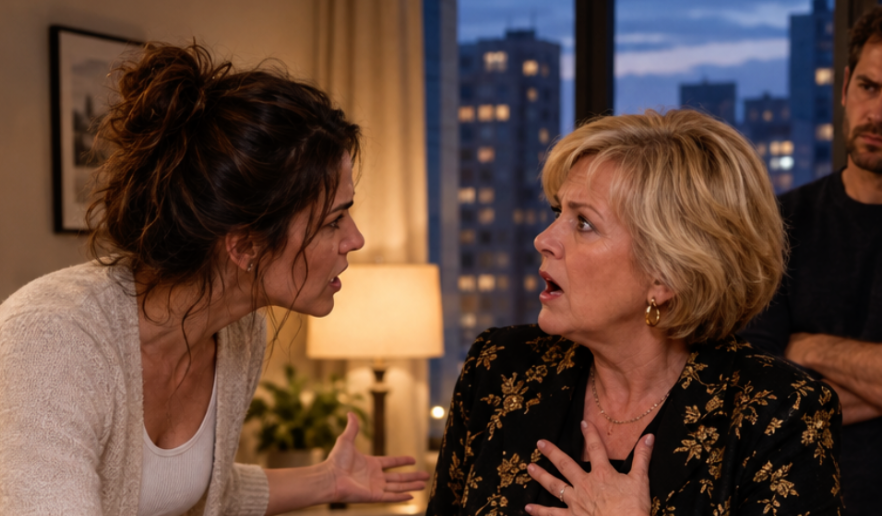
“Mom, please don’t laugh,” Polina said, glancing at the three huge boxes by the door of her new apartment. “But I think Denis has moved in before I even did.”
Oksana set a bag of disposable cups on the windowsill and took a look at the boxes.
One box was labeled “Computer” in marker, another said “Magazines,” and the third had no label at all. Right next to them stood a lumpy brown armchair with wide armrests.
“And what’s this?” Oksana asked.
“A family heirloom, I guess.”
Polina walked over to the armchair and pressed her palm on the seat. Something deep inside made a pitiful crunch.
“It stood in Denis’s room at Inna Borisovna’s place for about ten years. She’s wanted to throw it out for ages.”
“Seems she didn’t throw it out after all. She gave it a promotion and sent it off to live separately.”
Polina finally burst out laughing.
That day, they came to the apartment to walk through the rooms one more time before renovations began.
Polina’s grandmother, Lyudmila Sergeyevna, had bought the apartment a month ago.
The purchase had come as a surprise to everyone in the family.
Lyudmila Sergeyevna had been saving for several years, and that spring she sold her country house near Chekhov. After her husband passed, she no longer wanted to go there alone. She was paying the neighbor’s boy to mow half the yard, had no use for all the apples in the fall, and the roof seemed to find a new way to need repairs every year.
After receiving the sale money, Lyudmila Sergeyevna added her savings and bought her only granddaughter a small one-bedroom apartment in a new building.
No mortgage.
No debts.
Under Polina’s name right away.
“While I’m still alive, I want to see for myself who gets what,” she said back then. “Otherwise, after I’m gone you’ll all end up fighting over the old sideboard.”
She chose the apartment together with Oksana and Polina. Thirty-seven square meters, a kitchen, a room, a glazed balcony, and a decent bathroom. Not a palace, of course, but for a twenty-four-year-old woman, it was a great start.
Polina worked as a packaging designer at a small advertising studio, earning about eighty thousand. By the time she got the keys, she already had about two hundred and fifty thousand saved, and she planned to cover the rest of the renovation costs herself, sometimes taking on freelance jobs.
Denis was twenty-eight.
Over the past two years, he’d worked as a car dealership manager, a courier, an assistant to a photographer friend, and spent a couple of months selling car accessories online.
For the last ten months, he kept saying he didn’t want to just take anything, because this time he needed to find something he could really grow in.
Oksana tried not to interfere.
He didn’t drink, never made a scene, treated Polina well. Sometimes he did delivery gigs, sometimes he helped a friend out with cars.
The only thing Oksana didn’t get was why this “search for his calling” usually happened in bed before noon.
But her daughter was planning to marry him, and Oksana figured it wasn’t going to be her life anyway.
The first strange things started after Denis’s mother found out about the apartment.
“How much does a place like that go for these days?” Inna Borisovna asked during a family dinner.
Polina gave her a rough figure.
— Wow. Is the utilities bill going to be high?
— I don’t know yet.
— And is it possible to take down the wall between the kitchen and the room?
— I don’t really want to.
— Maybe you don’t want to now, but eventually you’ll see that the space really needs to work for you.
Oksana thought at the time that Inna Borisovna was just getting carried away.
But a week later, her future mother-in-law was already speculating if it would be profitable to sell the apartment in a couple of years.
A week after that, she was asking whether the neighborhood was increasing in value.
And then one day she said:
— Well, at least the young couple now has their own place.
Polina corrected her:
— Actually, the apartment is mine.
Inna Borisovna smiled:
— Oh, Polina, I didn’t mean legally. You’ll be a family. What’s yours is shared.
The phrase sounded warm enough.
But somehow after she said it, for the first time Oksana wanted to count the spoons.
Denis himself settled into the apartment quickly.
Before the renovation, Polina had planned to put a big wardrobe along the wall, a small couch next to it, and a workspace by the window.
Denis arrived, walked around the room, and declared:
— There’s no need for a wardrobe here at all.
— So where will the clothes go?
— In the entryway.
— The wardrobe in the hallway is only a meter and twenty centimeters wide.
— Then we need to have fewer things.
A minute later, it turned out that Denis wanted the now empty wall for a TV.
The thing was, he didn’t even own a TV yet.
But he already knew what size he wanted.
Then came the idea of a computer desk.
— Let’s put it here.
— Denis, that’ll be almost in the middle of the room.
— That’s more convenient.
— Convenient for whom?
— Well, mostly for me.
Denis suggested turning the balcony into a workshop.
Polina was actually intrigued.
— What kind of workshop?
— I haven’t decided yet. Maybe I’ll get into detailing. Or airbrushing.
Polina looked at the balcony, which was only four square meters.
— And how do you plan to drive the car in there?
Denis got offended.
But when it came to the armchair and the boxes, he spoke completely calmly.
— Mom scheduled a delivery. I stopped by in the morning to meet the movers and left before you arrived. What’s the difference, moving everything now or in a couple of months?
— Denis, we haven’t even started the renovation yet.
— The boxes aren’t in the way.
Polina looked at the armchair, which was now blocking half the passage.
— Especially the armchair.
— It’s a shame to throw it out. It’s comfy.
Later, Oksana told her daughter:
— I’m not saying anything for sure, but your fiancé is moving in pretty energetically for someone who hasn’t even bought the rings yet.
Polina just waved it off.
They were planning to buy the rings after Denis’s next paycheck.
Although, at that moment, he still didn’t have a stable income again.
The real argument started a bit later.
Inna Borisovna brought up the question of registration.
Everyone was sitting in her kitchen. Denis was scrolling on his phone, Polina was cutting a cake, when suddenly Inna Borisovna said:
— After the wedding, Denis needs to get registered right away.
Polina looked up.
— Registered where?
— With you, of course.
— Why?
Inna Borisovna was even surprised.
— What do you mean, why? Husband and wife should be registered at the same address. That’s normal.
— I haven’t even registered there myself yet.
Polina really hadn’t gotten around to changing her registration: she was still registered at her mother’s.
— Well then, do it together.
— We’ll decide later.
— What do you mean “we’ll decide”?
— Just what I said. We’ll live, see how it goes.
Inna Borisovna put down her spoon.
“Polina, it’s important for a man to feel like he’s truly at home.”
“And if he’s not registered, is he going to forget how to get there?”
Denis stopped looking at his phone.
“Pol, mom actually makes sense.”
“I’m not saying you’re just a temporary lodger there. I just don’t want to deal with this right now.”
On the way home, Denis looked more glum than usual.
“Do you even trust me?”
“I do trust you.”
“Then what are you afraid of?”
“I’m not afraid of anything. I just don’t see any reason to do it.”
“Well, that’s nice, really. We’ll get married, live together, but the apartment will still be yours.”
Polina stopped near the car.
“Denis, it is mine.”
He looked at her like she had chosen the most hurtful words possible.
After that, the apartment started coming up in almost every conversation.
At first, Denis talked about getting registered.
Then he talked about how he felt like a guest.
Then he declared that a man can’t live somewhere he could ‘in theory be asked to leave at any moment.’
Polina tried to explain that marriage, after all, isn’t based on the impossibility of kicking each other out.
But Denis wasn’t convinced.
A week later, he came up with a solution.
“How about you sign over a small share to me, and I’ll do the renovations?”
At first, Polina thought she misheard him.
“With what money?”
“Mom will help.”
“How much?”
“Well, maybe three or four hundred thousand. We’ll work it out.”
“And what share?”
“I don’t know. At least twenty percent or something.”
That evening, Polina told her mother everything.
Oksana asked her not to promise anything yet and started doing the math.
The apartment was worth over seven million.
Twenty percent—that’s more than one million four hundred thousand.
The renovations Denis and his mom proposed were estimated at a maximum of four hundred thousand.
And Denis was planning to lay the laminate, assemble the kitchen, and do some of the electrical work himself.
The last time he’d used a drill was when he helped a friend hang a curtain rod.
“Let’s not even count the electrical work,” Oksana said. “I still want to become a grandmother someday, not an arson investigation case study.”
Polina laughed, but the smile quickly faded.
She herself was no longer finding it amusing.
She suggested they all meet together.
On Sunday, Inna Borisovna and Denis showed up.
Oksana came too.
Inna Borisovna put a piece of paper on the table.
“I did all the calculations so we won’t be driven by emotions.”
Oksana seemed interested.
The list included utilities, groceries, cleaning supplies, future furniture, and renovations.
Next up: gas expenses.
“What does gas have to do with this?” Polina asked.
Inna Borisovna explained:
“Denis will be driving home. The car costs money to run.”
“But he’ll be driving home, not taking the apartment for a spin.”
Denis glanced at her unhappily.
“Can we drop the sarcasm?”
“Sure. I’m just trying to understand why paying for gas should increase your share in my apartment.”
“Because I’ll be contributing too!”
“Contributing to family life, yes. But how do groceries turn into real estate?”
Inna Borisovna chimed in:
“You’re being very one-sided. So Denis will spend years paying utilities, buying groceries, fixing things, and in the end gets nothing.”
Until then, Oksana had barely spoken.
Now she pulled the paper closer to herself.
— Inna Borisovna, so what is Polina supposed to do for the next few years?
— What do you mean?
— Won’t she need to buy groceries? Pay utilities? Buy furniture?
— Of course she will.
— Then why are Denis’s expenses being counted as a contribution to the apartment, but Polina’s as just regular living costs?
Inna Borisovna pursed her lips.
— Because Polina already has an apartment.
— So what?
— And Denis doesn’t.
Oksana looked at her.
This was the moment when everything finally became crystal clear.
It wasn’t about the renovation.
It wasn’t about the paperwork.
It wasn’t about masculine pride.
For Inna Borisovna, what seemed truly unfair was that her future daughter-in-law had an apartment, while her son did not.
— What does your son have to do with this? — Oksana asked. — The grandmother bought the apartment for her granddaughter, not for your grown-up freeloader.
— Mom! — Polina snapped.
— No, hold on. I’ve listened long enough about gas, groceries, and a man’s self-esteem. Lyudmila Sergeyevna sold her dacha, added her savings, and bought Polina an apartment. Denis didn’t put in a single ruble. So why should a woman who worked for forty years now have to provide housing for your son, too?
Inna Borisovna turned pale.
— No one gets to call my son a freeloader.
— Then he shouldn’t be asking for a share of the apartment in exchange for future laminate flooring.
Denis jumped up.
— I see how it is. You were always against me.
Polina was surprised:
— Who?
— Your mom.
— Denis, the idea for a share was yours.
— Because I’m thinking about the future!
— Whose future?
He didn’t answer.
The conversation ended badly.
Inna Borisovna was the first to leave.
Denis left five minutes later.
Polina stayed at her mother’s place.
She was upset, but she wasn’t planning to call off the wedding just yet.
— Maybe they’re just afraid I’ll kick him out later, — she said.
Oksana didn’t try to argue.
— Maybe. But you should talk to him again, just the two of you—no parents.
Polina talked to him.
And maybe, they would’ve made up.
If, three days later, Lera—a mutual friend—hadn’t texted her.
“Are you really planning to sell the apartment?”
Polina read the message twice.
“Which apartment?”
The answer came almost immediately.
“Yours. Denis said a one-bedroom is too small for a family. That you’ll sell it, use the money as a down payment, and get a two-bedroom. He also mentioned that your neighborhood is going up in value.”
Polina called Lera.
Turns out, Denis had been telling this story to his friends for weeks already.
Not as a dream.
Pretty much as an actual plan.
“First we’ll live in our apartment.”
“Then we’ll sell ours.”
“We’ll add a mortgage.”
The word “ours” really got to Polina.
That evening, she went to see Denis.
He tried to explain:
— I was just thinking out loud.
— Why were you thinking out loud about selling my apartment without me?
— We’re getting married, aren’t we?
— So what?
— Polya, you’re starting this again.
— No. I’m actually finishing.
Denis went silent.
— Tell me honestly, — she continued. — Do you already think of this apartment as yours?
— I think everything between a husband and wife should be shared.
— Fine. So is your car shared too?
— What does a car have to do with it?
Denis had bought his car before he met Polina, using money left to him by his grandfather.
He’d always made it clear he didn’t plan to sell it.
Polina nodded.
— I get it.
That whole “what does this have to do with anything” moment was the final straw.
It wasn’t about his mother.
It wasn’t about the armchair.
It wasn’t about the registration either.
And it wasn’t even about the offer to get a share for helping with the renovations.
Polina suddenly saw something simple: Denis changed the rules depending on who owned the property.
His car was his and his alone.
But somehow her apartment was instantly considered “theirs.”
A week later, they called off the wedding.
Denis called a few more times after that.
First, he was angry.
Then, he suggested they just forget about the whole conversation about shares.
Then he promised he’d stop discussing the apartment with his mother.
But Polina kept saying the same thing:
“It’s not about the share anymore.”
The boxes had to be sent back.
Oksana ordered a moving van.
When the driver saw the armchair, he asked:
“Is this going too?”
“Absolutely,” said Polina. “It’s the main character in this story.”
Inna Borisovna wasn’t exactly thrilled to see the delivery.
An hour later, Denis texted Polina:
“My mom’s asking why you sent the armchair back.”
Polina replied:
“So that family property doesn’t get lost.”
After that, he didn’t write again.
The renovation took almost four months.
Polina gave up the idea of a big TV, put in a decent wardrobe, kept her desk by the window, and turned the balcony into a cozy nook for coffee and flowers.
At the housewarming, Lyudmila Sergeyevna inspected everything for a long while, then sat down on the new couch and said:
“You did a great job.”
“It really turned out well,” agreed Oksana.
Grandma looked over at the empty space near the wall.
“You know, when I bought the apartment, there was one important feature I didn’t think to ask about.”
Polina was intrigued:
“What feature?”
“I should’ve asked the developer if a built-in fiancé was included. It was so much trouble dealing with a freestanding one.”
Everyone burst out laughing.
Polina brought out the tea.
Oksana walked over to the window.
She remembered how, just a few months ago, she thought her mother’s gift would give her daughter a great start to family life.
And in a way, it did.
It’s just that the apartment helped Polina start a life of her own, not a family one.
And honestly, Lyudmila Sergeyevna really did invest her money well.