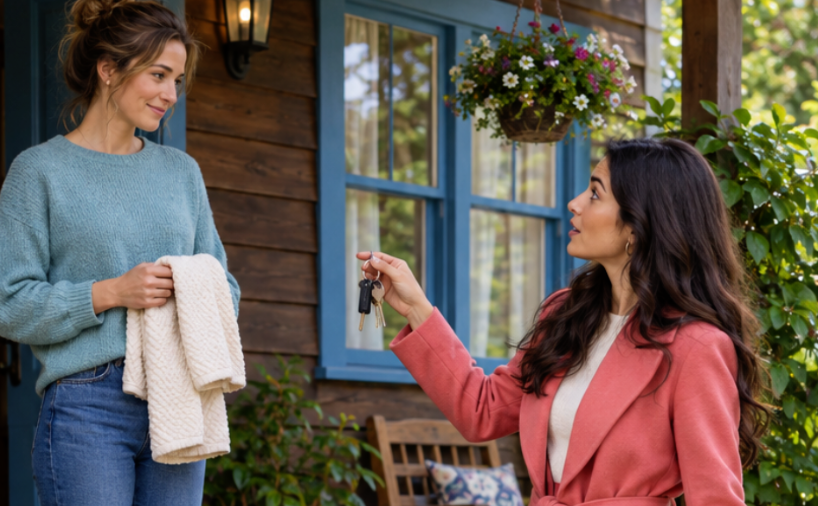
The bell rang just as Vera was scraping burnt porridge from the bottom of the frying pan. She wiped her hands on a towel, opened the door, and there stood a woman on the porch, holding a pink suitcase and the keys to Vera’s own house.
Vera recognized the keys immediately. There was a red tag made from electrical tape wrapped around the ring—something she’d done herself to keep them from getting mixed up with the garage keys. That set had gone missing back in January.
“Hello,” the woman said, smiling the way store clerks do in expensive boutiques. “You must be Vera. I’m Lilia. So, I’m kind of the new owner of this house. And of Gleb, too. Didn’t he tell you?”
She looked about thirty. Chestnut hair down to her shoulder blades, straight as if ironed perfectly strand by strand. Her coral coat was open, and she wore white sneakers that were spotless, even though the walk from the gate to the porch was nothing but muddy April slush. Vera’s eyes caught on her right index finger, where the nail polish was chipped.
A deep silence settled inside. The kind you feel in a medical clinic before you pick up the syringe, while the patient has already lain down.
Vera looked at the suitcase, then the keys, then the visitor’s face. Behind her, water dripped from the kitchen tap at regular two-second intervals—the sound growing unbelievably loud, as if someone had placed it right next to her ear.
“If you’re the owner, pay for the gas,” Vera said. “The bill’s on the fridge, under the strawberry magnet.”
The morning had started off just like any other.
By 7:30, Vera was already at the stove in an old sea-green sweater that Sonya always called ‘Mom’s turquoise spacesuit.’ The porridge was made with milk—her daughter would only eat it that way since she was a child. The whistling kettle should have been replaced long ago, but Vera held onto it for sentimental reasons: it was her grandmother’s, enamel, with a chipped side. A strawberry magnet on the fridge held the gas bill that had arrived on Thursday: four thousand seven hundred twelve rubles. Winter had been long.
Gleb called at eight. For the past six months, he’d been calling Vera every Saturday at eight o’clock, ever since he’d started working on a site near Moscow. He would leave on Monday and come back Friday night. Then Saturday morning. Then, eventually, not until Saturday afternoon.
“Verunya, listen, here’s the thing,” his voice was upbeat, wind in the background. “The client’s coming and wants to inspect the roof. I’ll be home by evening. Maybe tonight.”
“Okay.”
“Don’t be upset. I’m doing this for us.”
“I’m not upset.”
“By the way, did you check that paper? The one for the bank? Needs a signature in two spots—I’ve marked them with checkmarks.”
Vera glanced at the kitchen drawer. The paper had been there for the past three weeks, folded in half, under a pack of napkins and the old TV remote no one could bring themselves to throw away.
“I’ll look.”
“Please do,” he said. “The roof’s leaking. They’ll give us a loan secured by the house quickly—I checked. Alright, gotta go. Love you.”
He hung up before she could reply. Vera stood there with her phone in hand for a moment, then placed it face down on the windowsill, right next to the pot where the violet hadn’t bloomed for the third year in a row.
The roof really was leaking. A yellow stain had spread in the corner above Sonya’s room in the fall, and when it rained hard, Vera would put a basin there to catch the drips. Gleb had promised to fix it last summer. He was a foreman, had built homes, saunas, and terraces for people for twenty years, and yet his own roof was leaking. Vera used to think it was funny—a cobbler with no shoes. But she didn’t find it funny anymore.
The house had come to her from her mom. Well, technically from her grandmother, through her mother: her grandmother had built it with her grandfather after the war, her mom had lived there all her life, and six years ago, when her mom passed away, Vera inherited it. She recalled how the local notary dryly said as she leafed through the papers:
“Inheritance property. This is only yours, it has nothing to do with your husband. Just remember that, just in case.”
Vera nodded at the time and didn’t think much of it. Just in case. What kind of case could there be when you’re both in your forties, you have a daughter in fifth grade, and a husband who grills kebabs on Sundays and calls you ‘Verunya’?
Sonya left for her exam prep at nine. Seventeen years old, eleventh grade, advanced math classes on Saturdays in town, two hours each way by bus. At the door she turned back as she swung her backpack onto her shoulder.
“Mom, seriously, not again.”
“What now?”
“That face. Like Dad’s not coming home.”
“He’ll be here. By evening.”
“Yeah, right,” Sonya said and slammed the gate.
Vera went back to the kitchen. The porridge her daughter hadn’t finished was now burnt onto the pan because Vera had forgotten to turn off the burner while listening about the roof. She poured water into the pan, let it soak, and started to scrub it clean.
It was right then the doorbell rang.
Lilia was standing on the porch, blinking. Words about the gas bill reached her slowly, as if through poor reception.
“What do you mean, gas?”
“Gas. Heating, stove, water heater. Over four thousand. The owner has to pay it, you know.”
“Are you kidding me right now?”
“No.”
Vera stepped aside to let her into the hallway. She wasn’t even sure why—her hands just acted out of habit, like they had a hundred times whenever a neighbor came by for some salt or the postwoman brought her mother’s pension. Later, when she thought it over, she decided it was just easier: having the conversation inside instead of on the porch, where Tamara Petrovna’s pompom hat was already poking over the fence.
Lilia rolled her suitcase in. The wheels left two dirty streaks on the doormat.
“Take your shoes off,” Vera said. “Slippers are in the basket.”
The guest glanced at the basket, then at her white sneakers, then at Vera again. She took her shoes off. The only clean slippers left were Sonya’s, with bunny ears. Lilia slid her feet into them looking like she’d just stepped into cold water.
In the kitchen, it smelled of scorched milk and dish soap. Vera took the bill off the fridge and laid it on the table in front of her guest, smoothing it with her hand. The strawberry-shaped magnet just hung there by itself, useless.
“Here it is.”
“I don’t understand what’s going on,” Liliya said, perching on the edge of the stool without taking off her coat. “Gleb told me you’re in the loop. He said you broke up a year ago, that you’re moving to your mom’s place in the city. That the house belongs to him, inherited from his parents. That you just haven’t had a chance to collect your things.”
Vera turned on the kettle. The old whistling one from her grandmother. She stood with her back to Liliya, watching the blue flames lick the enamel bottom.
His parents. Gleb’s mother lived in Rybinsk in a small two-room Khrushchyovka and only called on holidays. His father passed away when Sonya was three.
Something hard and small, like a cherry pit, tightened under Vera’s ribs. She placed her palm on the countertop for support and felt a sticky spot—jam that Sonya had spilled yesterday and forgot to wipe up.
“I can’t move in with my mom,” she said evenly. “Mom’s at the cemetery, behind the church. It’s been six years.”
Liliya opened her mouth, then shut it again.
“This house belongs to my mom. And my grandmother. My grandma built that shed by the window herself, out of timber, when grandpa was sent out to work in the forest. And now it’s mine. According to the papers. Want to see them?”
“No, wait.” Liliya reached into her bag, pulled out her phone. Her hands were shaking, and she dropped it on the table face down, then flipped it over. “Hold on. I’m calling him right now.”
She dialed his number and held the phone to her ear. Vera could hear the rings even from her spot. Long ones. Five. Seven. Then a mechanical voice.
Liliya tried the number again. And again.
The kettle whistled, and both of them jumped.
Vera brewed tea in a big teapot, with thyme she had dried on the veranda last summer. She set out two cups: her own, a plain white one with a chipped handle, and the guest cup, trimmed with gold, from her mother’s china set. She didn’t even know why she grabbed the guest cup—her hands just did it without thinking.
Liliya finally took off her coat. Underneath, she wore a thin beige sweater, a loose thread dangling from the sleeve. Vera had the urge to pull it off—probably a professional habit. She’d spent twenty years at the clinic straightening patients’ collars, gown ties, and stray bandages.
“How long have you been together?” Vera asked.
“A year and a half.” Liliya wrapped her hands around the cup but didn’t drink. “He came to me to get his nails done. Well, not for himself—I’m a nail technician, have a little salon in the city, in the mall with the Pyaterochka supermarket. He was buying a gift certificate for his wife. For you, it turns out.”
Vera remembered the certificate. The New Year before last—the red envelope with glitter. She’d never used it: work shifts, Sonya, the garden. The envelope was still in her drawer with the important papers.
“He said you don’t love him,” Liliya continued, a little faster, as if afraid of being interrupted. “That you’re cold. That you’ve been sleeping in separate rooms for years. That you’re like strangers, just hanging on for your daughter. Then he said that’s it, you both agreed, you’re leaving. He’s selling the house, this old dump—sorry—and we’re buying an apartment in the city. A two-bedroom place, near my salon.”
“Sleeping in separate rooms,” Vera repeated.
It was true. For two years now, ever since Gleb started snoring so loudly that the glass in the cabinet rattled. Vera would retreat to her mother’s room with a book and fall asleep there, curled up beneath her mom’s old deer-patterned rug. Neither of them called it a breakup. They just said it was “so we can get some sleep.”
“So why did you come here today?” Vera asked. “With a suitcase.”
Lilia dropped her gaze.
“He told me, until May. That in May he’d get everything sorted. And I waited and waited… My landlady sold my apartment, I have to move out by Monday. I messaged him on Wednesday, he didn’t reply. Thursday either. I figured, well, since you’re supposedly not here, and I have the keys… He gave them to me back in winter. Said I should come check on things while you’re at work. I never came. Today’s the first time.”
Winter. Vera remembered January, when she tore the whole house apart looking for the second set of keys. How Gleb said Sonya must have lost them, and Sonya sulked and cried in the bathroom. How they planned to change the lock on the front door… But they didn’t. Gleb said he’d do it himself over the weekend, and he never did.
A little ache twisted under Vera’s ribs.
“Do you realize he’s been telling me something completely different about you?” Lilia suddenly said, her voice rising. “That you’re the one throwing him out. That you shout at him. He’d come to me, all tired, saying he didn’t want to go home. I felt sorry for him.”
“I don’t shout,” Vera said. “I honestly don’t really know how to shout.”
That was true, too. Her mother spoke softly, her grandmother spoke softly, and so did Vera. Once, when a drunk man with a cut eyebrow yelled at her in the clinic, she quietly asked him to sit down, and he did.
Lilia started to cry. It was ugly and childlike, mouth wide open, her mascara instantly streaming toward her cheeks. Vera reached into a drawer for some tissues, and as she pulled out the pack, a folded piece of paper slipped out and dropped to the floor.
She picked it up. Unfolded it. Two blue check marks at the very bottom.
It wasn’t a loan application.
Vera read the words on the paper three times before she understood. The letterhead from a notary office, a sample, not yet certified. A power of attorney. I authorize. With the right to sell my house and the land. With the right to receive the money. Gleb’s surname was listed in the “to whom” field.
Her fingers let go on their own. The paper landed on the table, right in a puddle of tea, and the corner began to darken.
“What’s that?” Lilia sniffled.
“Bank paperwork,” Vera said. “For the roof.”
She pulled out her phone, opened her gallery, and took a picture of the power of attorney. Then another, closer up so the name and document number would be clear. Her hands moved calmly, as if she were bandaging a wound. Somewhere beneath her hair at the back of her head, sweat broke out, and a cold drop slid down her neck.
Lilia stared at the paper, and her face changed. First confusion. Then something else, sharper.
“He wanted you to sign and sell. Right now, before May,” she said slowly.
“Seems like it.”
“Wait a second.” Lilia grabbed her phone again and started scrolling. “Hold on, hold on. So, here’s the thing. I gave him money. A deposit. He told me he’d found a buyer, but I had to pay ahead for the apartment so no one else would snatch it. Four hundred thousand. I took out a loan.”
She looked up at Vera. Her mascara was smudged all the way to her ears, making her look like the little raccoon from Sonya’s favorite childhood book that she wore out when she was five.
Vera stayed silent. What was there to say? That she felt sorry? She didn’t. She didn’t feel anything at all. It was as if someone had hit mute inside her, and now everything stood out sharply: the chipped nail polish, a thread on the sleeve, a jam stain, the darkening corner of the power of attorney.
Then she said:
“Take screenshots. Of your chats, of the bank transfers. Everything.”
“Why?”
“Just in case.”
Lilia’s phone chimed. She looked at the screen and her lips pressed into a thin, white line. She turned the screen toward Vera.
“Lil, I told you to wait until May. Where are you? Don’t do anything silly, kitty. I’ll explain everything tonight.”
“Kitty,” Vera repeated.
“That’s what he calls me.”
“He calls me Verunya.”
Suddenly, Lilia laughed. Through her tears, it was short, almost a hiccup. And to her own surprise, Vera laughed too. Two women sitting in the kitchen over thyme tea, one in bunny slippers, the other in a turquoise sweater covered in pills, laughing at the word “kitty” until their stomachs hurt.
And then, just as suddenly, they stopped.
Tamara Petrovna appeared in the doorway half an hour later. No knock, just like she’d done all her life, ever since the year she came to Vera’s mom to borrow a sieve and ended up being friends for forty years.
“Verotchka, I see you’ve got a guest with a suitcase. Thought maybe it’s Sonya’s teacher?” She squinted at Lilia. “Hello, dear. So, what brings you here today?”
Tamara Petrovna was sixty-eight, stood one meter fifty, and wore the same knitted hat with a pompom all year round, only taking it off in church. She spoke quickly, with little catchphrases, and she always asked “what brings you here” because she’d worked as a secretary in the village council for thirty years.
“Housing issues,” Vera answered.
“Is that so? And where’s Gleb?”
“At work.”
Tamara Petrovna looked at Vera, at Lilia, at her smudged mascara, at the power of attorney lying in a puddle of tea. She didn’t take off her hat, but she sat down.
“Alright. Pour me some tea, Verotchka. Looks like I’ll be here a while.”
Vera poured it. Her hands weren’t just moving on their own anymore: she poured the tea because she wanted to, and she noticed that.
Lilia was picking at the thread on her sleeve. It was getting longer.
“I guess I’ll be going,” she finally said. “But I don’t really have anywhere to go. My landlady gave me until Monday.”
“That’s two days till Monday,” Tamara Petrovna said, as if she were counting ballots. “You’ve got two days to spend at a friend’s. Do you have a friend?”
“I do. Yulka.”
“There you go. Go stay with Yulka, girl. And don’t come back here. We have our own problems here.”
Lilia stood up, put on her coat, and went to the hallway. Then she came back. She lingered in the kitchen doorway, holding onto the doorframe.
“You probably hate me, and you should. I just want to say one thing. I really didn’t know. I thought you were throwing him out.”
Vera nodded.
Lilia placed the keys with the red tag on the table. She set them carefully, right next to the receipt. The tag landed directly across the number ‘four thousand seven hundred’.
“These are yours.”
“They’re mine,” Vera said.
The gate slammed. The wheels of the suitcase rattled along the tiled path—the one Vera had paved herself last summer because Gleb was away at work again.
Tamara Petrovna took a sip of tea and, gazing out the window, said:
“Your grandmother had a similar incident once, Verochka. When your grandfather Nikolai was young, he used to visit the feldsher woman at the farm. Your grandmother found out, went over there, and came back arm in arm with the feldsher. That woman later was the witness at your mom’s wedding. That’s how it went.”
“And what did Grandma say to him?”
“She didn’t say anything. She just put his boots out on the porch. He had to sleep in the bathhouse for a week.”
Vera picked up the keys. The metal was warm from someone else’s hand.
Sonya came home around four. Vera heard her from down the road—her daughter was talking on the phone so loudly that the crows in the poplar tree by the well all flew off.
“Honestly, this whole trigonometric problem, I just don’t get any of it… Okay, Dasha, bye, I’m home.”
She walked into the kitchen and stopped.
“Mom. Why are you sitting in the dark?”
It wasn’t actually dark in the kitchen. The sun had just shifted to the other side of the house, making the corner where the table stood look grey. Vera hadn’t turned on the light. She just hadn’t noticed it was needed.
Sonya flipped the light switch. She looked at the table: two dirty cups, one with a gold rim, the receipt, the keys with the red tag, a piece of paper wrinkled from tea.
“Wait, are these the keys I supposedly lost?”
“Those exact ones.”
“Where were they found?”
Vera looked at her daughter. Seventeen years old. Tall, like her father, with dark eyebrows almost meeting at the bridge of her nose—also from her father. Her mother’s mouth. Her grandmother’s hands: broad palms and short fingers, like those who have always worked the land. It was with these hands that Sonya dug through the snow at the gate back in January, searching for keys she hadn’t actually lost.
What could she say? The truth? Part of the truth? Nothing at all?
“Sit down,” Vera said. “Eat first. There’s soup.”
“Mom, come on. What’s going on?”
“Eat first.”
Sonya sat down. She ate the soup while watching her mother over the spoon, and Vera could see her daughter’s chin trembling, just like it used to when she was five and knew she was about to get a shot.
When the plate was empty, Vera told her. Briefly, with hardly any words, the way you talk to a district officer. No ‘sweetie.’ No mention of four hundred thousand. Just about the woman, the keys, the power of attorney.
Sonya was quiet for a long time. Then she asked:
“Did he really want to sell our house?”
“He wanted me to sign. He couldn’t do it himself.”
“Why not?”
“Because the house is mine. Grandma’s. Inherited. It’s only mine. The notary said so.”
Sonya stood up and walked to the window. Out by the porch, Grandma’s rose bush was pushing up from the ground, tied to a stake, with its first reddish shoots. Every fall, Vera covered it with fir branches, and every spring Gleb would say, Just dig out that old thing, it’s just taking up space.
“What if you had signed?”
Vera didn’t answer. Sonya didn’t turn from the window.
Outside Tamara Petrovna’s window, a dog was barking. Sonya was staring at a rose. Vera looked at her daughter’s back and wondered: if she had signed, would the three of them be standing on this porch with their suitcases in May? Or maybe they wouldn’t be. Or maybe just she and Sonya would be there, while Gleb was signing for a two-bedroom apartment near the shopping center.
Why did she keep that paper in the drawer for three weeks? Why didn’t she sign it right away, just like she signed every other document he brought her—car loan, insurance, the school application? Vera didn’t know. Maybe she just didn’t have time. Maybe the handwriting looked unfamiliar, too careful. Maybe her mother was pulling strings from somewhere.
“Is he coming today?” Sonya asked.
“By evening. Maybe even at night.”
“I don’t want to see him.”
“Go to Tamara Petrovna’s. She promised pie.”
“Mom, I’m seventeen. I’m not going over for pie while you…“
“Go,” Vera said. Quietly. Just like her grandmother used to say.
Sonya looked at her, took her jacket, and left.
Gleb showed up around eight. Vera heard his car brake outside the gate, the car door slam, his whistling as he walked up the path. He always whistled coming home. It used to mean: I’m home. Now Vera wasn’t sure what it meant.
She was sitting in the kitchen. The light was on. The bill lay on the table, keys were nearby, and the power of attorney was tucked into the folder with the house papers, right there with the inheritance certificate.
Gleb walked in, leaned down, and kissed the top of her head. He smelled of gasoline, cigarettes, and something sweet, vanilla—something he’d never smelled of before.
“Verunya, listen, I am starving. Got any soup? Let’s have soup.”
Vera ladled out the soup. Set it in front of him. Gleb ate quickly, noisily, telling stories about his client, the roofing, how the metal tile was the wrong color and he argued with the supplier. Forty-seven years old, broad-shouldered, with gray at his temples—when Vera used to find that attractive. A white scar ran across his right palm; he’d cut it on glass back in the 90s putting in windows for a nouveau riche. Vera had sewn up that hand at home, in the kitchen, under the table lamp, because he refused to go to the hospital.
“Lilia came by today,” Vera said.
The spoon stopped halfway to his mouth. Didn’t fall, didn’t clatter, just hovered midair. Gleb slowly set it down in the bowl.
“Who?”
“Lilia. With a suitcase. With keys.”
He laughed. Loudly—a bit too loud.
“Oh, come on, I knew it. That crazy one. Verunya, she’s a client—I built her a sauna last year. Can’t get rid of her, she clings like a burr. She writes, she calls. I tell her: I have a wife, a daughter. But she doesn’t care. I didn’t want to upset you. I thought it would just blow over.”
Vera looked at him. He spoke so smoothly, with such ease, she almost believed him for a second. For one second. Right now, he’d say something more, she would nod, clear the dishes, and everything would go back to how it was before.
But what was it like before, really?
She remembered Sonya crying in the bathroom in January. Remembered how he’d said: I’ll change the lock myself. Remembered the paper with check marks.
“A client,” Vera repeated. “So where did she get the keys?”
“What keys?”
She slid the keychain toward him. The red tag, the electrical tape she wrapped around it with her own hands. Gleb stared at the keys. Vera could see his jaw clenching, muscles shifting back and forth under his cheekbones.
“Listen, I don’t know. Maybe they fell out when I was at her place. She picked them up. People like her—you wouldn’t believe what they’re capable of.”
“Did your little ‘sweetheart’ fall out too?”
He lifted his eyes. And in that moment, Vera saw him for who he really was—not her husband, not Sonya’s father, not the man she’d stitched up after he cut his hand, but a forty-seven-year-old man who was very quickly figuring out what to say next.
“Ver… What’s going on? You’re believing some…”
“I saw the messages.”
“She can show you anything she wants. You can fake anything these days.”
“So the power of attorney for selling the house—that was fake too?”
He fell silent. A bowl of unfinished soup sat between them, fat slowly congealing on the surface in round yellow spots.
Gleb stood up and went over to the window. He stood there, his back to her, the same way Sonya had stood earlier in the day. Vera caught herself thinking that their daughter even inherited this habit from him: turning away when there’s nothing left to say.
“Alright,” he finally said. “Alright. Let’s be adults about this. Yes, there was another woman. There was. I messed up—who hasn’t? But I was ending it with her, Vera. I swear. She kept pushing herself on me, I didn’t know how to tell her off. That’s why I told her I was selling the house—to make her back off.”
“And the power of attorney?”
“The power of attorney was for the roof. I really wanted to get a loan. That’s how it works at the bank. You don’t get those papers, but I do.”
Vera picked up her phone, found a photo, zoomed in, and turned the screen toward him.
“‘With the right to sell my residential house and land. With the right to receive the funds.’ Is that for the roof?”
“That’s just the standard form. They put all sorts of things in there, just in case.”
“Just in case,” Vera repeated.
Gleb turned around. His face had changed—red, eyelids swollen.
“Listen, enough. Stop treating me like I’m stupid. I’ve been in this house for twenty years. Twenty years! I did everything here with my own hands. Who built the porch? The sauna? Who put up the fence? I’m an owner here too.”
“You built the porch, sure. But the roof still leaks.”
“Because there wasn’t any money! Because I was slaving away on two jobs, so you and Sonya could…”
“Four hundred thousand,” Vera said. “Which job was that for?”
He froze. This time for real—mouth half open. Lilia hadn’t told her about the money in front of Tamara Petrovna. Lilia told her earlier, over tea, and Vera remembered. The number settled inside her like a weight on a scale, and the scales tipped.
“She told you about that too…”
“She told me about that too.”
Gleb sat back down heavily on the stool, pouring his whole body into it. He rubbed his face with his hands—the same hand with the scar.
“Ver. Verunya. Please, listen. I’m lost. Do you understand? I’m really lost. I’ll pay her back. I’ll end things with her. We’ll fix the roof this summer, I promise. I won’t leave for a week again. I’ll take a job nearby, in the neighborhood. Let’s start over. For Sonya’s sake, at least.”
He reached across the table and covered her hand with his. His hand was warm, rough, familiar down to every callus. For twenty years, this hand had rested on hers at the movies, in the maternity ward, by her mother’s grave.
Vera didn’t pull her hand away. She sat there, feeling something trembling inside her, like a glass of water filled to the very brim, being carried across a room.
The water was almost spilling over.
And then, the front door squeaked in the hallway.
Sonya stood in the kitchen doorway. She was still in her jacket, holding a bag with the corner of a pie wrapped in Tamara Petrovna’s towel sticking out. Vera had no idea how long she’d been there. Judging by her face, long enough… no, a long time. Too long.
“Dad,” Sonya said. “Back in January, did you get confused about me, too?”
Gleb quickly pulled his hand back.
“Sonya, what are you talking about…”
“I looked for those keys for two days. In the snow. You told me I was scatterbrained. Asked what side of the family I got it from, Mom’s maybe. Remember? But you had them. You gave them to her.”
“Sonechka, it’s not what you think…”
“Don’t call me Sonechka.”
Her voice broke. She set the bag on the table, right on top of the bills, turned around, and went to her room. She left at just the right angle, where a yellow stain spread across the ceiling. The door closed softly—not slammed—and somehow, that was worse.
Gleb watched her leave. Vera looked at Gleb.
The water was no longer on the verge of spilling. The glass sat steady on the table; nothing stirred inside.
She remembered her grandmother. How she’d laugh, old and toothless, telling stories about grandpa: “I put his boots out on the porch. He went to the bathhouse. For a week. And the nurse had to rub my back for the rest of my life, ever since I got sciatica.” Back then, Vera hadn’t understood what her grandma was laughing at. Now she did. Grandma wasn’t laughing at grandpa. She was laughing at how simple things become when you finally decide.
“Gleb,” Vera said.
He looked at her, hope in his eyes.
“I’m putting your boots out on the porch. You can sleep in the bathhouse—it’s warm, you built the stove yourself. And tomorrow, you’re leaving. Go wherever you want. To Lilia, to your mom in Rybinsk, to the site.”
“Are you serious?”
“I am.”
“Because of one woman? Twenty years, Vera!”
“It’s not about her.”
He jumped up, knocking over the stool. It crashed to the floor with a wooden bang, and next door, in Sonya’s room, something thudded, like a book dropping.
“Listen here. You think you’re so smart? I looked into this, too. Half of everything earned during the marriage is mine. The porch is mine. The bathhouse is mine. The fence is mine. I’ll take you to court for half the house, you got that? I can prove my investment, I’ve got all the receipts…”
Vera stood up. She was a head shorter than him, in her worn turquoise sweater, her hands still wet from washing dishes. But she stood, and he fell silent.
“Sue me,” she said. “The house was inherited. It’s mine. For the porch and the bathhouse, you can ask for compensation if the court agrees. I checked—all the way back when Mom died. The notary said: remember this, just in case.”
Vera hadn’t actually checked about the compensation. She just made that up now, standing at the table, but it sounded like she’d always known it. And maybe, deep down, she did—somewhere between grandma and those boots on the porch.
Gleb opened his mouth. Closed it.
“And I suggested to Lilia,” Vera added, “that she save every bank transfer. Four hundred thousand, Gleb. That’s not a bathhouse.”
He picked up the stool and put it back in its place, carefully aligning each leg. There was something truly unsettling about how precise he was—like his mind was already somewhere else, calculating, planning.
Then he left. Vera heard the gate slam, the engine start, the headlights sweeping across the hallway ceiling before fading away.
He didn’t go to the bathhouse for the night.
She sat in the kitchen until two in the morning. She didn’t cry. Just sat, looking at things: at the bag with the pie, the keys with the red tag, the empty strawberry magnet on the fridge. The clock above the door ticked, and Vera could hear each tick distinctly. One after another, like drops from a leaky faucet.
At half past one, the door to Sonya’s room creaked open. Her daughter came out in pajamas, barefoot, and sat across from her. There were swollen circles under her eyes and her nose was red.
“Did he leave?”
“He left.”
“For good?”
“I don’t know. Maybe.”
Sonya cut herself a piece of pie—cabbage, since Tamara Petrovna only ever baked them with cabbage. She took a bite and chewed for a long time.
“Mom, did you love him?”
Vera paused to think. The question was simple, but for some reason, the answer wouldn’t come. She probably did love him. When she was sewing his palm under the desk lamp. When he danced at their wedding and split his pants. When he held Sonya in the maternity ward, his hands shaking so much the nurse had to take the baby.
And after that? After came the snoring, her mother’s room, the job sites, and ‘Verunya, I’ll be back by evening.’ Then she stopped noticing. She didn’t stop loving him—no, she just stopped noticing she had been alone for a long time.
“I did love him,” she said. “For a long time.”
“And now?”
“Now I just really want to sleep.”
Sonya laughed, and a piece of cabbage shot out of her nose. Vera laughed too, for the second time that day, and again for no real reason. Then her daughter hugged her, awkwardly, leaning over the edge of the table and burying her nose in Vera’s turquoise sweater.
“You smell like burnt porridge,” Sonya murmured.
“I never washed the skillet,” Vera replied.
“We’ll wash it tomorrow.”
“We will.”
Gleb wrote to her on Sunday morning. It was a long, rushed message, full of typos. He said he realized everything. He’d come to collect his things on Wednesday when she wouldn’t be home. That he mentioned court in the heat of the moment. That he would help Sonya, of course, as soon as she got into school. And that she would regret this.
He later deleted that last word, but Vera had already read it.
She replied with just one word: “Alright.”
Lilia texted closer to lunchtime. Vera hadn’t saved her number, but recognized her from the first line.
“This is Lilia. Sorry to bother you again. He showed up at my place last night, said you kicked him out, called you kind of crazy. I didn’t let him in. Yulka said I should go to the police about the money, I’ll go tomorrow. If you need, I can be a witness. About the power of attorney. If you need it. And thank you for the tea.”
Vera reread the message. Thought for a moment. Then she replied:
“Thank you. Please save my number.”
Then she saved it herself: “Lilia (cat).” Looked at the screen, erased the parentheses. In the end, just “Lilia.”
On Monday, Vera took the day off. She went to the city, to a workshop near the market, where an older man in a blue coat changed the cylinder in her front door lock in twenty minutes. Three new keys. One for herself, one for Sonya, one for Tamara Petrovna, just in case.
She placed the old keys with the red tag into the kitchen drawer, right where the power of attorney had been sitting for three weeks. Under the napkins and the old remote.
Then she stepped out onto the porch. That April day felt warm, almost like May, and a mist hovered above the garden from the damp earth. The air was filled with the smell of musty leaves, smoke from the neighbor’s bathhouse, and something sweetly herbal you only notice in the very first warm days.
Vera walked down to the rose bush. She removed the last spruce branches, dusted off the shoots from last year’s needles. On one branch, buds had already appeared—red-tinged, firm, pea-sized. The stake supporting the bush had tilted, so she straightened it, pushing it deeper into the ground. The earth was cold and sticky, and black dirt collected under her nails.
Tamara Petrovna peeked over the fence. She wore a pom-pom hat and balanced a shovel on her shoulder.
“Verotchka. Are you alive?”
“I’m alive.”
“And Glebushka?”
“Glebushka is at work.”
Tamara Petrovna grunted, shaking her head.
“Your grandma brought this rose from the farmstead, you know?” she said. “From the feldsher woman there. She gave her the cutting. Said it would bring peace.”
Vera looked at the rose. Sixty years old, maybe more. The gnarled stems were thick at the base, like the fingers of an elderly person. Every spring, Gleb said, ‘Dig it out.’ Every spring, she never did, not even sure why.
“I didn’t know,” Vera said.
“Well, now you do. Give it some water. May is supposed to be dry, according to the signs.”
The neighbor walked back to her house, tapping her shovel on the path. Vera lingered by the bush a bit longer, feeling the sun warming the back of her head and her back through her turquoise sweater.
That evening she went into the kitchen, turned on the light, and sat down at the table. Sonya was doing homework in her room; through the door came a low mumble—sine, cosine, and, yet again, this is a disaster.
The gas bill was on the table, held down by an empty jam dish. Four thousand seven hundred twelve rubles. Payment due by the fifteenth. Vera smoothed it out with her hand, just like she did on Saturday morning in front of Lilia, and felt the rough, slightly rippled paper under her fingers where tea had spilled.
She opened the bank app on her phone. Typed in the account number, checking each digit against the bill. The amount. She confirmed the payment.
Her phone chimed. ‘Payment completed.’
Vera looked at the screen, then at the bill. She picked up the pen—the same blue one Gleb used for ticking off the power of attorney—and wrote in the top corner of the bill: ‘Paid.’ And the date. And her last name. Her maiden one.
The handwriting came out neat, just like her grandmother’s.
The strawberry magnet on the fridge was empty. Vera lifted the bill, pressed it against the white door, and pinned it down with the strawberry.
Then she poured herself tea in a white mug with a chipped handle and stood by the window. It was already dark outside, and in the glass she saw the kitchen reflected: the light, the table, a woman in a turquoise sweater, with soil still under her nails.
Water dripped from the faucet. Once every two seconds.
Vera walked over and turned it off tight. By herself. No more waiting for someone to promise they’ll fix it.