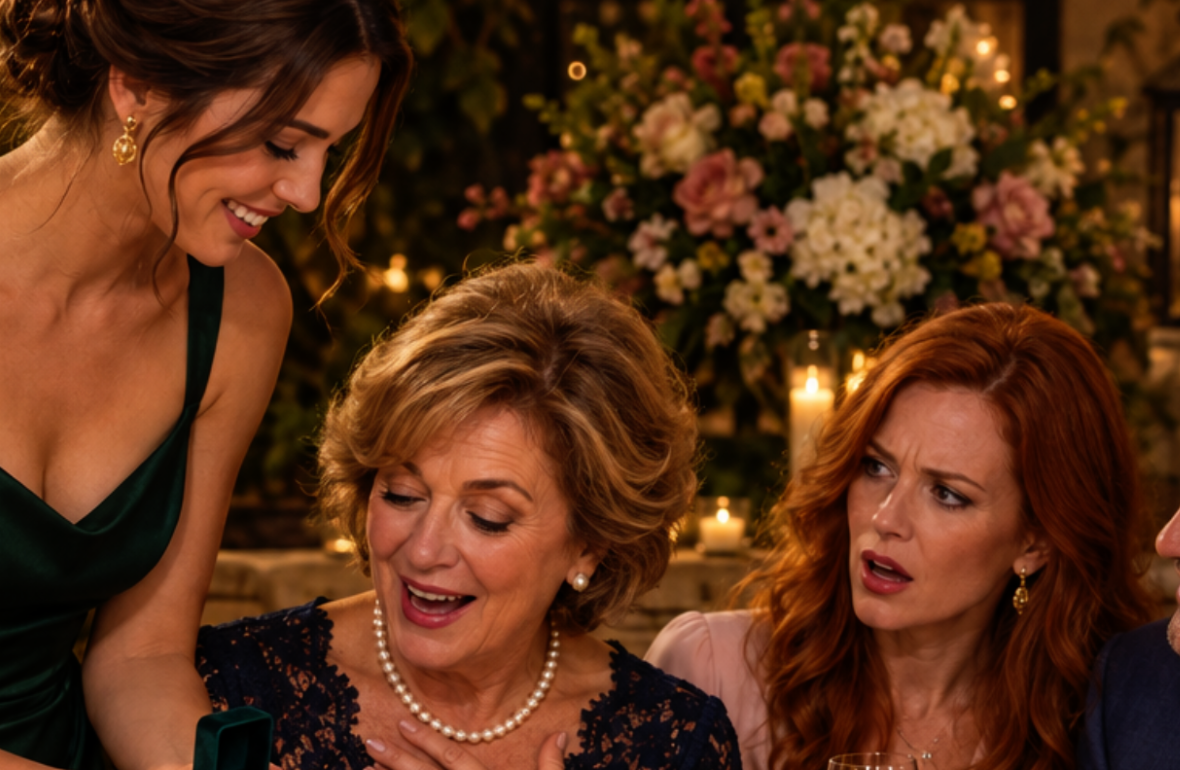
A month before her 70th birthday, Zinaida Pavlovna made it clear to her son and daughter-in-law what gift she expected: a new apartment. Vera stayed silent until the banquet. But then, she stood up with her glass, and even the clinking of forks stopped at the table.
Zinaida Pavlovna called at half past seven in the morning, just as Vera was holding a coffee pot in one hand and her husband’s phone in the other—he’d left it on the windowsill. The coffee was about to boil over, the phone was vibrating, and the screen simply showed “Mom.”
“Gleb, it’s for you,” Vera called towards the bathroom and took the coffee pot off the stove.
Water splashed in the bathroom. The phone quieted, then buzzed again. Vera sighed and pressed the green button.
“Good morning, Zinaida Pavlovna.”
“Verachka? Where’s Gleb?”
“He’s shaving.”
“Let him shave. I’ll tell both of you so you can’t say I didn’t warn you. I’ll be seventy in March.”
“Of course, we remember. We’re already checking out cafes.”
“A cafe is nice. That’s for people. But for myself, Verachka, I want a real gift. I spent my whole life on you two. I want an apartment. A new one. In a new building, with an elevator.”
Vera set the pot on the counter. The coffee boiled over and sizzled onto the stove, filling the air with a burnt smell.
“An apartment,” she repeated.
“That’s right, an apartment. I told Larisa. She agrees it’s only fair. After all, you’ve got your grandmother’s apartment just sitting there with renters in it. The summer house, too. Sell those, add some extra, and give your mother a proper gift. Can’t take it all with me to the grave.”
“Zinaida Pavlovna, maybe Gleb can call you back.”
“He’ll call back, always does.”
The phone disconnected. Vera set it back on the windowsill, screen-down, and grabbed a rag. The coffee stain had already crusted on the enamel, and she had to scrub it with her fingernail.
Gleb came out of the bathroom, a towel around his neck and smelling of minty foam.
“Who was it?”
“Your mom. She wants an apartment for her birthday.”
He let out a short laugh, the kind you hear in line after a bad joke.
“What do you mean, an apartment?”
“Just what she said. In a building with an elevator. She suggested we sell grandma’s place and the dacha.”
Gleb paused, stopped drying his neck. He poured himself what was left of the coffee and sat down.
“She’s just emotional, probably.”
“Probably,” Vera replied.
She knew that in nineteen years, Zinaida Pavlovna never said anything she didn’t mean—every word came out like a pie fresh from the oven: crusty, with filling, and you could only argue with it if your mouth was full.
Vera had a strange, almost embarrassing love for grandma’s little apartment. First floor of an old brick building on Sadovaya street, windows facing the courtyard, and geraniums on the sill that tenants were contractually obliged to water. Vera had added that line herself, and the realtor had glanced at her over his glasses.
“Geraniums? Seriously?”
“Seriously. They’re forty years old.”
They weren’t forty, of course. But they were cuttings from her grandmother’s plant, and every year Vera would break off a sprout and set it in water just in case. Like she could somehow lose it.
The rent went to a separate bank card—thirty-two thousand a month. That card paid for the younger one’s activities, the older girl’s braces, the winter tires. Gleb knew about it but never checked. It was Vera’s domain, and he respected that the same way he respected her habit of double-checking the iron after she’d already left for work.
But now, someone was eyeing that territory from outside. Judging.
That night, Gleb called his mom himself. Vera was washing the dishes, listening to his voice from the other room, going up and down like a kid explaining missing homework.
“Mom, it’s not that easy… No, I’m not saying you don’t deserve it… Mom. Mom. Well, Vera isn’t against it, we just need to think…”
Vera turned off the tap. The plate in her hands was still covered in suds. “We just need to think.” “Vera isn’t against it.” Since when had she said she wasn’t against it?
She put the plate in the rack, soap bubbles slowly sliding down to the grate.
Gleb came into the kitchen, sat, rubbed his brow.
“She’s crying.”
“Crying?”
“She says her knees hurt. She’s on the fifth floor. Going to the store feels like climbing Everest. Vera, she’s really old now.”
“I know her knees hurt.”
“Exactly.”
“Gleb, you told her I’m not against it.”
He gave her a look—guilt, hope that she wouldn’t push, and the fatigue of someone who’d fixed other people’s servers all day and just wanted to eat.
“I just said we’d think about it.”
“You told her: Vera isn’t against it.”
“Well, I just wanted her to calm down.”
Vera dried her hands on the towel, slowly, each finger separately.
“Alright,” she said. “Let’s think about it.”
He let out a relieved sigh. He didn’t hear the tone in her voice.
Zinaida Pavlovna lived in a two-bedroom walk-up on Stroitely street, the top floor with no elevator. She wasn’t alone: her daughter Larisa and grandson Timur, who’d turn seventeen in the spring, lived with her. Larisa had moved back six years ago after her divorce and never left, though she said it was “temporary” every New Year.
On Saturday, Vera visited alone—delivering a dress her mother-in-law had ordered online to Vera’s address because “your pick-up point is downstairs, ours is a trek.”
The entryway smelled of cats, boiled cabbage, and damp concrete. Climbing up, Vera heard a quiet, steady voice from above—like someone counting prayers.
“Thirty-one. Thirty-two. Thirty-three.”
Vera stopped. Two flights above, she saw gray hair and a wine-colored coat sleeve. Zinaida Pavlovna was standing on the fourth-floor landing, gripping the railing, one leg in a knee brace.
“Thirty-four.”
She stepped up, paused. Vera noticed her knuckles were white from gripping the rail.
“Zinaida Pavlovna!”
The older woman turned suddenly, startled, then straightened. Her face became reserved, lips pressed, chin raised.
“Verachka! I just came back from the pharmacy. Did you bring the dress?”
“I did. Let me carry the bag.”
“I’ll bring it myself.”
“Let me help.”
The bag was heavy—milk, two cans of peas, grains, medicine. Vera took it, walking alongside her mother-in-law, slowly matching her pace. She no longer counted steps aloud, but her lips moved.
On the fifth floor, Zinaida Pavlovna took a long time to find her house key—her hands wouldn’t cooperate, the key slipped and clinked against the lock.
“Forty-two,” she said when she finally opened the door. “Forty-two steps from the mailbox. I know them better than my grandkids.”
She said it as if simply reporting the weather.
Inside was hot, the TV on. Men’s sneakers, size 45, stood in the hallway—not Timur’s, he wore 42 and left shoes everywhere. These were neatly lined up, toes against the wall.
“You have guests?”
“That’s Larisa’s—Eduard. He stays over sometimes.”
Larisa walked out, in a pink robe, towel on her head, frizzy orange strands poking out.
“Oh, Vera’s here! Hey. Mom, you went up alone again? I told you, call Edik, he’ll come down.”
“Edik’s asleep,” Zinaida Pavlovna replied.
“You could have woken him up.”
Larisa took the bag, peeking inside and pulling out the peas.
“So, Vera, did mom tell you about her gift?”
“She did.”
“Well? Have you thought it over? Here’s what I think—it’s the right thing. Mom spent her whole life in this Khrushchyovka, fifth floor, no elevator. She needs a new building, with a concierge, a ramp. I found some at the new complex on Zarechnaya—one bedrooms, forty meters, lots of light. I showed them to her.”
“And this apartment?” Vera asked.
“What about it?”
“The two-bedroom. If mom moves.”
Larisa paused, adjusted her towel carefully.
“Well, what about it? We’ll stay here—me, Timur, and Edik. We won’t be out on the street.”
“Got it,” said Vera.
“What’s that supposed to mean?”
“That you and Timur will stay.”
Larisa gave a wide salesperson’s smile.
“Don’t get the wrong idea, Vera. It’s all for mom. Everything’s for mom.”
Zinaida Pavlovna, meanwhile, was at the bedroom door, unlatching her knee brace and staring at her leg, not at her daughter or daughter-in-law.
Back in her car, Vera sat for a long time before starting the engine, clutching the keys tightly enough to leave marks on her palm.
Everything for mom. Forty meters on Zarechnaya. Lots of light. Concierge. And the two-bedroom stays with Larisa and Eduard, who lines up his sneakers neat and sleeps till noon.
But right in the middle of all this, at the core, sat Zinaida Pavlovna herself—counting the stairs under her breath so she wouldn’t stop halfway. Saying “forty-two” like an apology.
Vera started the car. At the market light, a thought hit her so hard she nearly missed the green. The car behind honked.
Not now. There was something else she needed to check first.
At home, Gleb greeted her with his laptop.
“Look,” he said, turning the screen. “I did the math. If we sell grandma’s place, that’s about five million. The dacha, another 1.5—maybe 1.8 if we’re lucky. That’s exactly what a one-bedroom on Zarechnaya costs…”
“Did Larisa send you the link?”
Gleb blinked.
“Mom sent it.”
“Your mom doesn’t know how to send links. Timur set up her phone.”
“Maybe Larisa helped. What’s the difference?”
Vera hung up her coat, set her shoulders in place, and turned to him.
“Gleb. Who will the new apartment on Zarechnaya be registered to?”
“Mom, of course.”
“And then?”
“Then what?”
“When your mom’s gone. Who gets it?”
Gleb closed the laptop—not sharply, but the click echoed in the quiet kitchen.
“Vera, that’s not fair. She’s only seventy and you’re already talking about ‘when she’s gone’.”
“And who lives in the Stroitely two-bedroom while she’s on Zarechnaya?”
“Larisa. And Timur.”
“And Eduard.”
“What Eduard?”
“I’d like to know that, too.”
He stared at her, and she saw a muscle twitch in his cheek—sign that he was catching on before he was ready.
“You think this is Larisa’s scheme.”
“I’m not thinking anything. I just went up five flights with your mom today. She counted the steps.”
“She always does.”
“You’ve seen it?”
“Well… she said. Forty-two and all.”
“Gleb, she gripped the railing with both hands. Her knuckles were white.”
He stood, went to the window. Outside, in the yard, a kid was kicking a flat ball, the ball barely bouncing.
“So what do you suggest? Refuse? She did everything for me as a kid. Dad left when I was eight. She worked two jobs.”
“I know.”
“So now what?”
Vera didn’t answer. She got a glass, filled it up, brought it to her lips, then put it back without drinking.
“Give me two weeks,” she said.
“Why?”
“Just give me two.”
The next days were like going down the stairs in the dark—you never know where the floor ends.
Zinaida Pavlovna called every other day. Sometimes Gleb, sometimes Vera. Each conversation ended the same way.
“Verachka, I’m not rushing. Just checking—have you decided?”
“We’re working on it.”
“Keep working. The doctor at my clinic says: Zinaida Pavlovna, no more stairs. The joint’s worn out. I said: so where do you expect me to go—jump out the window?”
“And what did the doctor say?”
“He’s young, he just laughed.”
Another time, she called late—almost eleven. Her voice was softer than usual, no iron in it.
“Vera, are you awake?”
“Yes.”
“I just wanted to say—please don’t think I’m greedy. I’ve never been greedy. Have I ever done anything bad to you?”
Vera was silent. There’d been plenty—comments about her soup (“Well, not bad for a first try,” when it wasn’t her first or her tenth), at her oldest’s christening fifteen years ago, in front of everyone: “Vera is simple folk, give her anything, she’ll be happy.” Or new sheets for the housewarming, still in store wrapping, with a three-hundred ruble tag marked “special.”
But right now, Vera just heard the breath of someone who’d needed a lot of courage to call.
“No, Zinaida Pavlovna. Nothing like that….Continued a bit below the image in the first comment to this post…
A month before her 70th birthday, Zinaida Pavlovna told her son and daughter-in-law exactly what present she wanted: a new apartment. Vera stayed silent all the way until the party. Then, during the banquet, she stood up with her glass, and even the sound of cutlery faded out as everyone listened.
Her mother-in-law called at half past seven in the morning, just as Vera was juggling the coffee pot in one hand and her husband’s phone—which he’d left on the windowsill—in the other. The coffee frothed up, the phone vibrated, and the simple word “Mom” shone on the screen.
“Gleb, it’s for you,” Vera shouted toward the bathroom, removing the coffee from the stove.
The sound of running water responded from the bathroom. The phone went silent, then started buzzing again. Vera sighed and pressed the green answer button.
“Good morning, Zinaida Pavlovna.”
“Verachka? Where’s Gleb?”
“He’s shaving.”
“Let him shave. I’ll tell both of you now, so later you can’t say I didn’t warn you. I’m turning seventy in March.”
“We remember, of course. We’re already looking at cafes.”
“Cafes are good. Cafes are for people. But for myself, Verachka, I want a real present. I devoted my life to you both. I want an apartment. A new one. In a new building, with an elevator.”
Vera set the coffee pot down on a stand. Coffee spilled over onto the stovetop and sizzled, filling the air with the smell of burning.
“An apartment,” she repeated.
“An apartment. I told Larisa, and she agrees it’s only fair. You still have your grandma’s old one-bedroom, other people are living in it now. And you have your dacha just sitting there. Sell them both, add a bit, and your mother will have her gift. What am I supposed to do, take all this with me to the cemetery?”
“Zinaida Pavlovna, why don’t you let Gleb call you back.”
“He’ll call me back, he always does.”
Dial tone. Vera put the phone back on the windowsill exactly where it was, screen down, and grabbed a rag. The brown stain on the enamel had already dried, so she had to scrub at it with her nail.
Gleb came out of the bathroom with a towel around his neck, smelling of minty foam.
“Who called?”
“Your mom. She wants an apartment for her birthday.”
He gave a short laugh, the kind you hear when someone makes a bad joke in a queue.
“What do you mean, an apartment?”
“Exactly what I said. With an elevator. She’s suggesting we sell grandma’s place and the dacha.”
Gleb stopped drying his neck. He stood there, then poured himself some of what was left in the coffee pot and sat down at the table.
“Well, she’s probably just being emotional.”
“Probably,” Vera said.
She didn’t mention that in nineteen years, Zinaida Pavlovna had never said anything on impulse. Every word always came fully formed, like a pie fresh from the oven—crust, filling and all—and the only way to argue was with your mouth full.
Vera loved her grandma’s old one-bedroom with a strange kind of affection, almost shameful for a grown woman. First floor of an old brick building on Sadovaya, windows facing the courtyard, and a geranium on the windowsill that tenants were contractually obliged to water. Vera had even added that in as a separate point in the rental agreement, and the realtor had looked at her over his glasses when she did.
“The geranium? Seriously?”
“Seriously. It’s forty years old.”
The geranium wasn’t really forty. But it was a cutting from the original, her grandma’s, and every year Vera would pinch off a sprout and put it in a glass of water. Just in case. As if she might lose it.
The rent money was sent to a separate card—thirty-two thousand each month. That card covered the youngest’s activities, the eldest’s braces, and winter tires. Gleb knew about this card but never looked at it. It was Vera’s domain, and he respected it just as much as he respected her habit of checking the iron after she’d already stepped out onto the landing.
But now, someone had looked at that domain from the outside. Judgingly.
That evening, Gleb called his mother himself. Vera was washing dishes, listening to his voice from the next room through the noise of running water, the tone rising and falling like a schoolboy trying to explain to the teacher why he hadn’t done his homework.
“Mom, it’s just not that simple… No, I’m not saying you haven’t earned it… Mom. Mom. Well, Vera isn’t against it, it’s just that we need to think…”
Vera turned off the water. The plate in her hand was still covered in suds. “We need to think.” “Vera isn’t against it.” When did she ever say she wasn’t against it?
She put the plate on the drying rack still wet, without rinsing, and the suds began to slowly slide down toward the grate.
Gleb came back into the kitchen, sat down, and rubbed the bridge of his nose.
“She’s crying.”
“Crying?”
“She says it’s her knees. That she’s on the fifth floor. That going to the store feels like climbing Everest. Vera, she’s really getting old.”
“I know about her knees.”
“See?”
“Gleb. Did you tell her I’m not against it?”
He looked up at her from under his brows, and in that look was everything at once: guilt, hope that she wouldn’t make a scene, and the exhaustion of a man who’d spent all day fixing other people’s servers and just wanted to eat.
“I said we’d think about it.”
“You said: Vera isn’t against it.”
“I said it just so she’d calm down.”
Vera dried her hands on the towel. Slowly, each finger separately.
“Alright,” she said. “Let’s think about it.”
He exhaled in relief. He didn’t notice the way she’d said it.
Zinaida Pavlovna lived in a two-room apartment on Builder’s Street, in a five-story building without an elevator, on the top floor. She didn’t live alone: her daughter Larisa and her grandson Timur, who was turning seventeen in the spring, lived with her. Larisa moved back in with her mother six years ago after leaving her husband, and she’d stayed ever since, though every New Year’s Eve during the chimes, she’d say it was just “temporary.”
On Saturday Vera went there alone. There was a reason: to bring the dress her mother-in-law had ordered online to Vera’s address because, as she put it, “you’ve got a pickup point right by your house, and here, just getting there…”
The stairwell smelled like cats, boiled cabbage, and damp concrete. As Vera climbed, she heard a voice from above on the third-floor landing. Soft, steady, as though someone was reciting a prayer.
“Thirty-one. Thirty-two. Thirty-three.”
Vera stopped. Above the banister, two flights up, she could see a short gray haircut and a burgundy coat sleeve. Her mother-in-law stood on the fourth floor landing, clutching the railings with both hands, one leg in an elastic knee brace pulled over her tights.
“Thirty-four.”
She took a step. Stopped. Vera saw her fingers on the railing turn white.
“Zinaida Pavlovna!”
The elderly woman turned abruptly, almost startled, then immediately stood up straight. Her face returned to normal. Lips pressed together, chin raised.
“Verotchka. I just got back from the pharmacy. Did you bring the dress?”
“I did. Let me carry the bag for you.”
“I’ll carry it myself.”
“Come on, give it to me, I said.”
The bag was heavy. Milk, two cans of peas, some grains, and medicine in a white box. Vera picked it up and walked alongside, moving slowly at her mother-in-law’s pace. The older woman no longer counted out loud, just moved her lips.
On the fifth floor, Zinaida Pavlovna searched her purse for the key for a long time. Her hands wouldn’t cooperate, the key slipped between her fingers and clinked against the lock.
“Forty-two,” she suddenly announced after finally unlocking the door. “Forty-two steps from the mailboxes. I know them better than my own grandchildren.”
She said it without a hint of complaint, just like someone giving a weather report.
Inside, it was warm. The TV was on. In the hallway stood a pair of men’s size 45 sneakers—definitely not Timur’s; he wore size 42 and always left his shoes lying around, while these were neatly placed toe-to-wall.
“Do you have guests?”
“Those are Larisa’s,” her mother-in-law waved her hand. “Eduard. He spends the night here sometimes.”
Larisa walked out of the kitchen, wearing a pink robe and a towel around her head. Strands of red hair stuck out from under the towel like wire.
“Oh, Vera’s here! Hey, hey! Mom, did you go up the stairs by yourself again? I told you, call me—Edik would come down.”
“Edik’s asleep,” said Zinaida Pavlovna.
“Well, you could’ve woken him up.”
Larisa took the bag from Vera, peeked inside, and pulled out a can of peas.
“So, Vera, did Mom tell you about the gift?”
“She did.”
“And? Did you think it over? I’ll just say, it’s the right thing to do. Mom’s lived her whole life in this Khrushchyovka, fifth floor, no elevator. She should move to a new building, one with a concierge, with a ramp. I’ve already looked at places—there’s a new building on Zarechnaya, one-bedroom flats, forty square meters, bright and airy. I showed them to her.”
“And this apartment?” Vera asked.
“Which one?”
“This one. The two-bedroom. If Mom moves out.”
Larisa paused for a second. The towel on her head slipped and she carefully adjusted it with both hands, taking her time.
“Well, what about this one? It’ll stay as is. Timur and I will be here. And Edik, too. It’s not like we’re going to end up on the street.”
“I see,” said Vera.
“What do you see?”
“That you and Timur are staying here.”
Larisa grinned wide, with the practiced smile of a shop assistant.
“Vera, don’t get any wrong ideas. This is for Mom. Everything we’re doing is for her.”
At that moment, Zinaida Pavlovna stood in the doorway to her room, bending over to remove her knee brace, clutching the doorframe for support. She didn’t look at her daughter or daughter-in-law—her gaze was fixed on her own leg.
In the car, Vera sat for a while before starting the engine. She clutched the keys so tightly the keychain pressed into her palm.
Everything for Mom. Forty square meters on Zarechnaya. Bright. Concierge. And the two-bedroom goes to Larisa and Edik, who places his sneakers neatly against the wall and sleeps till noon.
And somewhere in the middle of it all, like a cherry pit inside the fruit, there was Zinaida Pavlovna herself, silently counting steps out loud so she wouldn’t stop halfway. Who said “forty-two” as if she was apologizing.
Vera started the car. At the traffic light by the market, a thought struck her so hard she almost missed the green light. The car behind honked.
Not now. First, she had to check something.
At home, Gleb met her with his laptop.
“Look,” he said, turning the screen to her. “I did the math. If we sell Grandma’s place, that’s five million, probably. The dacha—another one and a half, maybe 1.8 million if we’re lucky. And on Zarechnaya, a one-bedroom is just about…”
“Did Larisa send you the link?”
Gleb blinked.
— Mom sent it.
— Mom doesn’t know how to send links herself. Timur set up her phone.
— Maybe Larisa helped her. What does it matter.
Vera took off her coat, hung it on a hook, straightened the shoulders. Then she turned around.
— Gleb. Whose name will the apartment on Zarechnaya be under?
— Mom’s, of course.
— And then?
— Then what?
— Then, when Mom is gone. Who will get it?
Gleb closed his laptop. Not abruptly, but in the quiet kitchen, the lid snapped loudly.
— Vera, that’s a little harsh. She’s seventy, and you’re talking about ‘when she’s gone’.
— And who’s going to live in the two-room place on Stroiteley while Mom is on Zarechnaya?
— Larisa. And Timur.
— And Eduard.
— What Eduard?
— Exactly, I’d also like to know which Eduard.
He looked at her, and she could see a muscle twitch in his cheek. Once, then again. He always did that when he figured something out sooner than he wanted to.
— You think Larka came up with this.
— I’m not thinking anything. I walked up to the fifth floor with your mom today. She counted the steps.
— She always counts them.
— You saw?
— Well… she said. Like, forty-two.
— Gleb, she was holding onto the handrail with both hands. Her fingers were white.
He stood up and walked to the window. Outside, a child was kicking a deflated ball in the yard, and it didn’t bounce, just flopped.
— So what are you suggesting? Refuse? She raised me all by herself. Dad left when I was eight. She worked two jobs.
— I know.
— So what, then?
Vera didn’t answer. She took a glass from the cupboard, filled it with tap water, brought it to her lips, then set it back down without drinking.
— Give me two weeks, — she said.
— Why?
— Just give me the time.
The next few days felt like going down a staircase in the dark: every step was a guess, never knowing where the landing might be.
Zinaida Pavlovna called every other day. Sometimes Gleb, sometimes Vera. The conversations varied, but always ended the same way.
— Verochka, I’m not rushing you. I’m just asking. Have you decided yet?
— We’re deciding.
— Take your time, take your time. You know, the doctor at the clinic said: Zinaida Pavlovna, you shouldn’t use stairs. The joint is worn out. I told him: So where do I go, out the window?
— What did the doctor say?
— What do you think? He’s young, he thought it was funny.
Another time, my mother-in-law called late, almost eleven. Her voice was softer than usual, without that edge.
— Vera, are you awake?
— No.
— I just wanted to say—don’t think I’m greedy. I never was. Have I ever done anything bad to you?
Vera was silent. There had been a lot of bad. Remarks about soup that was ‘not bad for a first try,’ even though it wasn’t her first or tenth time. Fifteen years ago, at the eldest’s christening, right in front of everyone: ‘Vera is simple, give her anything and it’s good.’ Bed linen as a housewarming gift, neatly packed, with a tag from a store where it was three hundred rubles on sale.
But now, all she heard through the phone was the breathing of someone who had taken a long time to work up the courage.
— No, Zinaida Pavlovna. Nothing like that.
So here’s the thing. I was a daughter-in-law once too, you know. My mother-in-law—oh, Vera, you never met Anna Grigorievna. She disliked me right from the start! She even tried to take my room, the one from the factory. She said, “Sell it, Zina, and give the money to Kolya’s brother for his co-op.” And I…
She fell silent.
“And what did you do?”
“I didn’t give it up. I told her something so harsh that Kolya didn’t speak to me for a week. Anyway, get some sleep. It’s late.”
The line went dead.
Vera lay there for a long time with the phone resting on her chest. Gleb was next to her, turned toward the wall, breathing heavily with a whistle—like even in sleep he was climbing someone else’s staircase.
What had she said to her mother-in-law back then? And why on earth did this memory come back now, at eleven o’clock at night, just before her own big birthday?
The answer came by chance. Or almost by chance.
A week before the party, Zinaida Pavlovna asked Vera to help with the sideboard. She wanted to get out the special china set—the one with the gold trim they’d bought for Gleb’s wedding—and wash it. She couldn’t climb on a stool anymore, and Larisa was too busy.
The sideboard stood in the big room, dark and polished, with carved handles. The bottom drawer stuck. Vera tugged, and the whole drawer came out, landing in her lap, scattering papers—receipts, old postcards, some certificates in plastic covers—all across the floor.
“Oh dear,” her mother-in-law called from her armchair. “Just gather it up, there’s nothing important there.”
Vera started picking up everything: receipts for electricity from 2009, a certificate for ‘Best Accountant of the Trust,’ a postcard featuring Gagarin with a torn corner. And there was an envelope, yellowed, sealed long ago but now coming undone at the edges. On it, in neat, still-youthful handwriting: ‘To Anna Grigoryevna. Not Sent.’
Vera looked at her mother-in-law. She was sitting with her eyes closed, head leaning back on the armchair, seeming to doze. The TV murmured about blood pressure and magnetic storms.
Reading someone else’s letter is wrong. Vera had known this since she was little—her grandma used to say: someone else’s letter is like a wallet. Once it’s in your hands, you’re already a thief. She held onto the envelope for a moment, then put it back in the drawer. On top. And slid the drawer shut.
Later, while she was washing the china set in the kitchen with hot water running over the gold rims and the scent of lemon cleaner in the air, her mother-in-law suddenly appeared in the doorway, leaning on the frame.
“You saw the envelope.”
It wasn’t a question.
“I saw it. I didn’t read it.”
“I know you didn’t read it. You’re not that kind of person.”
She made her way to the table, sat down, and took a long time to get her sore leg comfortable.
“Read it,” she said. “Out loud. My eyes aren’t what they used to be.”
“Zinaida Pavlovna…”
“I said read it.”
Vera wiped her hands, went back for the envelope. Inside was a single sheet of grid paper, folded in quarters. The handwriting slanted so sharply to the right it looked ready to run right off the page.
“Anna Grigoryevna, today you told me I’m an outsider and my room is just a shared family space. I’m writing back to you, because my voice trembles when I try to say it aloud. This room is mine. I earned it before you even knew my name. I won’t sell it and I won’t give it up to anyone—not to Kolya’s brother, not to you, not to Kolya. It’s not because I’m greedy. It’s because every woman needs a door of her own. A place to go if she must, a space no one can kick her out of. You understand that—it’s something you’ve never had, and that’s why you are the way you are. But I won’t be like that. Zinaida.”
continued in the comments
Vera fell silent. The kitchen grew very quiet, except for the soft drip from the tap, each drop landing in a saucer with a golden rim and ringing lightly.
“I never sent it,” her mother-in-law admitted. “I didn’t have the courage. Ended up saying it all out loud anyway. My voice trembled, just as I expected. But I said it.”
“And the room?”
“Later, we traded the room for this two-bedroom. When Gleb was born. It’s mine. Still mine. That’s the door, Vera.”
She gazed out the window. Rain had left a faint film on the pane, making the five-story buildings across the street look like watercolor paintings.
“Then why do you want a new place?” Vera asked quietly.
Her mother-in-law was silent for so long that the tap dripped about ten more times.
“Because Larisa asked,” she finally replied. “Because this Edik… He seems nice. Doesn’t drink. Works. Maybe things will work out for her. But I’m in the way. I hear them whispering in the kitchen at night. I’m old, Vera, not deaf. Larisa says, ‘Mom, it’ll be better for you, too, with an elevator.’ And it’s true—my knees, after all.”
“And will you sign the two-bedroom over to her?”
Zinaida Pavlovna turned and looked straight at her, and for the first time in nineteen years, Vera saw not judgment but confusion in her eyes.
“She’s asking for a deed of gift. Says it’ll keep inheritance matters simple later. Says Gleb already has grandma’s one-bedroom. It seems fair, I suppose.”
“And what do you think?”
“I don’t think anything. I’m seventy years old. I’m tired of thinking.”
She stood up, took the sheet of paper from her daughter-in-law’s hands, folded it in quarters along old creases, and slipped it into her robe pocket.
“Bring the tea set home,” she said in her usual voice, a bit crusty. “Don’t scrub the rim, you’ll wear it off.”
That evening, Vera called the tenants on Sadovaya.
The tenants were a good young couple, both doctors, renting for their third year. Vera knew they’d been saving up for a mortgage and were planning to move into their own place in February. She herself had put off this conversation until March, not wanting to think about looking for new renters.
“Vera Andreevna, hello! We were just about to call you,” the girl on the other end said quickly and cheerfully. “We got our keys to the new place early. We could move out as soon as next Saturday if that’s okay with you. Of course, we’ll pay for the month as the contract says.”
“There’s no need to pay for the month. Move out whenever you’re ready.”
“Really? Oh, thank you! What about the geranium? We watered it, and it actually bloomed in January—can you imagine?”
“Leave the geranium,” Vera replied. “Let it stay.”
Later, she sat in the kitchen with a sheet of paper, making calculations—deadlines, sums, options—not steps. Gleb came in, glanced over her shoulder, and didn’t understand a thing.
“What’s that?”
“Later.”
“Vera, you’re scaring me.”
“Don’t be afraid. Everything’s going to be fine.”
She heard how those words sounded and couldn’t believe herself. But she finished writing the last line and folded the sheet of paper in four.
Four days before the banquet, Larisa called. Not her mom, not her brother. Vera.
“Listen, Vera, let’s be honest, woman to woman. Have you decided?”
“We have.”
“And? Are you selling?”
“Larisa, it’s a gift. You don’t reveal gifts beforehand.”
Larisa giggled, but it sounded nervous, almost like a sigh.
“Well, you could tell me. I’m the organizer. I need to know. I’ve already told the realtor on Zarechnaya that buyers were coming, asked her to hold that one-bedroom place.”
“You shouldn’t have said anything.”
Silence. Larisa breathed into the phone, and somewhere near her a vacuum cleaner was humming, then went quiet.
“What do you mean, shouldn’t have?”
“I mean, don’t hold anything for us.”
“Vera. Are you really refusing? Do you realize Mom won’t be able to take this? Her blood pressure—she’s told all her friends already.”
“I’m not refusing. Come on Saturday. You’ll see.”
“You’re acting weird,” Larisa said. “Does Gleb even know about this?”
Vera hung up. She didn’t slam the phone, but set it down carefully, as if placing back something that didn’t belong to her.
Gleb had no idea. That was the worst part.
He found out Friday night, the day before. Vera told him everything herself, sitting on the edge of the bathtub while he brushed his teeth, because that was the only place he couldn’t slip away from the conversation.
He listened. The toothbrush froze in his hand, foam dripped onto his T-shirt. He didn’t wipe it.
“So you… You want to move Mom into Grandma’s old place?”
“I want her to live on the first floor. As long as she wants. For free. For the rest of her life, if she wants.”
“But the ownership?”
“It’s mine. It’ll stay mine. I’m not selling a thing. Not the apartment, not the dacha.”
“And the two-bedroom on Stroitely?”
“The two-bedroom is Mom’s. She can do whatever she wants with it. But I really hope she doesn’t give it away. Because then she won’t have her own door anymore.”
“What door do you mean?”
Vera didn’t bother to explain. She got up, grabbed a towel, and wiped the spot of foam from his T-shirt. He stood there, motionless, the way he probably did as a boy when his mother straightened his collar before school.
“Larka will freak out,” he finally said.
“Most likely.”
“And Mom?”
“I don’t know, Gleb. I really don’t. Maybe she’ll be offended. Maybe she’ll call me greedy. In front of everyone.”
“And you’re okay with that?”
“I’m okay with that.”
He spat out toothpaste, rinsed his mouth, and stared at his reflection in the mirror for a long time. Then he turned around.
“Why didn’t you tell me earlier?”
“Because you told her I wasn’t against it.”
He lowered his head. The muscle in his jaw twitched, then went still.
“Alright,” he said. “I’m with you.”
He said it quietly and awkwardly. But for some reason, Vera believed him right away.
The café was called ‘Beryozka’ and it probably still remembered Zinaida Pavlovna’s own wedding. The walls were paneled in wood, chandeliers dangled with glass drops, and the tables were set with stiff white tablecloths that could almost cut your hand. It smelled of dill, warm bread, and someone’s sweet perfume that tickled your throat.
There were about twenty guests: old colleagues from the trust, two neighbors, a cousin from Tver with her husband, and Timur in a jacket that was too tight at the shoulders. Eduard sat next to Larisa—big, a little bald, wearing a checkered shirt—and politely smiled at everyone.
The birthday girl sat at the head of the table. She wore a burgundy dress, pearls, a fresh hairstyle, and her lips were painted a deep dark cherry. Her knee was tightly bandaged under her tights, and Vera saw how she lowered herself into her chair—slowly, holding onto the chair’s back—and then instantly smiled to the guests as if nothing was wrong.
The toasts made their way around the table. Former colleagues recalled how Zinaida Pavlovna had balanced the annual accounts in just one night back in ’98. The neighbor shared a story about how she and Zinaida nursed a kitten back to health. The cousin from Tver was moved to tears and forgot what she wanted to say. Timur, blushing, stood up and mumbled, ‘Gran, you’re the best,’ before sitting back down and staring at his plate.
Then Larisa stood up. She tapped her fork on her glass and waited for quiet.
‘Mom. I won’t be long. You’ve always cared for everyone else—for Gleb and me, for the grandkids, for everyone. Edik and I decided it’s time someone took care of you. So, we’re giving you this…’
She reached under the table and pulled out a bag. Inside, there was a boxed blood pressure monitor and a plaid blanket.
‘So you can check your blood pressure, Mom. And so you’ll be cozy in your new place.’
She said ‘in your new place’ with emphasis and looked across the table at her brother and his wife. The guests started whispering. One of the colleagues asked in a loud whisper, ‘Wait, is Zina moving?’
Zinaida Pavlovna thanked her daughter, kissed her on the cheek, and placed her hands on the tablecloth, fingers tightly interlaced.
‘Well, now,’ she said, her voice firm and steady, ‘now I’m waiting for the main present. My son and daughter-in-law promised me one.’
Everyone turned to look at Gleb. Gleb looked at Vera.
Vera stood up.
She wore an emerald dress that she had bought especially for this occasion three weeks ago, the same evening when dish soap suds slid off a plate in the drying rack. In her hand was a small velvet box—the kind used for rings. She walked around the table, her heels clicking on the tile so loudly that each step could be heard.
She placed the little box in front of her mother-in-law.
‘Happy birthday, Zinaida Pavlovna.’
Her mother-in-law opened it. Inside, on gray velvet, lay two keys on a keyring. A red satin ribbon was tied into a bow around them.
Someone at the table gasped. Larisa sat up a little straighter. The cousin from Tver exclaimed, ‘Oh my!’
‘This is…’ her mother-in-law began.
‘These are the keys to the apartment on Sadovaya,’ Vera said steadily, without raising her voice. ‘Grandma’s apartment. First floor. Not a single step to climb, there’s a ramp at the entrance, put in just last year. The tenants moved out last Saturday, and I cleaned everything there. The clinic is across the street, the market’s around the corner. Live there as long as you like. For the rest of your life, if you want.’
Larisa exhaled and started to smile.
‘See! There it is! Mom, Vera gave you an apartment!’
‘No,’ Vera said. ‘Not gave.’
The room fell silent. Even the waitress at the door froze, tray in hand.
“The apartment stays with me. I’m not selling it, I’m not transferring it to anyone. And I’m keeping the dacha, too. Gleb and I will sign a contract with Zinaida Pavlovna for free use—it’ll all be official, done with a notary, legal in every way. No one is going to ask her to leave. Not me, not Gleb, not our kids. We’ll take care of all the utilities.”
She turned to her mother-in-law.
“And your apartment on Stroiteley stays yours. It’s your door. Nobody will touch it. Unless you decide otherwise.”
Larisa sat down. Slowly, as if the chair had been pulled out and then pushed back beneath her. Red blotches climbed her face, starting from her neck all the way up to her ginger bangs.
“What is this?” she said. “What kind of stunt is this, Vera? Are you mocking us? Mom wanted a new place! Her own! And you’re offering her a rental? In grandma’s dump?”
“Larisa,” said Gleb.
“No, you keep quiet! You’re useless, you just do whatever your wife tells you to…”
“Larisa,” he repeated, but this time his voice was different. Not loud. Firm, like a starched tablecloth. “Mom wanted the ground floor. With or without an elevator, but no stairs. Here’s the ground floor. What else did mom want?”
“She wanted something of her own!”
“She already has something of her own. On Stroiteley. Or did you want her to have nothing of her own?”
Eduard put his hand on Larisa’s shoulder. She shrugged it off. He took his hand away and stared at his plate, his ears turning red.
The guests stayed silent. A colleague from the trust quietly poured herself some mineral water, and the bubbling sounded like it echoed through an empty hall.
Everyone was waiting to hear what the birthday girl would say.
But Zinaida Pavlovna said nothing. She just sat there, holding a small box and looking at the keys. Then she took them out. The red ribbon dangled from her fingers as she wound it around her index finger, once, twice, almost as if testing how strong it was.
Then she reached into her handbag, which hung on the back of her chair, and pulled out a sheet of graph paper folded into quarters.
Vera recognized it instantly. And suddenly her knees started to shake, strong, healthy forty-one-year-old knees—not from pain, but nerves—so she had to grab the back of the nearest chair for support.
“Here’s what I have to say,” the mother-in-law began. Her voice trembled, just a bit. “Fifty years ago I wrote a letter. To my own mother-in-law. I never sent it, didn’t have the guts. But Vera read it to me the other day. Out loud. I can’t see anymore myself.”
She unfolded the sheet, but didn’t read it. Just held it.
“It says there that a woman should always have her own door. A place she can go if she has to. A place where nobody will kick her out. I understood that when I was twenty. At seventy, I almost forgot.”
She turned to her daughter.
“Larisa. I’m not signing the two-bedroom over to you. I’m sorry. You and Timur can live there as long as you need, even with Edik, I don’t mind, he’s a good man. But it’s mine. I earned it.”
Larisa opened her mouth and closed it again. Then she stood up, grabbed her purse, and headed for the exit, bumping a waitress on the way. The tray wobbled, but the waitress caught it. Eduard sat for another second, murmured “sorry” to everyone, and left after her.
Timur stayed. Sitting there, red-faced in a cramped suit jacket, absentmindedly spinning a fork between his fingers.
“Grandma,” he said softly. “Can I come visit you on Sadovaya? It’s so close to college.”
Zinaida Pavlovna looked at her grandson and laughed. It was the first time she had laughed all evening. Her laugh was raspy and ended in a cough, so she covered her mouth with a napkin.
“Sure,” she said. “Just take your shoes off in the hallway. That’s your daughter-in-law’s floor.”
Larisa hadn’t called for two weeks.
Then she called, but not Vera. She called her mother. The conversation was long, and Vera only found out about it from Gleb, who in turn heard it from Zinaida Pavlovna herself. She retold it briefly and dryly, like a quarterly report.
“She said I betrayed her. That I took my daughter-in-law’s side. That Edik is having second thoughts now.”
“And you?” Gleb asked.
“And I told her: let him doubt. If a man lives with a woman only because of the square meters, it’s better he starts doubting now.”
There was silence on the other end of the line for a while.
“She cried,” her mother-in-law added. “Lariska. Like a little girl. I told her: Baby, I’m not dying. I’m just moving to Sadovaya, you’ll have the fifth floor all to yourself. Just remember, it’s not in your name. It’s in mine. It’s safer that way. Safer for you, silly. Who knows what kind of Edik he’ll turn out to be.”
They moved at the end of March. Zinaida Pavlovna didn’t take much: a chair, the china cabinet—which Gleb, Timur, and the neighbor spent almost an hour dragging down from the fifth floor, grumbling under their breath—a box of dishes, and another, smaller box from under some shoes, which she kept on her lap the whole ride in the car.
Eduard, by the way, helped too. He carried boxes silently and steadily, never stopping to sit down. Larisa arrived later, already at Sadovaya, with a bag of pies from the bakery. She stood in the hallway, looking around.
“Not bad,” she said. “It’s bright.”
“Take your shoes off,” her mother said.
Larisa shrugged—but took off her shoes anyway.
In April, Vera stopped by Sadovaya after work. With a loaf of bread and a carton of kefir, as her mother-in-law had asked.
The stairwell smelled of fresh paint—they’d been repairing the railings on the upper floors. The door opened before she could even ring.
“I saw you parking through the window,” said Zinaida Pavlovna. “Come in. Take your shoes off.”
Inside, the apartment smelled of cabbage pie and something else, a slightly bitter, green scent. It took Vera a moment to realize it was geranium. There were two plants now on the windowsill: the old one, her grandmother’s, and next to it in a plastic yogurt cup, a new cutting with three little leaves.
“I pinched it off myself,” her mother-in-law said, following Vera’s gaze. “Is that okay? You always do the same, I’ve seen you. Just to be safe.”
“It’s fine. Good thinking.”
They drank tea in the kitchen. The mugs were Vera’s, and her grandmother’s—one had a broken handle, and for some reason her mother-in-law chose that one. Her knee wasn’t bandaged anymore. She said she now went to the market by herself every day—”back and forth, and not a single step, can you believe it, not a single one.”
“What about on Stroiteley?”
“Lariska’s started doing renovations there. She’s putting up new wallpaper. Edik is helping her. She calls to ask if it’s okay to take down a wall in the small room. I said: no, that’s a load-bearing wall. And she says: Mom, well, it’s yours—you decide.”
Zinaida Pavlovna took a sip of tea and set her mug on the table. A wet ring was left on the oilcloth, and she carefully wiped it off with the edge of her hand.
“First time in six years she ever asked,” she said. “What’s allowed in my apartment and what isn’t.”
Vera gazed out the window. In the yard, a boy of about eight was kicking a ball across the asphalt. The ball was pumped up tight, bouncing high and loud—almost reaching the branches of the poplar tree.
Her mother-in-law stood up, walked to the sideboard, and pulled out the bottom drawer. It didn’t stick anymore—Gleb had adjusted the runners when he put it together. She took out a bundle of keys tied with a red ribbon, held them in her palm for a moment, and then placed them next to Vera’s plate.
“These are the spares,” she said. “You should keep them. It’s your door after all. Just in case.”
Vera took the keys. The ribbon felt smooth and slightly warm, as if someone had held it for a long time.
She slipped them into the pocket of her coat and went to cut the pie.