***
I was riding the train, gazing out the window—the forest was yellow, wet, the birches shining like they’d been dipped in gold. Beautiful. I thought about home. About the quiet. About how I’d put the kettle on, wrap myself in a blanket, and sit out on the veranda in silence. I spent seven years building that house—by hand, with my own money and nerves. Every board, every nail was mine. Every outlet—I personally picked it out. Every tile—I spent two hours at Santeri choosing each one. The house was mine, completely, entirely, from foundation to roof.
The train arrived at six in the evening. Perm greeted me with an October wind and a low, gray sky. I called a taxi. When it turned onto my street, I saw bicycles. Two kids’ bikes—a pink one and a blue one—stood by the front steps. Not by the garage, not by the fence—right in front of the steps, blocking them. Next to them was a big inflatable ball, a child’s scooter, and a bag filled with toys.
I got out of the car and just stood there staring. Bikes. Kids’ bikes. Right in front of my steps.
“Miss, do you want me to carry your suitcase?” the taxi driver asked.
“No, I’ve got it myself.”
I walked up to the door. In the entryway—coats. Three coats, hanging on the hooks I hung myself, perfectly level. A man’s coat—dark, woolen. A woman’s—short, with a fur collar. A child’s—pink, with a patch that says “Princess.” And shoes—men’s size 45 boots, women’s boots, little pink rain boots. All wet and muddy. On my doormat. The one I brought from IKEA, gray with a black pattern.
I stood in my own hallway and couldn’t figure out where I was. It felt like someone else’s house. Like I’d gotten the wrong address.
Laughter came from the kitchen. A woman’s laughter—loud, with a giggle. A man’s—deep, booming. Children’s squeals—sharp and piercing. Dishes clinking. Something banging, rustling, and clattering. And the smell—nothing like mine. Fried meat, onions, something sweet—a pie? Pancakes? My home always smelled like coffee and wood. This was someone else’s kitchen smell.
I walked down the hall, stepping over a backpack—a kid’s backpack, Frozen-themed—and peeked into the kitchen.
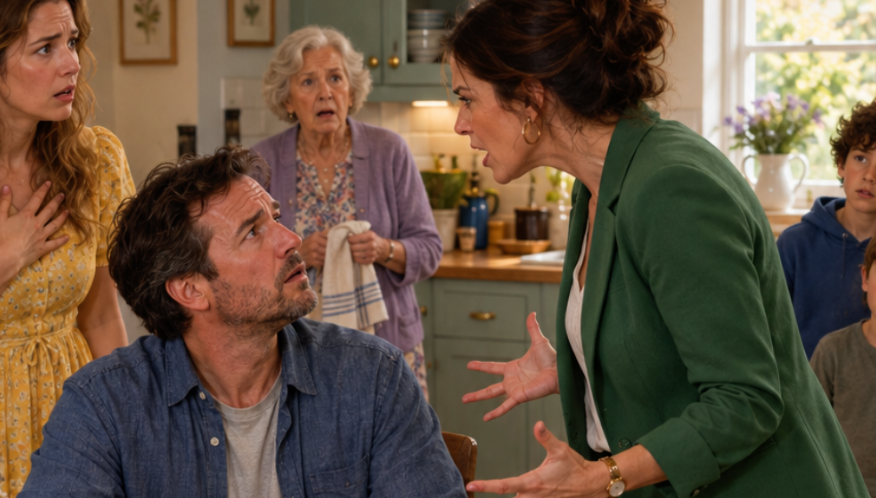
The kitchen. My kitchen. Gray cabinets, the oak countertop I took three weeks to choose. Copper handles. The window overlooking the garden where I planted those apple trees. Four people sat at my table.
A man—big, with reddish hair, in a checkered shirt—was eating from my plate with my fork. A woman—thin and quick, short hair—was at the stove flipping pancakes on my pan. Two kids—a boy about six and a girl around four—ran around the table, shrieking and throwing things at each other—I couldn’t tell what at first… Bread. They were throwing bread. In my kitchen.
“Hello,” I said.
The woman at the stove turned around and smiled—wide, without a hint of embarrassment:
“Oh! Katya’s home! Hi! We made pancakes—want some? Come in, don’t just stand there, we’re all friends here!”
I looked at the man. He glanced up, nodded, and kept chewing.
“Who are you?” I asked.
The man swallowed his food, wiped his mouth with a napkin—my napkin, linen, from ‘Textile-Baza’—and said:
“Who am I? I’m Roma’s brother—Gena. And this is Alyona, my wife. And these are Yegor and Masha, our kids.”
I stayed silent. Three seconds. Five. Ten.
“And on what grounds are you running my house?” I still couldn’t wrap my head around it. “Who let you in? What are you doing here?”
“Roma let us in,” Gena replied calmly. “He said, ‘stay as long as you need.’ We rented out our place till we find a new one. It’s spacious and warm here, the kids can run around. We’ll be careful, don’t worry.”
“Don’t worry?! You’re living in my house. Without telling me. Without asking. Eating off my plates. Your kids are throwing bread around my kitchen. And you say, ‘don’t worry’?”
Alyona put the frying pan on the stove—my stove—and turned to me:
“Katya, why are you getting so upset? We’re quiet, we’ll be careful. Roma offered himself. He said, ‘The house is big, there’s enough space.’ We didn’t force ourselves in.”
Roman appeared in the kitchen doorway. He stood there in his home t-shirt, with a cup of coffee—in my mug, my favorite, with a reindeer, a gift from my friend in Finland. He saw me and—I’m sure—I saw it clearly—he froze for a moment. He looked just like someone who’s been caught. But only for a second. Then he smiled, stepped toward me:
“Katya! You’re back early! Well, meet everyone—this is Gennady, my brother. Alyona, his wife. And the kids—Yegor and Masha. They’re from Izhevsk, a one-bedroom apartment there, it’s cramped, the kids barely have space. I thought—our house is big, plenty of room, let them stay until they find a place. You don’t mind, do you?”
“I already asked, on what grounds?” I said.
“Katya, but I called you. Don’t you remember? I told you—my brother called, needs help.”
“You said, ‘my brother called.’ You didn’t say, ‘I brought his family to live in our house.’ You said, ‘help.’ Helping means giving money. Helping move. Helping find an apartment. Not inviting four people to stay in my house without me knowing.”
“Well, I thought you wouldn’t mind…”
“You thought. You always think for me. And you’re always wrong.”
“Roma,” Gena got up from the table, “I told you—you should have talked to her first. You said, ‘she’s cool with it, she’ll be fine’. See—she’s not fine.”
“Wait,” I raised my hand. “Gena, you said—‘he said she’ll be fine’? So Roman knew in advance you’d be moving in? And he knew that I didn’t know?”
Gena looked at Roma. Roma looked at Gena. Silence. The kids stopped running—even they felt it.
“Well…” Roma scratched his head. “Yeah, I knew they were coming. I talked to Mom, she said—‘let them stay, they’re family’. So I…”
“Wait. Mom? Which mom?”
“Mine. Marina Pavlovna. She called, said Gena and Alyona rented out their place, have nowhere to go, let them stay with you. And I…”
“So you let them in. Without telling me. Gave them a key?”
“Well, yeah. Gena took the key. They arrived last night.”
“Last night. And I was in Tolyatti. You called me yesterday—what did you talk about? The rain outside. Not a word about a family moving into my house.”
“I wanted to tell you, but…”
— But you thought, ‘she’ll come home and it’ll be done already, nothing she can do about it.’ Right?
Roma stayed silent. Gena cleared his throat. Alyona turned towards the stove. The kids were back to playing, but more quietly now, sneaking glances my way.
— Where did they sleep? I asked.
— In the living room, said Roma. On the pull-out couch. The kids were on the floor, on a mattress.
— In the living room. On my couch. On a mattress—on the floor. In my living room, where I welcome guests, work, and read.
— Katya, it’s only for a little while. A couple of months. Until they find an apartment.
— A couple of months. And then half a year. And then a year. And then—‘well, they’re settled in, why move out now?’
— Katya! Alyona turned around. Why are you acting like it’s forever? We’re not staying for good. Just for now. We have money, we’re already looking. A week—two at the most.
— A week or two. So why not with your mom? Marina Pavlovna has a three-bedroom. Why not go there?
Gena looked uncomfortable:
— Well, there’s mom… She maybe wouldn’t… It’s not so convenient there either. There’s more space here.
— ‘There’s more space here.’ This is my house. Not just ‘more space’—it’s mine. And I never gave my consent.
At that moment, Roma’s phone rang. He glanced at the screen:
— Mom.
— Answer it, I said. On speaker. I want to hear.
Roma hesitated, but picked up. He put it on speaker.
— Roma, so how is it? Did you arrive? Gena called, said you settled in?
— Mom, Katya’s here.
— Oh! Katya’s back! Hi Katya! How was your trip? Feels good to have family close, right? I told Roma—“Roma, the house is big, why let it sit empty? Let Gena and his family stay.” How are the kids? Masha, Egorka—are they behaving?
— Marina Pavlovna, I took the phone from Roman. This is Katya. Hello.
— Katyusha! How are you? Tired from the journey? Get some rest! We put the guys up here, they won’t bother you. Gena is quiet, Alyona cooks so well. Just give them a couple of months—they’ll move out.
— Marina Pavlovna, I never gave my permission. No one asked me. Roman made his choice. You made yours. Everyone decided—except for me. But this house—it’s mine.
Silence. Long. Then Marina Pavlovna spoke again, her tone now hurt:
— Katya, a house is for family. Not just for one person. A big house should be for a family. And you alone… isn’t that strange? Now you have kids, laughter, life. A house should serve a family, not sit empty.
— The house is mine. I spent seven years building it. I put all my money, all my energy into it. It’s in my name. I decide who lives here. Not you. Not Roman. Me.
— But, Roma is also—
— Roma is not the owner. Roma didn’t build. Roma didn’t pay. I built it. I paid for it. I own it. That is a legal fact.
— Katya, are you threatening us?
— I’m not threatening. I’m setting conditions. Gena, Alyona, the kids—you all pack up and leave today. Right now.
Gena stood up:
— Katya, where will we go? It’s almost night. The kids are tired.
— You arrived yesterday. You knew I didn’t know, but didn’t ask. That’s your risk. Not mine.
— Katya, Roma put his hand on my shoulder, let’s give them a couple days. At least until the weekend. They’ll find an apartment—they’ll leave.
— No.
— Katya…
— Roman. You knew. You knew ahead of time. You planned it so I would come home and find everything already done. You didn’t call, didn’t warn me, didn’t ask me. You made the decision for me. In my own house. This isn’t a mistake—this is a choice.
— I didn’t plot anything “against you.” I just wanted the best for our family.
— And I’m not family? Or is your family just your mom and your brother?
— You’re my wife. You are family. But they’re family, too.
— They are your family. Not mine. My family is me. And you. But you chose them—at my expense.
Roma moved over to the window. He stood with his back to me, shoulders slumped. I could see him clenching his fists—not out of anger, but out of helplessness. He knew I was right. And he hated it.
— Katya, — Alyona came up to me, — can we at least stay just for tonight? We’ll leave in the morning. I promise. Early, as soon as it’s light. The kids need to sleep, they’re exhausted…
I looked at her. Then at the kids—Masha was already asleep on the sofa, curled up in a ball. Egorka sat on the floor, spinning a toy car, and his expression wasn’t scared, just tired. Kids are kids. It wasn’t their fault.
— Until morning, — I said. — Just until morning. Tomorrow at nine—you leave. That’s it.
— Thank you! — Alyona grabbed my hand. — Katya, thank you! We’ll be quiet, we…
— No need to thank me. Just leave tomorrow.
***
I went to the bedroom. Closed the door. Sat down on the bed. My bed, in my bedroom, in my house—and I cried. Not because of Gena or Alyona. They’re small-minded people, they took advantage of someone else’s kindness. It was Romain who hurt me. He knew. He kept quiet. He made the decision for me. Seven years—and he still didn’t understand the most important thing: my home isn’t just walls. It’s my freedom. And he gave it away.
Roman knocked at ten o’clock that night. Quietly:
— Katyush, can I come in?
— No.
— I… I’m sorry.
— Don’t apologize. Explain. Why didn’t you tell me?
— Mom called. Gena called. They asked me. I couldn’t say no.
— You couldn’t—or you didn’t want to?
— I couldn’t. Mom… well, you know how she is.
— I know. I know your mom decides things for you. That you can’t say “no”—not to her, not to your brother. To you, “family” means them, and I’m just an add-on. I knew that before. But before it was—“Mom called, I went to help.” Now it’s—“Mom decided, I let four people into your house.” Is there a difference?
— There is. But I didn’t think it was that serious.
— Exactly. You didn’t think. You don’t consider me. You don’t consider my house. You don’t consider my opinion. To you, it means nothing.
— Katya, that’s not true!
— Then answer me: if I had asked you not to let them in—would you have listened?
Silence.
— Answer me.
— I… well, I’d have talked to Mom about it…
— There it is. That’s the answer. You’d talk to your mom, not me—to your mom. You’d go to her for permission. And I’d come home again to strangers in the house. Just like today.
He stood silent outside the door. I could hear his breathing—heavy and uneven.
— Roman, — I said, — go. Please.
— Go where?
— To them. To the living room. You made your choice—live with it.
In the morning, they left. Alyona packed their things silently, quickly, like she was used to it. Gena carried out the bags. The kids were eating pancakes—the last ones, made from my flour, on my pan. Masha asked:
— Mom, will we come back here again?
— No, — Alyona said. — We won’t come back.
Roma stood in the hallway. I looked at him.
“Are you leaving with them?” I asked.
“Katya…”
“Yes or no.”
“I… I’ll go to my mom. I’ll talk to her. Explain things. Then I’ll come back.”
“Don’t come back.”
“What?”
“Don’t come back. Not until you understand — why. And if you never understand, then don’t come back at all.”
He grabbed his jacket, his phone, his keys — and left. No door slam. Just quietly. Which somehow felt worse.
Two weeks later, I filed for divorce. There was no fight over property: the house was built and registered in my name before marriage, all the paperwork in order, notarized. Roma didn’t contest anything. He was silent. The lawyer said, “He didn’t even show up for the hearing.” Maybe he understood. Maybe he didn’t.
For several more months, Marina Pavlovna kept calling our mutual friends, telling everyone that her daughter-in-law threw the family out over money. That the house is sitting empty and her family has nowhere to live. That Katya is cold, calculating, will leave nothing standing.
Let her say what she wants. I don’t care.
I repainted the bedroom. What used to be beige is now a warm grey — “greige,” as the magazine called it. Changed the curtains from beige to heavy, natural linen ones. The old wardrobe — the one Roma brought from his old apartment — I took to the dump. Bought a new one, white, all the way to the ceiling. The house felt quieter and brighter.
In the evenings, I sit on the veranda, drink tea, and look at my garden — the apple trees I planted, the pears, the blackcurrant bushes. It’s quiet. Sometimes it’s so quiet it startles me, as if I’m expecting footsteps. But there’s no one. No one to boss me around, to decide things, to let me in or out.
This is the silence I dreamed about all seven years I spent building this house. The silence of a space that’s finally, completely mine.