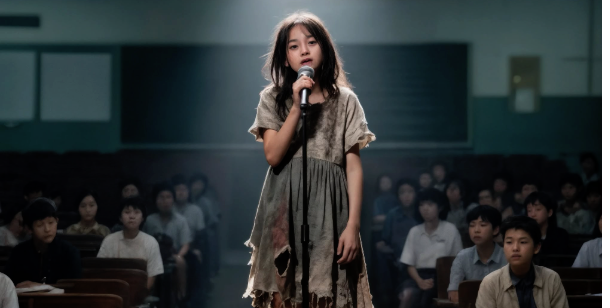
A poor girl was asked to sing at school so people could laugh at her… but her voice left the entire room speechless!
That morning, sunlight spilled across the cracked pavement of Winslow Elementary, casting long golden shadows that danced between faded hopscotch lines and rusty bicycles. Inside, the hallway buzzed with the usual Monday chatter: kids swapping lunches, gossiping about the weekend, and talking excitedly about the upcoming Talent Week. But in a quiet corner near the trophy case, one girl stood completely still, clutching a folded piece of paper to her chest.
Her name was Sophie Lane.
To most of the students, she was simply the girl with patched-up shoes and a secondhand backpack. The one who never raised her hand in class. The one who always ate alone near the gym doors, her eyes fixed on the notebook she never let anyone read.
But that day, something about her was different. She did not look taller, louder, or suddenly more popular. Yet in her eyes, usually soft and distant, there was a quiet fire, as if she had made a decision no one else knew about.
She stared at the sign-up sheet pinned outside the office. A long list of names: dancers, magicians, kids bringing karaoke tracks on USB sticks. And at the very bottom, she added her own. In neat, slanted handwriting:
“Sophie Lane – Singing (a cappella)”
Somewhere down the hall, laughter burst out.
“What? Sophie Lane? She’s going to sing?”
“I bet she’ll meow the lyrics. Or rap about cleaning houses!”
“Someone record it. This is going to be legendary.”
The mockery spread faster than paper airplanes. But Sophie did not react. She quietly walked away, her cheeks burning red, her fingers still wrapped tightly around the notebook filled with lyrics written in pencil and worn faint from being read so many times.
That evening, her mother found her in their tiny trailer bedroom, sitting cross-legged on a mattress barely wide enough for two. A cassette player hummed a lullaby softly in the background. Sophie was singing the words under her breath, almost too quietly to hear.
Her mother did not interrupt.
She simply listened.
Later, as the wind tapped gently against the window, her mother spoke without turning on the light.
“You know, sweetheart… when I was your age, I wanted to sing too. But I was too afraid. Too poor. Too… everything.”
Sophie whispered, “I’m afraid too.”
Her mother replied, “Then maybe it’s time someone sang anyway.”
No one at school knew what Sophie had been through — the nights without electricity, the early mornings spent sweeping flour off the bakery floor before sunrise. They never saw her practicing beneath streetlights when home was too noisy. They did not know the story behind the song she had chosen.
But soon, they would hear it.
And when the moment came — when a girl no one ever noticed stepped onto the school stage alone, with no music, no accompaniment, nothing but a single breath and her voice — the room fell into such deep silence that even the clocks seemed to stop…
A poor girl was asked to sing at school so people could laugh at her… but her voice left the entire room speechless!
Sophie didn’t have many friends. Her old school uniform, patched in every possible place, and her worn-out shoes made her an easy target for ridicule at Winslow Elementary. She usually sat in the back row of the classroom, quiet and withdrawn, yet her brown eyes always seemed to hide something deep within them, as if they carried songs she only dared to hum softly in her mind.
Before we continue Sophie’s extraordinary journey, if you also believe that a person’s true worth is not measured by appearance or background, but by passion and unwavering perseverance, then feel free to like and subscribe to the channel. Together, let’s share more inspiring stories. And now, let’s return to the story, where even more surprises are waiting ahead.
One Monday morning, the principal’s voice crackled over the loudspeaker: “Welcome to Talent Week. If anyone would like to volunteer for a performance, please write your name on the list outside the office before Wednesday.”
The classroom came alive at once. Some students bragged about their TikTok dances, while others planned to play piano or drums.
Sophie remained silent. But that evening, after washing dishes with her mother and listening to an old cassette her mother had once recorded of lullabies, she picked up a pencil and wrote her name on a small scrap of paper. She whispered, “I’ll sing that song. Mom, the one you used to sing when I was sick — *Scarborough Fair*.”
The next day, she stood motionless in front of the notice board outside the school office. Her hands were trembling.
The list was already long. Then, after taking a deep breath, she wrote her name on the very last line: Sophie Lane, singing.
Less than ten minutes later, giggles echoed down the hallway. Sophie had signed up to sing? This had to be some kind of joke. Maybe she’d sing into a rice cooker.
Sophie heard every word, but she didn’t cry. She simply lowered her head and walked away, clutching the little notebook where she had carefully written down the lyrics in her slanted handwriting. That evening, her mother found her practicing alone in her room, her voice trembling but clear as spring water.
“Window,” Sophie thought as the door opened gently so she would not be disturbed. Joanne said nothing and finally sat down beside her daughter. “You know,” she said softly, “I once dreamed of standing on a stage too.”
“But then my grandmother fell ill, and I had to leave school to take care of her. I never regretted it. But if I could see you stand on that stage today, it would be the greatest gift I could ever receive.”
Sophie looked up at her mother, tears gathering on her lashes. “Will you be there?” she asked.
Joanne nodded. “Even if I have to walk all the way to school.”
On rehearsal day, Sophie was the last to go. The music teacher asked briefly, “Do you have a backing track?”
“No, ma’am, I… I’ll sing a cappella.”
A sigh. A few eye rolls.
Still, Sophie straightened up, closed her eyes, and began: “Are you going to Scarborough Fair?” Her voice rang out on its own. No microphone, no instrument, no spotlight.
But within seconds, the room froze. The music teacher looked up. Another teacher, halfway through pouring a cup of coffee, stood completely still.
Sophie’s voice drifted like a light mist, reaching even the most closed hearts. When she finished, no one applauded. Not because they didn’t like it, but because they had forgotten what they were supposed to do after hearing something so raw, so fragile.
On the way home, Sophie asked her mother, “Mom, if people make fun of me, should I stop?”
Her mother smiled and gently squeezed her hand. “No, sweetheart. You keep singing, because the world needs to hear the voices that have never been heard.”
That morning, the yard at Winslow Elementary was packed.
Flags and decorations hung through both hallways, and a temporary stage in the auditorium was decorated with colorful balloons. The LED board flashed: *Winslow Elementary. Jolante, let your light shine.*
Sophie Lane arrived early. She wore a simple white dress, the only one left in her closet that was still intact. Her mother had carefully ironed every fold.
Her brown hair was neatly tied into two small braids. Her face was a little tense, but her eyes were determined. In her hands, she still held the faded notebook with the lyrics written inside.
Her mother stood beside her, holding her hand. Despite working nights at the bakery, she had done everything she could to be there. Her face looked pale from lack of sleep, but her eyes shone with pride.
The students went on stage one after another. There was a modern dance group with sparkling lights. A boy played electronic drums through a small speaker.
A girl in a pink dress sang pop songs with a wireless microphone. Every act was greeted with cheers from friends in the audience. Sophie sat alone in the waiting area.
No one spoke to her. A few sideways glances followed by soft giggles were thrown her way. Some whispered, “Just wait. The fairy-tale act is coming. I heard there won’t be any music. She’s going to sing? A cappella?” Then Sophie’s name was called.
“And finally,” the host announced, “we have a solo performance. With no background music at all, she will sing *Scarborough Fair*. Please welcome Sophie Lane.”
A few scattered claps. Some students pulled out their phones, ready to record it for fun.
One of them had even prepared a funny sticker to post on the school’s internal network. Sophie stepped onto the stage. From up there, she could not clearly make out the crowd.
The stage lights were too blinding. But she knew her mother was there, sitting in the third row near the window.
And that was enough to make her stand tall and take a deep breath. “Are you going to Scarborough Fair?” she began. “Parsley, sage, rosemary, and thyme…”
Her voice rose, gentle as wind moving through a meadow.
Simple, unpretentious, yet heartbreakingly sincere. At first, there were whispers, a few impatient looks, but little by little, the entire auditorium was wrapped in silence. A strange silence, born not of boredom but of complete captivation. The music teacher, who had been taking notes just moments before, lifted her head and set down her pen.
An elderly parent, with white hair and gold-rimmed glasses, slowly took off his glasses and wiped his eyes. Every word Sophie sang seemed to carry loss, hidden nights, silent anxiety, and unspoken dreams. No sophisticated technique, no flashy choreography.
Just a child singing with all her heart. When the final note faded, the room remained silent. Three seconds, then four.
Then a storm of applause broke out, not loud or showy, but filled with reverence. One person stood first — that same elderly parent — then another. Soon the entire auditorium was on its feet, applauding as if thanking something pure that had just passed through the room.
Sophie stood frozen, her hands clutching the hem of her dress, her eyes shining though not a single tear fell. The spotlight lit her face. She was no longer the “poor girl” everyone teased, but a young artist living her dream.
Below, her mother slowly rose, hand over her heart, eyes red but lips smiling. After the performance, just as Sophie stepped off the stage, a woman in a white blouse with a name badge approached her.
“You must be Sophie, right? I’m Clara Jensen, choir director of the City Children’s Choir. I came today because my daughter performed earlier, but you’re the one who made me want to come speak to you. Would you like to come to the studio for a vocal audition? There’s a special scholarship program.”
Sophie didn’t know how to answer.
She turned to her mother. Joanne nodded, her eyes shining. “Go on, sweetheart. That’s the voice the world has been waiting for.”
The following Saturday morning, Sophie Lane stepped into a professional recording studio for the first time — a space where every wall was covered in acoustic panels and soft ceiling lights cast a glow that felt both strange and magical. Outside, the downtown Amarillo traffic hummed like any ordinary day, but inside, everything seemed suspended in time.
Clara Jensen, the choir director who had invited Sophie, had come to pick up Sophie and her mother from the bus station. Clara was a woman in her fifties, with a gentle voice but piercing eyes. “Think of this session as a little adventure,” Clara said. “No need to panic. I just want to hear you sing the way you did that day.”
Sophie nodded, clutching her notebook full of lyrics as if it were a talisman. She wore an old white blouse and clean jeans, no makeup, no elaborate preparation — just herself, simple and sincere. Leo, the studio engineer, sat behind the glass, adjusting the microphone and headphones.
He had a salt-and-pepper beard and the calm restraint of someone who had listened to thousands of voices. But when he saw Sophie walk into the booth, he raised his eyebrows — not out of admiration, but surprise.
“That’s the kid?” he asked Clara over the intercom.
“Yes. Trust me, Leo. Let her sing.”
Sophie stepped up to the microphone. It was too high, so Leo lowered it to fit her height.
Clara entered the recording booth and gently placed a hand on Sophie’s shoulder. “You can sing *Scarborough Fair* again, or any other song you want.”
Sophie looked through the thick glass at her mother, who gave her a soft smile, then turned back to Clara. “I’ll sing that one. My mother’s song.”
No background music, just silence and the voice of a twelve-year-old girl rising inside the soundproof booth.
“Are you going to Scarborough Fair?” she sang.
Leo stood still.
Clara folded her arms, her expression softening. Sophie closed her eyes, and every word flowed like a warm breeze through a room accustomed to polished recordings. When the song ended, no one in the control room spoke for several seconds.
Then Leo leaned toward the microphone. “You’ve never had formal vocal training, have you?”
“No, sir.”
“And yet you know how to keep time, control your breathing, and deliver emotion without forcing it. Kid, your voice isn’t loud, and it isn’t perfect, but it’s real.”
Clara came back into the booth and gently took Sophie’s hand. “Do you know that *Scarborough Fair* is a folk song that’s several centuries old?”
“My mother sings it a lot,” Sophie replied.
“She says it’s a lullaby for dreamers,” Clara smiled. “Maybe that’s why your voice reaches people the way it does.”
That afternoon, Clara sent the recording to the admissions committee of the Emerson School of Music, where she served as an advisory member.
It was part of a partial scholarship program for young talents from rural areas. Only two students were selected each year.
“You don’t have to outdo anyone,” Clara told Sophie. “You just have to be yourself.”
Three weeks later, a pale blue envelope bearing the school’s logo arrived at Sophie’s temporary address. Joanne, her mother, opened it with trembling hands.
“Dear Sophie Lane, we are deeply impressed by your recording. With the unanimous approval of the selection committee, we are honored to invite you to join Emerson’s prestigious summer scholarship program this June in Austin. All tuition, travel, and housing expenses will be fully covered.”
Joanne could not hold back her tears, and Sophie simply stood there staring at the letter before whispering, “Mom, I got in.”
For the first time in her life, Sophie Lane no longer felt like she belonged in the last row.
In June, Austin’s sunlight shone like a sheet of gold spread across roads shaded by ancient oak trees. Emerson Conservatory stood modestly on top of a hill, its historic red-brick building decorated with hand-painted stained-glass windows. For many students, the program was simply a prestigious summer camp. For Sophie Lane, it was an entirely different world, overwhelming and delicate like a fragile dream.
On the first day, Sophie rolled her old suitcase into the dormitory, walking slowly among classmates in floral dresses, brand-name shoes, and embroidered bags. They came from New York, Los Angeles, and San Francisco. Some had vocal coaches since the age of seven.
Others had already sung in large halls or performed with international choirs. Sophie came from a trailer park in Lubbock, had never studied music or theory, and still kept her worn notebook of handwritten lyrics tucked inside her suitcase.
The opening orientation took place beneath a domed ceiling. Clara Jensen, the woman who had introduced Sophie to the program, spoke at the podium, her voice soft yet resonant:
“Here, we are not looking for perfection. We are looking for souls that tell stories through music. Remember, sometimes the simplest voice is the one people keep listening to the longest.”
But Sophie quickly realized those words did not fully reflect what was happening behind the scenes. The first workshop was on vocal anatomy.
The teacher handed out colorful diagrams of the throat, explaining the diaphragm, vocal folds, and resonance. Sophie was bewildered. She had never heard those terms before.
“Do you know if your voice is soprano or mezzo?” one girl asked.
“I… I have no idea.”
“You’ve never had vocal training?”
Sophie smiled awkwardly. “No, I just sing with my mother.”
That answer drew a few looks that made her feel like a handmade object in a high-tech showroom. A girl named Eliza, from an arts academy in Boston, whispered to her neighbor, “They should have chosen someone else this year.”
The days that followed were difficult. In harmony class, Sophie could not grasp music reading quickly enough. In vocal technique, she often lagged behind.
Once, she forgot the lyrics purely from nerves. Old wounds from the teasing at her former school resurfaced like reopened scars.
One night, Sophie sat alone on the dorm steps, staring at the dim courtyard lights. Clara appeared quietly, sat beside her, and placed two cups of mint tea between them.
“I don’t think I belong here,” Sophie murmured.
“Why do you say that?” Clara asked.
“I’m not like them. I don’t know anything about technique. I come from a place no one’s ever heard of.”
Clara looked at her gently. “Sophie, I was a country girl too. When I arrived at the conservatory, all I had was a shabby guitar and a voice. At first, people mocked my accent and my lack of music theory, but one teacher told me, ‘Technique can be learned. Emotion cannot.’ You bring something many people have forgotten — a reason to sing.”
Sophie stayed quiet. She had never thought that could be a strength.
A few days later, the class was assigned to prepare a solo for the final showcase. Eliza chose a complex Italian aria. Another student chose a Broadway musical number. Sophie chose a classic country song: *You Are My Sunshine*. The one her mother used to sing when they walked home in the rain, their hearts warmed by a simple cardboard box filled with leftover bread from the bakery.
When it was Sophie’s turn to step onto the rehearsal stage, several students looked at her in surprise. No backing track, no spotlight — just her. And that voice, rising light as a breath, soft as a memory, echoing through the silence of the room.
Eliza, sitting in the front row, stopped taking notes. One music teacher let out a long, quiet sigh, as if rediscovering some distant childhood memory. When Sophie sang the final line, “You make me happy, when skies are gray,” no one spoke, but everyone felt it.
She had reminded them all why music had the power to move people.
The final showcase at Emerson Conservatory took place at Willow Hall Auditorium, a historic 500-seat wooden concert hall. That day, a light rain fell over Austin.
Colorful umbrellas lined up outside the main gate. And inside, the atmosphere hummed with excitement. Parents, musicians, local journalists, and even talent scouts were in attendance.
Sophie Lane stood backstage, clutching a handwritten lyric sheet with “You Are My Sunshine” written on it. The dress she wore was a pale blue one, made by a teacher from two old blouses as a gift. Her hair was loosely pinned up, and around her neck hung a little sun-shaped pendant, the only gift her mother had given her on her tenth birthday.
Joanne, Sophie’s mother, sat in the fourth row. She wore a simple outfit, her hair slightly damp from the rain, her eyes fixed on the stage. She had taken the night bus from Lubbock, bringing along a small box of pastries and a hand-embroidered handkerchief with her daughter’s name on it.
As she entered the auditorium, she paused for a moment when she saw the other parents in suits and luxury watches, but she did not waver.
“My daughter is going to stand on that stage,” she thought, “and I will be the first to rise for her.”
The program opened with classical pieces, dazzling musical theater excerpts, and powerful voices trained for years. Each performance received a polite, measured ovation. Then the host announced:
“Next, a voice from Lubbock, Texas. Young Sophie Lane performing *You Are My Sunshine*.”
A faint murmur rippled through the hall. Some whispered, not expecting much from an old folk ballad. Sophie stepped onto the stage, her legs trembling slightly.
The lights blurred everything beyond her. She could not see her mother or Clara, nor make out the looks in the room, whether hopeful or doubtful. All she could hear was her heart pounding and the memory of a rainy day.
“You are my sunshine, my only sunshine…” Her voice rose, soft, low, and sincere, like a breath coming straight from the heart. Every word she sang was not merely a lyric, but a story: long nights without electricity, shared loaves of bread, being held in the rain while her mother sang in a trembling voice.
“You make me happy, when skies are gray…” The auditorium gradually fell silent. A parent in the third row placed a hand over their heart.
A student intern covered their mouth. Clara Jensen, seated near the back, lifted her eyes, lips pressed together, eyes wet. And when Sophie held the final note — “Please don’t take my sunshine away…” — one person stood up first.
It was Joanne. She did not clap. She simply stood there, hands pressed to her heart, as if telling the whole world, “That is my daughter, and I have heard her with my whole being.”
One second, then two, and then the auditorium erupted in applause. The applause came like waves, thunderous and sincere. Some quietly wiped away tears.
A journalist lowered his camera and cleaned his glasses. Eliza, the girl who had once looked down on Sophie, turned to her classmate and whispered, “I was wrong.”
Sophie bowed. This time, she was no longer trembling. She knew she had been seen — not because she was perfect, but because she was real.
The next morning, while Sophie and her mother were having breakfast in a small diner on the corner, Clara arrived holding an envelope.
“Congratulations,” she said. “The academy board held an emergency meeting last night. They want to offer you full admission to the year-round program starting this fall. No need to audition again.”
Joanne set down her fork, tears running down her cheeks. Sophie asked softly, “Can I bring my mother with me?”
Clara smiled. “If your mother is the reason you sing the way you do, then I think the school would be honored.”
Years later, during a television interview, the host asked Sophie Lane, now a well-known singer-songwriter, “What moment changed your life the most?”
Sophie did not hesitate. “It was the moment my mother stood up in the middle of the crowd. When no one else knew who I was, she did — and that was enough for me.”
And that is how Sophie Lane’s story ends: from the last row to the spotlight, from an ignored voice to one that left hundreds of people in awestruck silence.