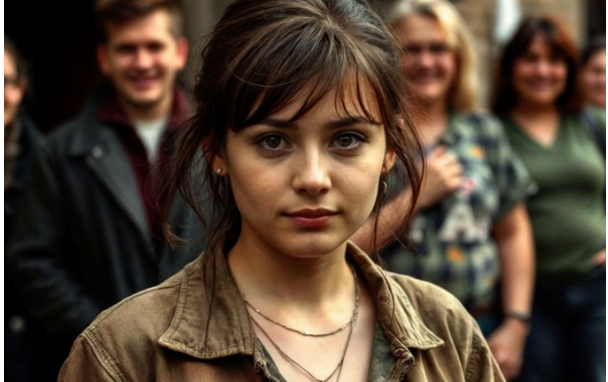
My husband’s family humiliated me because they thought I was poor, but they had no idea I was a millionaire’s daughter pretending to be ordinary.
“Darling, you have no idea who I really am,” Anna said softly, staring at the ceiling.
“You’re the best thing in my life,” Vadim murmured sleepily as he held his wife close.
If only he had known how prophetic those words would turn out to be. Anna gave a faint smile as she thought back to how it had all begun — how, as a millionaire’s daughter, she had decided to conduct the boldest experiment of her life.
Their first meeting had felt like something out of a movie. At the time, she was already working at the neighborhood library, playing the part of a simple provincial girl. Vadim had come in looking for scientific books — he was preparing for his thesis defense. He was disheveled, wearing worn jeans and a shirt stained with coffee.
“Excuse me, do you have anything on quantum physics?” he asked, squinting.
“Third shelf, top row,” Anna replied, suppressing a smile. “But you’ll need a ladder.”
“Maybe you could help me? I feel like I’m about to knock everything over.” He scratched his head awkwardly.
That was how their romance began — among falling books, awkward jokes, and conversations that lasted until the library closed. Vadim turned out to be a simple man with a sharp mind and an incredible sense of humor. He could talk for hours about his scientific research, then suddenly crack a joke that made Anna burst out laughing.
He proposed to her six months later, in that same library.
“You see,” he said nervously, fiddling with a box holding a cheap ring, “I know I’m not rich. But I love you. And I promise I’ll do everything I can to make you happy.”
Anna said yes, though she felt guilty. But the experiment mattered too much — she wanted to understand how society reacts to a woman with no status and no money.
The first warning signs appeared at the wedding. Vadim’s mother, Elena Petrovna, looked at Anna as if she were a bug on the celebration cake. Anna understood that not everyone was the same, but somehow she had ended up with a particularly unpleasant in-law family.
“Is that really the best you could wear?” Elena asked, scanning the bride’s simple white dress.
“Mom!” Vadim interrupted.
“What, ‘Mom’? I’m worried about you! You could have found a better girl. Like Lyudmila Vasilyevna’s daughter…”
“The one who ran off with a fitness coach last year?” Vadim’s sister Marina sneered. “Even she would have been a better choice.”
Anna smiled silently, making notes in her research journal: *Day one: classic display of social discrimination based on presumed financial status.*
A month after the wedding, Vadim’s aunt, Zoya Alexandrovna, joined in trying to “educate” the new bride — a woman whose favorite hobby seemed to be interfering in other people’s lives.
“My dear,” she said sweetly, “do you at least know how to cook? Because Vadim is used to good food.”
Anna, who had studied cooking with top chefs in Paris, nodded humbly.
“I’m learning little by little.”
“Oh, what a tragedy,” Aunt Zoya exclaimed. “Let me write down my meat recipe for you. Though can you even afford the ingredients? They’re expensive these days…”
That evening, Anna wrote in her notebook: *First month: financial pressure used as a tool of social control. I wonder how quickly their tone would change if they knew my annual income.*
Vadim tried to defend his wife, but weakly, as if he were afraid to upset his family.
“Darling, don’t pay attention to them,” he would say. “They’re just worried.”
“About what? That I’ll spend your whole budget?” Anna would reply sarcastically.
“No, it’s just… you know, they want what’s best for me.”
“And I’m not what’s best?” In those moments, she wanted to shout the truth, to show them her bank statements — but she held back.
By the end of their first year of marriage, the mockery had reached its peak. At Vadim’s birthday party, Elena Petrovna once again outdid herself.
“And you, Anechka, what did you give your husband for his birthday?” she asked, looking disdainfully at the simple wristwatch.
“What I could,” Anna answered quietly, thinking of her collection of Swiss watches in her London apartment.
“Of course, of course… the important thing is love, right? But love is fine, yet a man needs status. Marina gave her Kolya a car for his birthday.”
“Bought on credit with outrageous interest rates, which Kolya himself will have to repay,” Anna muttered — but no one heard her.
That evening, alone, she took out her notebook and wrote: *First year. Interim conclusion: social pressure intensifies in proportion to the length of contact. I wonder how much longer I can continue this experiment before it destroys my marriage.*
She had no idea that the answer to that question would come very soon.
“My darling, you can’t even imagine who I really am,” Anna murmured, staring at the ceiling. “You’re the best thing in my life,” Vadim mumbled sleepily, wrapping his arms around his wife. If only he had known how prophetic those words would turn out to be. Anna gave a faint smile, remembering how it had all begun—how she, the daughter of a millionaire, had decided to carry out the boldest experiment of her life.
Their first meeting had felt like something out of a movie. She was already working at the neighborhood library, playing the role of a modest girl from the provinces. Vadim had come looking for scientific literature—he was preparing to defend his thesis. He was tousled, dressed in worn jeans, with a coffee stain on his shirt.
“Excuse me, do you have anything on quantum physics?” he asked, squinting.
“Third shelf, top row,” Anna replied, holding back a smile. “But you’ll need a ladder.”
“Maybe you could help me?” he said, scratching the back of his head awkwardly. “Otherwise I feel like I’m going to knock everything down.”
That was how their romance began—among falling books, clumsy jokes, and conversations that lasted until the library closed. Vadim turned out to be a simple man with a sharp mind and an incredible sense of humor. He could talk for hours about his scientific research, then suddenly crack a joke that made Anna laugh until she cried.
He proposed to her six months later, in that very same library.
“You know,” he said, nervously fiddling with a box holding a cheap ring, “I know I’m not rich. But I love you. And I promise I’ll do everything I can to make you happy.”
Anna said yes, feeling a stab of guilt. But the experiment mattered too much—she wanted to understand how society treated women with no status and no money.
The first warning signs sounded at the wedding. Vadim’s mother, Elena Petrovna, looked at Anna as if she were a cockroach on a праздничный cake. Anna understood that not all people were like that, but she had somehow ended up with an especially unpleasant in-law family.
“Is that really the best thing you could find to wear?” she said, examining the bride’s simple white dress.
“Mom!” Vadim snapped.
“What do you mean, ‘Mom’? I’m worried about you! You could have found a better girl. Look at Lyudmila Vasilyevna’s daughter…”
“The one who ran off with her fitness trainer last year?” Marina, Vadim’s sister, snorted. “Even she would have been a better match.”
Anna smiled silently, mentally taking notes in her research journal. *Day one: a classic display of social discrimination based on presumed material status.*
A month after the wedding, Vadim’s aunt, Zoya Alexandrovna—a woman whose greatest hobby was visiting government service offices—joined in the “education” of the new bride.
“My dear,” she said sweetly, “do you at least know how to cook? Because dear Vadim is used to good food.”
Anna, who had learned cooking from the best chefs in Paris, nodded modestly.
“I’m learning little by little.”
“Oh, what a pity,” Aunt Zoya said, waving her hands. “Let me give you my meat recipe. But will you be able to afford the ingredients? They’re expensive these days…”
That evening Anna wrote in her journal: *Month one: financial pressure is being used as a tool of social control. I wonder how quickly they would change their tone if they knew my annual income.*
Vadim tried to defend his wife, but he did it weakly, as if he were afraid to stand up to his family.
“Darling, don’t pay attention,” he would say. “They’re just worried.”
“Worried about what? That I’ll spend your whole budget?” Anna laughed.
“No, just… you know, they want what’s best for me.”
“And I’m not what’s best?” At moments like that, she wanted to shout the truth, to show them her bank statements, but she held herself back.
By the end of their first year of marriage, the mockery had reached its peak. At Vadim’s birthday, Elena Petrovna outdid herself.
“And what did you give your husband for his birthday, Anechka?” she asked, looking at the modest wristwatch.
“What I could,” Anna answered softly, remembering her collection of Swiss timepieces in her London apartment.
“Yes, yes…” her mother-in-law drawled. “Love is the main thing, of course, isn’t it? Though love is love, but a man needs status. Look, Marinka gave Kolya a car for his birthday.”
“A car bought on credit at outrageous interest rates, which Kolya will be the one paying off,” Anna muttered under her breath, but no one heard her.
Alone that evening, she took out her journal and wrote: *Year one. Interim conclusions: social pressure intensifies in direct proportion to the length of contact. I wonder how long I can continue this experiment before it destroys my marriage.* She had no idea that the answer would come very soon.
In the second year of their marriage, Vadim got a promotion. He was now running a small department in an IT company, and his relatives acted like unleashed hounds.
“My son, now you have to live up to your status,” Elena Petrovna chirped, openly examining the worn wallpaper in their rented apartment. “Maybe you should think about changing… the setting?”
Anna imagined pulling out her platinum card and buying a penthouse in the city center. But instead she simply shrugged.
“We’re fine here.”
“Of course you are,” Marina, Vadim’s sister, sniffed. “You’re used to… simplicity.”
*Day 748 of the experiment,* Anna wrote that evening in her journal. *Social status continues to be the main criterion by which a person is judged. Even a slight increase in one family member’s income causes a sharp rise in demands placed on the other, less wealthy one.*
Everything changed on a rainy Tuesday. Aunt Zoya brought another “suitable girl” to their home—the daughter of an important man in the district.
“Vadimushka, meet Verochka,” she sang out, pushing forward a heavily made-up blonde. “By the way, she has her own real estate agency!”
Anna froze, a cup of tea in her hand. She could endure a lot, but this…
“I’m shocked myself!” Vadim said, looking at her in confusion.
“And what about Anna?” Zoya Alexandrovna threw up her hands. “She’ll understand! You need to think about your future!”
Verochka giggled.
“Yes, and by the way, I have some excellent apartments I could show you… privately.”
That was the last straw. Anna stood up, straightened her shoulders, and declared:
“I think it’s time for a family dinner. This Friday. I’m inviting all of you.”
Friday came both too quickly and unbearably slowly. Anna prepared for that evening as if for a theater premiere. She pulled her favorite designer dress out of hiding, put on her family diamonds, and called her personal chef—for the first time in two years.
The relatives arrived in full force, expecting yet another chance to mock the poor daughter-in-law. Elena Petrovna had even brought along her friend Lyudmila Vasilyevna—apparently as a spectator for the show to come.
“Oh, we have guests!” Anna exclaimed as she opened the door. “Come in, I just ordered dinner from a restaurant.”
“Ordered?” Marina narrowed her eyes. “And where did the money come from?”
Anna smiled mysteriously.
“You’ll know everything in good time.”
When everyone was seated around the table—an antique rosewood table specially rented for the occasion—a true theater of the absurd began.
“And what kind of wine is this?” Aunt Zoya sniffed at her glass. “It doesn’t look like our Krasnodar wine…”
“An excellent vintage, 1982,” Anna said casually. “Dad brought it from his wine cellar.”
Silence fell over the dining room. You could have heard a fly trying to cross the stained-glass window.
“What dad?” Elena Petrovna stammered. “You said you were an orphan…”
“Oh, that’s the most interesting part,” Anna said, rising with her glass in hand. “You see, for the past two years, I’ve been conducting a social experiment. I’ve been studying how society treats women without visible wealth or social status. And I have to say, the results have been very… informative.”
She paused, watching as the color slowly drained from her in-laws’ faces.
“My father is a millionaire,” Anna continued, savoring the moment. “And all this time I’ve been living modestly to see how you would treat me if I didn’t meet your standards.”
Vadim stared at her with wide eyes.
“Anna, what…”
“But now,” she cut him off, “the experiment is over. And I think we all need to discuss how we’re going to live from now on.”
The silence in the room was broken only by the ticking of the expensive clock on the wall. Anna smiled, knowing her words had changed everything.
She paused. A silence so deep settled over the dining room that one could hear Lyudmila Vasilyevna’s dentures creak.
“The truth is, I am Anna Sergeyevna Zakharova. Yes, that very Zakharova. My family owns the ZakharGroup. Perhaps you’ve seen our offices—that huge glass building in the city center.”
Elena Petrovna turned so pale it looked as though she might merge into the tablecloth.
“And we also own a chain of five-star hotels,” Anna continued, savoring every word. “And by the way, that real estate agency where your Verochka works—it’s ours too. Dad bought it last year… as you like to say, he was ‘thinking about the future.’”
Marina tried to say something, but it came out more like a strangled squeak.
“And do you know what?” Anna swept her gaze over the frozen relatives. “During those two years, I gathered incredible material for my book. *Social Discrimination in Modern Society: An Inside View.* I think it’s going to make quite a splash in academic circles. Most people, meanwhile, treat someone like me very well. They help, give useful advice. But your little family is a fascinating anomaly.”
Vadim sat there gripping the arms of his chair. His face looked like Munch’s *The Scream*.
“You… all this time…” he began.
“Yes, darling. I wasn’t who I pretended to be. But my love for you was the only thing that was real.”
“And how…” Elena Petrovna finally found her voice, “how did you endure all those humiliations? You could have stopped us at any time…”
“Stopped you?” Anna smiled. “Of course I could have. But then the experiment would have lost its purity. Besides, you can’t imagine how amusing it was to listen to your conversations about how I didn’t deserve your son, while my annual income exceeds the value of all your property combined.”
Lyudmila Vasilyevna choked on her wine and started coughing. Aunt Zoya nervously clutched her Gucci bag—a fake, as Anna had noticed long ago.
“But the most interesting part,” Anna said, turning to her husband, “is that you, Vadim, were the only one who loved me for who I am. Without money, without status, without—”
“Without the truth,” he interrupted, getting up from the table. “Excuse me, I need some air.”
He walked out, leaving Anna standing there with her half-full glass. A dead silence hung in the dining room, broken only by Marina’s muffled sobs and the rustle of Aunt Zoya’s napkin.
*Day 730 of the experiment,* Anna noted mentally. *Result achieved. Cost… still to be determined.*
Three weeks after the “truth dinner,” Vadim did not come home—he spent the nights at a friend’s place, taking only the essentials with him. The relatives scattered as if they had never existed. Only Marina occasionally sent pleading messages on VK: “Annechka, maybe we could meet? I’ve been thinking…”
Anna did not reply. For the first time in two years, she allowed herself to be herself—ordering food from her favorite restaurants, working on her book on her expensive computer, which she had hidden in the attic all that time, and suffering. Dear God, how she suffered.
“You know what’s funny?” she said to her assistant Katya, the only person who had known the truth from the start. “I really did fall in love with him. Truly.”
“And he fell in love with you,” Katya shrugged elegantly, stirring sugar into her cappuccino. “Otherwise he would’ve come back for the money already.”
They were sitting in Anna’s favorite café—a tiny place on the rooftop of the ZakharGroup skyscraper. From there, the whole city looked like a toy, including their rented apartment in an ordinary residential district.
“Dad called yesterday,” Anna said with a sad smile. “He said I was crazy. That I could have simply written an article based on other people’s research.”
“And what did you say?”
“I told him that was exactly the problem—everyone writes based on other people’s stories. No one wants to live them themselves.”
Katya finished her coffee and suddenly asked:
“Listen, if you could go back in time… would you change anything?”
Anna thought for a moment, looking down at the city below.
“You know… probably, yes. I would have told him the truth. Not right away, but… definitely before the wedding.”
Vadim appeared suddenly—he simply rang the bell of their rented apartment at seven in the morning. Anna opened the door wrapped in a Valentino silk robe—she was no longer hiding—and froze. She still hadn’t moved into the expensive apartments. She had been waiting for him.
“Hi,” he said hoarsely. “Can I come in?”
He had lost weight, with shadows under his eyes. Anna stepped aside silently and let him in.
“I’ve been thinking…” Vadim began, nervously playing with his keys.
“Twenty-three days,” Anna interrupted.
“What?”
“You’ve been thinking for twenty-three days. I counted.”
He gave a faint ironic smile.
“And was that part of the experiment too? Counting the days of our separation?”
“No,” she shook her head. “That was part of love.”
Vadim sat down on their old sofa—the one they had bought at IKEA, even though Anna could have afforded furniture made of solid rosewood.
“Do you know what I realized during those days?” he asked, staring at the floor. “I tried to remember a moment when you had not been sincere with me. And I couldn’t.”
Anna sat down beside him, still keeping some distance.
“Because I never pretended in the things that mattered. Only in the small things.”
“The small things?” he laughed bitterly. “You call being the heiress to a multimillion-dollar fortune a small thing?”
“Yes!” she suddenly flared up. “Because the money is not me! It isn’t even my achievement—I was simply born into a rich family. And you loved the real me—the one who laughs at your stupid jokes, the one who loves science fiction, the one who…”
“The one who kept a journal for two years, recording every humiliation my family put her through,” he finished softly.
Anna turned to the window, trying to gather her thoughts. The first rays of sunlight were pushing through the barely drawn curtains they had chosen together in a cheap store. Cheap, but loved.
“You know,” she began quietly, still looking at the waking city, “when I was sixteen, I had a best friend. An ordinary girl from the neighborhood. We would talk for hours about everything and nothing, share secrets. Then her mother found out who I was…” Anna smiled bitterly. “A week later she started hinting that it would be nice if I took her daughter to Europe on vacation… just because I could afford it.”
She turned to Vadim, tears shining in her eyes.
“I didn’t want our story to begin with money. I wanted to be sure that someone could love me for me. Stupid, right?”
She thought of the way her father’s business partners flattered him, the way her classmates in London split people into “us” and “them” depending on the size of a bank account… She wanted to prove that something genuine really existed. That it wasn’t just an invention.
“And did you prove it?” he asked, his voice no longer bitter, only tired.
“Yes. But do you know what I realized?” She moved closer to him. “There are things more important than any experiment. Like trust.”
Vadim finally looked up.
“And now?”
“Now…” Anna pulled a thick notebook out of her bag—her research journal. “Now I want to burn it. To hell with science, to hell with experiments. I just want to be with you.”
He looked at the journal for a long time.
“And your book?”
“I’ll write a new one. About how I almost lost the most important thing in my pursuit of scientific glory.”
Vadim picked up the journal.
“You know, I realized something too during those days. I wasn’t angry because of the money. I was angry because I thought all of it was fake.”
“But it wasn’t,” Anna said softly.
“I know. Now I know,” he said, suddenly smiling. “By the way, what about your stupid jokes?”
She laughed through her tears.
“Well, for example, your favorite one about the theoretical physicist and Schrödinger’s cat walking into a bar…”
“Who is both drunk and sober until the bartender checks his passport!” Vadim joined in, and they laughed together, just like in the beginning.
An hour later, they were sitting in the kitchen, drinking instant coffee—even though Anna had the keys to a penthouse with a professional coffee machine in her purse—and discussing the future.
“So, do we start over?” Vadim asked.
“Yes. But this time without secrets. And you know what? Let’s stay here, in this apartment.”
“But you could…”
“I could,” she nodded. “But I don’t want to. This is where our story began. Let’s continue it here. I’ll do a nice renovation, and we’ll live here at least another year.”
Vadim smiled.
“And what about Mom? Marina? Aunt Zoya?”
“Oh, they won’t be able to avoid me now,” Anna narrowed her eyes mischievously. “They’ll come to family dinners and eat the simplest food. No wine worth thousands of dollars.”
“Cruel,” he laughed.
“But honest.”
The doorbell rang—it was Marina with a huge cake and a guilty expression.
“Annechka, I’ve been thinking…” she began with a prepared speech.
“Come in,” Anna interrupted. “Would you like some instant coffee?”
Marina blinked in confusion, but nodded. And Vadim, watching this, understood that everything would be all right. Because true love is not in expensive wine or designer clothes. It is in the instant coffee you drink with your loved ones in a small rented apartment.
And this was no longer an experiment.
It was life.