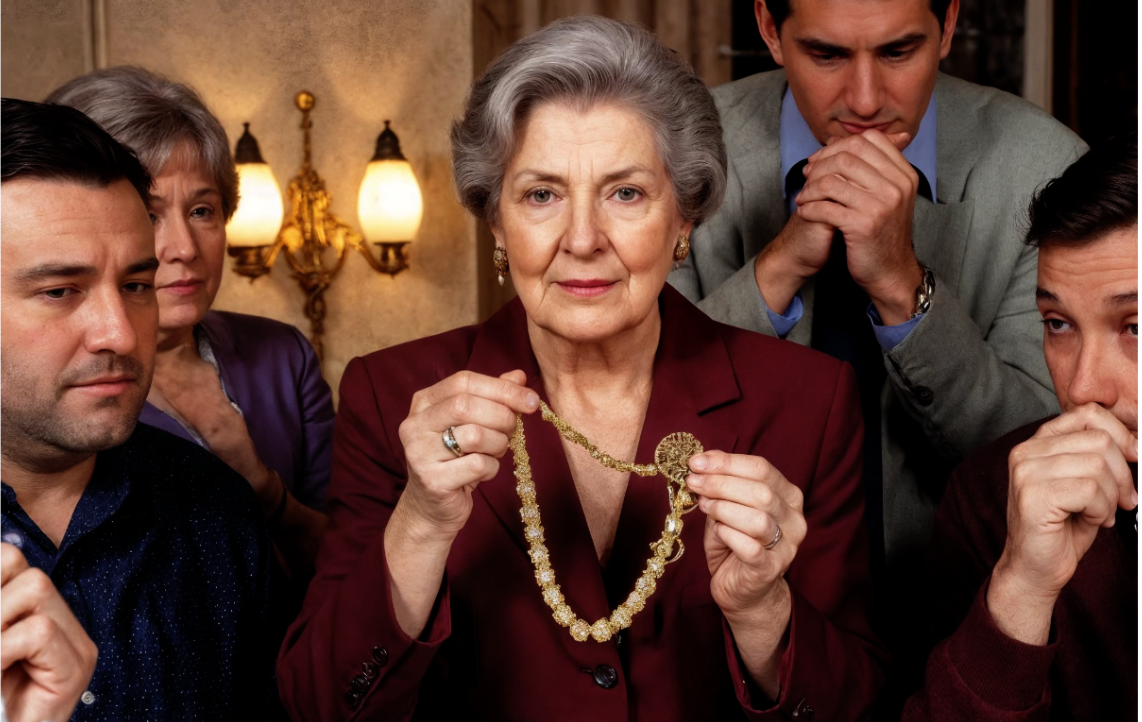
I gave my mother a necklace worth 1.5 million for her anniversary — and she humiliated me in front of everyone. My response was so final that there was no one left to humiliate.
Larisa Petrovna raised her glass of champagne, and I immediately knew something was wrong. It was in the way she straightened her back, the way she narrowed her eyes as she looked at me across the table.
The guests fell silent — about fifteen people, all close acquaintances: fellow teachers, neighbors, distant cousins. The necklace lay in front of her on the velvet, the gold and large topazes shimmering under the chandelier. I had been putting money aside for that gift for five years. Five years of giving up vacations, a car, a normal life. Because she wanted that exact necklace. Vintage, collectible, like something from old catalogues. A symbol of status, as she called it.
She took her time, the way she always did when she wanted every word to hit its target.
“Thank you, Dmitry. A magnificent gift. Except you’ve always believed you could make up for years of your… soulless absence with a piece of gold.”
I froze. Around us, the silence became so deep that we heard someone awkwardly set down a fork.
“The real treasure is my nephew Sasha,” she said, nodding toward him, and he lowered his eyes, hiding a satisfied smile. “At least he appreciates me while I’m alive, not just as a picture in a jewelry catalogue. He comes by just because he wants to, for no reason. But you… you show up once a month for two hours, sit there as if you’re on pins and needles, and run away at the first chance.”
Someone snickered. The neighbor, Aunt Zina, nodded with compassion — for my mother, of course, not for me.
I stood up without looking at anyone and went out onto the balcony to smoke. My hands weren’t shaking. Inside, there was only emptiness — pure, icy, almost freeing.
The guests left around midnight. Larisa Petrovna left the box with the necklace on the living room dresser — she probably wanted to admire it again in the morning. I waited until she went to bed, took the box, and left the apartment without a sound.
The calls started two hours later. I didn’t answer. In the morning, I returned to my city and waited.
She didn’t keep me waiting long. She called my workplace, and the HR manager, Valentina Mikhailovna, passed on the message: my mother said I was unstable, that I had stolen a family heirloom. Then a photo appeared on social media: Larisa Petrovna holding an empty jewelry box, looking devastated, with the caption: “A mother’s heart cannot be bought with stones. I pray my son comes to his senses.” In the comments, Sasha supported her, pitied her, and showered me with insults.
I looked at the screen and thought: she doesn’t regret her words. She regrets losing control.
Three days later, she ended up in the hospital with a hypertensive crisis. She posted a selfie in a robe, under an IV drip: “My family wishes illness upon me. But I forgive.”
I came. Not to return the necklace. To answer.
She was lying alone in the room, pale, with a triumphant glimmer in her eyes. She thought I had come to apologize.
“Dmitry, finally. I knew you would come to your senses. Give back the necklace, and we’ll forget this foolishness.”
I sat down on the chair beside the bed and looked her straight in the eyes.
“I won’t be coming back. And neither will the necklace. Do you know why? Because you never needed it. What you wanted was a scene. A public humiliation. To show everyone what a bad son I am, and what a martyred mother you are.”
She tried to interrupt me, but I continued without raising my voice.
“For five years, I lived on bread and pasta to buy you that gift. You knew that. And still, in front of everyone, you called me a heartless son. And you called Sasha your treasure. The same Sasha who only visits you when he needs money. Who calls you once every six months, and even then, only to ask for something. But he knows how to flatter you, doesn’t he? Unlike me. I don’t know how to do that. I only worked and saved for your dream, like an idiot.”
Larisa Petrovna turned even paler.
“You… you have no right to speak to me like that! I’m your mother!”
“You were my mother. Now you’re just a woman who believes that giving birth to a child gives her the right to humiliate him for the rest of his life. I’m going to sell the necklace. And I’ll spend the money on myself. For the first time in forty-two years. On my own life, not on your approval.”
I stood up. She reached out and tried to grab my sleeve, but I pulled away.
“Dmitry, wait! You can’t just leave like this! I’m in the hospital!”
“You can call Sasha. After all, he’s the real treasure.”
I walked out without looking back. In the corridor, my hands finally began to tremble, but not from fear. From relief.
Over the following weeks, I prepared to leave. I sold my apartment quickly, gathered my things, and found a house on the banks of the Volga, in a quiet little town where nobody knew me.
Larisa Petrovna called from different numbers, wrote messages, sent furious texts, then tearful ones. I didn’t reply.
Sasha appeared too. He wrote: “Are you completely insane? Mom almost died because of you, and you’re playing the victim. Give back the jewelry while I’m still asking nicely.” I blocked him and deleted all my social media accounts. Whatever they were saying out there no longer interested me.
I learned what I call “karma” by chance, six months after I moved. An old neighbor called me, the one who had been sitting at the table during the anniversary.
“Dmitry, have you heard about Sasha?” His voice dripped with satisfied malice. “He borrowed a large sum from your mother, supposedly for a business. He promised to return it within a month.
“Six months have passed — no money, no Sasha. He doesn’t answer his phone and has moved out of his apartment. Your mother complains to everyone that she was deceived, that she trusted the wrong person. Remember how she humiliated you in front of everyone while praising him? Well, there’s your treasure.”
I listened in silence. I wasn’t happy. I wasn’t gloating. I simply accepted the information as a fact.
“She was looking for your address,” the neighbor added. “She wanted to come see you, to talk. But no one told her where you moved.”
“Don’t tell her,” I asked him. “Please.”
He was silent for a moment, then sighed.
“All right. Take care of yourself out there.”
The house welcomed me with a silence I hadn’t heard in years. I adopted a dog from a shelter, an old greyhound named Marshall, whom nobody wanted because of his age. In the mornings, we walked slowly down to the river, enjoying the peace.
At the local cultural center, they asked me to hold financial literacy workshops for retirees — I agreed. They came in small groups of ten, listened attentively, and thanked me without flattery. Simply. Humanly.
One morning, as I was drinking coffee on the porch, I received a message from an unknown number: “Dmitry, it’s Mom. I’ll soon be turning eighty. Sasha disappointed me; he didn’t live up to my hopes. Maybe I was wrong that day. I’d like to see you and talk.”
I read the message, finished my coffee, and deleted it. Not out of hatred, and not out of revenge. Simply because I no longer wanted to return to that life where love had to be bought, approval had to be begged for, and I had to feel forever indebted.
I had learned to live differently — without guilt, without having to be perfect for someone who saw me only as a way to make herself look important.
Marshall came over and rested his head on my knees. I scratched behind his ear and looked at the river, at the morning mist above the water. This was my life now. Mine. And it was more than enough.
If you enjoyed this story, leave a like, a comment, and subscribe!