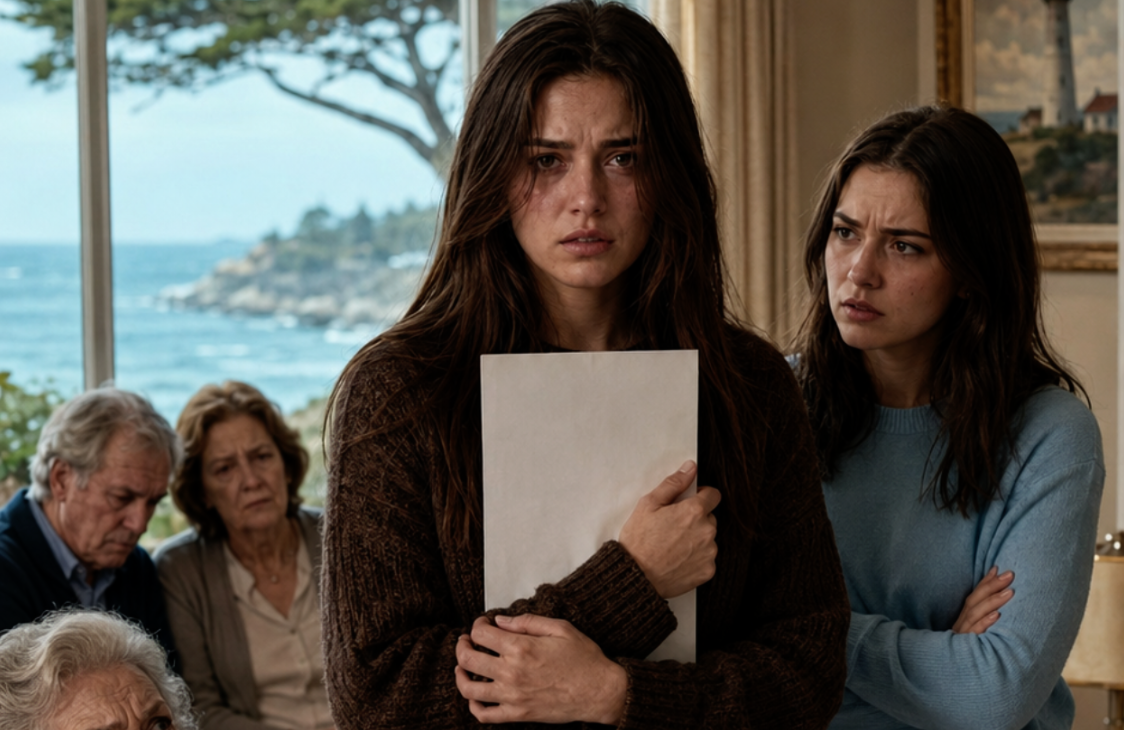
“We’ll put the seaside house in Liza’s name. She has little children,” my mother-in-law declared, forgetting that my mother had bought it.
The morning began with the smell of cypress trees and roof tiles warmed by the sun. I stood on the veranda, my hands wrapped around a warm ceramic mug, watching the waves lick the sand right by the fence. At moments like that, it felt as though life had finally taken pity on me and given me a pause. The house breathed with me — the floorboards creaked softly, the refrigerator hummed somewhere in the kitchen, and seagulls cried outside the window. My mother used to say this house would become my nest. A nest where I could exhale after all my losses and believe again that I had a future.
Andrey was busy by the grill, shifting the coals around and whistling something under his breath. I looked at his broad back, at his tanned arms, and thought that we were almost happy. Almost. Because soon a minibus was supposed to arrive, and inside it would be my mother-in-law with Liza’s children. And then the silence would end.
When the white van appeared in the driveway, I set my mug on the railing and went to greet the guests. Andrey wiped his hands on a towel and stood beside me, slightly tense, though he tried not to show it.
The first to jump out of the car was my mother-in-law, Irina Borisovna — short, sturdy, with perfect hair and a sharp, penetrating look. She glanced around the yard as if she had come to inspect the work of careless builders. Then Liza unloaded the children — Styopa, who had recently turned three, and eight-month-old Anechka in a baby carrier.
“Hello, my dears,” Irina Borisovna sang. “Goodness, it’s stuffy here. Didn’t you turn on the air conditioner? It’s bad for children, but you still need to air the place out.”
“Hello, Irina Borisovna,” I kissed my mother-in-law on the cheek, feeling the sugary scent of her perfume. “It’s cool inside. The shutters are closed.”
“Good,” she said, already marching toward the porch, leaving me no choice but to step aside. Liza smiled apologetically, adjusting the strap of the carrier. In her eyes was the same exhaustion as always. Liza’s husband disappeared on sea voyages for months at a time, and she lived as if she were constantly waiting.
We settled in the living room. I had prepared lunch — a light seafood soup, salad, and baked fish. My mother-in-law examined the table and nodded approvingly.
Over lunch, we talked about trivial things. The weather, how the children were growing, gas prices. Andrey talked about a new project at work, Liza silently fed Anechka with a spoon, and I watched Styopa enthusiastically chase an olive around his plate, feeling a familiar dull ache somewhere beneath my heart.
When dessert was finished, Irina Borisovna pushed her plate away and swept a long, proprietary look around the living room. She looked at the fireplace, at the staircase leading to the second floor, at the painting of the lighthouse that my mother had hung above the sofa on the day of the housewarming. Then she sighed and said:
“A good house. Solid. Plenty of room here for children.”
I nodded, still not sensing the trap.
“It’s right that we’ll put it in Liza’s name,” she continued calmly, as if we were discussing the purchase of a new washing machine. “While the little ones are still growing up. You and Andryusha won’t be alone forever. Liza has two children, they need it more. Family doesn’t abandon its own.”
I froze with the plate in my hands. My temples started pounding. For a few seconds, it seemed to me that I had misheard her, that the waves outside had distorted her words, that it was a bad joke.
“What did you say?” My voice sounded muffled, as if through a pillow.
“I said,” my mother-in-law looked me straight in the eyes, not a single muscle twitching in her pupils, “that the house should be transferred to Liza. She has little children. You and Andrey will buy yourselves another one, or you can live here too, what difference does it make? Liza will feel calmer. And in general, it’s the right thing to do as relatives.”
I lowered the plate onto the table. My hands were shaking. Andrey sat beside me, silently pouring tea for his mother. His face was completely calm, as if we were discussing where to put a flowerpot. Liza froze, staring at the tablecloth, and I noticed how white her knuckles had become.
“Irina Borisovna,” I tried to speak evenly, but my voice betrayed me and broke, “my mother bought this house. Not Andrey and I. Not you. My mother. She sold her apartment so this house could exist. You forgot that.”
Silence hung over the table. Even Styopa stopped dragging his spoon across the plate and stared at the adults. My mother-in-law slowly took a sip of tea and smiled at me with that condescending smile reserved for spoiled children.
“Katyusha, my dear,” she set the cup on the saucer and folded her hands in front of her, “what does money have to do with it? We’re talking about loved ones. About family. Are you really against children?”
That phrase hit me in the stomach. I felt the blood drain from my face.
“Liza has babies,” my mother-in-law continued, and every word struck its target precisely, “while you, for now… well, for now there are just the two of you. You’re an adult, self-sufficient woman, successful, working from home and earning money. But Liza is practically a single mother while her husband is off at sea. She won’t get a mortgage. And here there’s a ready-made house. We’re one family. Or are you against children?”
She repeated it again, and I heard the hidden hiss in her voice. “You’re against children.” Me, who had survived three miscarriages. Me, who looked at a pregnancy test every month with hope and terror. Me, who cried in the bathroom while Andrey slept so I wouldn’t wake him. “You’re against children.” It was a blow below the belt — precise and merciless.
“Mom, maybe not now?” Liza spoke up, but my mother-in-law waved her off.
“When, then? When she throws us all out of here? I love Katya like a daughter, but understand, my girl,” she turned to me again, and now her voice oozed sugary poison, “your mother is a wise woman, she’ll understand. In the past, everything was shared anyway, families lived under one roof, and no one counted what belonged to whom. Your mother didn’t help you personally, she invested in the family.”
I rose from my chair. My legs were weak, but I forced myself to stand straight. Everything inside me was boiling, but I knew: if I screamed, I would lose. That was exactly what my mother-in-law was waiting for — emotions, tears, hysteria. Then she would say, “See? Her mind isn’t right. How can she own a house?”
“Excuse me, I need some air.”
I walked out onto the veranda and closed the door behind me. The evening sun gilded the tops of the cypress trees. The sea breathed steadily and calmly, as though nothing had happened. I leaned on the railing and inhaled deeply.
She had said it over lunch, in front of everyone, in an ordinary tone. She had said it as if we were talking about rearranging furniture. And no one objected. Andrey silently poured her tea.
I remembered the day my mother came to our rented apartment a year and a half earlier. It was November, gray and damp. I had been lying in bed for the third week after another loss. I couldn’t work, couldn’t eat, couldn’t look Andrey in the eyes. He was caring, but I saw something in his gaze that frightened me more than my own pain — disappointment. Or maybe it only seemed that way to me then. My mother came in, sat on the edge of the bed, took my icy hand, and said:
“Katyusha, I sold the apartment.”
I remember trying to object, but she pressed a finger to my lips.
“Listen to me. You always wanted to live by the sea. I found a house on the coast. It’s old, but solid. It needs hands and love. I want you to wake up and see the waves. This isn’t a gift, Katya. This is repayment of a debt to you for all the tears you cried within four walls.”
She sold a three-room apartment in the city center. The apartment where she had raised me alone, without a husband. The apartment she had bought on a music teacher’s salary, denying herself everything. She didn’t consult me. She simply presented it as a fact.
And then, when the house was bought, she insisted on a deed of gift strictly in my name. Andrey joked then, “Elena Viktorovna, don’t you trust me?” And my mother looked at him with her calm gray eyes and replied, “Andryusha, love is love, but a woman should have her own safety cushion.”
I hadn’t attached much importance to it then. Now I understood. My mother knew. My mother had foreseen it.
The door creaked behind me. Liza came out onto the veranda and stood beside me.
“Katya, I didn’t know,” she said, her voice muffled and frightened. “She didn’t tell me anything. I thought we were just visiting.”
I looked at her. Liza was pale, with shadows under her eyes. She nervously twisted the hem of her T-shirt.
“You know what she’s like,” Liza continued almost in a whisper. “Once something gets into her head, that’s it. But I didn’t ask for this. I swear, I didn’t ask.”
I nodded. I knew. Liza wasn’t evil. She was weak. As weak as my husband, who had grown up obeying his mother. They had both been molded from the same dough, only Andrey had learned to smile and pretend everything was fine, while Liza still flinched whenever her mother raised her voice.
That evening, when the children were asleep and Liza had gone to her room, Andrey came into the bedroom. I was sitting on the windowsill, looking at the moonlit path on the water. He sat beside me and took my hand. His palm was warm and damp.
“Katya, listen,” he began in a conciliatory tone. “Don’t be petty. Mom just wants to legalize the status quo. We’re not selling the house. We’ll just put it in Liza’s name temporarily, while the children need it more. You’re kind. You’re above this.”
I slowly turned my head and looked at my husband.
“Above what, Andrey? Above the fact that your mother is trying to take property that my mother bought by selling her only home?”
He winced as if from a toothache.
“Why do you have to put it like that? ‘Take,’ ‘property.’ There shouldn’t be boundaries in a family.”
“There shouldn’t be lies in a family, Andrey. Your mother knows perfectly well that the house isn’t yours and isn’t hers. It’s mine legally. She didn’t forget. She is deliberately trying to devalue that.”
He sighed and pulled his hand away.
“You’re exaggerating. Mom is old-school. For her, family is a whole, not a bunch of separate individuals with contracts. And maybe you should think about the fact that you’re cutting yourself off from the clan. From my family. You’re married to me, but you still live as if your mother matters more than our shared decisions.”
There it was. I felt something snap inside. Until then, I had thought Andrey simply avoided conflict. Now I saw that he didn’t just avoid it. He believed it. He believed his mother that I was selfish. That I was “cutting myself off from the clan.” That my mother had given the house not to me, but to some faceless family unit, one that neither she nor I had the right to control — only the senior woman in my husband’s hierarchy did.
“Andrey,” I said quietly, “my mother didn’t buy the house for your sister. She bought it for me. Because I am her daughter. And she has no one else.”
He shrugged and went to the bathroom. I remained sitting on the windowsill, looking at the moon, and for the first time in seven years of marriage, I thought: “I don’t know him at all.”
The next day, Irina Borisovna invited guests. It was her favorite tactic — create the impression of a collective decision so the victim felt outnumbered. By lunchtime, Uncle Kolya, a former notary now retired, and Aunt Galya, a public activist from the local women’s council, arrived. Both were relatives from my late father-in-law’s side, and both hung on Irina Borisovna’s every word.
The table was set in the yard, under an old apricot tree. I helped slice salads, feeling a barely restrained fury boiling inside me. My mother-in-law directed the process, seating the guests, and every gesture of hers said, “I am the mistress here.”
When everyone had sat down and filled their glasses, Irina Borisovna stood.
“My dears, I gathered you here for an important family matter,” she swept a solemn look over everyone present. “Look, Uncle Kolya, admire this: the young couple has a house, and they refuse to share it.”
Uncle Kolya grunted into his mustache and glanced sideways at me.
“We discussed it as a family,” my mother-in-law continued, not giving me a chance to open my mouth. “The house needs to be transferred to Liza. She has two children, there’s no help from the government, her husband is always at sea. And Andryusha and Katya will earn more. Katya is a smart, talented girl, she earns well. Are we really not going to help a sister?”
“That’s right,” Aunt Galya chimed in, adjusting her hat. “How was it in the old days? Everything was shared. The elders helped the children, the children helped the parents. And now what? Everyone hides behind their own fence and trembles over what’s theirs.”
“Exactly,” my mother-in-law picked up, encouraged me. “This isn’t just a house. It’s our family estate now. The children will grow up here. Liza will be secure. And Katya and Andrey can still be here, nearby. No one is throwing them out.”
I listened to this performance and felt the ground disappear beneath my feet. They were talking about me in the third person. They were discussing my property as if I weren’t there. As if I were nothing. And Andrey sat beside me, nodding, pouring wine for Uncle Kolya, and not once looking in my direction.
I stood up. The chair scraped against the tile, and the sound cut through the conversation.
“May I say something?” My voice sounded unexpectedly firm.
My mother-in-law turned to me with an expression of mild displeasure, as if a piece of talking furniture had suddenly found its voice.
“Of course, Katyusha, speak.”
I looked around at everyone gathered there. Uncle Kolya stared into his plate. Aunt Galya pressed her lips together. Liza had shrunk into her chair and looked ready to sink through the floor. Andrey twisted a napkin in his fingers. Only my mother-in-law looked me straight in the eye, confident in her victory.
“I want to clarify the situation so there are no more misunderstandings,” I spoke calmly, though everything inside me was shaking. “This house is not joint property. It was not bought during the marriage. My mother, Elena Viktorovna, bought it. She sold a three-room apartment in the city center. An apartment she had earned over the course of her entire life while working as a music teacher. She spent that money on a house so that I would have a place where I could feel safe.”
I took a breath and continued:
“I have a document. A notarized deed of gift. The owner of the house is me. Only me. And I am not going to transfer it to anyone.”
Dead silence fell over the table. My mother-in-law turned crimson before my eyes.
“Katya, you look very ugly right now,” she said in an icy tone. “We’re talking about helping relatives, and you’re pulling out papers.”
“It isn’t just a paper, Irina Borisovna,” I did not look away. “It is the law. And morality. My mother did not go through terror during chemotherapy while saving that money so that a stranger could now dispose of her sacrifice.”
My mother-in-law jerked as if she had been slapped.
“Don’t you shut my mouth with the past!” her voice broke into a shrill pitch. “It’s a sin to talk about death while parents are still alive! And who here is a stranger? I’m a stranger?! I’m your husband’s mother! You entered this family, yet you act as if you fell from the moon!”
“I did not enter this family,” I replied quietly, but each word fell heavily, like a stone. “I married Andrey. And I created a new family with him. You are his mother, and I respect you. But you will not get the house.”
The silence became deafening. Uncle Kolya coughed into his napkin. Liza cried silently, covering her face with her hands.
“Andrey,” my mother-in-law turned to her son, “tell your wife. Are you a man or not?”
Andrey raised his eyes. I looked at him and waited. Now. Now he would say even one word in my defense, and perhaps I would be able to forgive him for yesterday.
“Katya,” he muttered, “let’s not do this in front of everyone. We’ll discuss it later.”
I closed my eyes. That was it.
I turned and went into the house. I walked slowly, trying not to show how badly my legs were trembling. I went up to the bedroom, locked the door, and sank to the floor. There were no tears. There was only emptiness and a strange feeling, new to me: clarity.
That same night, I couldn’t sleep. The house was quiet; only the sea sighed below, rolling onto the sand again and again. Andrey was sleeping in the guest room — after the scandal, he had said he needed to think. I lay there staring at the ceiling, counting the cracks in the plaster.
Around two in the morning, I went downstairs for water. As I passed the kitchen, I heard voices. The window was slightly open, and the night breeze carried fragments of phrases. I froze in the hallway.
My mother-in-law was speaking. Or rather, hissing, trying not to wake the others, but rage made her whisper piercingly clear.
“You’re a fool, son. What deed of gift? A woman is always emotional, and what is the law? If she dies, you inherit as her husband. But that takes too long. We need leverage now. Tomorrow you’ll tell her you’re leaving. That you can’t live with a person who refuses to give your sister a future. She’ll get scared, soften, sign the agreement. We’ll put on a performance using her fear of loneliness. You know she’s afraid of losing you.”
I stood with my back pressed against the wall and couldn’t breathe. My temples pounded, my heart hammered against my ribs. I slowly took out my phone and turned on the voice recorder.
“And what if it breaks her?” Andrey’s voice sounded muffled, but I could make out every word. “You know about her breakdowns. After the miscarriages, she barely pulled herself out.”
“She’ll survive. But you’ll have full control, and Liza will have the house. And everything stays in the family. Do you think about the future at all? Are you a man or what?”
A pause hung in the air. I waited, pressing the phone to the wall.
“All right,” Andrey said. “I’ll tell her tomorrow.”
I moved away from the wall and walked back to the bedroom on stiff legs. I locked the door. Sat down on the bed and replayed the recording. The quality wasn’t perfect, but the words were clearly distinguishable. I saved the file and sent it to myself by email, then to the cloud, then to my mother.
To my mother. I typed a message: “Mom, come tomorrow. They’ve declared war.”
The reply came a minute later: “I’m leaving at six in the morning. Hold on, daughter.”
I lay on top of the blanket and watched the sky slowly brighten outside the window. I didn’t sleep. I couldn’t. My mother-in-law’s words kept turning over and over in my head. “She’ll get scared, soften.” “We’ll put on a performance using her fear of loneliness.” “If she dies, you inherit.” “Everything stays in the family.”
At what point did love become a bargaining chip? When had Andrey turned into a person willing to trade on my fear? I replayed our life in my memory and found no answer. Everything had seemed real — his care after the hospitals, his warm hands, his whisper: “We’ll get through this, Katyusha.” And now this.
At six in the morning, I heard a car door slam. I looked out the window and saw my mother. She was getting out of a taxi, straight-backed and stern, in her beige raincoat. I ran barefoot onto the porch and threw myself around her neck.
“Easy, easy,” she stroked my hair the way she had when I was a child. “You’ll tell me everything in order.”
We went into the house. I put the kettle on and told my mother everything: the previous night’s dinner, the “performance,” the recording. She listened silently, her lips pressed into a thin line.
When I finished, she nodded and said:
“In an hour, we’ll have a general meeting. Let everyone be present. But for now, bring me my bag. I’ll show you something.”
I brought the bag. My mother unzipped it and took out a thick envelope. Inside were printouts — screenshots of messages dated two years earlier.
“What is this?” I asked, though I already guessed.
“Read,” my mother said. “I kept this for a long time, just in case. But last night you sent me the recording, and I realized the time had come.”
I began to read. It was correspondence between Irina Borisovna and some friend of hers, apparently from two years earlier, when we had just found this plot of land and started arranging the purchase.
“…the main thing is for her mommy to buy the house with her own money. Then we’ll work on Andryusha. The house has to be ours. Liza can’t get a mortgage, and that quiet little thing is already afraid of losing me. We’ll wait a couple of years, and then quietly transfer it. Katka is childless, who does she have to leave it to? Everything should go into the clan.”
My vision darkened.
“Where did you get this?” I whispered.
My mother calmly folded her hands on her knees.
“Do you think I’m completely naive? I’ve lived a life, Katya. I’ve seen people. And when Andrey first brought you to meet them, I already noticed how Irina looked at you — appraisingly, like merchandise. I didn’t interfere because you loved him. But when I bought the house, I asked an acquaintance who is a specialist to check the people around you. He found Irina’s old phone, from which she had deleted the messages, but not completely. More precisely, a copy had been saved by that same friend of hers, who once had a falling-out with her and leaked everything. I kept quiet and waited until you saw the truth yourself.”
I looked at my mother and didn’t recognize her. She had always seemed gentle to me, yielding. And now before me sat a woman who had been playing her own game for two years, knowing that sooner or later this conversation would happen.
“The house was your safe harbor, daughter,” she said. “But it became a cage. I was waiting for you to open the door.”
At eight in the morning, we all gathered in the living room. My mother-in-law entered with the air of an offended queen. Uncle Kolya and Aunt Galya had spent the night in the guest rooms and now sat on the sofa with tired faces. Andrey stood by the window, arms crossed. Liza sat in the corner with Anechka in her arms, her face swollen from crying.
I stepped into the center of the room.
“I have two pieces of evidence,” I said, raising my phone and the envelope. “Or rather, one document and one recording.”
My mother-in-law was tense.
“First,” I turned on the voice recorder.
The nighttime conversation spilled from the speaker. My mother-in-law’s voice: “Tomorrow you’ll tell her you’re leaving. We’ll put on a performance using her fear of loneliness.” Andrey’s voice: “And what if it breaks her?” And my mother-in-law again: “She’ll survive. But you’ll have full control.”
The living room became quiet. So quiet that the ticking of the clock on the mantelpiece could be heard. Aunt Galya pressed her palm to her mouth. Uncle Kolya slowly removed his glasses and began cleaning them.
Andrey stood white as a sheet. He opened his mouth but said nothing.
“And now the second,” I took the printouts from the envelope. “Here is Irina Borisovna’s correspondence from two years ago. I quote: ‘The main thing is for her mommy to buy the house with her own money. Then we’ll work on Andryusha. The house has to be ours.’”
I raised my eyes and looked around at everyone gathered there.
“This is called a conspiracy. Fraud on an especially large scale. And I have every right to hand these materials over to the police.”
My mother-in-law sprang from her chair.
“It’s fake!” she shouted, waving her arms. “You fabricated everything, you filthy thing! You never loved my son, you always despised us! I warned Andrey that you were an outsider!”
“Mom, be quiet,” Andrey suddenly said.
For the first time, he raised his voice at his mother. My mother-in-law froze with her mouth open.
“I’m not participating in this anymore,” he continued and turned to me. “Katya, I know you don’t believe me. But I really didn’t know about those messages. And about the plan with leaving…” He ran a hand over his face, and I saw that his hands were trembling. “I’m an idiot. A weak idiot. I never wanted to lose you. But I was afraid of her judgment. I’ve been afraid my whole life.”
Irina Borisovna looked at her son in horror. Her face twisted, and for a moment I almost felt sorry for her.
“You’re betraying your mother?” she asked in an icy voice. “For her?”
“For myself,” Andrey replied. “For the wife I love and almost lost. For the truth I should have told you many years ago. You don’t know how to love, Mom. You only know how to possess.”
Liza suddenly burst into sobs, covering her face with her hands. Anechka whimpered in her arms.
“I’m leaving,” Liza said through tears. “I don’t want this house. I didn’t ask for it. Mom, you humiliated me in front of Katya. You made it look like I needed a handout, when all I wanted was for the children to have the sea for the summer. I knew nothing about your plans. I’m leaving today.”
She stood up and left the room, pressing her daughter to her chest. My mother-in-law remained standing in the middle of the living room, suddenly aged and broken. Her entourage, Uncle Kolya and Aunt Galya, quietly retreated toward the exit, muttering something about urgent business.
“Katya,” my mother-in-law whispered, “you destroyed the family.”
“No,” I replied. “You destroyed the family when you decided that someone else’s property could become yours by right of kinship. I did not take your son away from you. I simply refused to let you steal my house.”
She left an hour later. She called a taxi and drove away without saying goodbye. Liza had left even earlier, taking the children. I promised her that she could always come visit, simply as Andrey’s sister, without claims or plans. She hugged me goodbye and whispered, “Forgive me.” I nodded.
Andrey and I were left alone. He stood in the doorway of the living room, shoulders lowered, and for the first time in a long while he did not look like a confident man, but a lost boy.
“I don’t know what to do,” he said. “I ruined everything.”
“You were afraid,” I answered. “You were afraid of your mother. And you allowed her to almost destroy our marriage. That cannot be fixed with one apology. That takes a long time to heal.”
“Do you want me to leave?”
I looked out the window. The sun was rising over the sea, and the water shone like liquid gold. This house had not been built for scandals and intrigues. It had been born from my mother’s love for me. And I would not let anyone turn it into a battlefield.
“I want you to rent an apartment for six months. You will go to a psychologist. You will figure out why you allowed all of this. And if in six months you can honestly say that our family matters more to you than your mother’s opinion, we will try to start over. But for now, I will live in this house alone. Until the walls dry out from the lies.”
He nodded. Slowly, as if every movement took effort.
“And then?” he asked.
“And then maybe I’ll invite you to visit. We’ll see.”
He packed his things that same day. I stood on the veranda and watched his car drive out onto the road and disappear around the bend. There was no triumph, no relief. There was only silence and the steady sound of the surf.
My mother came out and stood beside me. We were silent for a long time. Then she took my hand and said:
“You know, Katya, home is not where the sea is. Home is where you have the courage to throw out strangers.”
I nodded. And suddenly I felt something inside me loosen. As if all this time I had been holding a sharp stone in my fist, and only now had I opened my fingers.
We went back into the house. I sat at the kitchen table, opened my laptop, and stared at the blank screen. Outside, seagulls cried. Waves crashed against the shore. And for the first time in many months, I wanted to write — not for clients, not on commission, but for myself. I created a new document and typed the first line:
“‘We’ll put the seaside house in Liza’s name. She has little children,’ my mother-in-law said, forgetting that my mother had bought it.”
My finger hovered above the keyboard. I smiled and continued.