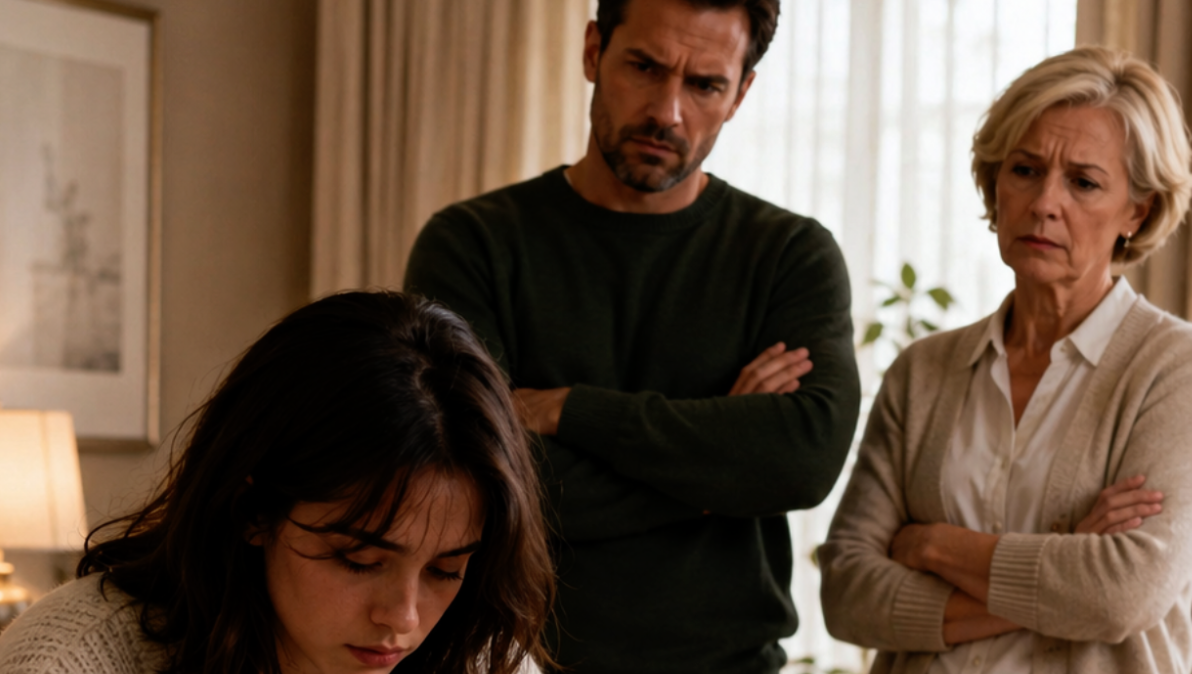
“If you don’t respect my mother, pack your things and get out,” my husband said. He didn’t expect me to leave that very evening.
The silence in the apartment was so thick it felt as if the air could be cut with a knife. It smelled of valerian drops and apple charlotte with cinnamon — a smell I had come to hate over eight years of marriage. Anna Sergeyevna, my mother-in-law, was half-reclining in the armchair, pressing a linen handkerchief to her temple. The pose of sorrow. The pose of a dying seagull. I looked at her and felt nothing but emptiness.
We had just returned from a private clinic. An hour earlier, I had personally taken her for an MRI, paid for with my freelance money, because Viktor had said his mother felt ill and needed help. The doctor, a tired man with bags under his eyes, studied the scans for a long time and then spread his hands.
“Thank God, we found nothing. The blood vessels are clear, there are no tumors. Possibly a migraine caused by a change in the weather. Or psychosomatic symptoms.”
“What psychosomatic symptoms?” Anna Sergeyevna hissed right there in the office. “Are you trying to make me look like a faker?”
The doctor said nothing. I said nothing too. I had long ago learned to stay silent at the right moments. Eight years of practice.
At home, my mother-in-law collapsed into the armchair and began breathing as if she had just run a marathon. Viktor loomed over me in the living room. Tiredly, I remarked that Anna Sergeyevna’s head seemed to start hurting only when I was in the kitchen, not when she watched her Turkish soap operas until two in the morning.
“What are you implying?” My husband’s voice sounded low and threatening.
“Nothing. I just find it interesting that her heart has never once acted up during the finale of Magnificent Century.”
That was when everything happened.
On the coffee table stood my favorite Bohemian crystal glass. Viktor had given me a set of six for our third wedding anniversary. Five were left. He grabbed the sixth one from the table, clenched it in his fist, and put it back down with such force that the thin twisted stem cracked.
The sound was like a bone breaking.
“If you don’t respect my mother, pack your things and get out,” he said in an icy voice.
I looked at him. No, not at my husband. At a stranger standing in the middle of our living room with his arms crossed over his chest. His eyes showed not anger, but disgust. That is how people look at an object they have grown tired of and are ready to throw away.
Anna Sergeyevna froze. I physically felt how she stopped breathing. She was waiting for my hysteria. Waiting for screams, tears, excuses. So that later she could tell her son, “See, Vitenka, I told you so.”
I said nothing.
I turned around and went to the bedroom. Silently. Without a single tear.
Viktor followed me. I heard his heavy footsteps behind my back. He leaned against the doorframe and watched as I took an old fiberboard suitcase from the top shelf. The very one I had used ten years earlier when I left my parents’ house in a provincial town. The suitcase was dusty, but intact. Just like my memory.
“Where do you think you’re going?” confusion slipped into his voice.
I opened the wardrobe. Took out a stack of underwear. Put it at the bottom. Jeans. A sweater. My laptop. Charger.
Viktor was waiting for tears. He was waiting for hysteria, pleading, humiliation. He wanted me to get down on my knees and ask forgiveness for daring to doubt the holiness of his mother. He did not expect me to leave that very evening.
“You do understand that if you open that suitcase now, there will be no way back?” he whispered to my back. “You’ll be alone. And no one besides me needs your little performances.”
I looked at the cracked glass in the living room, visible through the open door.
“God, how symbolic,” I thought. “Our marriage just cracked, and he didn’t even notice.”
I kept packing.
That whole evening was the finale of a long war I had been losing for years. I grew up in a small town, in a family where my father yelled at my mother over every little thing. “Who do you think you are to raise your voice?” I had heard that phrase since childhood. My father broke dishes. Sometimes he hit my mother. I hid in the closet and promised myself: I will never have that. Never. I will build a normal family.
Viktor had seemed perfect. Tall, calm, with a gentle smile. He held my hand and told me I was his universe. I believed him.
I did not notice how his mother became our shadow.
At first, she visited on weekends. Then her “faucet broke,” and she stayed for a week. A week turned into a month. A month turned into three years. She occupied the guest room we had planned to turn into a nursery. She hung her icons on the walls. Rearranged the furniture to suit her taste.
When I tried to discuss it with Viktor, he frowned.
“Lena, she’s my mother. Aren’t you ashamed? Do you want to throw an elderly person out onto the street?”
I was ashamed. I was always ashamed of my own wishes.
That evening, when everything collapsed, Katya came to our home — Viktor’s younger sister. A thirty-year-old woman with the face of an offended child. Her mother smothered her with overprotection and at the same time despised her for not getting married. Katya lived in a rented one-room apartment, worked for pennies, and came to our place to complain about life and eat from our fridge.
It was Katya who started the chain reaction.
Two hours before Viktor broke my glass, Katya was rummaging around in the bathroom. I caught her holding a bottle of birth control pills.
“What is that?” she asked with the tone of a school tattletale.
“None of your business.”
Half an hour later, I heard whispering in the kitchen. Katya was reporting to her mother. Anna Sergeyevna gasped and moaned as if I had turned out to be a serial killer.
Then came the conversation. Or rather, the interrogation.
“You don’t want to have children?” my mother-in-law stared straight at me, her small pale eyes drilling into my soul. “You’re poisoning your body with pills so you won’t give my son an heir?”
Viktor stood nearby and said nothing. I waited for him to tell the truth. That two years earlier, when the crisis began in the country and he had almost been fired, he himself had asked me to wait before having children. “Lena, let’s pay off the mortgage first, get on our feet. A child is expensive. Let’s wait a year or two.”
I agreed. I always agreed. I took hormonal medication that damaged my liver and ruined my mood because my husband had asked me to.
And now he stood there and said nothing.
“I knew nothing about it,” he finally said, looking at the floor. “Lena has been taking them secretly.”
At that moment, something inside me snapped. Not my heart. I had armored my heart long ago. What snapped was the last thread of trust in the man I had lived with for eight years. He sacrificed me for his mother. He betrayed me without even blushing.
“Barren flower,” Anna Sergeyevna pressed her lips together. “Infertile soil.”
I went to the bathroom, emptied the pills into the sink, and washed them down the drain. Then I returned and sat at the table.
“What are you doing?” my mother-in-law flared up.
“Nothing anymore.”
And an hour later, Viktor broke the glass and told me to pack my things.
While I packed the suitcase, Anna Sergeyevna began her signature performance. First, she wheezed. Then she rolled her eyes. Katya rushed for the blood pressure monitor and screamed that her pressure was nearly two hundred.
“You’re killing my mother!” Viktor shouted, bursting into the bedroom. He grabbed me by the shoulders and shook me. “Can’t you see she’s unwell?! Apologize immediately!”
I looked at him. Then I turned my gaze to my mother-in-law, who was theatrically sliding from the armchair onto the floor.
And then I said what I had not dared to say for eight years.
“Anna Sergeyevna,” my voice sounded cold and even, like a doctor reading out a diagnosis. “Lie flat on the floor. If you do not stop faking a hypertensive crisis right now, I will call not an ambulance, but the police.”
Silence fell like a guillotine.
“Because this apartment was bought with a mortgage, and my share here is sixty percent, since I am the primary borrower and made the down payment. My father gave me that money as a wedding gift. I thought I was spending it on our family. Now I understand that I wasted it. You are not registered here, Anna Sergeyevna. Neither are you nor Katya. So packing things is not my issue.”
My mother-in-law froze halfway to the floor. Her eyes instantly dried. I saw what had been hiding behind the mask of a dying old woman — a sober, angry, calculating stare. The stare of a predator caught by the paw.
“You little bitch,” she whispered and sat back down in the armchair. Without anyone’s help. Her blood pressure had miraculously normalized.
Viktor opened his mouth. Closed it. He looked at his mother with horror and astonishment. Katya turned pale and pressed herself into the corner of the sofa.
I locked myself in the bedroom and waited for a taxi.
While I waited, I looked at an old framed photograph. Viktor, graduation class. Standing with a bouquet of roses for his homeroom teacher. Next to him was his mother, clutching his elbow. Back then, I had thought it was sweet — a son and his mother were so close. Now I understood: it was not an embrace of love. It was a grip.
My phone vibrated. Viktor’s aunt, Tamara Petrovna, was calling. She was the only relative with whom I had kept a normal relationship. She lived in another city and visited rarely.
I hesitated, but answered.
“Lenochka, forgive me for calling so late. I know what’s happening at your place.”
“How?”
“Katya blabbed in the family group chat. Listen to me carefully. What I’m about to tell you, Vitya will never tell you himself. Before you, he had a fiancée. Alisa. A good girl, from a well-off family. Anna tortured her too with migraines and heart attacks. Alisa gave up. She left on her own and left him a car as a gift. Do you know where that car is now? Registered in your mother-in-law’s name.”
I was silent.
“And a month later, Alisa tried to take her own life. Because Viktor, under pressure from his mother, accused her of being mercenary. Even though he accepted an expensive gift himself without blinking. Lena, run from there. I’ve wanted to tell you for a long time, but I was afraid to interfere in someone else’s family.”
“Thank you, Tamara Petrovna.”
“You’re a strong girl. You’ll manage.”
I hung up. I looked at the wardrobe where the folder with documents was kept. Inside was an application for divorce and division of property. I had prepared it a year ago. I had been waiting for the right moment.
There was no point waiting anymore.
I stepped into the hallway with my suitcase. Viktor blocked the door. His face was confused, almost childish. He did not understand what was happening. In his picture of the world, I was supposed to cry and beg. I was supposed to break.
“Lena, stop this circus,” his voice trembled. “Mom is an elderly person. Just endure it. Everyone lives like this. I am your husband, after all. How can you cut into living flesh like this? If you leave now, everything between us is over.”
I looked at his mother. She was standing behind him, clutching the doorframe. A bruise on her shoulder, left after Viktor had shoved her aside to get to me, was already turning purple.
“He shoved his mother to stop me,” I thought. “Today he shoved her. Tomorrow he will hit me.”
I carefully unclenched his fingers from my wrist. Not a word. Not a single tear. Silence was my main weapon.
The elevator doors opened. I stepped inside. And only when the cabin started moving down did I whisper into the darkness of the shaft:
“Thank you, Vitya. You couldn’t have given me a better reason.”
It was raining outside. A fine, nasty autumn rain. The taxi was late. I stood under the entrance canopy, shivering but not crying. Inside me was a desert. Scorched earth where nothing had grown for eight years except the weeds of other people’s demands.
I did not know where to go. My friends had their own families, their own problems. A hotel? They would charge my card, and I still needed money to live on. My parents’ house in the region — I would not go back there. My father, an old abuser, would say, “I told you no one needed you.” My mother would stay silent, staring into the television.
A man came out of the building. Middle-aged, in a wrinkled jacket, with a tired face. I recognized him. He was the very doctor who had performed Anna Sergeyevna’s MRI. Judging by the hospital badge on his chest, he had just finished his shift.
“Forgive me for interfering,” he said, stopping two steps away. “I saw you come out. With a suitcase. In the rain. I knew it would end like this.”
“What exactly?”
“I’ve worked in the emergency department for fifteen years. Your mother-in-law changes clinics once a month so her medical record won’t show a pattern. We can smell fakers like that from a kilometer away. She has no pathologies. She has the talent of a dramatic actress.”
He paused.
“I saw your eyes when you came to us last time. People who have been cornered and poisoned for years have eyes like that. You didn’t cry, you didn’t complain, but I understood everything. I went through something like that myself. An abusive wife. After the divorce, I went to a psychotherapist for three years.”
He held out keys to me.
“Stay for a couple of days in my aunt’s apartment on the outskirts. She’s away. The keys are just lying around anyway. You don’t need questions right now. You need silence.”
“I can’t,” I really was confused.
“You can. It’s not forever. Just a breather.”
“Why are you doing this?”
He gave a crooked smile.
“Because once, no one held out a hand to me. And I know what it’s like — at night, in the rain, with a suitcase. The address is on the keychain.”
I took the keys. A man who smelled of hospital corridors and was tired as a dog turned out to be more human than my husband.
The apartment was small, two rooms, but cozy. It smelled of dried mint and old books. I placed the suitcase by the door, went into the kitchen, sat at the table, and stayed there, probably for an hour. Just staring at the flowered wallpaper. Then I poured tap water, drank it. My phone was exploding with calls and messages. Viktor. Katya. Some unknown numbers. I turned off the sound. Then I turned off the phone itself.
I dreamed of complete silence.
Morning came gray and murky. I woke up on a stranger’s sofa, covered with a blanket. Sunlight pushed through curtains with faded sunflowers. Cars hummed outside the window, somewhere a dog barked. Ordinary life. I had slept for almost fourteen hours. My body, which had lived under constant stress for eight years, had finally exhaled.
I got up, washed my face, and switched on the kettle. I brewed the mint I found in a jar on the shelf. I sat by the window and watched passersby. They hurried about their business, carried bags, fell in love, argued. And I simply sat and breathed.
I turned on my phone only on the third day.
Two hundred missed calls. Text messages, voice messages. I did not listen to them. I opened my laptop and found a folder in the cloud that I had created a year ago. It was called “Plan B.” Divorce application. Copies of mortgage payment receipts. Bank statements. Audio recordings.
Yes, I had been preparing for a year.
I had endured my mother-in-law’s headaches, her passive aggression, Katya’s informing, my husband’s betrayals — precisely so that he himself would push me out of the house. By law, if I had left on my own without serious reasons, he could have accused me of abandoning the family. His mother would have told everyone that I had abandoned a sick person. But this way, I had an audio recording where my husband threw me out onto the street at night in front of witnesses.
The pills Katya had found? They were placebo. Vitamin D and calcium. I could not risk bringing a child into that hell. I had long understood that I would not give birth to a child from a man who was not capable of protecting even himself.
All that time, I had been waiting for the right moment. I thought it would happen after New Year’s. But life made adjustments. And that was good. The sooner, the better.
Meanwhile, in our former apartment, a drama unfolded that I later learned about from fragments of messages and a single conversation with a former neighbor.
On the first day, Viktor was proud. He had punished his rebellious wife. He was waiting for me to crawl back on my knees. Anna Sergeyevna, in celebration, ordered pizza and watched Magnificent Century until three in the morning. Katya ate the leftovers and dreamed of moving into the freed bedroom.
On the second day, the apartment became cold. Viktor did not know how to set the gas boiler to the right mode. Dirty dishes piled up in the sink — it turned out that for eight years, no one except me had washed plates. Anna Sergeyevna tried to command Katya, but Katya flew into a rage and said she was not a servant. Viktor tried to find the TV remote. He did not find it. When leaving, I had put the television into engineering mode and changed the password. The screen displayed: “Enter code.” He tried all the birth dates. None worked.
The code was “Goodbye.”
On the third day, a notification arrived about an overdue loan payment. Viktor was used to the money being debited from my account. He did not even know the bank details. He called me, but the subscriber was unavailable. Then he opened my old laptop, which had remained in the bedroom. He opened the documents folder.
And saw the files.
Divorce application. Claim for division of property. Certificate of mortgage payments. Sixty percent was mine. And an audio file titled “Recording from October 15.”
He played it.
From the speakers came his own voice. Clear, confident, full of disgust: “If you don’t respect my mother, pack your things and get out.” Katya could be heard gasping, Anna Sergeyevna breathing loudly in the background. Everything could be heard. Every word. Every vibration of hatred.
And then came my quiet voice, recorded in the elevator when I was already leaving: “Thank you, Vitya. You couldn’t have given me a better reason.”
Viktor sat in the kitchen. Dirty dishes towered around him, sour milk smelled in the air. Anna Sergeyevna shouted from the room:
“Vitya! I feel bad again! Vitya!”
He did not turn around. He looked at the broken glass that was still lying on the coffee table. The stem separate, the bowl separate. Impossible to glue back together.
And slowly, like icy water, the truth reached him.
He had not thrown out his wife. He had thrown out his only protection from his own mother. All those years, I had shielded him with myself, taking on her hysterics, her complaints, her toxic love. I had been a buffer, a living shield between him and her. And now the shield was gone.
He was left alone with her. Forever.
The cage had slammed shut.
I stood by the window of someone else’s apartment, drank mint tea, and looked at the autumn sky. My phone vibrated one last time. A message from Viktor:
“Lena, please, let’s talk. I understand everything now. I’ll send Mom to Katya. I’ll change. Come back.”
I took a sip. The tea was hot and spicy.
I deleted the message.
Then I dialed my lawyer’s number.
Anna Sergeyevna, in the background, had stopped breathing at the very moment she realized she had lost control. But her lungs managed without my help. As always.
Viktor waited for an answer. He stood by the window of our former bedroom and watched the leaves fall from the poplar tree in the yard. He remembered how he had first brought me into that home. How his mother had smiled and said, “I only want what’s best for you, my son.” How I lowered my eyes. How I endured.
He remembered Alisa. Her pale face when he threw after her, “You mercenary bitch.” His mother had shone with satisfaction then. The car was transferred into her name a week later. And a month after that, he learned that Alisa had tried to take her own life. He did not go to the hospital. His mother said there was no need. That it was manipulation. He listened to her.
Now he stood alone in a dirty apartment and understood: he had already destroyed the lives of two women. There would not be a third.
Behind him, Katya rummaged through the things I had left behind, searching for what she could take for herself. In the kitchen, Anna Sergeyevna ate cold pizza with appetite, having forgotten about her heart attack. Her blood pressure was perfect. Like an astronaut before a flight.
Viktor closed the laptop. The audio recording had ended, but its echo still sounded in his head.
“Thank you, Vitya. You couldn’t have given me a better reason.”
He realized that he had never known me. All those years, he had lived with a convenient, silent, understanding wife who, in reality, had been an observer. I had studied him. I had waited. And when he himself gave me the key, I opened the door and walked out.
No hysterics. No scandals. No requests for forgiveness.
Just silence. Just an empty suitcase. Just leaving.
A week later, I met with my lawyer. We filed the documents in court. The mortgage still had to be divided, but I knew that my sixty percent would remain mine. When my friends found out what had happened, they silently brought me groceries and offered money. I refused. I had money. What I had earned over those years was sitting in a separate account Viktor did not know about.
People asked me, “Why aren’t you crying?”
I did not know what to answer. I had cried all my tears over eight years. At night, in the bathroom, while Viktor slept and his mother watched her series. I cried quietly, silently, so no one would hear. No one needed those tears. They changed nothing.
Now there were no tears. There was only emptiness. And peace.
One evening, sitting in the kitchen of my rented apartment, I suddenly realized that I was smiling. For no reason at all. I smiled while looking at the sunset outside the window and felt something inside me slowly letting go. The back pain disappeared. The headaches disappeared. The heaviness in my chest disappeared.
My body stopped hurting along with my soul.
The doctor who had given me the keys — his name was Nikolai — wrote to me a month later. He asked how I was. I answered, “I’m living.” We met at a café. Drank tea. Talked about unimportant things. He did not try to save me. He was simply there. That turned out to be enough to believe in people again.
Anna Sergeyevna continued living with her son. Katya eventually moved into my former bedroom. Now the three of them were stewing in their own toxic broth. Neighbors said that shouting from the apartment could be heard more and more often. Viktor changed. He became irritable, angry. One day he hurled a plate at the wall when his mother once again put on a performance.
I did not gloat. I did not care.
The story ended neither in victory nor defeat. It ended with the realization of a simple truth: you are not obligated to endure. You are not obligated to be convenient. You have the right to stand up, pack your things, and leave. Even if you are afraid. Even if there is rain and darkness outside the door. Even if they tell you, “No one needs you.”
That is a lie.
You need yourself. And sometimes that is more than enough.
I look at the new glass in my new apartment. A simple one, made of clear glass, bought at a supermarket. It is whole. It stands straight on the table. And no one, no one will ever dare to break it again.