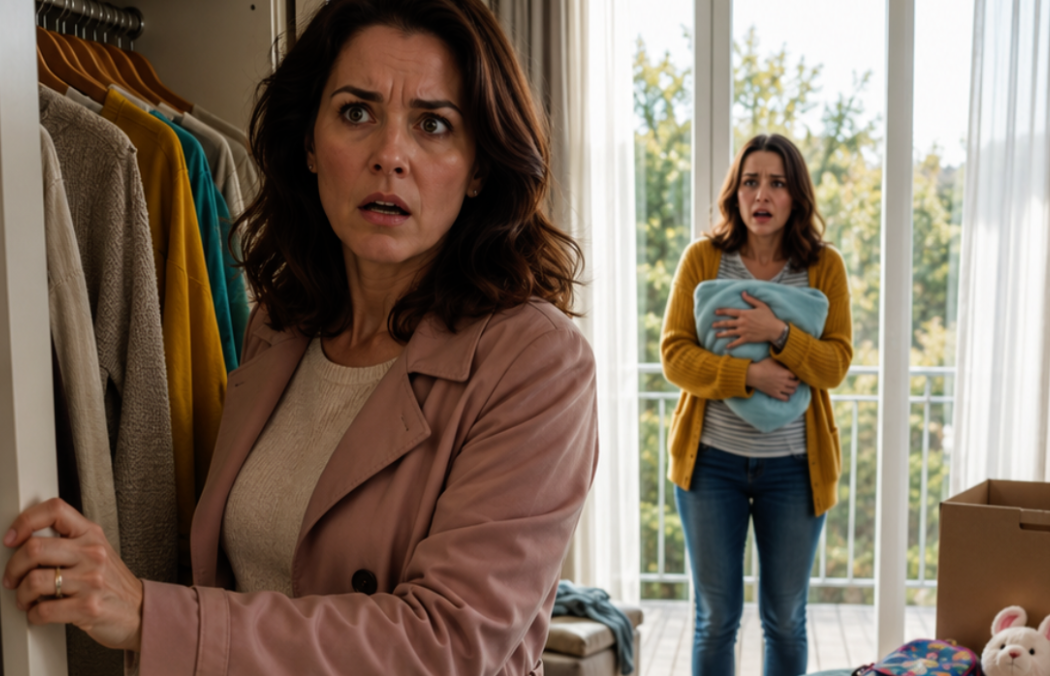
“Who the hell are you people? And why have you spread all your junk across my bedroom?”
“Excuse me, but who exactly are you, and what gives you the right to make yourselves at home here?” Vera asked, frozen in the doorway of her own bedroom.
The woman bending over the dresser jerked so violently that it looked as though she had been electrocuted. A stack of Vera’s bed linen slipped from her hands and landed on the floor with a slap.
Vera’s bed was piled high with unfamiliar bags, children’s floral tights, a thermos, phone chargers, and a man’s razor in a plastic case. Two enormous duffel bags stood against the wall. On one of them, directly across the fabric handle, someone had written in black marker:
“Winter clothes. Do not turn over.”
“And who are you?” the woman asked, straightening very slowly while still pressing someone’s padded vest against her stomach.
Vera looked toward her wardrobe. Where her summer coats and office blouses had been hanging only a week earlier, there were now unfamiliar men’s jackets and a brightly colored scarf.
“I’m the owner,” Vera said quietly.
A deep male voice immediately came from the hallway.
“Zina, what is it? The neighbors?”
A large man almost ran into the bedroom. He was wearing sweatpants with stretched-out knees and a faded T-shirt bearing the logo of some construction supply store. A little girl of about five peeked out from behind his leg, clutching his trouser leg, then immediately hid again.
The moment the man saw Vera, he stopped dead. His face changed from pink to grayish pale within seconds.
“How did you get in?”
Vera showed him the bunch of keys still clenched in her fist.
“With my own key. Into my own apartment.”
The silence in the room became so thick that Vera’s ears seemed to ring. In that silence, they could hear water dripping from a poorly closed faucet in the kitchen.
Vera was supposed to return five days later.
She had been sent to conduct an on-site audit in a neighboring district. They had promised her a mountain of accounting discrepancies, but the inspection had ended much sooner than expected. The branch director had apparently received the necessary phone call from headquarters, and by Thursday morning all the reports had been signed.
Vera saw no point in sitting in a hotel room until Monday, staring blankly at the ceiling. She threw her suitcase into the trunk, drank some disgusting machine coffee at a gas station, and headed down the highway.
The whole way home, she had been thinking about how wonderful it would be to sink into her own bathtub, put on her old robe, and avoid seeing another human being until lunchtime the following day.
She had not told her ex-husband Denis that she was coming back.
Why would she?
Since the divorce, their communication had been reduced to rare text messages concerning an old debt for a garage he still had not sold.
And now Vera was standing in the middle of her own bedroom, breathing in the unfamiliar smell of tobacco and damp clothes, staring at someone else’s bags and realizing that something unimaginably idiotic had happened.
“Let’s not get emotional,” the man said, attempting to sound calm even though his hands were trembling. “This is some kind of ridiculous mistake.”
Vera put the keys into the pocket of her windbreaker and smiled with one side of her mouth.
“A mistake is when you mix up two folders at the office. When I come home from a business trip and discover a traveling circus in my bedroom, that is called something else.”
The woman called Zina blinked rapidly, as though something had gotten into her eye.
“Denis gave us permission. He said the apartment was standing empty anyway, that you weren’t here, and that we would only be staying for a month.”
Hearing her ex-husband’s name struck Vera like a blade. She clenched her jaw but remained perfectly calm on the outside.
“What the hell does Denis have to do with this?”
“Denis Olegovich. Your former husband. He said you had left for six months to work somewhere in the North Caucasus.”
“I was a hundred kilometers outside the city. On a four-day business trip,” Vera said, carefully emphasizing every word.
The man shifted awkwardly from one foot to the other.
“My name is Oleg, and this is my wife, Zinaida. The children are in the living room. We honestly thought everything was legal.”
“Can you show me the rental agreement?” Vera asked coldly.
“Well…” Oleg drawled, and Vera noticed beads of sweat forming on his forehead. “It was only a verbal agreement. But we have a receipt from your ex-husband. We paid two months in advance.”
Vera closed her eyes for a moment.
Denis had always been full of wild ideas, but even for him, this level of audacity marked a new low.
She walked into the hallway.
There were packs of cheap instant noodles, a bucket of potatoes sitting directly on the parquet floor, and a children’s bicycle missing its rear wheel.
In the living room, a boy of about nine sat on Vera’s favorite sofa, which she had bought on credit three years earlier. He was carefully picking at the upholstery on the armrest with his fingernail. Candy wrappers and a half-eaten bread ring lay beside him.
On the coffee table, where Vera usually kept her glossy art books, there was now a jar of hot water with tea bags floating in it. The books had been dumped in a pile on the floor beneath the radiator, and a damp stain was already spreading across the top one.
“All right,” Vera said, turning toward the people who had taken control of her home. “We are all going to the kitchen now. The children stay here. Turn off the cartoons. And I expect a clear explanation as to why my former husband is renting out my apartment as though it belongs to him.”
Zinaida nodded nervously. Oleg pressed his lips together.
In the kitchen, Vera discovered another masterpiece of absurdity.
Her expensive refrigerator, for which she had saved money for six months, was stuffed with cheap sausages and margarine. A cast-iron frying pan containing the remains of fried potatoes stood on her ceramic cooktop. Vera would never have bought such a pan because its rough bottom could scratch the surface.
Someone had attached a plastic spoon rack to the wall above the table with suction cups. One side of it had already come loose.
“Where is the receipt?” Vera demanded.
Zinaida rushed into the hallway, rummaged through her bag for a long time, and returned with a crumpled sheet torn from a squared notebook.
The note had been written in Denis’s clumsy handwriting:
“Received 80,000 rubles for two months of residence by the family of Oleg and Zinaida at 14 Chekhov Street, Apartment 56. I undertake to ensure that the property owner makes no claims against them.”
Below it was a date from three days earlier and Denis’s sprawling signature with its ridiculous flourish.
Vera placed the sheet on the table and smoothed it with her palm.
“Eighty thousand rubles. Impressive. My ex-husband certainly knows how to charge,” she said, looking at Oleg. “How do you know him?”
“We don’t. We posted an online advertisement saying we urgently needed somewhere to live. He called us himself. Said he had an empty apartment. Told us not to worry about the documents. He said the owner was his ex-wife, but that he handled everything. We believed him.”
“And why exactly did you believe him? Without seeing my passport, the ownership documents, or any proof that he had the right to rent the place?”
Zinaida sobbed and buried her face against her husband’s shoulder.
“We had nowhere else to go. Our previous landlords gave us one week to leave because they sold their apartment. We had the money in cash, the children were already upset, and Denis was so polite. He said, ‘Move in today. Here are the keys. There are two bedrooms, excellent furniture.’”
“He gave you the keys himself? In person?” Vera asked.
“Yes. He came here, opened the apartment, and showed us everything. He said we could use the bed linen from the wardrobe and that we didn’t need to buy dishes.”
“What extraordinary service,” Vera said through clenched teeth as she dialed Denis’s number.
It rang for a long time.
After the fourth ring, he finally answered. Judging from his voice, he had only just woken up.
“What do you want, Ver?”
“Wake up. I’m home. I’m standing in my kitchen with people who paid you money to live in my apartment.”
There was a pause at the other end. Vera could hear Denis swallow and apparently sit up in bed.
“But you’re in Dagestan.”
“I’m in my apartment on Chekhov Street, and there are strangers living here. Either you arrive within forty minutes, or I call the district police officer, and you can explain under which criminal statute renting out someone else’s home without the owner’s knowledge falls.”
“Vera, don’t get hysterical. I’m coming right now. Just don’t do anything rash,” he blurted out before ending the call.
Vera threw her phone onto the table.
Oleg stood there shifting from one foot to the other.
“Pack your things,” she said evenly.
“But where are we supposed to go now? It’s already evening!” Zinaida cried.
“To be perfectly honest, that is not my concern. Do you have a car?”
“Yes,” Oleg muttered.
“Do you have relatives?”
“My sister lives in the next courtyard, but her place is crowded. She has children, and their grandmother is bedridden,” Zinaida said, almost crying.
Vera picked an apple out of a vase, turned it over in her hand, and put it back.
“I am genuinely sorry that you have ended up in this ridiculous situation. But I am not a charity, and I am not going to sleep in my car while someone else’s children sleep in my bed.”
“We didn’t know!” Zinaida exclaimed. “Please understand. I told him we should meet the owner. But he kept saying, ‘Don’t worry, everything has been arranged.’ Well, this is how he arranged it.”
Oleg remained silent, but Vera could see the muscles working along his jaw.
He was angry, but not at her. He was angry at Denis, who had placed all of them in this situation.
“All right,” Vera said, softening slightly. “You have one hour. Pack your personal belongings, groceries, and toys. Leave the bed linen here because it belongs to me. Take any dishes you brought yourselves. My towels stay here.”
“What about the money?” Oleg asked quietly. “We gave him eighty thousand.”
“You will demand it from Denis. In front of me. He is on his way, and I will make sure he transfers every last ruble back to you.”
Denis arrived even sooner than promised.
Approximately thirty-five minutes later, the doorbell rang.
Vera opened the door and saw her former husband standing there unshaven, wearing a wrinkled shirt carelessly tucked into his jeans. His eyes shifted nervously.
He tried to step over the threshold, but Vera blocked the doorway with one arm.
“The keys,” she said.
“Ver, let me come inside.”
“Put the keys to my apartment on the table.”
Denis pulled a bunch of keys out of his pocket and tossed them onto the small cabinet.
“Two keys. Is there a third one?” Vera asked.
“No.”
“Think carefully. If I find out later that there is another key, this conversation will become very different.”
He grimaced, reached into his wallet, and took out a third key. It was completely new and had no key ring.
“Happy now?”
“That is a very unfortunate choice of words,” Vera replied, turning around and walking toward the kitchen.
Denis followed her.
The moment Oleg saw him, he lunged forward so suddenly that Vera instinctively stepped aside.
“You!” Oleg shouted. “What the hell have you done, you bastard?”
“Calm down, man.” Denis raised both palms. “I’ll sort everything out.”
“Sort out what?” Zinaida jumped up from her chair. “You told us the apartment was yours! You said your ex-wife had gone to the Caucasus and had given permission!”
“I never said it was mine. I said I had the right to live here.”
Vera gave a short laugh before she could stop herself.
“You still haven’t learned how to lie convincingly. What right do you have? You’re not registered here, you don’t own anything, and since the divorce, you have had no business setting foot in this apartment.”
“I was only trying to help people,” Denis muttered. “And earn a little money for myself. I have debts.”
“Eighty thousand rubles is earning a little money?” Oleg clenched his fists. “You left us and our children on the street.”
“I’ll return it now,” Denis said, frantically tapping at his phone. “Here, look. I’m making the transfer. Eighty thousand. Exactly. Did you receive it?”
Oleg checked his phone and nodded.
“It came through.”
“There. The matter is settled.” Denis attempted to smile, but his lips were trembling.
“No, it is not settled,” Vera said. “You are going to help them pack. You will personally carry their suitcases to their car. After that, you and I are going to your apartment.”
“Why?” Denis asked cautiously.
“To collect the remaining keys to my country house.”
His face turned almost blue.
“What country house? I don’t have any keys to your country house.”
“Oh, you don’t?” Vera picked up her phone again. “Then let’s call your father. Right now. We can ask whether he gave you the keys to our property when you promised to go there and check the water pump.”
Denis began breathing rapidly and noisily, like an exhausted horse.
Oleg watched him with disgusted curiosity. Zinaida shook her head.
“Are you completely insane?” she asked Denis. “Why not move us into a museum while you’re at it?”
“Oh, come on,” he snapped. “Nothing terrible happened. You spent a couple of nights here. So what?”
“You went through my documents,” Vera said sharply. “I saw the folder. The envelope had been opened. Were you looking for the ownership documents?”
Denis said nothing.
His silence was more revealing than any answer.
“You wanted to find the certificate so you could show it to them, didn’t you? To make your story more convincing?” Vera stepped almost directly in front of him. “And what would you have done if you couldn’t find it? Forged one? Do you even understand that this could be a criminal offense?”
Oleg spat angrily, barely missing the floor.
“What a piece of filth. I even bought him a beer when he helped us carry in the suitcases.”
“Keep packing,” Vera reminded them. “Your time is running.”
It took almost an hour.
Zinaida, silent and red with shame, packed the duffel bags, removed tubes and toothbrushes from the bathroom, and pulled drying socks from the line on the balcony.
Vera stood by the window and watched her neighbor, Aunt Raya, who was known throughout the building for her sharp tongue, feeding pigeons in the courtyard while observing the loading process with great interest.
Oleg carried the bags. Denis helped him while muttering curses under his breath, although he caused more trouble than assistance.
The children, sullen and frightened, sat in the hallway on top of their backpacks. The little girl sucked on the corner of a teddy bear. The boy glared at Denis from beneath lowered brows.
Vera suddenly thought that the child would remember the man who had deceived his family for the rest of his life.
When the door finally closed behind the last of the unwanted guests, Vera turned toward Denis.
“Now we’re going to the country house.”
“Listen, can’t we forget about it for tonight? It’s late. I’ll bring you the keys tomorrow.”
“We are going now. You and me. In my car.”
“You’ve always had an obsession with controlling everything,” Denis hissed as he put on his shoes.
“And you have always had an obsession with other people’s property,” Vera replied. “Apparently, some things never change.”
Denis lived in an old prefabricated apartment building on the other side of the city.
His one-bedroom apartment was a complete mess. Unwashed dishes were scattered everywhere, cigarette packets covered the windowsill, and computer cables twisted like snakes across the dirty floor.
Vera stepped over the threshold with disgust.
Denis went to the wardrobe and rummaged for a long time inside a shoebox stored on the top shelf.
“Here,” he said, handing her a bunch of keys with a wooden pear-shaped key ring.
Vera remembered the key ring. She had bought it herself years earlier in Anapa.
“Is this everything?” she asked, weighing the keys in her hand.
“Everything.”
“Are you certain? Because if I drive out there tomorrow and discover that someone has tampered with the lock, I will file a police report without hesitation.”
He dropped onto a chair and rubbed his temples.
“Ver, why are you behaving like this? We lived together for eight years.”
“That is exactly why. I know you too well. You have always believed that anything your wife owned automatically belonged to you. Nothing changed after the divorce. Except that I am no longer your wife.”
“You’ve become a bitch,” he said bitterly.
“No. I’ve become an adult.”
She turned around and walked toward the door.
When Vera returned home, the first thing she did was call a locksmith.
He arrived an hour later, an elderly man carrying a case of tools, and quickly replaced both locks.
Naturally, Aunt Raya immediately appeared on the landing, claiming that she had come outside “to get some air.”
“What happened, Verочка? Were you robbed?”
“Almost, Aunt Raya.”
“I kept seeing strangers coming and going, pushing a stroller around. I thought, ‘How strange. Vera is away, but someone has allowed tenants into her place.’”
“My ex-husband arranged it.”
“What a parasite,” Aunt Raya said with feeling. “I remember I never liked him. He had the eyes of a rat.”
The locksmith completed his work.
Vera closed the door behind him, locked the new lock, and slid the interior bolt into place. Then she leaned her back against the wall.
The apartment was silent.
Yet the presence of strangers still lingered in that silence: the smell of burned cooking oil, sweet perfume, and baby powder.
Vera opened every window, lit an aroma lamp, and collected the rubbish left behind by her unwanted guests.
In the bedroom, she discovered a dirty sock beneath the bedspread. On the windowsill, she found a child’s comb with several broken teeth.
The following day, she woke up late with a heavy head and only one desire: to see no one.
But her phone would not stop ringing.
Denis kept sending messages.
“Do you even understand that Zinaida is now posting online that I scammed them? People are calling and threatening me.”
“Answer me. We need to handle this like civilized people.”
“Did you tell them to shut their mouths?”
Vera stared at the messages for a long time.
Then she typed:
“Your lies are your reputation. It has nothing to do with me.”
Denis replied instantly.
“You’re cruel.”
Vera snorted and set the phone aside.
Cruel.
How amusing.
During eight years of marriage, she had heard that word constantly. Denis called her cruel when she refused to pay off his loans, when she would not allow his relatives to register at her apartment, and when she asked him to return money he had borrowed from her.
The accusation had hurt her before.
Now it was almost funny.
Three days passed.
Vera had nearly removed every trace of the strangers from her apartment. She washed all her clothes and bed linen, cleaned every dish, and threw away the old folder Denis had touched.
Life was slowly returning to normal.
One evening, she was sitting with a cup of tea and watching a television series when the intercom rang.
“Vera, open the door,” Oleg’s distorted voice said through the speaker. “It’s important.”
“What happened now?” she asked, pressing the button.
“I’m alone. Zina isn’t with me. I only need to speak to you.”
Reluctantly, she let him in.
Oleg came upstairs and stood awkwardly at the threshold, apparently afraid to enter.
“Do you smoke?” he asked, even though the smell of tobacco could be detected from several meters away.
“No. And nobody smokes inside my apartment.”
“Understood. I’ll only take a minute.” He finally stepped across the threshold. “Vera, I don’t know how to begin. Zina and I want to apologize again. Properly. We were idiots for believing him.”
“Apology accepted.” Vera nodded. “Why are you really here?”
“Your ex-husband…” Oleg hesitated. “We weren’t the only people he tried to scam.”
“What do you mean?”
“He had another key to your country house. I accidentally overheard a phone conversation while I was helping him move some furniture. He told someone, ‘The property is excellent, the house can be used in winter. Move in before my ex finds out.’”
Vera froze.
An unpleasant pain stabbed her chest.
So the key with the wooden pear had not been the only one. And while he was deceiving one family, Denis had already been preparing his next scheme.
“Who was he talking to?” she asked, trying to keep her voice steady.
“One of his friends. I don’t remember the name, but it sounded like the man had already visited the property. I think he was supposed to move in on Saturday.” Oleg handed her a crumpled piece of paper. “I remembered the address. Your property is number one hundred and eighty-four, right? I searched online. It matches.”
“One hundred and eighty-four,” Vera confirmed. “Thank you.”
“I could have kept quiet. But it’s been eating me alive. People like him shouldn’t be allowed to get away with this. My daughter cried for two days because she thought the police were going to arrest us, while he carries on as though nothing happened.”
Vera looked at Oleg and saw a tired, tormented man who had also been a victim.
But now, it seemed, he had decided to do something to correct the twisted situation.
“I’ll go to the country house tomorrow morning,” she said. “If he has already moved someone in, or if someone is preparing to move in, I’ll call the police immediately.”
“I could go with you,” Oleg offered. “For support. And as a witness.”
“That won’t be necessary. I’ll handle it myself. But thank you for warning me.”
Early Saturday morning, Vera was already driving along the suburban highway.
Bleak fields, garages, and peeling bus shelters flashed past the window.
She replayed every conversation she had had with Denis in recent months. How he had complained about having no money. How he had asked to borrow from her. How offended he became whenever she refused.
And how he had apparently concluded that the easiest way to solve his financial difficulties was to secretly sell access to her property.
Vera had inherited the country house from her father a few years earlier.
It was peaceful and comfortable, with an old apple tree and a sturdy little house. She loved the place.
The thought of strangers breaking in, disturbing her deceased father’s belongings, and trampling across the garden beds filled her with a cold, controlled rage.
The property was quiet when she arrived.
The gate was locked.
Vera opened it with her key and went inside.
At first glance, everything appeared to be in its proper place.
But she noticed the evidence of strangers immediately.
Two empty beer bottles stood on the porch. The door to the house was slightly open. A smell of dampness and cheap cigarettes drifted from inside.
Vera entered the enclosed porch.
An unfamiliar baseball cap hung from one of the hooks. A sleeping bag was spread across the floor in the main room, and a man’s tracksuit jacket had been thrown onto her favorite wicker chair.
“Well,” she said aloud.
Her voice echoed through the empty house.
At that moment, a floorboard creaked behind her.
Vera spun around and saw an unfamiliar man climbing down from the attic.
“Oh. Hello,” he said, clearly not yet understanding who she was.
“Who are you?” Vera asked, pulling out her phone and visibly turning on the camera.
“Who are you?” he replied insolently as he jumped from the final step.
“I own this house. Get out.”
“Denis said the place was empty,” the man replied. He had clearly not expected this development.
“Denis lied to you. This is my property. You are going to collect your belongings and leave immediately, or I will call the police.”
“Come on, calm down.” He attempted to smile, but the expression came out crooked. “I didn’t know. I paid him fifteen thousand rubles for one month.”
“You’ll have to get your money back from him,” Vera said without lowering her phone. “You have two minutes.”
The man muttered curses about being “scammed for no reason” as he rolled up the sleeping bag and grabbed his belongings.
Vera remained silent and watched him carry everything through the gate.
“You’re lucky,” she called after him once he was outside. “If you had managed to damage anything here, this conversation would be taking place at the police station.”
“Your Denis will answer to me too,” he muttered before walking away.
Vera locked the gate and then the house.
She sat down on the porch steps and lit a cigarette.
She had not smoked for approximately three years, but she had purchased a packet specifically for this occasion.
The tobacco smoke scratched her throat but brought a strange sense of calm.
Her hands were trembling.
For the second time in one week, Denis had allowed strangers onto her private property.
And those were only the incidents she knew about.
How many other attempts had there been? How many people had he given keys to “just in case”?
Vera took out her phone and called Denis.
He did not answer immediately.
“Yes?” he finally said.
“You know where I am.”
“I can guess.”
“You managed to move a tenant in here too. For fifteen thousand rubles.”
She heard heavy breathing on the other end.
“I was going to ask him to leave later. Before winter.”
“Have you completely lost your mind?” Vera’s voice trembled, but she quickly regained control. “This is my land. My house. You have absolutely no rights here.”
“I thought he could stay for a while and keep an eye on the place.”
“You were thinking about money. Only money. As always.”
“I’m sorry,” he forced out through clenched teeth. “I don’t know what else to say.”
“There is nothing left to discuss. I’m filing a police report.”
“Come on!” Denis almost shrieked. “We’re not strangers!”
“That is exactly the problem. For far too long, I treated you as someone who wasn’t a stranger and ignored your smaller betrayals. No more.”
She ended the call and silenced her phone.
Let him call.
Let him send messages.
Enough.
Vera sat on the porch and watched the wind sway the branches of the old apple tree.
Fragments of their marriage rose in her memory.
Denis asking to borrow her father’s car and returning it with a dent, saying, “It wasn’t as though I did it deliberately.”
Denis taking her credit card because he only needed “something to get him through until payday,” except payday never seemed to arrive.
Denis promising to help with repairs, then disappearing for a week and leaving a wall torn apart.
A constant theft of peace, one drop at a time.
The invasion of her home had been the final drop.
The perfect summary of everything that had come before.
Vera stood up, brushed off her jeans, and returned to her car.
On the way home, she stopped at a construction supply store and bought two heavy padlocks, a chain, and strong metal hinges.
She would replace every lock at the country house with her own hands.
Without a locksmith.
Without anyone’s help.
So that no one would ever again be tempted to treat her property as though it belonged to nobody.
That evening, back in her apartment on Chekhov Street, she sat in the kitchen looking at an old photograph that had fallen out of a book.
She and Denis were standing beside the sea, young and laughing.
At the time, she had believed that nothing but happiness awaited them.
Yet even during that trip, Denis had gambled away all of his business travel allowance and secretly sold her gold chain.
Vera remembered how he had lied, claiming the chain must have been lost in the sand.
Back then, she had pretended to believe him.
“Enough,” Vera said aloud and tore the photograph in half.
There was a cautious knock at the door.
Vera tensed and looked through the peephole.
Zinaida was standing on the landing alone, holding a small bag.
“Is it too late?” she asked when Vera opened the door. “Oleg told me that you found another tenant at the country house. I couldn’t stay away.”
“Come inside.” Vera stepped aside.
Zinaida entered the kitchen, sat on the edge of a stool, and placed the bag on the table.
“Oleg and I were thinking. There are homemade pastries in there. I baked them for the children and brought some for you. It isn’t compensation for the damage or anything. It’s just… a human gesture.”
“Thank you.” Vera accepted the bag.
“And there’s something else.” Zinaida searched her handbag and removed a folded sheet of paper. “This is a statement. We wrote it ourselves. It says that Denis took our money through deception. If you decide to go to the police, take it with you. We are prepared to confirm everything.”
Vera unfolded the sheet and read the clumsily written but honest lines.
“Do you understand that he could be held legally responsible?”
“I certainly hope so,” Zinaida said firmly. A flash of steel appeared in her tired eyes. “He endangered my children. He made me feel like a thief. I will not forgive that.”
Vera nodded and carefully placed the statement inside a folder.
“You did the right thing, Zina.”
“I’m simply tired of being afraid. And tired of taking people at their word.”
They sat together for a while longer, speaking very little.
But there was no awkwardness in the silence.
After Zinaida left, Vera locked the door, turned the new key twice, and fastened the security chain.
Several days later, Vera was sitting in an investigator’s office.
On the desk lay her police statement, copies of the receipts, photographs of strangers’ belongings inside her apartment and country house, and statements from Oleg and Zinaida.
The investigator, a tired middle-aged police captain, frowned as he examined the papers and shook his head.
“Your former husband is quite a remarkable character.”
“I know.” Vera nodded.
“There are already three victims. You, the family, and the man from the country house. He filed a statement as well. He claims he believed the house was abandoned because your husband introduced himself as the owner.”
“He is not my husband,” Vera corrected him.
“I can see that. Tell me, did you ever file a complaint against him before?”
“I used to believe I could solve everything through conversation.”
The captain sighed, picked up a pen, and wrote something in his calendar.
“We’ll open a case. In the meantime, stay away from this man. If he threatens you, call us immediately.”
Denis called Vera that same evening after learning about the police report.
His voice was hoarse and angry, with hysterical notes beneath it.
“You actually did it!”
“Yes.”
“You’ve destroyed me. They’ll inform my employer, and I’ll be fired.”
“You destroyed yourself, Denis. I simply stopped serving as your alibi.”
He continued shouting, but Vera ended the call and blocked his number.
Then she went to the window and watched the evening courtyard for a long time.
Boys were kicking a ball around. A woman was walking a dachshund. Someone was parking a car.
Ordinary life continued as usual.
And in that life, there was no longer any room for the constant tension or fear that her kindness would once again be secretly used against her.
One month later, Vera sat in a café with Oleg, Zinaida, and their children.
The children devoured ice cream. The little girl excitedly talked about kindergarten, while the boy demonstrated a new coin trick.
Zinaida smiled shyly.
“Vera, we still don’t know how to thank you.”
“For what? You helped me far more than you realize.”
“Nevertheless,” Oleg said, raising his mug of tea. “To justice.”
Vera touched her cup against his.
Justice.
A word she had been afraid to apply to her own life for so long, continually postponing it and hoping for persuasion and conscience where neither had ever existed.
Autumn descended on the city quickly.
The days became shorter, and the rain came more frequently.
But Vera’s apartment was always warm and dry.
She completed a small renovation, rearranged the furniture, and threw away the final reminders of her former life: a stack of old discs, Denis’s mug, and a belt he had left behind.
One morning, while preparing for work, she found a folded note beneath the doormat.
“Forgive me.”
There was no signature, but Vera would have recognized Denis’s handwriting among a thousand others.
She crumpled the note and threw it into the rubbish bin.
Forgiveness was far too personal and complicated a task to begin because of the first carelessly written note left on someone else’s doorstep.
She put on her coat, locked the door with the new lock, and pulled the handle to check it.
Secure.
The stairwell smelled of a neighbor’s freshly baked pies.
Outside, the caretaker had swept fallen leaves into yellow piles.
The world beyond her door was enormous and noisy, and for the first time in many years, it seemed safe.
Vera got into her car, started the engine, and drove to work, leaving behind the home that had finally become entirely hers again.
From the attic to the basement.
From the threshold to the final nail.
Without strangers invading it.
Without illusions.