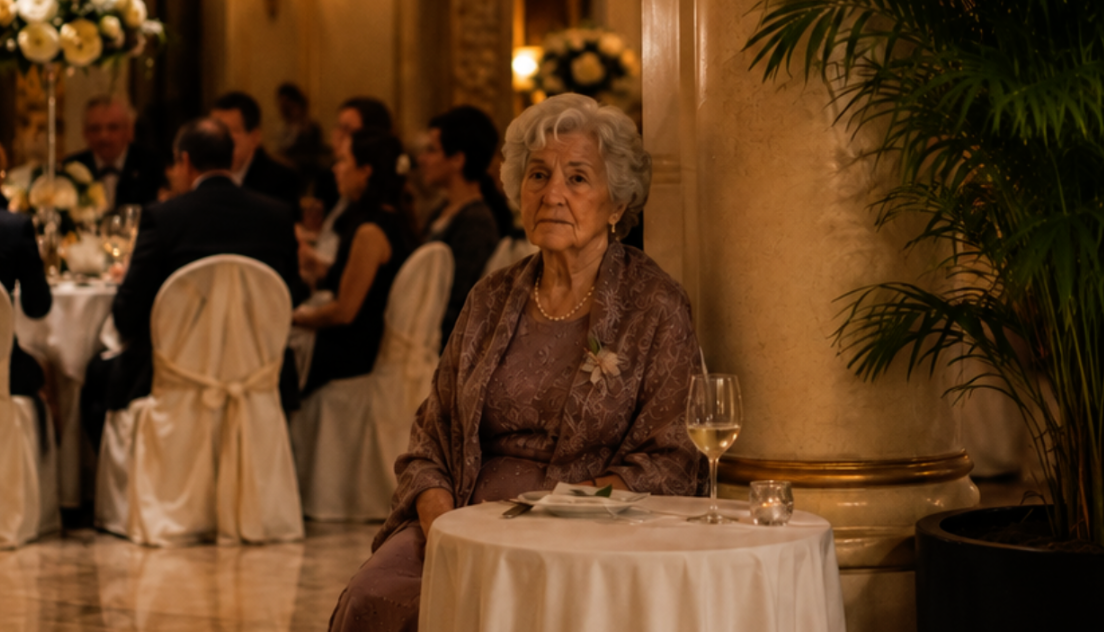
At Her Grandson’s Wedding, Grandma Was Given a Seat in the Farthest Corner
She spent almost three weeks choosing her shoes. Not because she enjoyed shopping—her knees had long since cured her of that pleasure. She simply needed a pair she could endure an entire evening in: shoes that wouldn’t rub, wouldn’t slip on the parquet floor, and would allow her to sit upright for at least a few hours without constantly thinking about the pain.
Her grandson was getting married. And Anna Iosifovna could not come to his wedding wearing just anything.
They seated her at a small table that everyone carefully referred to as “the most comfortable place for Grandma.”
In reality, it was in the farthest corner of the large restaurant hall. Behind a column, beside a tall ficus in a ceramic pot. From there, she could see the newlyweds only when someone at a neighboring table happened to lean over to reach for a napkin.
“Mom, you’ll be better off here,” her daughter-in-law Oksana said quickly, adjusting the shawl around her shoulders. “It’s noisy near the speakers, and you have blood pressure problems. It’s quiet here, there’s no draft, and a waiter is always nearby.”
Anna Iosifovna nodded. Long ago, she had learned not to argue with the kind of care that was really just a polite way of moving someone farther away so they wouldn’t inconvenience anyone. She was eighty-two. Her hair, gathered into a neat low bun, looked almost completely silver beneath the chandeliers. She had worn the same crepe dress to every important occasion for the past ten years—modest, but elegant. In her handbag were her pills, a handkerchief, and a small mirror.
Her grandson Taras sat at the newlyweds’ table. Tall, wearing a dark suit, he looked slightly overwhelmed by the endless stream of hugs, congratulations, and advice about married life. Beside him glowed the bride, Kristina, one of those people whose warmth you felt immediately.
During the entire evening, Taras came over to his grandmother only once. He kissed her on the temple and whispered:
“Grandma, you’re the best.”
Then the photographers whisked him away again.
Anna Iosifovna wasn’t offended. Young people were young people. It was their evening, their guests, their toasts. She simply sat there, smoothing the edge of the tablecloth with her fingers and watching the small piece of fish on her plate grow cold. She had never touched it. She wasn’t hungry.
Her son came over.
“Mom, how are you?” Bogdan leaned close to her ear, trying to make himself heard over the music. “Are you tired? Just say the word and Sergei will drive you home right away. The car’s downstairs.”
“I’ll stay a little longer, son. Go on.”
He nodded and returned to the table where his wife’s relatives were sitting.
They were all good people. They were simply afraid of old age as though it might rub off on them. They protected Anna Iosifovna from loud music, drafts, and “unnecessary fuss.”
But it never occurred to any of them that the most painful thing wasn’t a draft.
What hurt was being protected from life itself all evening, like an old vase everyone was afraid of bumping into and breaking. Then suddenly, the music changed. The host announced something, the guests murmured, and a waltz slowly floated from the speakers.
Anna Iosifovna closed her eyes.
And the hall disappeared.
She was nineteen again.
The summer of 1963.
A small town by the river, a dusty road, the scent of linden trees warmed by the sun. A white dress—though not quite white, more the color of cream, because her mother hadn’t been able to find any other fabric.
The edges of the dress kept fraying, and her mother angrily wet her fingers with saliva and grumbled:
“Stand straight, Anyuta, or I’ll make your whole waist crooked.”
And beneath her window, Mikhas waited for her.
With his bicycle.
He whistled softly so her future mother-in-law wouldn’t hear him—or rather, almost future mother-in-law.
He had broad hands, a funny dimple in his chin, and absolutely no sense of rhythm. He couldn’t dance at all.
“I won’t embarrass you at the wedding,” he promised after stepping on her foot yet again on the dance floor in the town park.
“You’re already embarrassing me,” she laughed through tears.
Their wedding was supposed to be on Saturday.
On Friday morning, Mikhas went to see his uncle in a neighboring village to collect boards for the benches.
That afternoon, a neighbor came to their gate.
She stood in the doorway, gripping the frame, unable for a long time to say the first word.
After that, the house filled with strangers.
Muted voices.
Her mother’s hands resting on her shoulders.
And the cream-colored white dress remained hanging on the wardrobe door.
Anna never danced again after that.
Seven years later, she married Pyotr—a calm, dependable man who never once raised his voice at her in his entire life.
He wasn’t Mikhas.
But he never caused her pain, either.
He gave her a home, a son, and a quiet, long life without grand promises.
Sometimes, at other people’s weddings, he would hold out his hand.
“Anyuta, shall we dance?”
She would shake her head.
“My legs hurt.”
Back then, her legs didn’t hurt at all.
It was something else that hurt. She opened her eyes. The waltz was still playing, though the bass and clinking glasses were already beginning to drown it out.
Anna Iosifovna was just about to ask her son to call the driver when the host tapped the microphone again.
“And now we have a very special moment! The groom would like to invite the most important woman in his life to dance—the woman without whom this celebration simply wouldn’t be happening today!”
He’ll go to his mother, Anna Iosifovna thought.
Or perhaps to his mother-in-law.
Maybe to Kristina. It would make a beautiful shot for the wedding video.
Then a spotlight suddenly shone directly into her corner.
Taras was walking toward her.
Between the tables.
Past the column.
Past the ficus in the pot.
One by one, the guests fell silent.
Kristina sat at the newlyweds’ table, smiling as she discreetly wiped the corner of her eye with a napkin. There was no offense in her expression, no jealousy.
Quite the opposite.
Her grandson stopped in front of his grandmother and held out his hand.
“Grandma, come with me.”
She clutched her handbag as though it might save her.
“Taras, what are you doing? I can’t. My legs. And everyone is looking.”
“Let them look.”
“Go to your bride.”
“She’s the one who asked me to do this. Kristina.”
Anna Iosifovna froze.
“Asked you to do what?”
Taras crouched beside her so he could speak quietly, just for her.
“Dad told me everything this morning. About Mikhas. About the dress. About how you never got to dance your first wedding waltz.”
Her throat went dry.
She searched the room for her son.
Bogdan was standing by the wall with his head lowered, his shoulders trembling slightly.
“I didn’t even know he remembered,” she whispered.
“He remembered his whole life. He was just afraid to ask.”
Taras still held out his hand.
“Grandma, I’m not Mikhas. And I’m not trying to be. But today, I’m your grandson. And if you’ll let me, I want to walk you through at least a few steps of the dance that was taken away from you all those years ago.”
She closed her eyes again.
Her left knee ached.
Her back pulled painfully.
Her heart was beating so hard that she almost felt embarrassed by how loudly it seemed to pound.
“I’ll fall.”
“I’ll hold you.”
“I’ve forgotten everything.”
“Your feet will remember.”
And she placed her thin, dry hand into his broad, warm one. Taras helped her rise slowly and carefully, without rushing her.
They walked to the center of the hall.
The tables seemed to disappear somewhere in the darkness.
There was only the waltz and a circle of soft light.
The first step was difficult.
The second was uncertain.
And on the third, Anna Iosifovna suddenly straightened.
She herself didn’t understand when it happened.
Her body remembered what her soul had preserved for sixty years.
A turn.
A pause.
The slightest tilt of her head.
Taras guided her gently, adapting to every movement. And she was no longer simply holding on to her grandson.
She was dancing.
The entire hall was silent.
Bogdan was crying openly now, no longer trying to hide it.
Oksana pressed a hand to her lips.
Kristina stood beside the newlyweds’ table, smiling through tears.
Anna Iosifovna saw none of them.
She saw the sunlight over the old dance floor, the cream-colored white dress, and the young man with the dimple in his chin who had once sworn he wouldn’t embarrass her at their wedding.
Well, Mikhas, she thought. I’m dancing after all.
When the music ended, the room remained completely silent for several seconds.
Then the guests stood and began to applaud.
Not loudly.
Not for entertainment.
Carefully, somehow.
Humanly.
As though they were afraid of frightening away something very fragile.
Taras kissed his grandmother’s hand.
“Thank you, Grandma.”
“No,” she replied. “Thank you. For not leaving me in that corner forever.” They did not send her back behind the ficus.
Kristina personally moved Anna Iosifovna closer to the newlyweds.
“I want you to be near us,” she simply said. “You’re my family now too.”
Anna Iosifovna took her hand.
“Be happy, sweetheart. And dance while you can. Don’t put life off until later. Life doesn’t like that.”
Later, while Bogdan drove his mother home, she stared silently through the window. The city blurred into yellow lights beyond the glass.
“Mom, forgive me,” her son said quietly. “I should have asked you about it a long time ago.”
“No, son. Some doors only open when there’s someone beside you willing to take your hand.”
At home, she didn’t turn on the light for a long time.
She took off her shoes and placed them beside the wardrobe—and suddenly smiled.
Her knees hurt.
Her back ached.
But inside her chest, she felt strangely light.
The next morning, Anna Iosifovna took down an old cardboard box of photographs from the top shelf.
There, among yellowed greeting cards, lay a small mother-of-pearl button.
From that same cream-colored wedding dress that had never fulfilled its purpose.
She placed it in her palm and said aloud:
“Well, Mikhas. We finally finished our dance.”
And for the first time in many years, it seemed to her that the past was no longer pulling her backward.
It was simply standing quietly beside her.
And, at last, letting her go.