In her new apartment, the silence possessed a physical weight, pressing against her eardrums far louder than any cacophony she had ever known. At the confectionery factory dormitory, peace was an abstract, unattainable concept. Someone was always loudly arguing over a stolen shift, dragging heavy furniture across the scarred floorboards, or laughing with raucous abandon behind thin, paper-like walls. In the communal kitchen, battered pots clashed like cymbals, kettles shrieked their boiling warnings, and the ancient washing machine in the damp shower room convulsed violently, threatening to breach the plaster.
Here, however, the air was entirely still. There was not even the familiar, low hum of a refrigerator. Elizaveta sat cross-legged on the cold, cheap linoleum near the window, quietly eating plain buckwheat from a plastic deli container. Every so often, her eyes would dart toward the front door. She had been handed the keys only that morning. It was a modest one-room apartment, exactly thirty-two square meters, perched on the fifth floor of a newly constructed concrete block on the dreary outskirts of Lesogorsk. It boasted stark white walls, an electric stove, and a narrow balcony that looked out over a desolate vacant lot, a rusted railway line, and a jagged strip of dark pine forest.
To a stranger, this space might have seemed claustrophobic, a mere concrete box. To Liza, it was a sprawling empire. For the first time in her twenty-two years, she possessed a door she could securely lock from the inside without the paralyzing anticipation of a stern caretaker throwing it open with a master key. For the first time, she did not have to guard her threadbare towel, hide her worn slippers, or aggressively label her meager food. Her bed—a luxury yet to be delivered—would arrive next week, so she had spread a thin camping mattress beside the radiator.
She was just preparing to lie down when the doorbell suddenly pierced the quiet. It was a sharp, aggressive, and prolonged sound. Liza glanced at the glowing screen of her phone. It was eight-thirty in the evening. Except for her workshop supervisor and a housing administration clerk, absolutely no one in the world knew her address. The second ring was even more demanding. Liza crept to the door. “Who is it?” she asked, her voice steady but guarded.
“Elizaveta Andreevna? Please, open the door. We are your relatives.”
Liza froze. The word “relatives” sounded entirely alien, an absurd fabrication. Her family had ceased to exist fifteen years ago. After her mother’s premature death, a seven-year-old Liza had been summarily deposited into a state-run children’s reception center. No father was listed on her faded birth certificate. Social services had efficiently declared that no grandparents, aunts, or uncles could be located. She was alone.
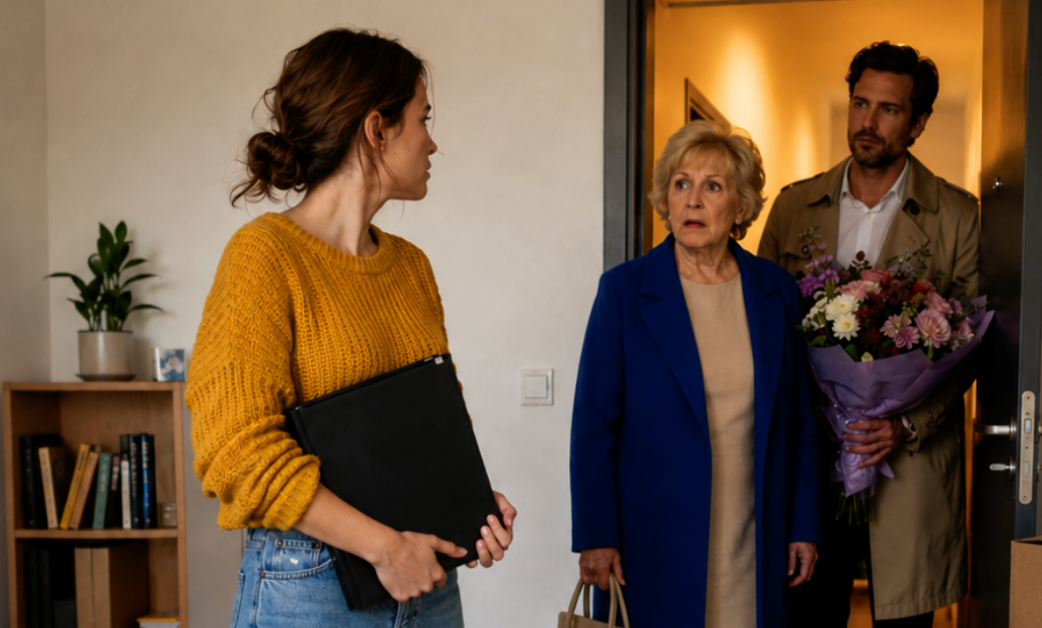
Looking through the peephole, she saw two strangers. An elegantly dressed woman in her mid-sixties wearing a pristine light-colored coat, and a tall, well-groomed man slightly older than Liza, sporting a meticulously trimmed beard and clutching a massive, utterly inappropriate bouquet of white roses.
“Tell me exactly who you are,” Liza commanded through the heavy steel door.
The woman stepped closer. “I am Vera Konstantinovna Meshcherskaya. I am your father’s older sister.”
Ice flooded Liza’s veins. “I don’t have a father.”
“You did. His name was Andrei Meshchersky. He passed away eleven years ago.”
The bearded man shifted awkwardly. “And I’m Denis. I suppose that makes me your cousin.”
Liza kept the deadbolt locked. “How did you find this exact address?”
“The notary informed us that you had finally been granted state housing,” Vera replied, her tone attempting a maternal warmth that rang entirely hollow. “Liza, we need to have a very serious conversation. Please, let us in.”
Only after photographing their passports through a crack in the door and sending the images to a trusted friend did Liza finally step aside. The pair walked into the center of the barren room. Denis glanced dismissively at the camping mattress and the plastic food container, offering to buy her furniture. Liza ignored the extended bouquet.
“First, explain why you are here,” Liza demanded.
Vera draped her expensive coat over her arm, revealing a tailored dark-blue suit. “Andrei was my younger brother. He got involved with your mother, Galina. He drank heavily, couldn’t hold a job, and when she became pregnant, he panicked and fled. That is why he was never legally declared your father.”
“And when my mother died?” Liza’s voice was dangerously quiet.
Vera looked at the floor. “I was informed by a child welfare officer.”
The silence that followed was suffocating. Liza felt a hot, venomous anger rising in her chest. All those years in the orphanage, she had comforted herself with the naive illusion that her relatives simply did not know she existed. She had imagined them desperately searching for her. Instead, they had known. They had received the call, and they had actively chosen to leave a terrified seven-year-old girl to the mercy of the state.
“You refused to take me,” Liza stated. It was not a question.
“It was a difficult time,” Vera deflected, her eyes darting away. “My husband was ill. We lived in a cramped communal apartment.”
“You refused,” Liza repeated, the words dropping like stones onto the bare linoleum. The true reason for their visit was swiftly laid bare. Liza’s paternal grandfather, Konstantin Pavlovich Meshchersky, had died four months prior. He owned a historic, pre-revolutionary two-story brick building in the center of Lesogorsk. The first floor had once housed the family’s renowned confectionery, Almond. Miraculously, in a fit of belated guilt or spite, the old man had willed the property equally to Denis and Liza.
“A pharmacy chain wants to buy the building for thirty-eight million rubles,” Vera explained, retrieving a thick legal folder from her designer bag. “But Denis took out a massive loan against the house for a failed restaurant project. The bank is demanding twenty-four million. If we sell, we can clear his debt.”
“And my share?” Liza asked, her analytical mind quickly processing the math.
Denis cleared his throat. “We can offer you one million two hundred thousand.”
Liza laughed—a harsh, scraping sound. “Out of a nineteen-million-ruble inheritance, you offer me a fraction so you can save your own skin? And you need my signature to authorize the sale.”
Vera stood tall. “Denis made a mistake, but he is family. Blood relatives must help one another.”
“Family?” Liza sneered, her fists clenching at her sides. “You abandoned me to an institution where I hid food under my mattress until I was sixteen. I spent every birthday hoping someone would walk through those doors. You left me to rot, and now you dare ask me to save your son’s business?”
“I couldn’t have done anything differently!” Vera pleaded.
“You simply didn’t want to,” Liza countered, shoving the folder forcefully back into Vera’s hands. “Get out. I am not signing away my future to pay for your past.” Days later, armed with free legal counsel, Liza stood inside the old Almond confectionery. The building smelled of damp plaster and forgotten history. Marble counters and darkened mirrors stood as silent witnesses to a bygone era of prosperity.
While inspecting her grandfather’s untouched study on the second floor, Liza uncovered the final, devastating truth. Hidden in a drawer beneath faded receipts was a stack of gray envelopes bearing the unmistakable stamp of Orphanage No. 6.
Liza opened them with trembling fingers. They were letters from the orphanage director, begging Vera to at least write to the grieving seven-year-old girl who desperately missed her family. In the margins of the first letter, her grandfather had scrawled: Do not reply. Andrei will just use her to extort money from us.
Vera stood in the doorway, her face pale. “Father forbade me from answering,” she whispered weakly. “I depended on him financially.”
“You were a forty-seven-year-old woman,” Liza said, her voice completely devoid of emotion as she carefully placed the letters into her bag. “You were a coward. And you let a child pay the price for it.”
When Denis realized Liza would not blindly sign the documents, his facade crumbled. The debts were not merely from a failed restaurant; he had committed severe financial fraud. Liza held all the leverage. The building was appraised at forty-four million, and the legal obligations attached directly to the estate were minimal. The rest of the debt belonged entirely to Denis’s shady shell companies. Denis was subsequently arrested and sentenced to four years in prison. Liza felt no joy in his downfall, but she did pay for his children’s initial legal representation. They, unlike their grandmother, were entirely innocent.
Liza never sold the historic house. Instead, she poured her inheritance and relentless energy into restoring it. Six months later, the Almond confectionery reopened. It was not just a bakery; it was a sanctuary. The sign in the window proudly read: Training Confectionery.
Liza actively recruited young adults who had just aged out of the orphanage system—kids who possessed vocational culinary training but lacked the vital experience and support network required to secure stable employment. She gave them jobs, temporary housing on the second floor, and the unyielding structure they desperately needed.
Vera Konstantinovna remained in her rooms upstairs. Their relationship was entirely devoid of warmth. They were not family; they were merely survivors sharing a roof. Vera occasionally attempted to apologize, expressing a melancholic desire to rewrite history. Liza never offered absolution. Some betrayals are simply too profound to be magically erased by belated guilt.
Hanging near the entrance of the bustling bakery was a child’s crude drawing, framed in simple wood. It depicted a house with a blue roof and four figures, bearing the uneven, hopeful inscription: My Family Who Will Find Me.
When curious customers asked if the little girl’s family had ever found her, Liza would simply smile tightly, the comforting scent of warm almonds and baking sugar swirling in the air around her.
“They found the house,” she would answer softly.
Liza had accepted that her past could never be miraculously repaired. The adults in her life had failed her completely. But as she watched her young, scarred apprentices laughing as they enthusiastically iced honey cakes, she knew she had successfully broken the cycle. She had finally built the very doors she had once prayed someone else would open.