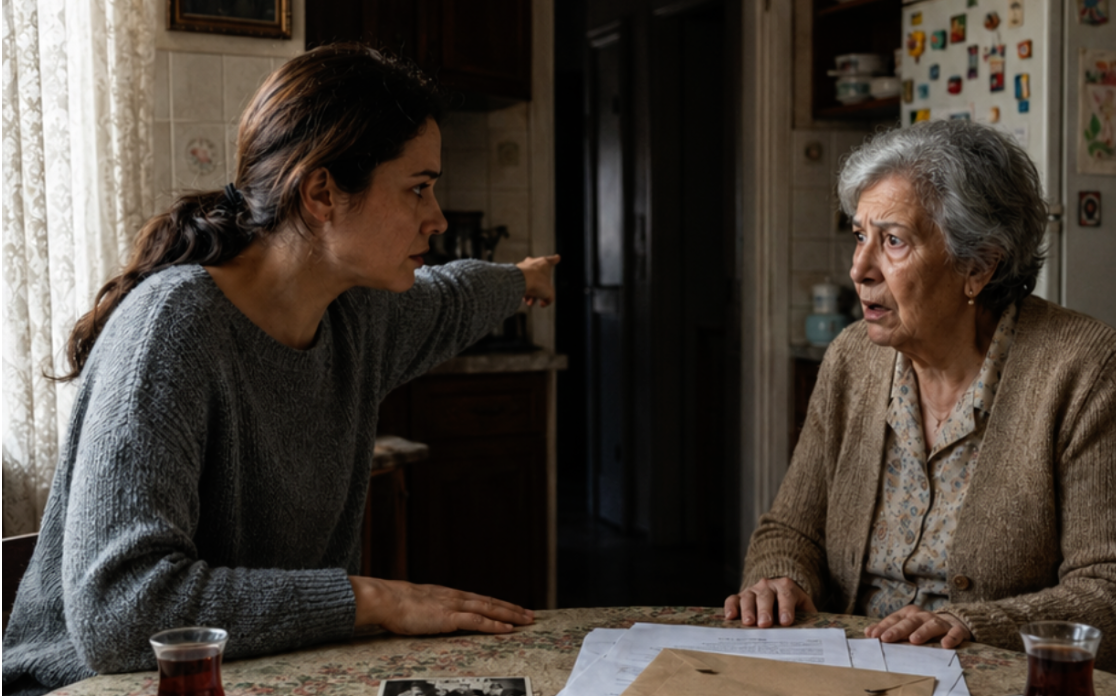
“Sign right here, Marina Andreevna, and the property will be legally transferred to your mother-in-law,” the lawyer murmured. He slid a heavy brass pen across the polished mahogany of his desk, his eyes fixed firmly on a manila folder. To him, this was merely another mundane transaction. To Marina, it was a sudden, violent severing of the reality she thought she knew.
The small, claustrophobic office was suffocating, heavy with the scent of stale espresso and the harsh, metallic tang of an overworked space heater. Outside the frosted windowpane, the first wet snow of December was falling, blanketing the city in a gray, unforgiving slush. Beside Marina sat Tamara Viktorovna, her hands folded with agonizing, practiced precision in her lap. Her mother-in-law was staring at the blank wall, wearing a meticulously crafted mask of meek suffering. Over seven years of marriage, Marina had memorized the geography of that expression. It was the face Tamara wore whenever she was quietly, ruthlessly wresting control—a flawless portrait of a woman sacrificing herself for the greater good of the family.
“Wait,” Marina said. Her voice cut through the stagnant air as she physically pushed the pen away. “What house? This is my grandmother’s country estate. It is my inheritance. What could this possibly have to do with my mother-in-law?”
“Oh, Marinochka, please,” Tamara Viktorovna purred, turning her head slowly. Her tone was as thick, sweet, and suffocating as honey left to crystallize in the sun. “We discussed this thoroughly yesterday. Kostya explained the rationale to you.”
Kostya. Her husband. The man who had conveniently become stuck at a critical construction site that very morning. The man who had spent the entire previous evening hiding behind the glowing, isolating screen of his smartphone, offering only monosyllabic grunts in response to her questions.
A paralyzing chill crept into Marina’s fingers. “No,” she replied, her voice dropping to a terrifying, absolute quiet. “We did not discuss this. Kostya told me we needed to finalize some municipal land survey paperwork regarding Grandma’s property. I came here under the impression I was helping.”
The lawyer cleared his throat, suddenly finding the crown molding of his office utterly fascinating. Meanwhile, Tamara was already producing a pristine white handkerchief from her leather purse, preparing to dab at eyes that were entirely, objectively dry.
“My dear child,” Tamara began, wielding her words like velvet-wrapped blades, “why must you always resist? I am only trying to shield you. You are young; you lack foresight. I have lived a long, arduous life, and I understand the sudden perils of property ownership. Debts, unexpected heirs, liability—anything can happen. It is simply safer, logically speaking, to place it in my name.”
“Meaning what, exactly?” Marina’s voice trembled, betraying the hurricane of realization making landfall in her mind.
Tamara unleashed a heavy, theatrical sigh—the burden of a martyr forced to deal with an incompetent, outsider daughter-in-law. “Always so ungrateful,” she whispered to the room at large.
It was a word Marina had swallowed for seven years, alongside useless, incompetent, and outsider. Marina stood, her movements deliberately slow, and gathered the documents.
“I am signing nothing today. I am going home to speak with my husband.” She walked to the bus stop through the biting wind. The physical cold was nothing compared to the absolute, shattering clarity settling in her chest. Kostya knew. He had orchestrated this ambush because he lacked the spine to look his wife in the eye and ask for her birthright.
The house in question was a small, creaking sanctuary with an expansive apple orchard planted by her grandmother, Zoya. It was a physical repository of Marina’s childhood, smelling of samovar tea and echoing with Zoya’s fierce, unwavering wisdom: > “Marisha, never surrender what is yours. You must protect your boundaries.”
When she unlocked the door to their apartment, Kostya was sitting at the kitchen table, idly stirring a lukewarm cup of tea, scrolling through his phone. He looked remarkably leisurely for a man supposedly trapped at an emergency job site.
“Back already?” he asked, attempting a disarming smile that failed entirely to reach his eyes.
Marina dropped her bag. “You knew.”
The smile dissolved like sugar in hot water. “Marish, let’s not—”
“You knew she wanted my grandmother’s house transferred to her name. You sent me into a legal ambush alone so you wouldn’t have to watch.”
Kostya unleashed a long, patronizing sigh—the universal signal meant to convey that a woman simply did not grasp the complexities of the real world. “Mom is just worried about our financial leverage. We have a mortgage. If the house is in her name, it’s protected from our liabilities.”
“Our mortgage is on this apartment. What does my family inheritance have to do with it?”
He wouldn’t look at her. “If we run into financial trouble…”
“Tell me the truth, Kostya.” Marina stepped directly into his line of sight.
The silence stretched, agonizing and heavy, until he finally cracked under the weight of his own cowardice. “I took out a loan. A small one, for Mom’s back treatments and a health resort. I couldn’t say no to her. And… I promised her the house could serve as collateral.”
Marina sank into the nearest chair, her legs suddenly hollow. “You promised my grandmother’s house to a bank. For your mother.”
“She’s my mother! We’re a family, everything is shared!”
“Shared,” Marina repeated, a bitter, hollow laugh escaping her lips. “It is ‘shared’ when you want to extract a resource from me. But when your mother has been wiping her feet on my dignity for seven years, it is ‘just how she is.’ You never protect me.”
Marina stood and walked into the bedroom, closing the door on seven years of normalized betrayal. The scent of baked milk and fresh blini wrapped around Marina as she stepped into Aunt Galya’s modest, honest apartment. Over tea, Marina unspooled the entire ugly tapestry of her marriage—the invasive tidying of her closets, the hostile takeovers of her kitchen, the deliberate undermining of her parenting, and Kostya’s eternal, enabling refrain of “Be patient.”
Galya listened in grim silence. Then, she retrieved a battered faux-leather folder from a heavy oak cabinet.
“When Zoya’s health failed, she gave this to me,” Galya said, laying a thick, notarized document on the table. “She saw right through Kostya at your wedding. She knew he would always place his mother on a pedestal above his wife. So, she didn’t just leave you the house. She attached a legal failsafe.”
Marina read the dense legal jargon, her breath catching. The deed of gift stipulated that if Marina attempted to sell, gift, or use the property as collateral within twenty-five years, ownership would automatically and irrevocably revert to Galina, who could then return it whenever the threat had passed.
“If they force your hand, the house becomes mine,” Galya explained softly. “Your grandmother is still protecting you, Marisha. Even from beyond.”
Marina buried her face in her hands, weeping from the profound, crushing relief of being fundamentally understood and fiercely protected. The next morning, Marina returned to an apartment thick with tension. Kostya looked thoroughly rumpled, having slept on the sofa.
“Mom is having heart palpitations,” he began defensively.
Marina bypassed his manipulation entirely and dropped the copies of the deed on the table. “Read.”
She watched his face transition through the stages of grief for his own foolishness: confusion, comprehension, and finally, stark, unadulterated panic.
“It goes to your aunt?” he stammered. “But my loan…”
“Will remain exclusively your problem,” Marina said, her voice forged in iron. “Your mother doesn’t want financial security; she wants absolute control over you, me, and our daughter. The house was just another leash. And you tried to hand it to her.”
Kostya stared at his hands. “What do I do?”
“I am giving you one chance,” Marina said, outlining her boundaries with architectural precision.
First: You go to your mother and tell her she gets nothing. You take back our apartment keys today.
Second: You pay off that loan yourself. Sell your car if you must.
Third: We go to a marriage counselor.
“If you ever hide behind her again, I will file for divorce. This is my boundary.”
For the first time, Kostya looked at her not as an extension of his household, but as a sovereign individual with her own agency. “I agree.”
“Don’t agree with me. Go tell her.” When Kostya finally stood his ground, Tamara’s theatrical wails of betrayal echoed through her building. But Kostya held firm, demanding basic respect for his wife as the non-negotiable price of his presence.
It took a year of grueling, exhausting therapy. There were days of hoarse shouting and profound, icy silences. Yet, Kostya slowly untangled himself from his mother’s emotional enmeshment. He sold his beloved car, rode the bus, and paid his debt, learning the heavy, rewarding labor of being a true partner.
Tamara Viktorovna’s visits became sparse and remarkably restrained. The true olive branch came not in words—which her pride could not muster—but in a jar of homemade Antonovka apple preserves, placed silently on Marina’s table.
Years later, at the summer house, their daughter Vera chased fireflies through Zoya’s orchard. The house remained untouched, the deed safely hidden in Aunt Galya’s tin.
Marina had evolved. She was no longer the silent vessel for passive aggression. She had learned the ultimate, profound lesson her grandmother had woven into that legal document: A home is not merely timber and brick. A home is a physical manifestation of a boundary. And a boundary is the truest expression of respect—respect for oneself, and for the sanctuary of a life built with those who love you for who you are, not for what they can extract from you.