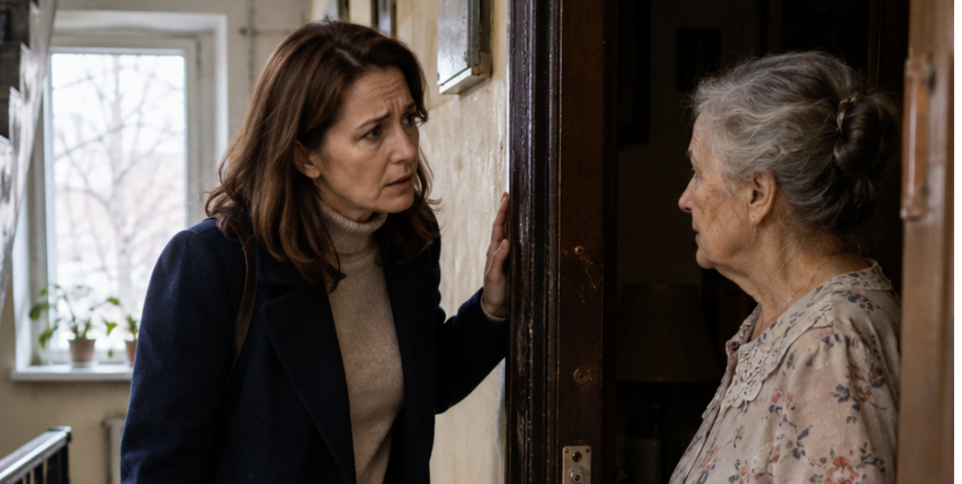
Her mother-in-law slammed the door of Anna’s own apartment in her face—the apartment Anna had spent ten years paying for out of her salary.
Anna stood on the landing with grocery bags in her hands, unable to understand what was happening. Her key would not turn. The lock had been changed. Her bag of belongings sat on the doorstep, neatly packed and tied with string as though it were being sent off to a country house.
“Tamara Ivanovna, open the door!” Anna pounded on it with her fist. “What is the meaning of this?”
There was silence behind the door. Then her mother-in-law’s voice rang out—sweet and syrupy, the kind that always made Anna grit her teeth.
“Anya, sweetheart, you should go. Go on. Dima will explain everything. He and I have talked it over and made a decision. As a family.”
“As a family?” Anna felt the grocery bags growing heavier in her hands. “This is my apartment, do you understand? Mine!”
“There’s no need to shout in the stairwell,” her mother-in-law said in a singsong voice. “The neighbors will hear you. You’re a respectable young woman. Go stay with your mother and get some rest. Dima and I will sort everything out in the meantime.”
Anna sank onto the step. The bags of milk and bread stood beside her like witnesses to her humiliation.
Ten years. Ten years of work. Ten years of monthly payments of thirty-five thousand rubles. Ten years without vacations, new clothes, or lunches at cafés with her friends.
And now there was a bag of her belongings on the doorstep.
She took out her phone and called her husband. It rang and rang, the long, indifferent tones echoing in her ear.
He wasn’t going to answer. Of course he wasn’t.
Ten years earlier, Anna had been a different person: twenty-seven, naïve, and head over heels in love. Dima had been charming and attentive. He said that he dreamed of having a large family. He also made incredible coffee and did a hilarious impression of his boss. Anna fell in love with him within two months.
Her mother-in-law, Tamara Ivanovna, cried at their wedding. She hugged Anna tightly and whispered in her ear:
“My dear daughter, take care of my Dimochka. He’s my only child, such a sensitive boy.”
Anna had been touched. She thought her mother-in-law seemed like a kind, caring, homely woman in an apron decorated with sunflowers.
The first warning sign appeared a month after the wedding. The newlyweds lived in a rented one-bedroom apartment. Anna worked as an economist at a bank, while Dima was a sales manager at a small company. Their salaries were barely enough to cover their expenses.
Even then, her mother-in-law began arriving without warning.
“Anya, I brought you some pies. Dimochka loves the ones with cabbage.”
Anna would open the door and find her mother-in-law carrying a bag that contained not only pies but also three saucepans, a bucket of pickles, and a stack of bed linens.
“What do we need the linens for, Tamara Ivanovna?”
“What do you mean? Everything you have here is new and synthetic. Dimochka has been used to natural fabrics since childhood. I’ll wash and iron them and check whether you’re keeping the apartment tidy while I’m at it.”
She would not leave until three days later.
Dima remained silent. He always fell silent whenever the subject concerned his mother. It was his greatest skill—hiding behind his mother’s broad back and pretending that none of it had anything to do with him.
When Anna suggested taking out a mortgage, her mother-in-law caused her first major scene.
“What mortgage? Why? Come live with me! My three-bedroom apartment is practically empty, and Dimochka’s room is as good as new.”
“Tamara Ivanovna, we want a home of our own.”
“Your own?” Her mother-in-law pursed her lips. “And where will the money come from? Dimochka doesn’t earn much, and you know that. What do you expect from him?”
“I’ll take out the mortgage in my name. I earn a good salary.”
Her mother-in-law looked at Anna as though she had suggested eating a frog.
“In your name? So the apartment will belong to you, while my son will have no rights there?”
“Tamara Ivanovna, we’re husband and wife. What do you mean, no rights?”
Her mother-in-law said nothing, but Anna noticed the corner of her mouth twitching. She realized that Tamara Ivanovna would not forget this.
The apartment was registered in Anna’s name. The mortgage term was fifteen years, with monthly payments of thirty-five thousand rubles. They agreed that Dima would contribute ten thousand and Anna twenty-five thousand.
A year later, Dima lost his job. He found another one that paid less. Two years later, he lost that one as well. Then it happened again.
Each time, his mother arrived with pursed lips and said:
“Anya, you’ll have to be patient. Dimochka is talented; people simply don’t appreciate him. Cover his share of the payments for now.”
Anna did.
She worked in the evenings, took on freelance projects, slept five hours a night, and continued paying the mortgage.
Meanwhile, her mother-in-law moved in with them “for a couple of weeks” after a pipe had supposedly burst in her apartment. Those couple of weeks stretched into six months.
Tamara Ivanovna took over the small room that had been intended as Anna’s study and settled in extravagantly: religious icons on the walls, a portrait of her late husband on the bedside table, and knitted rugs covering the floor.
Anna put up with it.
Every evening, Dima whispered to her:
“Anya, Mom has grown accustomed to our home. She’s all alone. Where is she supposed to go?”
“Dima, she has an apartment of her own. A three-bedroom apartment in the city center.”
“It’s damp there. And there are too many memories. Anya, would it really hurt you to let her stay?”
Anna did not resent having to share.
She felt sickened by it.
Her mother-in-law imposed her own rules. She decided what groceries they bought. She rewashed the dishes after Anna because “your hands are useless and you leave streaks.” She entered their bedroom without knocking. She opened Anna’s wardrobe and said:
“Anya, why do you need so many clothes? You should dress more modestly. You’re a married woman.”
Dima remained silent.
Anna worked.
And she paid the mortgage.
In the seventh year of their marriage, her mother-in-law brought over some notarized documents. She placed them in front of her son on the kitchen table and solemnly announced:
“Dimochka, I’m transferring my apartment to you. That way, you’ll have something of your own—something that belongs entirely to you. I’m old now. I don’t need anything.”
Dima broke into a broad smile. Anna raised an eyebrow.
“Tamara Ivanovna, that’s your decision. I have no objection.”
“Who asked you?” Her mother-in-law did not even look at her. “This is a family matter. It doesn’t concern you.”
“It doesn’t concern you.”
Anna had heard those words a thousand times over the years.
“Don’t take offense, Anya,” Tamara Ivanovna said, stretching her lips into a false smile. “Dimochka simply needs to own something of his own. Just in case.”
“In case of what?” Anna asked.
Her mother-in-law did not answer. She merely gave her son a meaningful look. Dima lowered his gaze to his plate.
Anna did not sleep that night. She thought about the words “just in case.” She thought about the fact that her husband had not learned to defend her in ten years. She thought about how her mother-in-law had spent years building a nest inside Anna’s apartment, pushing Anna out of her own home one inch at a time.
And she thought about how tired she was.
Another year passed, and the conversations about having a child began.
“Anya, you’re already thirty-six,” her mother-in-law repeated at every dinner. “Your biological clock is ticking. Why are you waiting?”
“Tamara Ivanovna, we’ll decide for ourselves.”
“You’ll decide, you’ll decide… Dimochka needs an heir. The family line must continue.”
“The family line?” Anna finally lost her patience and laughed. “What family line, Tamara Ivanovna? We’re not aristocrats.”
Her mother-in-law was offended and refused to speak to Anna for three days. On the fourth day, she returned with pies as if nothing had happened.
Meanwhile, Dima began staying late at work more frequently. He came home late, smelling of another woman’s perfume.
Anna did not cause a scene. She did not have the strength. She simply watched.
At the same time, she was doing something else.
Anna was no longer the naïve young woman she had been ten years earlier. Working at the bank had taught her a great deal. She knew how to read contracts. She knew how to document payments. She knew which records needed to be collected and preserved.
For all ten years, she had kept the mortgage receipts, every income certificate, and every bank statement. She had a separate folder—a thick, heavy folder containing ten years of her life transformed into documentary evidence.
Anna did not know why she had saved it all. She simply sensed that she might need it one day.
And now she did.
On the evening her mother-in-law slammed the door in her face, Anna sat on the step for about ten minutes. She breathed slowly and gathered her thoughts.
Then she stood, picked up the groceries and the bag of her belongings, went downstairs, and drove to her mother’s house.
Her mother opened the door and immediately understood that something had happened. She asked no questions at first. She simply embraced her daughter, took the bags, and put the kettle on.
“Anya, what happened?”
“Mom, they threw me out of my apartment.”
“Who did?”
“My mother-in-law. She changed the locks. Dima must have helped her.”
Her mother sat down opposite her. A thin, gray-haired woman with work-worn hands, she had spent her entire life working as a nurse and had raised Anna alone, without a husband. She knew how to withstand a blow.
“What are we going to do, sweetheart?”
“Mom, I know what I’m going to do. I need your support—and a few days.”
Her mother nodded.
“This is your home. Stay as long as you need.”
Anna made up the bed in the little room where she had grown up. It was the same bed, the same lamp on the bedside table, and the same wallpaper covered with tiny flowers. It was as if she had gone back twenty years.
But she was different now. She was no longer a young woman dreaming of a large family. She was a woman who knew the value of every word, every payment, and every promise.
The following morning, Anna called her colleague Svetlana. Svetlana was a lawyer—not exactly a friend, but someone she knew through work. Anna knew she needed a professional.
“Sveta, I urgently need a consultation.”
“Anya? What happened?”
“It’s a long story. Can I come see you today?”
Svetlana was at her office an hour later. They sat in a small room overlooking the courtyard while Anna placed one document after another on the desk.
“Here is the ownership certificate. The apartment is registered solely in my name. It was purchased before the marriage—I paid the down payment two months before the wedding.”
“That’s already excellent,” Svetlana said, making notes. “What else?”
“Here are the mortgage receipts for all ten years. I made every payment myself from my own account. My husband occasionally gave me cash, but there are no receipts.”
“So legally, you were the only person making the payments?”
“Yes.”
“Anna, this is an ideal situation. What else?”
“My mother-in-law has been living in my apartment for three years. She isn’t officially registered there, and there is no agreement. She simply lives there and uses my property, my furniture, and my appliances. This morning, she changed the locks on my apartment and refused to let me into my own home.”
Svetlana looked up.
“Anya, do you understand that this is a criminal matter? It’s an act of arbitrariness under Article 330.”
“I understand.”
“Are you prepared to see this through?”
Anna looked at her calmly. There was neither rage nor hysteria in her eyes—only the quiet, unwavering determination of a woman who had spent ten years gathering her strength and was finally prepared to use it.
“Sveta, I’m ready. I’m no longer the daughter-in-law who will tolerate everything. I am the owner, and I’m going back to my home.”
Svetlana smiled.
“Then let’s get to work.”
After that, events unfolded quickly.
That same day, Anna filed a police report concerning the unlawful interference with her rights. She attached her ownership certificate and a copy of her passport. She explained everything in detail and without emotion.
The following morning, the local police officer was already knocking on the door of her apartment. Dima opened it, disheveled and wearing sweatpants. His mother hovered behind him in her dressing gown.
“Good morning. I’m looking for Anna Viktorovna Sokolova. Does this apartment belong to her?”
“Yes,” Dima muttered, turning pale.
“Then why isn’t she living here?”
“Well… we had an argument.”
“I understand that you had an argument. But who changed the locks?”
His mother-in-law peered over her son’s shoulder.
“I did. So what? This is a family matter!”
“Ma’am,” the officer replied evenly, “the owner of this apartment is Anna Viktorovna. You are not registered as a resident here. Preventing the owner from entering her home is an offense. The original locks must be restored within an hour. Otherwise, we’ll draw up an official report.”
Tamara Ivanovna turned pale. She was accustomed to solving every problem with smooth speeches and tears, but the officer looked at her without sympathy—as he would look at any offender.
“Dima!” she shrieked. “Tell him!”
Dima remained silent.
As always.
An hour later, the previous locks had been restored. Anna arrived, opened the door with her key, and entered the apartment.
Her mother-in-law was sitting on the sofa in the living room. Her face was red and her eyes were blazing with anger. Dima stood by the window.
“Tamara Ivanovna,” Anna said calmly, “you have three days to pack your belongings and move out. In three days, I’ll call the bailiffs.”
“What bailiffs?” her mother-in-law exploded. “I’m your husband’s mother!”
“My former husband’s mother,” Anna corrected her. “I’m filing for divorce.”
At last, Dima opened his mouth.
“Anya, don’t do this. We can talk.”
“Dima,” Anna said, looking at him with something close to pity, “we’ve been ‘talking’ for ten years. Yesterday, you helped your mother throw me out of my own home. What else do you want to say?”
He lowered his head.
“I didn’t mean to…”
“You never mean to do anything,” Anna said gently. “That’s the problem.”
Three days later, her mother-in-law moved out. She packed up her icons, portraits, knitted rugs, and three saucepans. She returned to the three-bedroom apartment she had transferred to her son a year earlier.
That was an interesting matter in itself. Anna learned from her lawyer that the gift transfer could potentially be challenged if it could be proven that Dima had used marital funds to maintain the apartment. But Anna decided not to get involved.
They could choke on it for all she cared.
Dima moved out with his mother.
Anna remained in her apartment.
Alone.
For the first time in ten years.
On the first night, she could not sleep—not because she was sad, but because she was unaccustomed to the silence. Nobody walked through the corridor. Nobody opened the door without knocking. Nobody clattered saucepans in the kitchen at six in the morning.
She got up the next morning, made herself coffee, and sat on the windowsill for a long time, watching the courtyard awaken. The cup warmed her hands. Sparrows chirped outside.
For the first time in many years, Anna felt that she was home.
In her own home.
Where she was in charge.
Their divorce was finalized two months later. Dima did not contest it, and there was nothing to divide. The apartment was hers, the car was hers, and the savings were hers. He had nothing except the three-bedroom apartment his mother had given him.
After the final court hearing, he approached Anna in the hallway. He had lost weight and looked worn out.
“Anya, forgive me.”
She looked at him and suddenly realized that she felt neither anger nor resentment. There was only a faint regret, like the feeling one has for something that ended long ago.
“Dima, it isn’t your fault. This is simply who you are. Your mother raised you this way. It’s all right.”
“And are you… Are you happy?”
Anna considered the question.
Was she happy?
She thought about waking up alone in her own bed. She thought about walking to work because it was spring and she wanted to breathe the fresh air. She thought about spending her evenings watching television series with her legs stretched across the sofa, without anyone criticizing her.
She thought about her mother visiting on Saturdays and the two of them baking a pie simply because they felt like it. She thought about the new wallpaper she had put up in the living room—the same wallpaper her mother-in-law had once called vulgar—and how she admired it every day.
“You know, Dima,” Anna said, “I’m finally living. Truly living. I’m not surviving, enduring, or convincing myself to hold on a little longer. I’m simply living. And that is happiness.”
He nodded silently.
As always.
Anna turned and walked toward the exit.
The March sun was shining outside. The sky was reflected in a puddle—high, clear, and springtime blue. Anna stopped to look at the reflection and smiled.
Ten years earlier, she had married dreaming of a large family, a warm home, and people who would love her.
She had not managed to build that family.
But she did have a real, warm home of her own.
And no one would ever take it away from her again.
Six months later, Anna renovated the apartment. She arranged everything herself—hiring workers and choosing the tiles, curtains, and furniture.
Apparently, her mother-in-law sometimes complained to Dima:
“That witch has turned our apartment into something beautiful, while you and I sit here like a pair of paupers.”
Dima remained silent.
Dima always remained silent.
Anna lived her life. She worked, met her friends, and went on vacation. For the first time in many years, she traveled to Turkey alone—and it was wonderful.
While sitting beside the sea, she realized that a woman could be happy without a husband, without a mother-in-law, and without shared Sunday lunches.
One day, Anna was promoted at work and became the head of her department. Her salary increased by fifty percent. She paid off the mortgage six months ahead of schedule and threw herself a celebration. She bought a bottle of champagne, ordered pizza, and spent the entire evening dancing in the kitchen of her apartment—within her own walls, inside the real home she had suffered so much to obtain.
She remembered her mother-in-law’s words:
“Anya, you should go. Go on. Dima will explain everything. As a family.”
There was little that was truly familial about Tamara Ivanovna. She had gotten her son back, but he turned out to be a forty-year-old man with no job, no wife, and no plans. He lived at his mother’s expense, and the burden was gradually beginning to wear her down.
Anna, meanwhile, had her apartment, her career, her mother, who occasionally stayed overnight, her friends, her travels, and her freedom.
She also had something else—something she had never possessed before.
Self-respect.
Anna learned to value herself as a real family would have valued her, had she ever had one. She became the family she had lacked throughout her life.
Sometimes, while sitting on the windowsill in the evening with a cup of tea, Anna thought about everything that had happened—about how her mother-in-law had tried to break her, how her husband had betrayed her, and how she had spent ten years living according to someone else’s script until the day she finally wrote her own.
She regretted nothing.
Her mother-in-law had called her “a barren flower” more than once—behind her back, of course, but always loudly enough for the words to reach her.
“That barren flower” had been one of Tamara Ivanovna’s favorite expressions.
Anna smiled whenever she remembered it.
A barren flower—a flower that bore no fruit.
Anna’s fruits grew in a different way. She had no children, but she had an apartment, a successful career, her preserved sanity, and newfound freedom.
And the most important fruit of all was Anna herself—the woman she had finally become.
The woman who would never again allow anyone to slam the door of her own home in her face.