When I Met My Fiancé’s Parents, I Told Them I Was Just an Ordinary Nurse—Even Though I Was the Chief Surgeon at the Most Expensive Private Clinic in the City
Nazar parked outside an aging five-story apartment building and switched off the engine. For several seconds, neither of us moved.
“They’re good people,” he finally said. “Just old-fashioned. If they say something strange, don’t take it personally.”
I looked at the peeling walls, the crooked bench near the entrance, and the dim yellow windows above us.
At Vector Clinic, everyone knew me as Dr. Darina Pavlovna, chief surgeon. I made life-or-death decisions every day without hesitation. Yet sitting beside Nazar before meeting his parents made me unexpectedly nervous.
“I just want to be an ordinary person tonight,” I said.
He squeezed my hand.
“If anything happens, I’m with you.”
I would remember those words later.
His mother, Larisa Semyonovna, welcomed us warmly. The apartment smelled of roasted meat and fresh pastries. His father, Miron Petrovich, was less welcoming. A broad-shouldered gray-haired man, he shook my hand briefly and studied me as if evaluating a purchase.
Dinner began politely enough.
Then came the questions.
“Your parents?”
“Doctors.”
“So you went into medicine too?”
“Yes.”
“Where do you work?”
“A private hospital.”
He looked at me carefully.
“As a nurse?”
I hesitated.
I could have told him the truth—that I headed the surgical department at one of the most prestigious clinics in the city. But I was tired of people changing their behavior the moment they heard my title.
“Yes,” I said calmly.
Miron Petrovich smirked.
“A nurse. I see.”
Nazar stiffened beside me.
His father put down his fork.
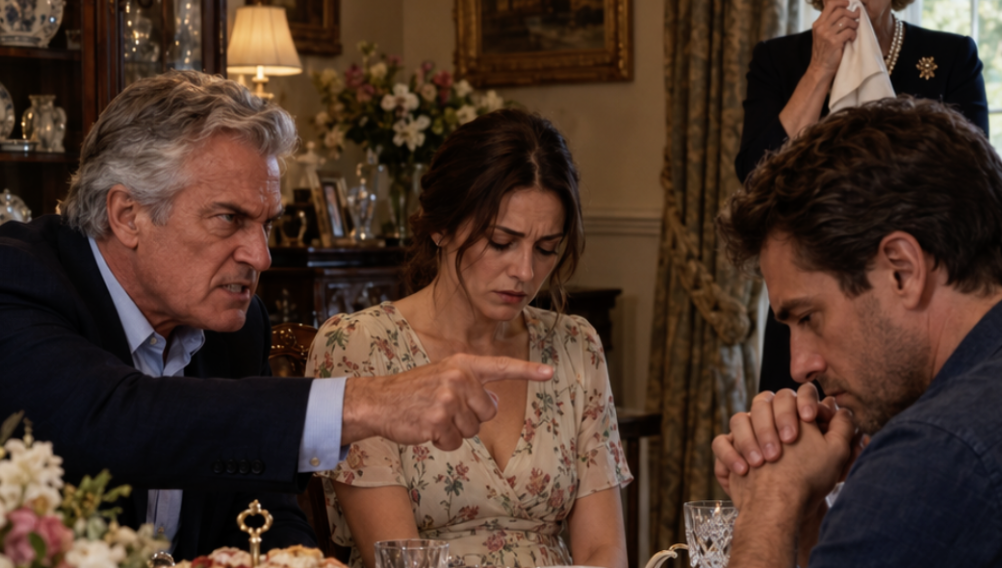
“I thought Nazar would eventually find a woman on his level. Someone with education and status. He runs a construction company, after all.”
“Dad,” Nazar warned.
“What? I’m telling the truth. Marriage isn’t only about love. There are mortgages, children, expenses. What can a nurse contribute?”
I felt disappointment rather than anger.
“A nurse’s salary may not be large,” I said, “but that doesn’t make her less worthy of respect.”
“I didn’t say it did. Everyone simply has their place. Some people make decisions; others follow instructions.”
I waited for Nazar to defend me.
He said nothing.
That hurt more than his father’s words.
Before I could respond, someone rang the doorbell.
Larisa opened it, and a terrified neighbor rushed inside.
“Miron Petrovich, please help! My father collapsed. He can barely breathe. The ambulance says there are no available vehicles!”
I stood immediately.
“Where does he live?”
“Next building.”
Miron waved dismissively toward me.
“She’s a nurse. What can she do? You need a doctor.”
I ignored him.
“Nazar, come with me.”
We ran downstairs and into the neighboring building.
An elderly man lay on the kitchen floor, his face bluish, his breathing shallow and irregular.
“Everyone move back!” I ordered.
The room went silent.
I knelt beside him and checked his pulse.
Weak. Dangerously weak.
“Nazar, bring me two pillows. Call the ambulance again. Tell them the patient may have acute cardiac tamponade with severe hypotension. We need a resuscitation team.”
Everyone stared at me.
Miron Petrovich had followed us and now stood frozen in the doorway.
“Darina… why are you giving orders?”
I looked up sharply.
“If you want your neighbor to survive, stay out of the way.”
He fell silent.
The man’s blood pressure was roughly seventy over forty.
I questioned his son.
“Heart disease?”
“Yes. Ischemia. High blood pressure. He had a heart attack last year.”
My phone buzzed.
It was the director of Vector Clinic.
“Nazar, answer it. Tell him Dr. Darina Pavlovna is assisting with an emergency resuscitation. Ask them to prepare the cardiac team.”
Nazar took the phone.
Behind me, Miron Petrovich whispered:
“Dr. Darina Pavlovna?”
I kept working.
When the ambulance doctor arrived, I quickly summarized the patient’s condition.
He stared at me.
“Dr. Darina Pavlovna? What are you doing here?”
“Helping. Do you have an IV catheter?”
“Yes, but—”
“No ‘but.’ Open the kit.”
Within minutes, we established access and began stabilizing the patient. The paramedic followed my instructions without question.
Miron Petrovich watched in stunned silence.
About ten minutes later, the man’s pulse strengthened and his breathing improved.
He opened his eyes.
“Where am I?”
“You’re at home,” I told him gently. “You’re going to the hospital now.”
He squeezed my hand.
“Thank you.”
After they took him away, his son repeatedly thanked me.
I turned to Nazar.
“Take me home.”
Outside, the rain had stopped.
Before getting into his car, I looked at him.
“Did you know your father would behave like that?”
“No. I hoped he’d behave decently.”
“He didn’t.”
“I know.”
We drove in silence.
When we reached my apartment, he took my hand.
“Darina, forgive me.”
“For what?”
“For not defending you.”
I looked at him.
“This isn’t about your father anymore. It’s about you. You sat beside me while he humiliated me.”
“I froze. I’m sorry.”
“You froze while I was being insulted. Then minutes later, I saved the life of a stranger without hesitating. Maybe you need to stop freezing.”
I got out of the car.
At home, a message from my clinic director appeared on my phone.
The patient had arrived safely and was stable.
I stared through the dark kitchen window.
In an operating room, I always knew exactly what to do. Around the people who might have become my family, I had felt powerless.
Perhaps titles were never the real issue.
The problem was whether people could see the human being behind them.
The next morning, Nazar returned to his parents’ apartment.
His mother was crying. His father stood by the window.
“You should apologize,” Nazar told him.
“For what? She told us she was a nurse.”
“That’s exactly the problem. You judged her because you thought she was a nurse.”
Then Nazar told them everything.
“She’s the chief surgeon at Vector Clinic. She performs heart surgery. Doctors across the city know her.”
His mother gasped.
“We didn’t know.”
“And if she really had been a nurse?” Nazar asked. “Would that have made your insults acceptable?”
His father had no answer.
Finally, Miron sighed.
“I was wrong.”
“That’s not enough.”
Nazar left.
The following morning, I went to work.
My first operation was a heart-valve replacement. For three hours, nothing existed except the patient, the monitors, the instruments, and the rhythm of a beating heart.
When I finished, my administrator sent me a message.
“Dr. Darina Pavlovna, Miron Petrovich is waiting to see you.”
I was surprised.
He entered my office wearing an old raincoat, nervously twisting his cap in his hands.
“I came to apologize,” he said.
I waited.
“I didn’t know what kind of specialist you were. If I had known…”
“That’s the problem,” I interrupted. “If you had known.”
He lowered his eyes.
“Are you apologizing because you regret what you said, or because you discovered who I am?”
“Both,” he admitted.
Then, after a pause, he revealed why else he had come.
The construction company where he worked was nearing bankruptcy. They were drowning in loans and losing contracts.
“You probably have connections,” he said. “Maybe you could help. As family.”
I almost laughed.
“As family?”
He reddened.
“You told me everyone should know their place. My place is not financing someone who insulted me during our first meeting.”
“But I apologized.”
“An apology doesn’t create an obligation.”
He said nothing.
“You came partly because you learned I might be useful to you.”
His silence confirmed it.
“I don’t hate you,” I said. “But I won’t do business with you.”
He left quietly.
That evening, Nazar came to my apartment with white roses.
“I talked to my father,” he said.
“He came to my clinic.”
Nazar looked surprised.
“He apologized?”
“Yes. Then he asked me for money.”
Nazar’s jaw tightened.
“I refused.”
“You did the right thing.”
I sat across from him.
“But this still isn’t mainly about your father. It’s about you.”
“I know,” he said.
“Why didn’t you defend me?”
“My father has always been difficult. I grew up avoiding conflict with him. I learned to stay quiet and wait for him to calm down. But that isn’t an excuse.”
I studied his face.
“I don’t know whether I can trust you the same way anymore.”
“Give me another chance.”
“I need time.”
“I’ll wait.”
Four days passed.
I threw myself into work and ignored most of Nazar’s calls.
Then Larisa Semyonovna came to my office.
She looked exhausted.
“I’m not here for what my husband wanted,” she said. “I simply came to apologize.”
She explained that Miron had spent his life believing a person’s value depended on achievement. He had started with nothing and built his identity around status and success.
“I’m not excusing him,” she said. “He was wrong.”
She also told me Nazar was barely speaking to him.
Miron had stopped sleeping properly. His blood pressure had risen, and they had needed an ambulance the previous evening.
“Why didn’t you call me?”
“We were ashamed.”
I sighed.
“I never asked Nazar to cut ties with his father.”
“I know. But he says he won’t reconcile until Miron truly understands what he did.”
I agreed to speak with Nazar.
We met at a café near the river.
“Your mother came to see me,” I said.
“I know Dad had a blood-pressure episode. That’s his problem.”
“No. You’re angry on my behalf, but I don’t want to become the reason your family breaks apart.”
“He caused this, not you.”
“Maybe. But punishment isn’t the same as principle.”
Nazar looked at me.
“Are you ready to forgive him?”
“I don’t know. I only know I’m tired of this war.”
He reached for my hand.
“I’m tired too. And I want to prove I can be better.”
I agreed to give him another chance under one condition.
“You speak with your father calmly. No threats. No revenge. But if he disrespects me—or anyone else like that—again, I leave. Permanently.”
Nazar nodded.
“I understand.”
A week later, he called.
“My father wants to see you. Not for money. Just to talk.”
So the following Saturday, I returned to the same apartment.
I deliberately wore the same gray dress.
Miron Petrovich stood near the table.
“Hello, Darina.”
There was no arrogance in his voice this time.
Dinner began quietly.
Then he cleared his throat.
“I was wrong that night. I was rude and unfair. You saved a man’s life while I sat there questioning whether you were worthy of my son.”
I said nothing.
“I was blinded by pride. I thought I knew what made someone successful. I was wrong.”
His eyes filled with tears.
“I’m not asking you to forget. I’m asking for a chance to prove I can admit my mistakes.”
I looked at Nazar, then back at his father.
“I accept your apology. But trust is earned through actions, not words.”
Miron nodded.
“I agree.”
The rest of the evening passed peacefully.
For the first time, we spoke like ordinary people instead of measuring one another by positions, money, or status.
When Nazar and I stepped outside, he smiled.
“That was progress.”
“Yes.”
He took my hand.
“I’m proud of you.”
“And I’m proud of you. But there’s still work ahead.”
“I’m ready.”
He pulled me close and kissed me.
For the first time since that terrible dinner, I believed we might actually recover.
A few months later, Nazar and I married.
The wedding was small, with only close family and friends.
During his toast, Miron Petrovich stood and admitted that his son had chosen a woman stronger and wiser than he had first understood.
I smiled and looked at Nazar.
He had made mistakes.
So had his father.
But both had learned that respect cannot depend on salary, status, or job titles.
I had entered their home pretending to be an ordinary nurse because I wanted to know whether they would accept me without prestige attached to my name.
At first, they failed that test.
But eventually, I realized something else mattered more than passing a test perfectly.
People can recognize their mistakes.
They can change.
And sometimes the willingness to learn, apologize, and become better is worth far more than money.