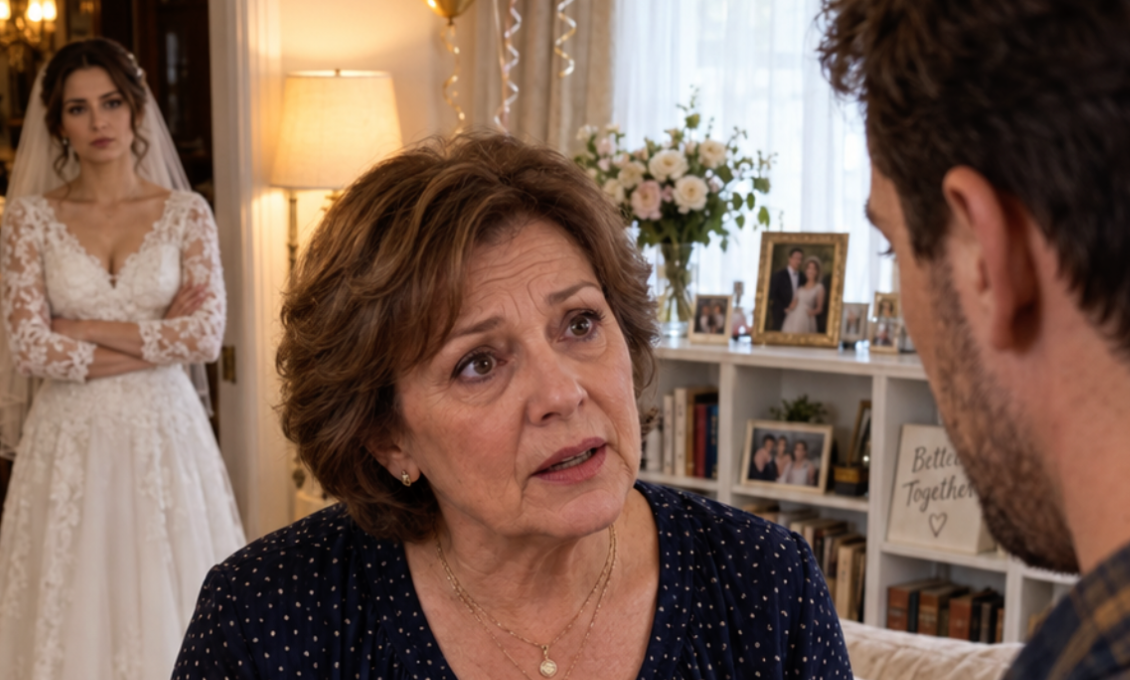
“You Borrowed Almost Half a Million for Your Niece’s Wedding, and Now You’re Just Presenting Me with a Done Deal?” the Wife Said Indignantly
“What are we having for dinner?”
Andrei asked the question casually, as though nothing in the world had changed. He stood in the kitchen doorway holding a bag of groceries, still wearing his shoes, smiling with the familiar expression of a man who had simply come home after an ordinary day at work.
Vera didn’t answer.
Silently, she held up a sheet of paper in front of her—a loan agreement for 480,000 rubles, with a five-year term and monthly payments of almost 13,000. In the borrower field, printed clearly in black and white, was his name: Andrei Kozlov.
A minute earlier, she had been looking for an envelope containing the money she had put aside for dental treatment when she found the document among their papers. At first, she hadn’t even understood what she was holding. She thought it was just another piece of advertising mail from the bank.
There were four days left until payday.
The refrigerator was almost empty. In a month, they would have to pay for their son’s preparatory classes, and Vera herself had already postponed her dentist appointment twice.
She looked at her husband as though she were seeing a complete stranger standing in front of her.
Vera and Andrei had been married for fifteen years, and during that time they had learned not to surprise each other.
They had two growing children: sixteen-year-old Liza, who was preparing for her final exams, and eleven-year-old Misha, who went swimming and still couldn’t manage mathematics without extra tutoring.
The family wasn’t poor, but they lived frugally. They rented a small three-room apartment on the outskirts of the city. Andrei worked as a supervisor at a manufacturing plant, while Vera was an accountant at a small construction company.
Their incomes were stable, but there was almost never any money left over.
They discussed every major purchase together: shoes for the children, sports fees, repairs, medical expenses. After payday, they would sit at the kitchen table with a notebook and divide the money among envelopes—a habit Vera herself had introduced, accustomed as she was to balancing numbers down to the last kopeck at work.
“Look,” she would say, moving aside the envelope marked “Apartment.” “If we don’t touch this one now, by spring we’ll have enough for a down payment.”
That envelope, their most cherished one, had represented their dream for two years.
And it was also the one they constantly had to dip into.
Sometimes their daughter needed money before exams. Sometimes the washing machine broke down. Sometimes their son needed a new suit.
“We’ll have to take money from the apartment savings again,” Vera would sigh while counting the bills. “It’s all right. We’ll catch up.”
She was especially worried about her teeth. The dentist had warned her that she couldn’t delay treatment any longer, but she had already postponed it twice.
“I’ll manage for another month,” she would tell her husband, trying not to show him that the pain had already become part of her everyday life. “After payday, I’ll definitely make an appointment. I promise myself.”
Andrei would usually nod and say that somehow they would manage.
And she believed him because, in fifteen years, he had never given her a reason not to.
Andrei had a younger sister, Marina, forty-three, who had raised her daughter Polina on her own. Polina was about to turn twenty-five.
Marina often complained to her brother about not having enough money, although Vera couldn’t help noticing with confusion that her husband’s sister always seemed to have something new—a renovated apartment, an expensive kitchen set, fashionable clothes for her daughter.
When Polina decided to marry Ilya and the young couple wanted a large wedding, Marina began convincing Andrei that the celebration couldn’t happen without his help.
“You’re her uncle,” she would say. “She’s my only daughter. Are you really going to refuse to help your own niece?”
At first, Andrei promised a modest amount.
But the savings Vera knew about wouldn’t have been enough.
That was when Marina suggested taking out a loan.
“You earn decent money. You’ll pay it off little by little. And Polina will always remember that her uncle didn’t abandon her,” she persuaded him.
Then she added more quietly:
“Just don’t tell Vera. She’ll start counting every kopeck and ruin everything.”
Andrei didn’t hesitate for long.
He took out a loan for 480,000 rubles and almost immediately handed most of the money to his sister.
Silence filled the kitchen.
Vera placed the agreement on the table and asked, trying to keep her voice even:
“Explain to me where this money went.”
Andrei put the grocery bag on the floor and admitted that he had taken out the loan for Polina’s wedding.
“I couldn’t leave my sister on her own,” he said almost pleadingly. “Polina is only getting married once.”
“Why didn’t you tell me?” Vera asked. “We’ve always made these decisions together.”
Andrei looked away.
“I knew you’d be against it.”
That sentence hurt more than the loan itself.
Vera realized that her husband hadn’t simply made a mistake.
He had known in advance that she would refuse, and he had deliberately hidden his decision from her, depriving her of a voice in her own family.
She took their family notebook out of the drawer and silently opened it in front of him.
Rent.
Groceries.
Utilities.
School.
Misha’s swimming lessons.
Liza’s exam preparation.
Her dental treatment.
And, heavily underlined, their apartment savings.
With the new monthly loan payment, that last line would practically be reduced to zero.
“What if one of the children gets sick tomorrow? What if the car breaks down? What if I lose my job?” she asked. “Did you even think about any of that?”
Andrei said nothing, staring at the floor.
And his silence was worse than any excuse.
That evening, Liza, who had accidentally overheard fragments of their conversation, quietly peeked into the kitchen.
“Mom, does this mean we won’t have money for my exam preparation now?” she asked, nervously tugging at the sleeve of her sweater.
“We will,” Vera answered, more gently than she felt. “I’ll figure something out.”
After her daughter left, Vera sat alone at the table for a long time.
What hurt most wasn’t even the amount of the debt.
It was the thought that their children might have to start denying themselves things simply because their father had decided to finance someone else’s celebration.
And in that silence, she made a decision.
The family budget would not become a source of money for someone else’s wedding.
Two days later, Marina called.
Her voice was sweet, as though nothing had happened.
“Andryusha told you everything? Oh, don’t be angry. We’re family,” she sang with feigned surprise.
“The loan is enormous, Marina,” Vera replied. “Almost half a million.”
“Andrei is an adult. He has the right to decide what to do with his own money,” Marina immediately changed her tone.
“He didn’t use his own spare money,” Vera reminded her. “He took on debt that our entire family now has to repay.”
“You begrudge money for your own niece?” Marina accused her.
“It isn’t the money I begrudge,” Vera said calmly. “I feel sorry for our children, who are going to have to live with the consequences of your decision.”
Marina hung up.
A few days later, Vera learned the details of the wedding.
A banquet for 120 guests.
A dress costing 90,000 rubles.
A photographer for 40,000.
A separate host.
Music.
Decorators.
A photo area.
And an expensive cake.
No one had even tried to make the wedding more modest.
Andrei’s loan had simply allowed the relatives not to economize at all.
Soon Polina herself came to see her uncle to collect the remaining money.
She was cheerful and excited, telling them that thanks to his help, they hadn’t needed to shorten the guest list.
“Do you know your uncle took out a loan for all this?” Vera asked, looking directly into her eyes.
“I know. Mom told me. But it was his decision,” Polina replied lightly with a shrug.
That sentence finally convinced Vera that the young woman hadn’t even considered the consequences of someone else’s debt.
That evening, Vera spoke firmly to her husband.
“If you want to pay for this wedding, then pay for it. But family money will not be used for the loan.”
She offered him three options.
Marina could return part of the money.
The newlyweds could reduce their expenses.
Or Andrei could find additional work himself.
Andrei was outraged, but for the first time in many years, Vera refused to back down.
“You presented me with a done deal,” she said. “Now I’m presenting you with one: I’m not going to make our children sacrifice things because of a decision you made behind my back.”
Andrei realized that his wife was serious and decided to prove that he could handle it.
He began taking extra shifts at the factory and, on weekends, started doing small repair jobs for neighbors.
During the first few weeks, he was even proud of himself. It felt as though he was making up for what he had done.
But gradually, the workload became exhausting.
He came home later and later.
The children saw him less and less.
One evening, Misha waited for his father until eleven o’clock so he could show him a medal he had won at a swimming competition.
But Andrei came home long after his son had fallen asleep.
Vera saw the medal lying forgotten on the table and felt something beyond anger.
She felt genuine concern.
The secret loan was no longer affecting only their finances.
It was damaging their family relationships too.
At dinner, Liza looked her father in the eyes and asked him directly:
“Dad, why are you working all the time? You’re hardly ever home.”
Andrei looked confused, unable to find the right words.
“You borrowed all that money for Polina’s wedding, didn’t you?” his daughter continued calmly.
He silently nodded, lowering his eyes to his plate.
“If it were me, I’d rather have saved that money for our apartment,” Liza said simply.
That short sentence struck Andrei deeply.
Polina’s wedding was luxurious.
Marina posted dozens of photographs in the family group chat: an enormous banquet hall, expensive flower arrangements, the bride in a lavish gown, a three-tiered cake, dancing late into the night.
Beneath the photos, she wrote:
“Thank you to my brother Andryusha, who made my daughter’s dream come true!”
Vera read the message and didn’t reply.
Andrei stared silently at the photographs for a long time.
Behind that beautiful celebration were months of additional work and years of future loan payments.
For the first time, he truly understood the price of his decision.
Several weeks later, after returning exhausted from another shift, Andrei finally admitted it aloud while sitting in the kitchen.
“I didn’t think it would turn out like this,” he finally forced himself to say. “I just wanted to help my sister, but instead I dragged all of us into this.”
“‘Just wanted to help,’” Vera repeated.
There was no anger in her voice now, only tired bitterness.
“Andrei, you didn’t just help. You made a decision for our entire family in secret, as though the children and I didn’t even exist.”
He tried to say something, then stopped.
Even he understood that making excuses was pointless.
“Marina knows how to pressure people,” he muttered quietly. “I didn’t even notice how I agreed.”
“You noticed,” Vera said firmly. “You simply preferred being convenient for your sister over being honest with me.”
He remained silent.
There was really nothing to argue about.
Their conversation that evening was long and difficult, filled with pauses and cups of tea that went cold.
Eventually, they reached an agreement.
Part of the loan payment would come from the family budget, while Andrei would cover the rest himself through his extra work.
Marina would receive no more money.
And from then on, loans and major purchases would be discussed together.
No secrets.
A couple of months later, Marina called again.
As cheerful as though nothing had happened, she asked for “a little money” toward a down payment on a car for Polina.
“No,” Andrei answered immediately, without hesitation.
Even he was surprised by how easily the word came out.
“Are you serious?!” Marina exploded over the phone. “Vera turned you against me, didn’t she? You used to be normal!”
“Vera hasn’t turned me against anyone,” he said firmly. “I figured it out myself, Marina. Enough.”
He ended the call and looked at Vera.
She silently nodded.
That was enough.
Several months passed.
Money began going into their treasured apartment envelope again.
Not much—three or five thousand at a time—but they were saving again.
Vera finally went to the dentist after delaying the appointment for almost a year.
She came home with a swollen cheek but a feeling of relief.
“At least I finally did something for myself instead of just counting everyone else’s expenses.”
Misha continued carrying wet towels back and forth to the swimming pool and preparing for competitions.
Liza surrounded herself with textbooks and barely left her room.
Andrei was still sending part of his salary to the bank every month, but now he no longer felt the same anger at himself.
He simply treated it as what it was—a debt he had created himself.
One evening, he pulled the old loan agreement out of a drawer, turned it over in his hands, and gave a small humorless chuckle as though speaking to himself.
“You know, I really thought that if I refused, it would mean I was a bad brother. But it turned out to be the opposite. When I hid it from you—that was when I was actually being bad.”
Vera sat down beside him, took the document from his hands, and put it aside.
“Sometimes it’s perfectly normal to say, ‘We can’t afford it,’ Andrei. That isn’t betrayal. It’s simply honesty.”
He didn’t respond immediately.
He only sighed and nodded.
There was no point arguing anymore.
She watched him for another second and quietly added:
“I haven’t forgotten what happened. But I don’t want to keep bringing it up forever either. That’s how we live now, I suppose—little by little.”
At that moment, Misha was yelling from the kitchen because he and his sister were fighting over the last piece of pie, while Andrei was already reaching into the cupboard for a screwdriver to finally tighten a loose cabinet door.
An ordinary evening, like hundreds they had experienced before.
Vera watched the familiar commotion and thought about how her husband had nearly put exactly this—their simple, slightly noisy life—at stake for the sake of someone else’s single celebration.