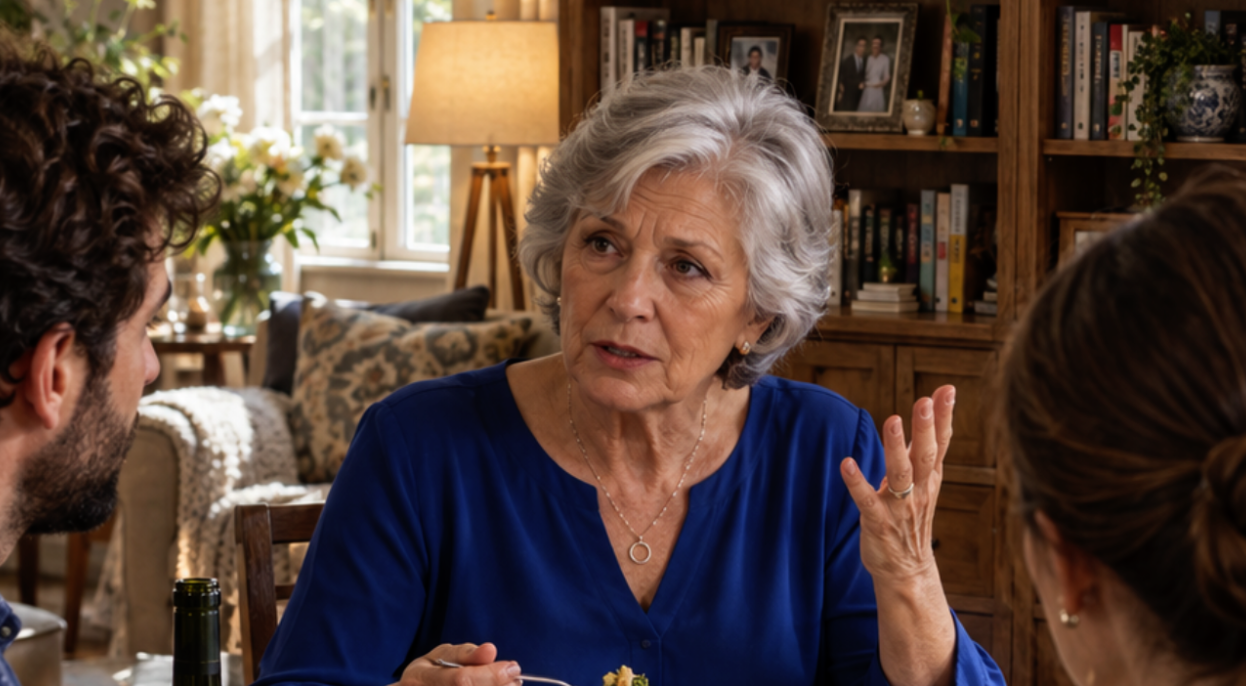
“We’ve decided that you’ll give your parents’ apartment to Anechka, and the country house to your father-in-law and me,” — her husband’s family skillfully divided up her inheritance
“We weren’t doing this for ourselves. You’re having a difficult time right now, so we took care of everything for you.”
Galina Petrovna placed her cup on the table and smoothed out the sheet of paper as though she were straightening a tablecloth before a holiday dinner. Elena stared at it, unable to move. A little more than two weeks had passed. She was still wearing dark clothes, barely sleeping, and struggling to force herself to eat.
There were four items on the sheet, written in neat handwriting. The three-bedroom apartment — for her and Dmitry. Their current apartment — for Oksana and the children. The country house — for Galina Petrovna and Viktor Andreyevich. The car — “they would decide later who needed it more.”
Elena read it twice. Then once again. She thought perhaps she had misheard something. Or misunderstood. But the words on the paper remained unchanged.
Her mother-in-law looked at her with mild bewilderment — sincere, almost offended.
Elena raised her eyes.
Her parents had died.
And their property had already been divided up.
Elena had grown up in a family where money had never been the main topic of conversation. Her father, Sergei Nikolayevich, worked as an engineer at a factory and was quietly proud of it, without making a fuss. On weekends, he disappeared into the garage, where he could spend hours tinkering with tools while humming something indistinct under his breath.
Her mother, Marina Viktorovna, worked as a librarian, grew peonies at their country house, and dried apples for compote every autumn.
They were not wealthy, but over the years they had managed to acquire a spacious three-bedroom apartment, a small timber house in the suburbs with a stove and an old apple tree, and a car that her father maintained so carefully as though it were a living member of the family.
Elena was their only child. She was accustomed to the quiet of that home, the smell of books and machine oil, and the knowledge that everything there had been earned through hard work and carefully preserved.
She met Dmitry at work.
At the beginning of their marriage, Galina Petrovna behaved tolerably — loudly, with excessive concern, but tolerably. Eventually, however, it became clear that her concern was of a special kind. She gave advice no one asked for, took an interest in their finances, and could suddenly decide something “for the good of the family” without warning anyone.
Dmitry always reacted in the same way.
“You know what Mom is like. She just wants what’s best.”
Elena knew.
She simply did not always understand why Galina Petrovna’s idea of “what’s best” so rarely matched what Elena herself wanted.
Everything changed one ordinary evening.
Her father came home from the garage with a dull headache, lay down on the sofa, and asked everyone to keep quiet. By morning, he was worse. He lost consciousness right there in the hallway.
“A severe stroke,” the doctor said briefly, without looking at Elena.
She began going to the hospital every day. She bought medicine, spoke with doctors, and listened to vague answers.
Her mother almost stopped eating.
One day Elena found her putting two plates on the kitchen table out of habit, as though she were preparing dinner for two. Then Marina Viktorovna stood staring at the second plate for a long time, seemingly unable to understand what she was supposed to do with it.
“Mom, Dad needs you alive. Don’t destroy yourself along with him,” Elena told her.
Marina Viktorovna looked up and shook her head.
“Until he wakes up, I have no right to think about myself.”
Dmitry sent Elena a few messages.
“Hang in there.”
“You’re doing great.”
Once Elena asked him to stop by her mother’s place and bring some groceries.
He promised.
And forgot.
Galina Petrovna called as well. But her questions were different.
Who was paying for Elena’s parents’ apartment?
What would happen to the country house?
Elena did not pay much attention to it.
At the time, it seemed impossible to her that anyone could be thinking about property while a person was lying unconscious in a hospital.
She was wrong.
Sergei Nikolayevich died a month later without ever regaining consciousness.
Elena learned about it from the doctor on duty — briefly, in the corridor, between two other conversations.
She called her mother.
Marina Viktorovna rushed to the hospital but arrived too late.
A few hours later, an ambulance had to be called for her right there in the hospital lobby.
Her heart.
For two days the doctors tried to stabilize her condition.
Then they came out to Elena wearing the same expression they had worn the first time.
Elena organized both funerals almost entirely by herself, moving through everything in a daze, on autopilot.
Dmitry attended, helped carry several heavy bags, and said something appropriate at the grave.
That was almost all.
Afterward, Elena returned to her parents’ apartment.
She could not make herself leave.
Her father’s glasses still lay on the armrest of his chair.
A shopping list written in her mother’s handwriting was still attached to the refrigerator:
bread, kefir, buckwheat.
In the hallway stood her father’s old boots — heavy and worn, their laces tied into bows.
On a kitchen shelf sat a jar of preserves with a paper label:
“Plum. August.”
Elena picked up the jar and held it for a long time.
Then she put it back.
The next day Dmitry came over.
He looked around like someone who had come not to visit his late in-laws’ home, but to inspect a property.
“Lena, have you been to the notary yet?”
She turned around.
“What?”
“Well, we need to figure out what we’re going to do with the apartment.”
Elena stared at him for several seconds.
“Dima, they’ve only been gone for two weeks. Two weeks.”
“I understand,” he said with a shrug. “But we have to start dealing with it sometime.”
She did not answer.
She went into the kitchen and put the kettle on.
The boots were still standing in the hallway.
The jar of preserves was still on the shelf.
Elena stood by the stove, waiting for the water to boil, thinking that “sometime” did not mean now.
Definitely not now.
Dmitry did not argue, but he left looking like a man who had failed to get the answer he wanted.
A few days later, Dmitry suggested visiting his mother — “just for dinner, nothing special.”
Galina Petrovna had made meat patties, mashed potatoes, and beet salad.
Everything felt familiar and domestic.
Oksana came without her husband but brought both children, who immediately ran into the next room.
At the table they talked about prices, the weather, and how early autumn had arrived that year.
Then somehow the conversation drifted toward renovations.
“We should have replaced our wallpaper a long time ago,” Oksana said as she spooned mashed potatoes onto her plate. “But everything costs a fortune now.”
“And the children will need separate rooms soon,” she added after a moment.
Galina Petrovna nodded and remarked casually:
“There’s going to be plenty of room in Lena’s parents’ three-bedroom apartment for just the two of them anyway.”
Elena stopped chewing.
“Excuse me,” she said slowly. “Why are you discussing my apartment?”
The table fell silent.
The children were shouting about something in the next room.
“Oh, Lena, they’re just thoughts,” Galina Petrovna said in a conciliatory tone. “We’re only talking.”
“About someone else’s property,” Elena clarified.
No one answered.
Dmitry stared at his plate.
Oksana reached for a piece of bread.
Galina Petrovna adjusted the salt shaker.
Elena pushed her chair back slightly and asked for tea.
The conversation returned to the weather, but something in the room had shifted — as if someone had tilted a painting on the wall, and now everyone could see that it hung crookedly, yet they all pretended everything was perfectly normal.
On the drive home, Elena stared through the car window.
Streetlights drifted past.
Dmitry remained silent.
She kept thinking that she wanted to hear just one simple sentence from him.
“I’m on your side.”
He did not say it.
Not then.
Not afterward.
When they reached their building, Elena got out of the car and said she was going back to her parents’ apartment.
Dmitry did not object.
Elena entered the apartment, switched on the kitchen light, and stood in the middle of the room for a long time without taking off her coat.
Then, almost automatically, she opened the cabinet above the sink.
On the bottom shelf stood her father’s mug with a chipped handle.
She had tried a hundred times to throw it away, and every time her father had said:
“It’s still fine. You can drink from it perfectly well.”
Elena picked up the mug.
Then she put it back.
On the bedside table in her mother’s room lay a magazine, open halfway through, with the corner of the page folded over.
Her mother never used bookmarks.
Elena sat down on the floor beside a box of documents and began sorting through the papers.
Near the bottom she discovered a sheet of squared paper covered in her father’s handwriting:
“Buy a light bulb. Check the kitchen faucet. Pick Marina up from work on Friday.”
She stared at the note for a long time.
Then she pressed it to her chest.
They had not left her a fortune.
They had left her a life — the life they had lived together.
Light bulbs.
Faucets.
Peonies at the country house.
A mug with a chipped handle.
She returned home around eleven.
Dmitry was waiting for her.
He said she had misunderstood his mother.
That everyone had only wanted what was best.
“Where were you when Mom died?” Elena asked quietly.
He hesitated.
“You didn’t come to the hospital. You didn’t help,” she continued evenly, without raising her voice. “But all of you managed to think about what I would inherit before any of you thought about how I was supposed to survive all of this.”
Dmitry began saying something about his mother, about how worried she had been.
Elena stood up.
She walked into the bedroom and opened the wardrobe.
“Lena, you’re emotional right now,” he said from the doorway.
“No,” she replied. “For the first time, I’m finally calm.”
She packed her belongings neatly, without rushing.
For the first time in several weeks, she was not crying.
The notary received her three days later.
Elena arrived with a folder containing the death certificates, her passport, and documents for the apartment, the house, and the car.
She did not ask her husband’s relatives for advice.
She did not call them at all.
Everything turned out to be easier than she had expected.
And at the same time, more difficult.
Every signature was an official confirmation that her parents were truly gone.
She kept the apartment.
She decided not to sell the country house for now. First she would put it in order, and then she would decide what to do.
She kept the car too.
Her father had taken care of it for twenty years.
It was more than just a vehicle.
Galina Petrovna called the next day.
“Lena, I don’t understand how you can do this. Oksana had already counted on it. The children were expecting it.”
“Galina Petrovna,” Elena replied calmly, “other people’s expectations do not turn my inheritance into shared property.”
There was silence on the other end of the line.
“You’ve changed so much,” her mother-in-law finally said.
Her voice sounded hurt, almost confused.
“Yes,” Elena agreed.
And ended the call.
Dmitry tried several more times to talk to her.
He kept insisting that they should not “destroy a family over one argument.”
Elena explained it calmly, and only once.
“This isn’t because of an argument. And it isn’t because of the inheritance. It’s because during the worst moment of my life, you weren’t there. But you had already started doing the accounting.”
He could think of nothing to say.
She filed for divorce at the end of October.
Her hands did not tremble.
Elena began putting her parents’ apartment in order slowly, without rushing.
She did not renovate it.
She simply removed unnecessary things and cleaned the windows.
She left her father’s bookcase exactly where it was.
She moved her mother’s pots of geraniums onto a windowsill where they could get more sunlight.
She had the kitchen faucet replaced.
Her father had been planning to do it for a long time.
Now it no longer dripped.
On her first free weekend, she drove to the country house.
She cleared the overgrown path and opened the windows.
Under an old blanket in the corner, she discovered a box of photographs.
She sat down right there on the floor and opened the lid.
Almost a year passed.
Elena lived alone.
The divorce had been finalized without dramatic scenes.
Dmitry called for a while, then eventually stopped.
Galina Petrovna and Oksana also went silent once they understood that the subject of the inheritance was permanently closed.
The silence turned out not to be as frightening as Elena had feared.
At the beginning of September, she drove to the country house.
She lit the stove — it took three attempts, but she did it herself.
She put the kettle on.
Then she opened the old photo album she had discovered in the spring.
The photographs had yellowed with age, and some had no captions.
Her parents when they were young.
At the seaside.
Standing beside someone else’s car.
And then Elena herself, still very small.
In one photograph her father was holding her hand while her mother stood beside them laughing, her eyes squeezed shut against the sunlight.
Elena stared at the photograph for a long time.
Then she cried.
Not from despair.
It was something warm and unbearable at the same time.
A longing for people who could never return, yet who would forever remain in that house — in the smell of wood, in the creaking floorboards, in the old apple tree outside the window.
The wind rustled outside.
The kettle began to boil.
Her parents had left her an apartment, a house, and a car.
But her true inheritance was something else:
the understanding of her own worth.
And the right to decide for herself how she wanted to live.