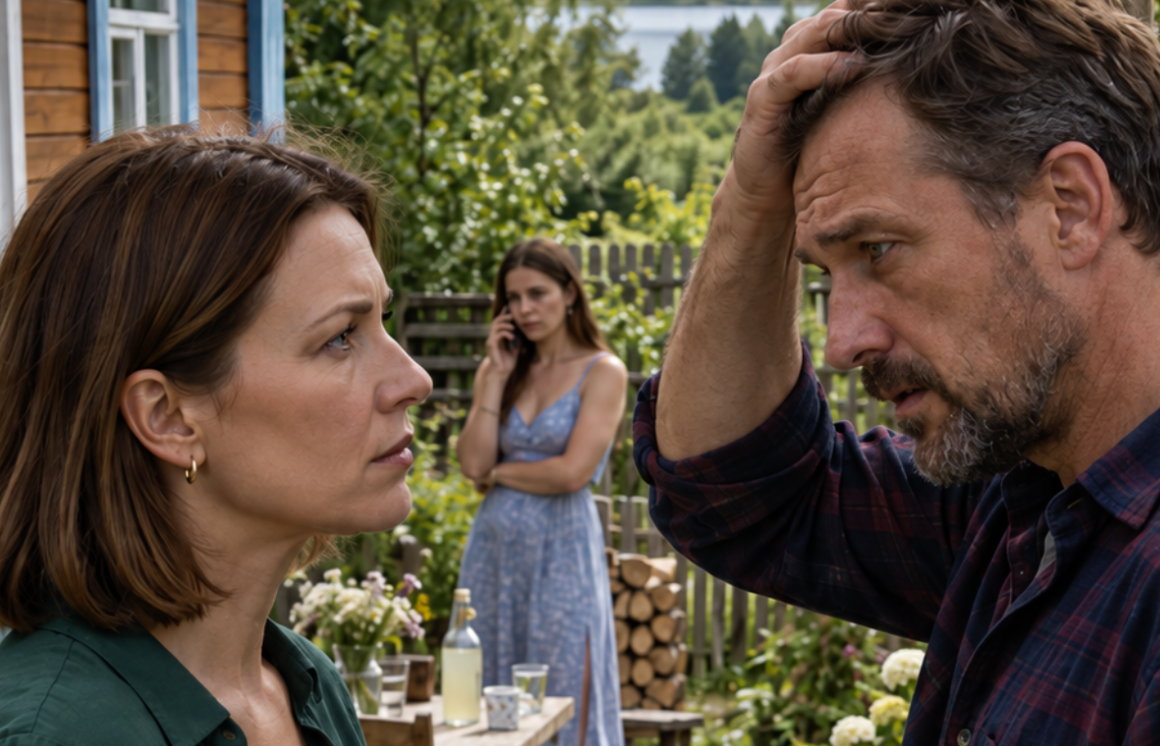
“That’s enough! I’m not feeding your sister at our country house anymore,” Marina told her husband
“Andrew, on your way, buy me turkey fillet, baby water, cheese, strawberries, and two packs of coffee. And charcoal too. Good charcoal, not the kind that smokes.”
Marina was standing at the kitchen table, packing a cooler bag, when that voice floated in from the hallway—confident, without even pausing to say hello. She raised her head and listened. Andrey stood in the doorway with the phone to his ear, silently nodding as though there were not a person on the other end of the line, but a recording.
Then the voice on the phone came to life again.
“And don’t forget to come early. I can’t get the gazebo ready for the guests by myself.”
Marina slowly lowered the bag of apples onto the table. Her eyes found the car keys, and just as slowly she pushed them aside. She looked at her husband. Andrey was still mumbling something into the phone—the usual agreeable, reassuring words.
“No,” Marina said quietly when he finally put the phone away. “That’s it. I’m not waiting on your sister at that country house anymore.”
Andrey looked at her as though she had just said something completely unimaginable.
Marina was thirty-six, Andrey thirty-nine. For almost ten years they had lived in a city apartment whose windows offered a narrow view of the forest on clear days. They used to look at that forest during long evenings and say the same thing:
Someday.
“Someday” finally arrived on their tenth wedding anniversary.
Galina Pavlovna came over with a cake and an envelope. She placed the envelope on the table and said simply:
“This is for you. Our country house in Sosnovka. I can’t manage it by myself anymore. After Dad died, everything fell into disrepair. Better to let someone actually use it.”
Andrey opened the envelope. Inside was a key attached to a wooden keychain with a little fir tree painted on it.
“Mom, are you serious?” He stood up and hugged her.
“Completely. The documents are still in my name for now, but later we’ll transfer them to you. Don’t worry.”
Marina thanked her mother-in-law and smiled, although something inside her tightened.
“Still in my name for now.”
That meant everything depended on someone’s word.
She said nothing aloud because Andrey was so happy.
The country house greeted them with creaking steps and the smell of damp wood. The veranda wobbled, the curtains had faded to a ghostly pink, the gutter sagged, and the path to the shed had disappeared beneath mint and nettles. Several panes of glass were missing from the greenhouse.
But they weren’t frightened by the amount of work.
They got started.
Marina remembered that first summer by the smell of paint and hot tea from a thermos. She scrubbed the kitchen until it shone, repainted the cabinets a soft white, and sewed linen covers for the stools. Andrey repaired the gazebo roof, replaced the wiring, and installed a water barrel for irrigation.
“Look,” he said one evening, nodding toward one of the garden beds. “The strawberries took root.”
Marina crouched down and touched a tiny white flower.
“Then maybe we’ll take root too,” she said.
In the evenings, they sat on the veranda listening to the rain tapping against the metal roof and making plans.
It was their place.
Just the two of them.
And they took it seriously.
Lidia looked at the photos from the country house and laughed.
“Andryukha, you’ve turned into a retired old man with a dacha. Marina, why do you even need a vegetable garden when everything is available at the supermarket?”
Marina didn’t take offense.
Everyone relaxed in their own way.
Sonya was born the following spring.
A month after Lidia came home from the maternity hospital, she called.
“It’s unbearably hot in the city. There’s no air to breathe. You can’t take a newborn to the seaside, and Maxim works around the clock. Maybe you could let us stay at the country house? Just for a couple of weeks.”
Andrey covered the phone with his hand and looked at Marina.
“The baby really does need fresh air. Just a couple of weeks.”
Marina nodded.
A baby really did need fresh air.
At first, everything was peaceful.
Lidia sat on the veranda, read books, and fed Sonya. Marina occasionally brought her tea and helped with lunch. It didn’t feel burdensome.
But then everything changed.
The Friday phone calls began.
First it was baby food.
Then groceries for Lidia herself.
Then household supplies, coffee, sweets.
Every time, Andrey said the same thing:
“We’re going there anyway.”
Marina agreed.
Then Lidia asked them to bring her a particular cream from a store on the opposite side of the city.
“We’ll settle up later,” she said casually.
“Later” never came.
Instead, Marina started noticing how Lidia increasingly referred to the place as “our country house.”
Casually.
In passing.
As though she had every right to do so.
One Saturday, Marina arrived early because she wanted to work on the flower bed. She laid out seeds, stones, and a wooden arch.
Then Lidia asked Andrey to drive her somewhere to buy a child’s high chair.
He left.
Marina worked alone for several hours under the July sun.
That evening Lidia stepped onto the veranda, looked around, and grimaced.
“Why did you dig up so much soil? There’s dirt everywhere.”
Marina said nothing.
But inside, she was boiling with resentment.
On Sunday morning, Marina walked into the kitchen and stopped in the doorway.
The shelf where she kept her preserves—the collection she had spent two seasons building up, with jars of jam, pickles, and sun-dried tomatoes—had been cleared.
Packages of baby cereal now stood there instead.
Lidia had claimed an entire corner of one cupboard.
And on the refrigerator was a white sticky note:
“Do not touch. This belongs to Sonya.”
Marina read the note twice.
She simply couldn’t believe it.
That evening she spoke quietly to Andrey.
“We need to talk. Properly. Without rushing.”
Andrey put his phone aside.
“What’s the problem?”
“The problem is that we allowed Lidia to relax at our country house. That doesn’t mean we’re obligated to bring her groceries every week. And it doesn’t mean she gets to move my things around and post her own rules on my refrigerator.”
Andrey sighed—the particular kind of sigh Marina had already learned to recognize.
“It’s hard for her with a baby. You understand that.”
“I understand,” Marina replied evenly. “But we have our own plans too. And our own space.”
They tried to reach an agreement.
Lidia would buy Sonya’s food herself. Shared groceries would be divided fairly. Everyone would contribute to the work around the property.
Lidia nodded her agreement while barely listening.
The sticky note remained on the refrigerator.
Every time Marina reached for the milk, she saw it.
And every time, she deliberately shifted her gaze away.
On Friday evening, Marina was packing a thermos and raincoat when Andrey’s phone rang in the hallway.
He answered, took out a pen, and started writing directly on a newspaper lying on the cabinet.
Marina watched from the doorway.
The list grew longer.
Baby food.
Meat.
Vegetables.
Water.
Coffee.
Charcoal.
Disposable dishes.
Wine—three bottles, preferably four.
Then Lidia said something else, and Andrey nodded.
“All right. We’ll try to get there early.”
Without saying a word, Marina took her jacket from the hook.
They arrived shortly after five.
Two unfamiliar cars were parked beside the gate.
There were strangers’ backpacks on the veranda, a boxed playpen, and supermarket bags.
Someone else’s towel hung from the swing.
An unfamiliar man in shorts walked out of the house, looked Marina over, and asked matter-of-factly:
“Where do you keep the clean towels? We’ve just arrived from the road.”
Marina told him where they were.
Mechanically.
As though she were dreaming.
She found Lidia in the kitchen, slicing cucumbers and looking completely relaxed.
“Why didn’t you tell us there were going to be guests?” Marina raised her voice.
Andrey came running when he heard the shouting.
He stood between them, looked first at his sister, then at his wife, and said exactly what Marina had been most afraid of hearing.
“Come on, both of you, calm down. Lida’s tired. She has a small child. There’s no need to make such a big deal out of this.”
“And what does that make me?” Marina asked. “The hired help?”
“What does that have to do with anything?” Andrey frowned. “Lida is my sister. I love her.”
“I’ve never forbidden you to love her,” Marina replied. “Love her as much as you want. I’m asking for one thing: that I be respected in the house you and I renovated together.”
Lidia stood by the window, turning a cup in her hands.
“You’re taking too much upon yourself,” she said with mild surprise, as though stating something obvious. “Besides, if it weren’t for Mom, you wouldn’t have this country house at all. And the documents are still in her name, in case you’ve forgotten.”
Marina knew that was true.
Legally, the country house did not belong to her.
It didn’t even belong to Andrey.
That was what made the situation especially bitter.
Everything she had invested in this place—her labor, her time, her energy—could be turned against her at any moment.
She was silent for a moment.
Then she said:
“All right. If it’s the family’s country house, then the whole family can take care of it. But I’m not buying groceries, cooking, cleaning, or waiting on your guests anymore.”
“Marina, wait…” Andrey stepped toward her.
But she was already walking toward the bedroom.
She packed quickly and without drama: several dresses, her makeup bag, her laptop, her gardening gloves.
From a shelf in the pantry, she took down a jar of strawberry jam made from berries grown in their own garden the previous July.
That was what she considered hers.
Only that.
At the door, she stopped, removed her rubber boots from the hook, and placed them on the floor near the entrance.
They could stay there.
She would leave wearing the same shoes she had arrived in.
The apartment was quiet.
Unusually quiet.
Almost ringing with silence.
No strangers’ voices through the walls.
No sound of baby bottles clinking in the sink.
No television playing for Lidia.
Marina cooked herself a simple dinner, put the kettle on, and sat by the window looking at the streetlamp in the courtyard.
She didn’t have to justify herself to anyone.
It felt strange.
And good.
Andrey didn’t return that evening.
Or the next day.
He stayed at the country house.
He started calling three days later.
At first, cautiously.
“You reacted too strongly. We could have talked about it.”
Marina said nothing.
Later, his voice became increasingly uncertain.
“Lida doesn’t know how to turn the water on in the greenhouse. The tomatoes are already wilting. And the cucumbers need watering. The guests left such a mess behind…”
“You said yourself it was your family’s country house,” Marina replied calmly. “So deal with it yourselves.”
Reality put everything into perspective very quickly.
Lidia discovered that a country house wasn’t simply a place where she could sit on the veranda reading a book.
The gazebo had to be cleaned after gatherings.
Plants dried out if nobody watered them.
Food spoiled in the refrigerator.
Maxim didn’t want to drive there after work.
Lidia became angry.
But not with herself.
Then Galina Pavlovna called her children in for a conversation.
She listened to both of them and remained silent for a long time.
Then she looked at her daughter.
“I gave you the opportunity to use the country house. I did not give you permission to turn your brother and his wife into servants.”
Lidia opened her mouth, then closed it again.
Those words were unexpected.
And especially unpleasant because they came from her mother rather than Marina.
Galina Pavlovna added quietly but firmly that she would postpone transferring the ownership documents until the family had restored some order.
Andrey came home himself.
Without calling first.
One evening, he simply rang the doorbell and stood in the entryway looking as though he didn’t know where to begin.
“I kept choosing the easiest option,” he finally said. “I agreed with Lida every time just so I wouldn’t have to deal with an argument. I understand now that it was unfair to you.”
Marina neither reproached him nor tried to act magnanimous.
She simply explained how things were going to be from then on.
No guests without warning.
No shopping lists paid for with their money.
No rearranging things or making rules around the house without discussing it first.
If the country house belonged to everyone, then everyone would share the work as well.
Andrey listened.
He didn’t argue.
A few weeks later, they returned there together.
The flower bed was overgrown with couch grass.
The greenhouse stood empty, the soil inside cracked from the heat.
Someone else’s cushions were scattered across the veranda, and one of them had a burn hole in it.
Marina walked silently through the property and stopped beside the strawberry bed.
The plants had survived, but they had gone wild, runners spreading in every direction.
She put on her gardening gloves.
Andrey brought over a shovel and pushed it into the soil beside her.
“Where do we start?” he asked.
“First, we agree on one thing. No one comes here anymore without both of us agreeing.”
He gave a short laugh.
A moment later, she laughed too.
That evening they sat on the veranda.
Their tea grew cold.
Somewhere in the grass, grasshoppers chirped steadily and monotonously, exactly as they always did during summer there.
The phone on the table vibrated.
Andrey glanced at the screen.
Lidia.
Then he looked at Marina.
“If that’s another shopping list, don’t answer,” she said.
He pressed “decline” and placed the phone face down on the table.
Marina said nothing.
She simply picked up her cup with both hands.