“So if my husband and I get divorced, I walk out with a suitcase, while dear little Igor gets to keep the apartment? You people are geniuses, Vasily Petrovich!”
“Why did you even tell them about the apartment?” Lidia’s voice trembled—not from tears, but from rage. So much rage that the kettle behind her seemed to reconsider boiling altogether and chose instead to evaporate from embarrassment.
“They just want to help…” Igor said without lifting his eyes from the screen, scrolling through something on his monitor. He would much rather have been playing Skyrim right now than participating in a family debate. “You said to yourself that we don’t have enough money.”
“Help?!” Lidia spun around sharply. The chair creaked as if it sensed the approaching apocalypse. “They want to help, but the first thing they say is, ‘Put the apartment only in Igor’s name, because what if you get divorced someday’? That’s what you call help?”
“They’re worried…” he mumbled with a shrug.
Of course, poor parents. How could they not worry? What if that scheming Lidia dragged their son into a dangerous mortgage and then abandoned him with nothing?
“Tell me, Igor, do you even see me in this equation? Or am I like a coffee machine to your family—as long as I work, you tolerate me, but nobody puts my name on the paperwork?”
He stood up.
That alone was impressive, considering that during the past two weeks his physical activity had mostly been limited to traveling between his office chair and the refrigerator.
“Lid, you know what they’re like. They’re old-fashioned. For them, everything is simple: the son is the owner, and the wife is attached to him. You’re an accountant. You understand…”
“Oh, thank you for reminding me,” she interrupted with a smile capable of freezing plastic windowsills. “Yes, I’m an accountant. Which means I can see the numbers perfectly clearly: one and a half million from me, one and a half from them. And we register the apartment in your name because apparently everyone here has medieval brains and nobody cares who contributed what.”
Silence settled over the kitchen.
Even the refrigerator seemed to stop humming, as though thinking, Better stay out of this. They might start dividing me next.
“Dad said it’s normal practice. And the notary confirmed it too,” Igor said, adjusting his glasses.
As if lenses could protect him from the storm already gathering above his balding head.
“Dad said so? The notary confirmed it? And does nobody care that I’m not a piece of furniture from a store that can simply be arranged according to someone else’s wishes?” She pressed her lips together. “Fine. Listen carefully. I spoke to someone too. A lawyer. And the lawyer confirmed that if both of us are investing money, the property should be registered in both names. Otherwise, I’m pulling out of the purchase. Completely. I’m not joking, Igor.”
He thought about it.
He looked like a programmer who had unexpectedly been asked to cook borscht without step-by-step instructions.
Possibly even without a pot.
“You’re overreacting…” he finally said.
“No. I’m only beginning to straighten my back, Igor. Do you understand?”
She went into the bedroom.
She didn’t slam the door dramatically. That would have been too theatrical for the quiet, sticky despair she felt. She simply closed it and sat down on the edge of the bed.
The bed creaked beneath her—the only thing that apparently still connected them.
The following day, Lidia left work early. Earlier even than the day when her dentist had kept her trapped in the chair until six-thirty.
She simply couldn’t sit in the office anymore, thinking about real estate agents, apartments, and Igor’s parents, who had begun to resemble prison commandants in her imagination: strict, precise, and absolutely unwilling to compromise.
Then Tamara Semyonovna called.
The same woman who had said at their wedding, “She’s such a calm girl, you could put her on a wound and she’d heal it.”
Now, apparently, she considered Lidia a source of anxiety and a threat to the family fortune.
“Lidochka, hello. How are you?”
Her voice was so sweet it could have been spread over pancakes.
“I’m fine, Tamara Semyonovna.”
“Vasya and I have been thinking. Really, a mortgage will be difficult for you two. And suppose, God forbid, something happens—then the apartment stays with you, while my son is left with nothing?”
“If, God forbid, something happens, that would mean the marriage has already fallen apart. And if the marriage has fallen apart, perhaps the apartment won’t be the most important issue anymore.”
“Are you deliberately being rude to me?” The mother-in-law’s voice immediately acquired that familiar icy edge Lidia knew from every trip to the family summer house—usually appearing whenever Lidia sliced the salad incorrectly or hung a towel in the wrong place.
“I’m being honest. And as you yourself said at your anniversary, ‘Not everyone has the teeth for honesty.’”
Her mother-in-law froze on the other end of the line like the proverbial fly trapped in amber.
Three seconds.
Maybe four.
An eternity by her standards.
“Well, we only want what’s best. You have to understand us.”
“I understand. I’m just afraid your version of ‘what’s best’ and mine are two completely different countries. And the visa regulations between them are extremely strict.”
She ended the call.
Igor didn’t come home for dinner.
Later, he sent her a message:
“I’m staying at my parents’ tonight. We need to cool down.”
And then, almost casually, he added:
“Dad says you’re behaving irrationally.”
She reread the word.
Irrationally.
Of course.
The second a woman insisted on protecting her rights, she instantly became irrational.
Too loud.
Too confident.
Too… alive.
They wanted her decorative.
Convenient.
Like a little shelf in the hallway.
The next morning, she went to see a notary.
Officially.
Without Igor.
Without Vasily Petrovich.
Without Tamara Semyonovna.
“Half of it is mine,” she told the lawyer. “Otherwise, I’m not participating.”
The man looked at her with respect, as though he didn’t often meet women willing to act as their own attorney, judge, and jury.
Later, already on the subway, Lidia realized that for the first time in days she wasn’t thinking about what her husband would say.
Or what her mother-in-law might do.
She was thinking about herself.
About how strange—but pleasant—it felt to have solid ground beneath her feet.
Her own ground.
Not her parents’.
Not her husband’s.
Hers.
Unfamiliar.
But damn, it felt right.
Lidia woke early on Saturday because some internal alarm system had issued the command:
Fight or run.
She went into the bathroom—cold tiles, wrinkled pajamas, red marks beneath her eyes.
She looked into the mirror and, for the first time in days, allowed herself a slightly malicious smile.
“Well, I still haven’t cracked.”
The kitchen was silent.
Even the refrigerator seemed to have gone to spend the night with Igor.
No husband.
No smell of coffee.
None of his usual morning grumbling before he had even fully opened his eyes:
“Where’s the sugar?”
There was a note on the table.
Unfortunately, it wasn’t romantic.
It was practically administrative.
Written in block letters:
“My parents want us to come talk. Please be at their place at 3:00 p.m. We need to reach an agreement.”
No signature.
It looked like an official notice from a housing office:
Appear.
Talk.
Sign your surrender.
Lidia arrived at exactly three because stubbornness had been cultivated in her since childhood.
Tamara Semyonovna opened the door.
Floral dress.
Cherry-red lips.
And a look normally reserved for a chicken about to be butchered.
“Come in, Lidochka,” she said, as though she were inviting her daughter-in-law into the living room rather than to a moral execution. “We’ve been waiting.”
Igor was sitting in the living room, drooping like a curtain in a cheap hotel.
Vasily Petrovich sat nearby in his formal shirt, a briefcase resting on his knees.
He always operated according to protocol.
If the man had worked at a factory manufacturing moral conscience, the whole country would have become holy.
“Sit down,” he said. “We’re going to talk like adults.”
Lidia sat.
She crossed her arms over her chest.
She felt cold, even though the radiators were blasting heat.
“Tamara and I have been thinking,” he began, opening his briefcase like a priest opening sacred scripture. “And we’ve decided to arrange everything through a deed of gift. The apartment will belong entirely to Igor, but we understand that you’ll also be investing money.”
“How generous,” Lidia exhaled. “And then what? He throws me out like a dog whenever he feels like it?”
“Don’t say ridiculous things!” Tamara Semyonovna interrupted, waving one hand dismissively. “You’re his wife. Who would throw his wife out?”
“Well, unless they get divorced, of course,” Vasily Petrovich added. “Then it would be a different conversation.”
“Exactly.”
Lidia stood up.
“A different conversation. And I’ve already started dreaming about that ‘different conversation’ at night. So with your permission—no. I will not participate in a scheme where my money becomes yours while my rights become zero. Either the apartment is registered in both our names, or you complete the deal without me.”
“You don’t understand!” Igor exclaimed, sounding as though she had just smashed his beloved laptop with a hammer. “My parents are giving us money. A large part of it. That’s their condition.”
“And what does that make me, Igor? A sponsor? A roommate? Or just some sweet woman with suitcases who pays for things but leaves whenever someone higher up gives the order?”
“It’s not difficult for you! It’s just a formality!” Tamara exploded. “And if you have children someday, you’ll get everything through them anyway. Stop being so stubborn.”
“Do you realize that I don’t lay eggs like a goose?” Lidia raised an eyebrow. “Or have you already planned the whole thing? I give birth and then conveniently disappear?”
Silence.
Igor shrank into himself.
His mother looked away.
His father cleared his throat, preparing to demonstrate how a real man handled matters.
“You don’t respect your elders,” he said quietly, almost threateningly. “And you don’t think about the future.”
“And you don’t respect me,” Lidia replied clearly. “And you don’t think about the present. The present in which I’m not your son’s shadow. I’m a complete human being.”
“Well, well,” Vasily Petrovich scoffed. “You’ll come crawling back eventually.”
“I’m not a cat. I don’t crawl back.” Lidia was already picking up her bag. “I’m an accountant. And I’ve calculated everything.”
“If you pull out of the deal, every penny comes back,” he shouted after her. “And don’t think divorce will be easy either. We’ll settle everything through court.”
“How convenient.”
She stopped in the doorway.
“Just remind me when exactly your family switched over to operating like a corporate tribunal. After the wedding? Or right after you gave us that fifteen-person dinner set and decided you had purchased me along with it?”
The door slammed.
This time, deliberately.
Outside, it was cold.
The wind seemed to blow some of the anger straight out of her lungs.
One thought pounded in her head:
This is the end.
The end of the illusion that she could be with Igor without still being completely alone.
The next day, Lidia packed her belongings.
Not everything.
Only what was hers.
Calmly.
Neatly.
Like she was moving into another life.
She left Igor a letter.
No sentimental tears.
Just copies of receipts and bank transfers.
“I’m leaving. Living inside your family’s system of coordinates is costing me too much. Thank you for everything. No need to thank me.”
A week later, she was staying with a friend, drinking cheap instant coffee in the mornings and looking through apartment listings.
Apartments for herself.
No parents.
No complicated arrangements.
No Igor.
And him?
He came home after work, saw the emptiness, stood in the kitchen, and stared for a long time at the stove where her keys had still been lying the previous day.
Then he called.
“Lid… Come on. We’re a family. My parents just…”
“Igor, you’re a grown man. A programmer, not an idiot. If you couldn’t choose between your wife and your parents, then let your parents save you now. They need you more. And I need myself.”
He said nothing.
Perhaps he finally understood.
Or at least began to.
The ground-floor apartment smelled of new linoleum, a foil-covered front door, and freedom.
There were no curtains on the windows.
Lidia had only moved in today, and buying curtains felt strangely similar to surrender.
No.
First the walls.
Then the furniture.
Then perhaps some sheer curtains.
Or perhaps not.
Because now she was the one who decided whether there would be sheer curtains or Roman blinds.
She decided whether anyone would wander around her apartment in slippers saying, “We only came to ask you something.”
On the kitchen table stood a thermos filled with freshly brewed tea and two mugs.
One had a chipped rim.
Old.
From that life.
The second was brand-new, white, with the words:
“Just pour and breathe.”
Lidia chose the new one.
The old things no longer worked.
She sat beside the window, took a sip of tea as bitter as somebody else’s truth, and switched on her phone.
Igor’s messages were all similar:
“Are you still angry?”
“Maybe we can talk?”
“I miss you.”
“Are you okay?”
“Are you home?”
“You’re not home?”
She didn’t want to answer.
Yet her hand treacherously kept reaching for the phone.
And at that exact moment—as if scripted by some badly dubbed television drama—the doorbell rang.
Tamara Semyonovna stood outside.
Gray puffer jacket.
A shopping bag in one hand.
An expression suggesting she had come to forgive Lidia personally for the collapse of the Soviet Union.
“So this is where you are,” she announced. “I thought you were staying with that friend of yours, what’s her name… Rita?”
“Sveta. But you were close.” Lidia tilted her head. “Come in. If you came in peace. Or at least brought chocolate.”
“I came… to talk.”
Tamara stepped over the threshold and looked around as though expecting to discover an underground wine-drinking club.
“It’s cozy. In its own way. Where are the curtains?”
“In the ‘later’ section. Sit down. Unless you plan on standing there in your righteous-mother pose.”
They sat opposite one another.
The smell of sausage drifted from the shopping bag.
Real pork sausage made according to the old state standards.
“You know, I’ve been thinking a lot,” Tamara began. “I went through something similar myself once. Vasya and I didn’t divide everything properly right away either.”
“It was different for you,” Lidia answered dryly. “He served in the army, then worked at the factory, then you had children. I doubt he ever told you, ‘We’ll put the apartment only in my name, and you can just sit there decorating the sofa.’”
Tamara was silent.
“I don’t want you two to divorce,” she finally said. “But I feel sorry for Igor too. He’s… well, he’s not a leader. He doesn’t know how to pound his fist on the table. He’s used to being told what to do, and then doing it. It isn’t deliberate. That’s just who he is.”
“He’s an adult, Tamara Semyonovna,” Lidia nodded. “And if he doesn’t know how to make decisions, living with him is like lying on railroad tracks and hoping the train decides to reverse.”
“What if I told you we changed our minds? What if the apartment were registered to both of you?” she suddenly blurted out, then immediately fell silent as if frightened by her own words. “Vasily is against it, of course. He thinks you did all of this deliberately.”
“And I think I don’t need an apartment where signatures are obtained through pressure. If he’s against it, then so be it. I’m buying my own place now. No conditions. No blackmail. No compromises.”
“Igor is suffering,” Tamara said more quietly. “He says you’re like cold water. At first you wake him up, and then you burn him.”
Lidia smirked.
“And he’s like an undercooked egg. Looks solid from the outside, but inside he’s barely formed.”
“Do you really not love him anymore?”
Lidia stood and walked toward the window.
Outside, as if deliberately mocking her, spring was beginning.
Sunlight slid across lightly snow-covered rooftops.
Children kicked a ball around as though divorces and mortgages didn’t exist anywhere in the world.
“I loved him very much,” she said softly. “But then I realized I was the soloist in that love story. And he was just applauding. Or rather… blinking.”
Tamara stood up.
She walked toward the door, gripping the handle of her shopping bag.
“Lidochka… if you change your mind, we’re here. We’re not monsters. We’re just… old. We don’t know how to do things differently.”
Lidia didn’t answer.
She simply nodded.
Then someone knocked on the door.
She didn’t even have time to be surprised before Igor walked in.
Gray-faced.
Exhausted.
With the eyes of a cat that had been thrown off a roof.
“I didn’t know Mom was already here,” he said. “I just… wanted to see you.”
“Well, you can see me.” Lidia crossed her arms. “I’m afraid you’re just too late.”
“We sold that apartment. We divided the money equally. My parents decided it would be fair. I insisted.”
“A little late, don’t you think?”
She sat back down at the table and gestured toward a cup.
“I already have everything here. A floor plan, furniture, even a new heated towel rail. And a life. Without you.”
“Could I just… visit sometimes? Not as your husband. Just as someone who still hasn’t understood everything about you.”
“That’s exactly what I don’t want—to be taken apart again like some unfinished novel. I’m not a chapter. I’m not a paragraph. I’m an entire book. And I’m not being returned to your family’s library.”
They fell silent.
Time seemed to stop.
Then Lidia stood up.
She handed him the old mug.
The one with the chipped rim.
“Here. This is the only thing left from ‘us.’ Take it. Or throw it away.”
He accepted it.
He stood there silently for a moment.
Then he left.
No words.
No drama.
He simply walked away.
That evening, Lidia lay on the sofa.
The apartment was quiet.
It smelled of new furniture and, unexpectedly, relief.
She scrolled through her phone and smiled.
Tomorrow she had an appointment to view an apartment she had saved for entirely by herself.
No one else’s conditions.
No deeds of gift.
No family councils.
She chose herself.
For the first time.
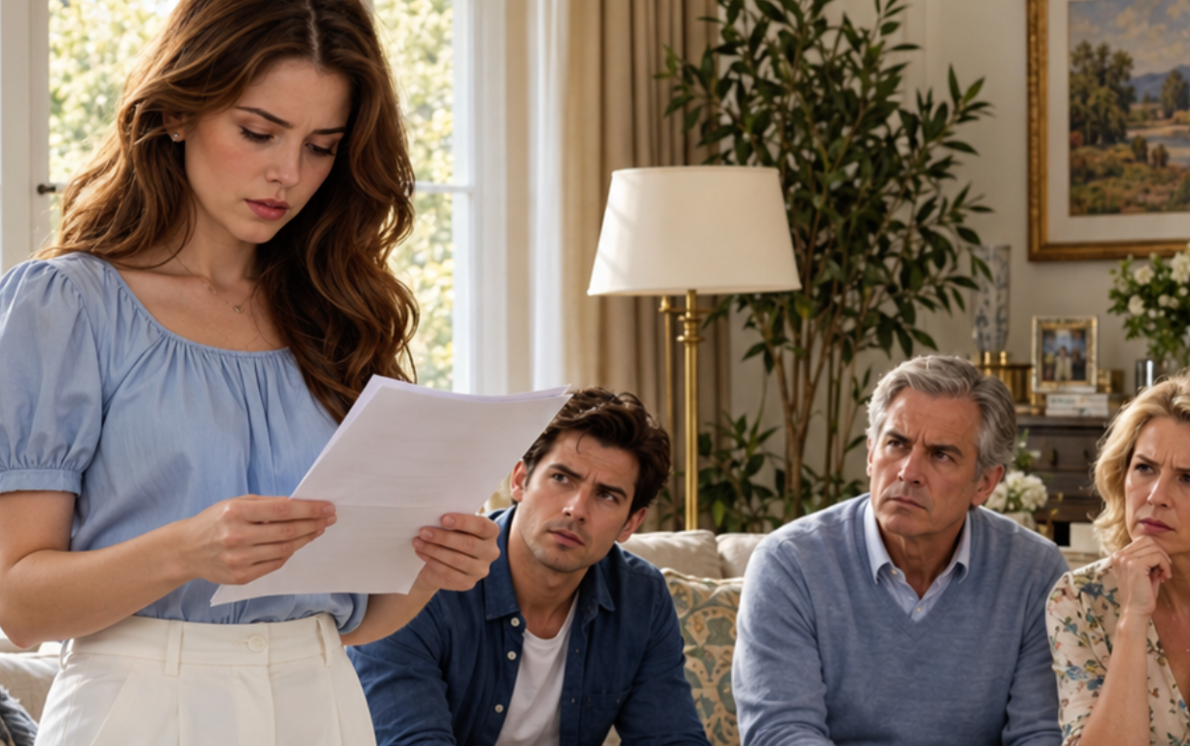
“So, if my husband and I get divorced, I’m the one who walks out with a suitcase, while dear little Igor gets the Khrushchev-era apartment? You’re geniuses, Vasily Petrovich!
Don’t forget to hit the SHARE BUTTON to share this video on Facebook with your friends and family.