I stood in front of my own apartment door, struggling to get my key into the lock. The shiny, new metal plate glinted in the hallway, but my familiar, notched key just bumped uselessly against the narrow slot and twisted without catching.
Behind me was my husband Anton, juggling two heavy suitcases, their wheels still covered in luggage tags. We had just come back from our first vacation by the sea in three years—two whole weeks away, no work phones, finally a break from the rush of city life.
“Kristin, what’s taking so long?” Anton asked, his voice tired as he shifted from foot to foot. “Hurry up, my shoulders are killing me from these bags.”
“Anton, the lock is different,” I said quietly, trying the key again. “Look for yourself. The plate is new and silver. We used to have a dark, brass one.”
Anton set the suitcases down, stepped closer, took the keyring from me, and tried to force the key in himself. It was no good. Our key didn’t even go into the lock.
“What the heck?” Anton frowned. “Who would change the lock?”
Anton and I have been together for four years. This two-bedroom apartment is fully mine—my grandmother gifted it to me before Anton and I even met. I’m the sole owner; the apartment isn’t joint property.
I work as a manager for a chain of big pastry shops—taking care of supplies, staff, sanitary checks, and running three locations downtown. It’s a stressful job that keeps me on my toes and demands conflict resolution skills.
Anton is a senior technician, repairing and maintaining industrial refrigeration units at a meat processing plant. He’s calm, hardworking, and incredibly easygoing—especially when it comes to family.
The only person who had a spare key to our apartment while we were away was my mother-in-law, Larisa Dmitrievna. We entrusted her with the key under one condition: to water the balcony plants twice a week and air out the rooms.
Larisa Dmitrievna spent her career as a senior administrator at a former Soviet hotel complex. There, she picked up an unshakeable belief that she knows best how to clean, organize, sort things, and tell people where they truly belong.
Anton pulled out his phone and dialed his mother’s number. The hallway was perfectly quiet, so every sharp ring seemed especially loud.
“Hello, Antosha!” Larisa Dmitrievna answered cheerfully on the fourth ring. “You’ve already arrived? How was your trip?”
“Hi Mom. We’re at our door in the building. What’s going on with the lock? Why don’t our keys work?”
There was a brief pause on the line, then my mother-in-law’s voice came through, calm and even a bit pleased:
“Oh, you’re already at the door! Good. I changed the lock, Antosha. The old one was completely worn out, the cylinder kept jamming when I came to water the plants. I called a locksmith, he installed a new, secure one with extra protection against break-ins. Don’t worry, I took care of everything.”
I felt my insides tighten with rising anger. Who changes the lock cylinder in someone else’s apartment without asking, and while the owners are away?
“Larisa Dmitrievna,” I interjected, stepping closer to my husband’s phone. “Why didn’t you warn us? And where are we supposed to get the new keys?”
“Kristina, there’s no need to speak to me that way,” my mother-in-law’s voice shifted instantly—now icy and lecturing. “I was only doing what’s best. You left, your phone was off, and what if the door slammed and there was a fire? I took the initiative. I have the keys with me. I’m out of town at a friend’s dacha. I’ll be back tomorrow evening, I’ll bring them then.”
“Tomorrow evening?!” I gasped. “Where are we supposed to sleep tonight? With our suitcases out on the street?!”
“No need to be on the street,” Larisa Dmitrievna coolly replied. “Go stay with Anton’s Aunt Lyuba on the other side of town, sleep on her couch. Or get a hotel for the night—you’ve just come back from vacation, you have money. Tomorrow I’ll come, let you in, and explain everything. You’ll also get to see the surprise I’ve prepared for you inside.”
“What kind of surprise?” Anton frowned.
“I went in and worked hard!” she announced proudly. “That’s it, I have to go. I’ll be at your place tomorrow at six in the evening.”
She hung up.
I stood in front of my own locked apartment door, feeling utterly helpless. Anton stared at his phone in confusion, then looked at me.
“Kristin, maybe we really should go to Aunt Lyuba’s… or maybe call a locksmith?” he suggested uncertainly.
“Aunt Lyuba? Seriously, Anton?!” I snapped, unable to contain my emotions. “This is MY apartment! My home! Your mother unilaterally changed the lock and left with the keys! Do you realize she’s crossed every boundary?!”
“She only meant well… The old lock really was acting up sometimes, remember? Just last month the key got stuck,” my husband tried to defend her.
“It was the top bolt jamming, and she replaced the bottom one!” I shot back. “We’re not calling any locksmith yet—I don’t want to break a brand new door. Let’s just get a hotel. But tomorrow your mom will answer for every single thing she did here without permission.”
We grabbed our suitcases, went down to the street, and checked into a small hotel nearby. The night was awful. I barely slept, replaying my mother-in-law’s words about the ‘surprise’ waiting for us inside.
What could someone possibly do in another person’s apartment in two weeks, if they were only given the keys to water the plants?
The next day I took the day off work. Anton also managed to get the afternoon off of his shift. By 5:45 p.m., we were already standing by our door.
Right at six o’clock, Larisa Dmitrievna strolled out of the elevator. She wore a summer dress, was holding a small purse, and there was a triumphantly smug smile on her face.
“Well, travelers, did you cool off?” she said instead of greeting, pulling a set of brand new keys from her bag. “I was hoping you’d appreciate all the care I took.”
“Larisa Dmitrievna, please give us the keys and come inside,” I said dryly, not about to make a scene in the hallway.
My mother-in-law slid the key into the lock, turned it twice with ease, and threw the door open.
“Come on in, check out my handiwork!” she declared triumphantly, stepping aside.
I stepped over the threshold and froze in the hallway. What I saw simply didn’t make any sense to me.
My favorite painting of the seascape— a special gift from my colleagues for my thirtieth birthday— was gone from the hallway. In its place hung a cheap tapestry of deer in a wooden frame. Our built-in coat rack had been completely rearranged, and my beloved oak shoe cabinet… it was missing. Instead, there was an old plastic shelving unit.
“What happened here?” I whispered, feeling my pulse pounding in my temples.
“Oh, come on in!” my mother-in-law waved her hands, slipping off her shoes. “I finally really cleaned up! You two were living like you were in a hotel— no coziness, no touch of a proper woman!”
I quickly went to the living room—and gasped.
Our thick beige linen curtains were gone. In their place hung a hideous synthetic lace with ghastly pink ruffles. My desk, where I’d spend nights checking reports from the bakeries, was pushed up against the window and covered with a polka dot oilcloth. The couch was missing our pillows; instead, it was draped with old knitted blankets I remembered from Larisa Dmitrievna’s own apartment.
But the worst of it was still waiting for me in the bedroom and the kitchen.
I flung open the bedroom wardrobe. My clothes were gone from the hangers. All my dresses, blouses, and suits were crammed into big plastic garbage bags sitting in the corner. Only Anton’s things and a couple of old robes now hung in the closet.
“Larisa Dmitrievna!” I shouted, running back into the hallway. “Where are my things?! Where’s my shoe cabinet?! Where are the curtains?!”
My mother-in-law walked out of the kitchen calmly, holding a cup of tea she’d already poured for herself.
“Kristina, why are you yelling?” she winced. “I cleaned up. Your closet was a disaster—couldn’t even step inside. So many jackets, dresses… I packed all your extra old stuff into bags. You can put them on the balcony or take them to the dacha. I made room in Anton’s things so he could actually access his wardrobe like a real man.”
“And where is my shoe cabinet?!” I couldn’t control my voice anymore.
“I gave the shoe cabinet to our neighbor at the dacha, Uncle Kolya,” my mother-in-law replied, completely unbothered. “It was way too bulky for the hallway. The plastic shelves are perfect—easy to clean. And honestly, Kristina, it’s time you understood something.”
She set her cup down on the little table in the entryway, straightened up, pursed her lips, and looked at me like a strict school principal:
“You live here with my son. Anton is the man of the house. But you’re always busy at work checking reports—you’re barely home except to sleep. I did an inventory here. I threw out half your jars of those weird foreign spices—just dust and harmful. Put your glass dishes away and brought out a proper dinner set, the one I gave Anton as a wedding gift.”
I turned my gaze to Anton. My husband was standing in the middle of the hallway, pale as a sheet, nervously glancing back and forth from his mother to the bags filled with my belongings.
“Mom…” he stammered. “Why did you do this? This is Kristina’s apartment…”
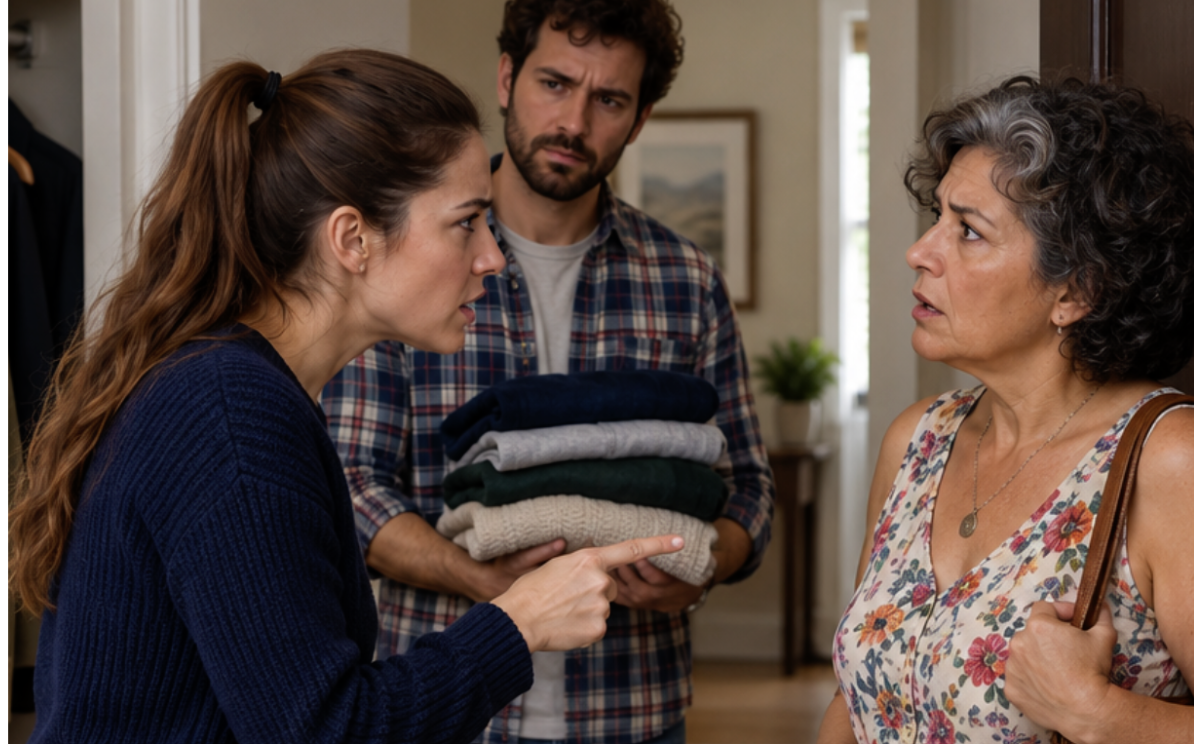
Larisa Dmitrievna shot me a poisonous grin and jabbed her finger in my direction:
“But you live here, Anton! You’re a man! Whether it’s legal or not, if a wife doesn’t respect her husband or know how to keep the house in order, then a mother has to step in and restore order! I’m in charge here as long as this mess lasts! And you, Kristina, you clearly have no idea how to keep a household. You should be grateful I turned your apartment into a proper home and not just a storage for trendy clothes!”
She said it all so effortlessly, with such confidence and deep conviction in her rightness that for a moment, a ringing silence filled the hallway.
I stared at this woman who had shoved my things into garbage bags, given my expensive furniture to a stranger, ruined my interior design, and told me to my face that in MY apartment, “she’s the boss and I’m nobody.”
It was like a switch flipped inside me. All the exhaustion from the journey, every bit of fear and confusion, vanished. All that remained was a cold, razor-sharp clarity.
Slowly, I looked from Larisa Dmitrievna to Anton. My husband stood there, shoulders hunched, nervously fiddling with the strap of his suitcase.
“Anton,” I said in a calm, almost icy voice. “Take your phone and show your mother the receipt for that oak shoe cabinet we bought two years ago.”
“What?” my mother-in-law frowned, not even bothering to lower her voice. “What shoe cabinet? You paid peanuts for that thing at some bargain sale!”
“Forty-two thousand rubles, Larisa Dmitrievna,” I stated, stepping right up to her. “Solid oak. Custom made. And you just gave it to a stranger for nothing.”
My mother-in-law hesitated for a second, but quickly pursed her lips and proudly lifted her chin:
“You won’t go broke! Anton has a good salary, buy a more modest one next time! At least the hallway is clear now!”
“Mom,” Anton finally spoke, stepping forward and putting himself between me and his mother. His voice was trembling with hurt and embarrassment. “Why did you take the shoe cabinet? Why did you put Kristina’s things in bags? Do you understand what you’ve done?!”
“Me? What I’ve done?!” Larisa Dmitrievna shrieked, pressing her hands to her chest. “You’re raising your voice to your mother over some rags and wood? I worked myself to the bone here for two days! I cleaned dust from under your sofa! I washed the windows! And instead of thanking me, you give me complaints?!”
“You did all of that without our permission,” I said, pulling my work notebook and pen from my bag. “Anton, come inside and close the door. No one leaves until we document everything that’s missing.”
“And why is that?!” my mother-in-law tried to rush toward the exit, but Anton unknowingly blocked the narrow hallway with his broad shoulders.
I walked through the rooms, opening closets, drawers, and nightstands. I recorded everything, just like an inventory at a bakery:
Oak shoe cabinet from the hallway—removed without the owner’s consent.
My natural linen curtains are gone—taken down, and now nobody knows where they are.
The painting of the seascape has been taken off the wall.
Jars of spices, my expensive collection tea, and all the glass containers from the kitchen? Thrown out.
Work uniforms, dresses, and coats have all been stuffed into trash bags, many of the items crumpled and dirty.
Larisa Dmitrievna trailed behind me nonstop, commenting on everything I did:
“Look at her, keeping a record! Thinks she’s a lawyer! Who even wanted your jars of herbs—probably expired anyway! I put your curtains neatly on the balcony, they were just collecting dust!”
“The curtains are on the balcony?” I repeated, peering behind the balcony door.
My beige linen curtains were lying right on the dusty concrete balcony floor in the corner, next to old pots filled with dirt. The light fabric was smeared with black tire marks from a bicycle.
In that moment, any last bit of respect I had for this woman just burned out. This wasn’t just daily rudeness—it was a calculated attempt to make it clear that everything I had made or bought meant nothing at all.
“Anton, look,” I pointed out the dirty curtains to my husband. “These are the ones we went all the way to another city for, the ones I even took to a tailor to have them hemmed to fit perfectly.”
Anton stared at the balcony floor, then back at his mother. For the first time, real anger—more than just confusion—flashed in his eyes.
“Mom… You just tossed fifteen-thousand-ruble curtains onto a filthy floor?”
“Come on, just wash them!” Larisa Dmitrievna waved me off, though now her cheeks were turning bright red. “No big deal! Toss them in the washer, they’ll be clean!”
“They’re pure linen, Larisa Dmitrievna,” I said, turning to her. “You can’t wash them in hot water or they’ll shrink and get ruined. And now I want you to listen very carefully.”
I placed my notebook on the kitchen table:
“Today is Thursday. I’m giving you until Saturday, twelve noon.”
“What do you mean, giving me time?! Are you trying to make demands here?!” my mother-in-law screeched.
“First,” I interrupted her calmly, without raising my voice. “You will contact your Uncle Kolya and make sure my shoe rack is back here by Saturday. In the exact same condition as when you took it—no scratches, no chips.”
“But he already screwed it onto the veranda!” Larisa Dmitrievna gasped.
“That’s not my problem. He can unscrew it and bring it back. Second, you’ll pay for cleaning my curtains and all the other damaged items from the bags. Third, you’re taking all your deer tapestry, your polka-dot tablecloth, and that plastic shelving unit back to your own place.”
My mother-in-law stood there gasping like a fish out of water. She was used to always having the final word at work and in the family. Now, someone was laying down firm boundaries in a way she’d never experienced before.
“And what if I don’t?” she hissed, narrowing her eyes. “What are you going to do, Kristina? Set your Anton against his own mother?”
“I’m not trying to stir up trouble,” I replied calmly. “But if the shoe cabinet isn’t returned by Saturday at noon, I’m going to the police. I have documents proving I own the apartment, a receipt for the shoe cabinet, a bank statement, and a witness – your son – who can confirm the furniture was here before we left. You removed someone else’s belongings without the owner’s permission. That counts as theft or unlawful self-help. Let the police decide.”
“You… you’re crazy!” Larisa Dmitrievna yelled at her son. “Anton! Are you hearing this?! She wants to put me in jail! Just because I tried to help you bring some order to the place! Say something! Are you a man in this house or just a doormat?!”
Anton sighed heavily, walked over to his mother, took her gently by the elbow, and started leading her toward the door.
“Mom, please go home,” he said quietly.
“What?! Are you kicking me out? Because of her?!”
“I’m not kicking you out, I’m asking you to leave,” Anton replied firmly, keeping his grip on her shoulder. “You’ve gone too far. You ruined Kristina’s things, you gave away someone else’s furniture. If Uncle Kolya doesn’t bring the shoe cabinet back by Saturday, I’ll go to the dacha myself and get it. Let’s go to the elevator.”
He guided the struggling and cursing Larisa Dmitrievna out to the landing, gently closed the door, and stayed out in the hallway with her. I could hear her shouting for another ten minutes – trying to guilt-trip him, bringing up her health problems, recalling how she raised Anton alone, and even calling me a ‘monster’ he married.
When Anton finally came back into the apartment, he looked completely drained. He sat down on the kitchen stool and buried his head in his hands.
“Kristina… I’m so sorry,” he whispered. “I didn’t know she was capable of this. I honestly thought she was just watering the plants.”
“The problem isn’t that you didn’t know, Anton,” I said, sitting down across from him. “The real problem is that your mom genuinely believes she has the right to control everything in our home. If we just let this slide and quietly clean up her mess, next month she’ll come back and replace our couch or put our stuff in her sister’s name.”
“I’ll go to Uncle Kolya’s tomorrow after my shift,” my husband said, looking up. “I’ll bring back the shoe cabinet myself.”
“No, Anton. Your mother needs to be the one to go,” I said firmly. “She has to realize she’ll be held personally responsible for what she’s done. And right now, we need to call a locksmith and change the lock again. I’m not comfortable leaving the same cylinder in the door when your mom still has keys.”
The next morning, our domestic war escalated. Apparently, Larisa Dmitrievna decided to bring out the big guns – and rally the whole family against us.
Friday morning started with a flurry of phone calls. Larisa Dmitrievna reached out to every relative she could: her cousin from the suburbs, Aunt Lyuba, and even Anton’s older brother.
By lunchtime, I started getting messages on my phone. Aunt Lyuba was sending me long texts about how ‘a mother is sacred’ and that our belongings are ‘just metal and wood – not worth breaking up the family over.’
I didn’t engage in a back-and-forth. I paused during my work, forwarded Aunt Lyuba the photos of the soiled linen curtains, the bags with my clothes dumped on the floor, and the receipt for the oak shoe cabinet, accompanied by a straightforward message: “Lyubov Dmitrievna, if someone came into your apartment uninvited, threw away your clothes, and gave your furniture to a stranger, would you call that family care?”
After that message, the stream of moral lessons abruptly stopped. Aunt Lyuba didn’t write anything else.
On Friday evening, Stas and I called a locksmith and changed the lock cylinder again. Now only the two of us had the new set of keys. Anton himself insisted on sending his mother money for the lock she’d paid to have changed, making sure she couldn’t say we owed her anything.
Saturday, eleven in the morning. Anton and I were finishing the cleaning: I was steaming dresses, while my husband was rehanging our seascape painting on the wall.
At eleven thirty, there was a commotion outside: an old pickup truck was loading up by the entrance. I glanced out the window—Uncle Kolya had arrived from the dacha, and standing next to him was Larisa Dmitrievna. She looked embarrassed but was trying to hold herself together.
Ten minutes later, the doorbell rang. Anton opened the door. Uncle Kolya stood there with our oak shoe cabinet in his arms, while my mother-in-law hovered behind him, clutching an enormous bag from a professional dry cleaner, the cleaned beige curtains peeking out.
“Here you go,” Uncle Kolya grumbled, carefully carrying the shoe cabinet into the hallway. “Larisa says it was all a misunderstanding. The furniture’s fine, I didn’t scratch a thing.”
“Thank you, Nikolai Petrovich,” I replied calmly, inspecting the wood. “You’re right, no damage at all.”
Uncle Kolya said a quick goodbye and left, clearly wanting to avoid getting involved in another family drama. That left just us and Larisa Dmitrievna in the hallway. She silently set the cleaner’s bag down and placed the payment receipt on top.
“Here,” my mother-in-law said tersely, not meeting my eyes. “Everything’s back. The curtains have been cleaned and all stains removed. The shoe cabinet is here.”
“Thank you, Larisa Dmitrievna,” I said. “Now let’s clarify things once and for all.”
I stepped closer and looked her straight in the eyes:
“This is MY home. The rules here are set by Stas and me. Any attempt to come in with your own order, throw out my things, or tell me how to run the household will mean these doors are closed to you forever. If you’re here as a guest, you’re a guest. But you’ll never be the mistress of this house.”
My mother-in-law pressed her lips together. I could see the urge to argue, to remind me about ‘order’ and respect for elders, boiling inside her. But then she looked at her son standing beside me, nodding in agreement with every word I said, and she realized: no one would support her taking control.
“I understand, Kristina,” Larisa Dmitrievna said quietly, through clenched teeth. “You’re not going to trust me with the keys anymore, are you?”
“We won’t,” Anton answered for me. “We’ll install an automatic watering system for the plants or ask neighbors to help. Mom, from now on, come visit only when we invite you.”
Larisa Dmitrievna turned around and walked toward the elevator. This time, she didn’t slam the door or shout through the whole building.
Six months went by. In that time, my mother-in-law visited us only three times — and only when invited, for family celebrations. She was extremely polite, didn’t offer any advice about our decor, and didn’t try to rearrange so much as a single cup in the kitchen.
Anton and I finally restored our apartment to how it was before. But most importantly, this whole situation served as a valuable lesson for my husband — a real immunization against blind, unquestioning obedience to his mom. He realized that it’s vital to firmly and promptly protect the boundaries of our own family.
Sometimes, to truly have peace and quiet at home, all it takes is one clear moment to show people exactly where their so-called ‘care’ stops and someone else’s personal life begins.