In the entryway, Mom’s Chaika sewing machine sat on the bench in its wooden case. The handle faced the door, just like a suitcase packed for a trip.
From the small room, I could hear the whine of a power screwdriver.
I walked right in with my boots on. Vadim was taking my thread shelf down from the wall.
Patterns, a box of zippers, and spools were piled up on the windowsill. Three dresses, ready to be handed off to clients on Monday, hung from the wardrobe door — all on a single hanger.
“What are you doing?”
“Oh, you’re here,” Vadim said, turning around without switching off the screwdriver. “Making space. Rimma’s coming on Sunday.”
“Coming where?”
“Here, to us. She’ll stay until she finds a job. I’ll move your table out to the balcony, put the sewing machine in the storage room. She doesn’t need much: we’ll set up a sofa, that’ll be enough.”
He spoke as if he was simply telling me he’d bought bread. Decision made, payment done, now he just had to carry it home.
“And you didn’t think to ask me?”
“What’s there to ask?” Vadim shrugged and took out another screw. “She’s my sister. You don’t leave family stranded at the train station.”
“No.”
“No what?”
“She is not going to live here.”
He set the screwdriver down right on the cutting table, on top of a piece of blue crepe, and looked at me with tired patience — the kind you give a stubborn child refusing to put on a hat.
“Inga, don’t start. She’s buying her ticket today. The train’s on Sunday, six forty in the morning. I’ll meet her.”
“Go ahead and meet her. But she’s not living here.”
I went back to the entryway, grabbed the Chaika by its handle and carried it back in. The case pulled on my arm and its sharp corner knocked my knee. I set the machine in its place by the window, pulled the crepe from under the screwdriver and shook it out. I put the dresses on separate hangers. I leaned the unscrewed shelf against the wall — I’ll put it back myself, not exactly rocket science.
“This is my workspace,” I said. “I have three orders to finish by Monday. There will be no sofa here.”
“I’ve lived here for eleven years,” Vadim shot at my back. “I have the right to make a decision in this house at least once.”
“Make decisions in your own home.”
He laughed — not angrily, but with the gentle mockery you give a bad joke.
“You’ll steam for a while, then calm down. You always calm down.”
Vadim went to the kitchen and clicked the kettle on. My phone chirped on the table, and he turned the screen to face me: “Vadik, I got the lower bunk!!! Ready to see your sister” — and three heart emojis.
“See?” he said. “She already has the ticket. Will you call her yourself and tell her to cancel it?”
I didn’t answer. Vadim poured himself some tea and went back to the small room. A minute later, the power screwdriver whined again.
That night, Vadim tossed and turned for a long time, then started talking into the darkness without turning over:
“You don’t know what it was like for us growing up. Mom worked two jobs, Dad drank. Rimka got me ready for school, altered my uniforms. She’s fifty-five now, Inga. No husband, no home, her landlady’s kicking her out of her room. Where else can she go?”
“And where am I supposed to put my orders?” I asked.
“You’re on about your rags again,” Vadim said, pulling the blanket over his ear.
A minute later he was already snoring. I got up, took a manual screwdriver from the storage room, and went to the small room. I put the shelf back on the old holes, arranged the spools by color. The power screwdriver was still on the windowsill — I put it away in the tool box and snapped the lid shut.
***
On Saturday morning, there was a flat box with a folding bed standing by the door.
“What is this for?” I asked.
“Since we don’t have a sofa yet,” Vadim replied. “She can’t just sleep on the floor, after all.”
He placed a cup of coffee in front of me, sat down across the table, and folded his hands. That was always his way when he wanted to have a serious talk.
“Inga, let’s not raise our voices. I know this apartment is yours. You make sure I remember that every day.”
“When do I do that?”
“Every day. By the way you look at me. By the way you always move your washing machine back. What am I here, just a tenant to you?”
I pushed the cup away. He’d even put two spoonfuls of sugar in it, just how I like it—he definitely came prepared.
“You came here with just one sports bag. A blue one, with a torn handle. Have I ever brought that up once?”
“Well, you just did now.”
I had no comeback, and that just made me feel even worse.
“Then let’s talk about something else,” I said. “Your sister borrowed one hundred and eighty thousand from us three years ago. For her teeth. She promised to pay it back before New Year. Which New Year, Vadim?”
“Those same old money issues again.” He leaned back in the chair. “I asked you nicely back then, didn’t I: don’t embarrass me in front of Rimma, don’t make a scene. She was going through a rough time. She still is. You don’t just leave family stranded at the train station, even if you don’t understand that.”
“I kept quiet that time. For you.”
“And that was the right thing to do.” Vadim tapped his finger on the table. “So, what now? You want me to choose between you and my sister? If you don’t let her stay, I’ll be at the station with her. Is that what you want?”
He looked at me calmly. He knew that wasn’t what I wanted.
“Two weeks,” I said.
“There we go!” Vadim immediately perked up and leaned across the table to kiss my temple. “You can be reasonable when you want to. I’ll call Rimka right now and make her happy.”
He dialed her number and put the phone between us, turning on the speaker. One ring, two rings.
“So, Vadik, is your woman going to let me in?” Rimma asked, as if I couldn’t possibly be sitting right there.
“Rimma, you’re on speaker. Inga’s here.”
“Oh! Inga, honey, hello, my dear!” Rimma’s voice instantly turned sugary sweet, like cough syrup. “I’m so glad, really so glad. Listen, could you clear some space for me on the bathroom shelf? I have lots of creams. And I can’t do the sofa, my back won’t let me. I’d love your room, it’s so quiet there.”
“My room is my studio,” I said.
“I’ll be quiet as a mouse!” Rimma persisted. “And one more thing. Vadik, can you register me here temporarily? You can’t get a proper job without registration.”
“No one’s registering anyone,” I answered before Vadim could. “He’s not even registered here himself. His registration is in Yuryevets.”
The phone went silent. Vadim twitched his cheek.
“What do you mean he’s not registered?” Rimma asked. “Vadik?”
“Later, Rimma,” he mumbled.
I pulled the phone closer to me.
“Rimma, listen to me. Two weeks. You leave on the nineteenth. You’re sleeping in the living room on the pull-out bed, not in my room. And about that money—we are going to talk about it. I haven’t forgotten a thing.”
There was silence for a second, then some crackling noises.
“Oh, Inga, I’m standing at the register, it’s not a good time. Vadik, I’ll call you back!” Rimma said and hung up.
“Happy now?” Vadim took the phone. “She hasn’t even left home yet, and you’re already handing her a bill.”
He got up, took the box with the folding bed, and carried it into the small room. My room.
After lunch, he asked where the spare keys were.
“I’m not giving them to you,” I said. “For two weeks, you can come and go only when I’m home.”
Vadim just shrugged and didn’t argue at all. Not a word. He didn’t even slam the fridge door like he always did whenever he lost an argument.
“I’m going downstairs to the supermarket,” he said as he put on his jacket. “Rimka can’t live without her coffee, and we’ve only got that instant stuff.”
He came back nearly an hour later. He put a shiny golden bag of coffee beans on the shelf above the stove, the kind we’d never had in our home before, and shoved my jar of instant coffee to the very back.
He never brought up the keys again.
***
At eight in the evening, I took Zoe Petrovna from the seventh floor her dress. Fitting, pins in my mouth, “Does it pinch under the arm?”—I got back about forty minutes later.
I unlocked the door with my own key and managed to pull off one boot. From the small room, through the crack in the door, I heard Rimma’s voice. Vadim always puts her on speaker when his hands are busy, and they were busy: the folding bed’s spring clanged. Rimma’s words were interrupted by the sound of wheels. She was already on her way.
“…so your woman is just going to keep bossing everyone around? ‘You leave on the nineteenth.’ Who does she think she is!”
“Rimm, just ignore her,” Vadim said. “She’s nobody. The apartment’s in her name—big deal, that’s all she’s got. She’ll yell for a bit and calm down. It’s been eleven years of her calming down.”
“Look, Vadik. I gave up the room myself, handed my keys to the landlady, there’s no way back for me. Sent my boxes with a transport company, they’ll get to the terminal on Wednesday.”
“We’ll pick them up on Wednesday. I’ll take the day off. Forget two weeks, just bring everything over. She’ll get used to it.”
“And let me be clear: I’m not doing anything around the house. My back can’t handle it. Let her cook and do the laundry. And I want coffee in bed in the morning, I can’t start my day without coffee.”
“You’ll get your coffee. She’ll have no choice,” Vadim snorted. “She’s spent her life hemming other people’s skirts, serving someone isn’t new for her.”
“And the keys? She said she wouldn’t give them to me.”
“I already made you a key. It’s in my jacket. You can come and go whenever you want, not only when Her Majesty’s home.”
Rimma burst out laughing, and her laughter was drowned out by the roar of an oncoming train.
I just stood there with one boot on. Vadim’s jacket was hanging right next to my shoulder. In the right pocket I found some gum and a charger cable. In the left—a little paper envelope from the booth at our supermarket, handwritten in blue ink: “Key made. 350 rubles.” Inside was a brand-new key, still shiny, with a rough bur on the end.
“That’s it, Rimm, I’ve got things to pack up,” Vadim said from the other side of the wall, and the folding bed’s spring clanged again.
So, there were never going to be two weeks. No one was throwing Rimma out: she gave up the room herself and is moving in for good, and Vadim made her a key to my apartment today, right after I said “no way.”
I slipped the envelope into my coat pocket, pulled on my boot, and left before he could look out into the hallway. I closed the door quietly, holding the handle so the latch wouldn’t click.
Sitting on the windowsill between the fourth and fifth floors, I dug my nails into the key wrapped in paper, gripping it so tightly that the edge left a red mark on my palm. Duty, that old ‘don’t shame me,’ and the two weeks I squeezed out of myself every morning—I really thought I was giving in. Turns out, I was just being waited out, like bad weather. How much longer would I be ‘calming down’ like this?
After about ten minutes, I got up, jingled my key ring at the door, and walked in with a slam so loud that the shelf in the hallway rattled.
“Oh, back from your friend Zoya’s?” Vadim stepped out of the small room, brushing his hands. “I just set up the folding bed. I’ll just leave it at your place for now, we’ll figure things out later.”
“Put it back,” I said. “You won’t need it.”
“So, the sofa then? Good choice.” He nodded, clearly satisfied. “Told you—give it time and you’d calm down.”
Then he looked at me more closely.
“Why do you look so pale?”
“Zoya made me redo the darts three times,” I said, and headed for the bathroom.
He was asleep before midnight. I waited until I heard him snore, then pulled two big shopping bags out of the closet.
I packed everything slowly—his shirts, the ones I ironed for him every Sunday. His winter parka. The box with fishing lures. I shoved his razor into a side pocket. I found his blue sports bag with a torn handle up in the attic, behind the Christmas ornaments, and stuffed it full too. After all these years, his things filled three bags and a box. I folded up the cot and set it with the rest.
At around three in the morning, I found a 24-hour locksmith online and called. The dispatcher took down my address in a sleepy voice.
“The locksmith will be there by six twenty. Sunday, early call-out—he’ll tell you the price when he arrives.”
“That’s fine,” I said.
I lined the bags up along the hallway wall, from the bench all the way to the door. I sat on the bench—and never lay down to sleep.
At 5:10, Vadim’s alarm went off.
***
Vadim came into the hallway in his underwear and shirt, squinting at the light, and immediately tripped over the first bag.
“What’s all this?”
“Your stuff,” I said. “Everything I found. Your razor’s in the side pocket.”
“Inga, are you out of your mind? It’s five in the morning.”
“You’ll meet Rimma and live together. Somewhere ELSE. Remember, you said last night you’d stay at the station with her. So stay there.”
Vadim looked at the bags, the folded cot, then at me. He let out the same condescending laugh he used on Friday.
“So this is a show, huh? Fine.” He hopped into his jeans, pulling them on one leg at a time. “I don’t have time. My train’s at 6:40. I’ll bring my sister and then we’ll talk properly.”
“Take your bags now.”
“I’m not taking them anywhere.” He grabbed his jacket off the hook without even checking his pockets. “You don’t leave family at the station, Inga. Sit tight, think things over. By the time we’re back, you’ll have cooled down.”
The door slammed. The elevator hummed and started going down.
Fifteen minutes later, my phone pinged: “Put the bags away before we get back. Don’t embarrass me in front of my sister.” I read the message and put my phone face down on the bench.
At 6:20, the locksmith called—a young guy in an orange jacket, carrying a toolkit. He looked at the lock, glanced at the bags by the wall, and didn’t ask a single question.
“Your cylinder lock is really cheap, easy to pick in a minute,” he said. “I’ll install a proper one, anti-burglary. With the call-out, it’ll be five thousand eight hundred.”
“How much?” I asked again. “For just one lock barrel?”
“It’s Sunday, six in the morning,” he shrugged. “On a weekday, it would’ve cost less. But I get the sense you can’t wait till then.”
“Go ahead and install it.”
He fiddled with it for about twenty minutes. He handed me the old cylinder, like a pulled tooth, and gave me a clear bag with five new keys. I transferred the money to his card, and by ten to seven, the elevator doors closed behind him.
At 7:50, the elevator buzzed again. Suitcase wheels rattled on the landing, and Rimma said, catching her breath:
“Wow, Vadik, what a tight elevator you have. I barely squeezed in with all my bags.”
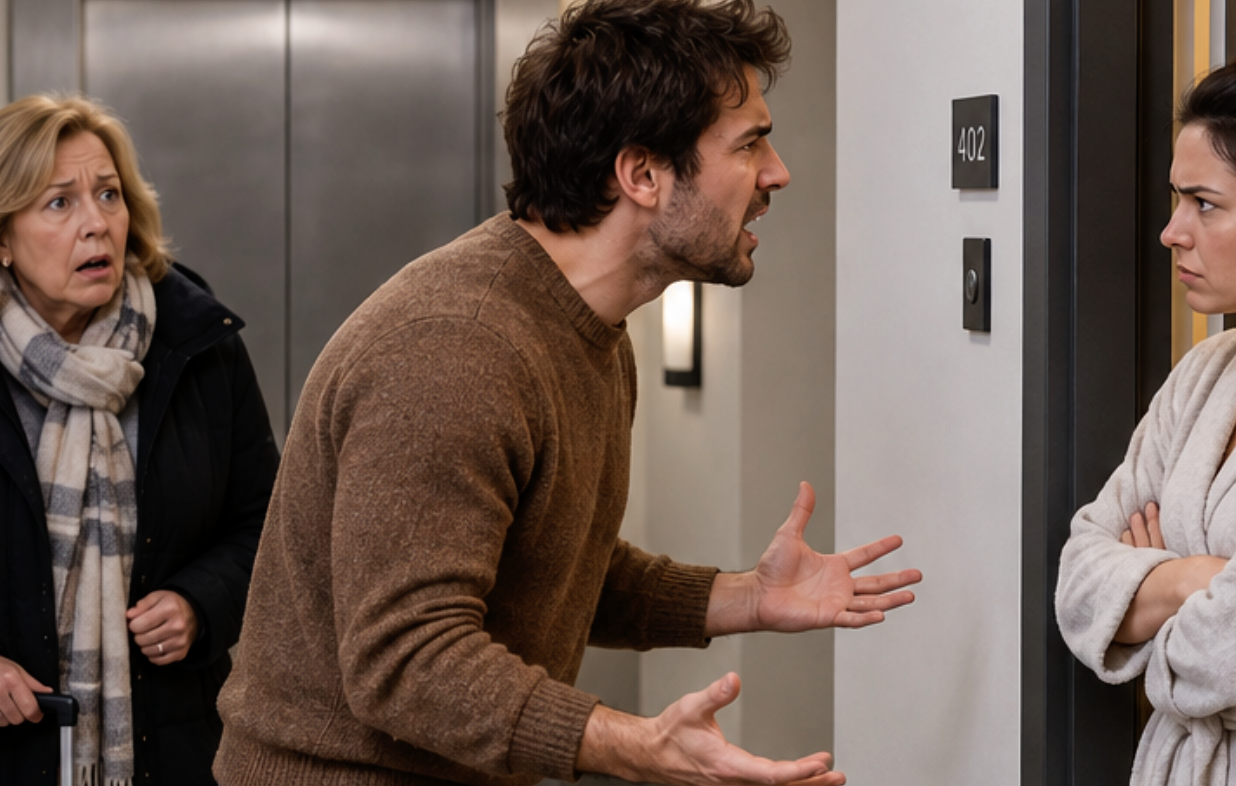
The key scraped in the lock. Stuck. Scraped again. Then somebody pounded on the door.
I put on the chain and opened the door.
“What did you do to the lock?” Vadim asked through the gap. His face looked ashen and unshaven.
“Changed it. While you were standing on the platform.”
Behind him, Rimma shuffled—pink puffer coat, with a rolling suitcase and two plaid bags at her feet.
“Vadik, what’s going on?” Rimma looked from her brother to me. “Am I supposed to go back to the station?”
“Ask your brother,” I said.
“Open the door,” Vadim hissed through his teeth. “The neighbors can hear.”
“Let them hear. I heard plenty yesterday. I was standing in the hallway with one boot on while you were putting together the cot in my room.” My voice was steady, like I was dictating measurements to a client. “‘She’s nobody here.’ ‘She’ll give in, where else can she go.’ ‘Waiting on her is no big deal.'”
Vadim opened and closed his mouth.
“And here’s something else.” I slipped a paper bag through the crack. “Take it, Vadim. You made a key, but it doesn’t work.”
The bag dropped to the tiles. Vadim didn’t bend down to pick it up.
“She was eavesdropping, Vadik!” Rimma clutched his sleeve. “Did you hear? She was right outside the door!”
“I was standing in my own hallway,” I replied.
Vadim shoved his sister aside with his shoulder and leaned closer to the crack. His voice got soft, homey.
“Inga. Come on, I blurted something out. Chatting with my sis, you know how people talk. Look, if you want I’ll have Rimma stay in a day-rate place tonight. I’ll pay, she won’t set foot here again. And I’ll stay. Eleven years together, Inga. Over a single conversation?”
“Vadik, what about me?” Rimma tugged at his sleeve. “Do I start hopping between short-term rentals now?”
“Be quiet, Rimm,” he shot back, not looking at her.
It was a way out, and I saw it. Rimma could live in a rented room, Vadim would stay, in a month the neighbors would forget, in a year so would I. Isn’t that what smart women do?
I couldn’t do it. Not because I didn’t believe him. But every morning I’d hand him his cup and hear those words—’where else can she go.’
“No,” I said.
I took off the chain, threw the door open, and started moving bags out onto the landing. The first one was a blue bag with a torn handle. Rimma backed toward the elevator, dragging her suitcase behind her. On the floor below, a door clicked—someone had come out to listen.
“I’ll call the police,” Vadim said. “I have a right to live here!”
“Call whoever you want. This apartment belongs to my mom, I inherited it. And you’re not even registered here.” I set the box of fishing lures at his feet. “Take the cot too. Rimma can use it.”
“Vadik, let’s go,” Rimma said, tugging him toward the elevator. “No need to beg in front of her.” She glared at me. “And you, Ingulya, don’t think I’ll forget this.”
Vadim picked up the little bag with the key from the tiles, turned it over in his hands, and slipped it into his pocket. He glanced at me over his bags.
“You’ll calm down sooner or later,” he said. “In a week, you’ll be calling me yourself.”
I closed the door.
The new key turned stiffly with an unfamiliar crunch. The elevator still hummed behind the door, then went quiet. I realized I was sitting on the hallway rug with my back against the door; my legs just gave out. I had no intention of calming down. Not in a week, not ever.
***
Six weeks went by. Vadim rented a one-bedroom apartment out by the bypass and now lives there with Rimma. I know this from her page—there are photos from a housewarming party, my brother cutting the cake, the caption reads, “Family is forever.”
Vadim doesn’t call me. He came by once for his power drill—I brought it out to the landing and closed the door before he could say a word. He filed for divorce through court and sent one message: he’ll demand money for the enclosed balcony he built himself. The first court hearing is set for December 18. Rimma hasn’t mentioned the debt, and neither have I.
Sometimes I wonder if I should have let him say all those things to my face.
Did I go too far by putting his bags out on the landing in front of my sister and the neighbors?
The “Seagull” sits by the window, in mom’s old spot. Today, I’m sewing curtains for Zoya Petrovna on it.