For three years, I financed my mother-in-law’s whims while my husband kept saying, “You only have one mom, it’s hard for her.” But one random ad on Avito changed everything. And at a family banquet, I made a toast no one will ever forget.
Three years ago, I married Kostya—and his mother, Zinaida Petrovna, came as a package deal. No, she didn’t live with us; she had her own tiny apartment on the edge of town. But she was in our lives so much, it felt like she was sharing every meal and even our pillow.
Kostya worked as an auto mechanic. He earned decently, but nothing fancy. I handled logistics at a transport company, and took on freelance gigs in the evenings. Together we paid our mortgage and lived pretty modestly.
But Zinaida Petrovna did not believe in modesty. Every month, there was some ‘urgent need.’ Sometimes it was a dentist appointment—but only at a private clinic. Or her blood pressure—requiring only imported medicine. Or her fur coat had worn out, and winter was coming.
In moments like these, Kostya would look at me like a guilty schoolboy: “Ira, it’s my mom. She raised me all alone. I can’t say no.”
And I didn’t say no. For the first year. The second, too. By the third year, I started counting. Turns out, we spent more on Zinaida than our mortgage. Meanwhile, my own mom in Tver hadn’t asked for a single ruble in those three years—she managed on her pension and some tutoring gigs.
When I tried to talk to Kostya, he hit me with the line that became the family’s favorite joke: “Your mom doesn’t go out, so she doesn’t spend. My mom lives life to the fullest! What, should she just sit around between four walls now?”
I bit my tongue then. But I didn’t forget.
In October, Zinaida Petrovna called and made a grand announcement: she was turning sixty-three and wanted to celebrate ‘like a real human being.’ Not at home with a cake, but at the ‘Kashtan’ restaurant—the one with the terrace and live music on the weekends.
“I’ll invite about twenty-five people—friends, neighbors, my second cousin from Ryazan will come. Kostya, you’ll organize it, right?”
Of course, Kostya turned to me. By then, I’d already done the math: a banquet for twenty-five people at ‘Kashtan’ would cost at least a hundred and twenty thousand. With live music, it could be all of one hundred and fifty.
“Ira, but this is a milestone birthday,” Kostya began.
“Sixty-three isn’t a milestone,” I pointed out.
“For Mom, every year is a milestone.”
I didn’t argue with that. It was absolutely true.
I said, “Fine. I’ll pay for the banquet. But I have one condition: I get to make a toast.”
Kostya was surprised. In three years at family gatherings, I’d barely spoken. I mostly smiled and poured drinks for the guests. He must’ve thought I finally wanted to truly become part of the family.
“Of course, Irochka! What a question!”
If only he knew.
Two weeks before the banquet, something happened. I was browsing Avito for a storage rack. Scrolling through listings, I suddenly saw a kitchen photo I’d recognize anywhere. Green cabinets with gold handles, sunflower tiles, a fridge covered in magnets from Anapa.
It was Zinaida Petrovna’s apartment.
But the ad wasn’t for selling. “One-room apartment for rent, 28 sq.m., furnished, appliances, 23,000 rub/month.” The phone number was unfamiliar. But the address, the photos, even the entryway mat saying “Welcome”—everything matched perfectly.
I called the number from the ad. A woman answered and introduced herself as Svetlana. She told me the apartment was available and I could move in as soon as tomorrow. The owner, Zinaida Petrovna, is currently ‘staying at relatives’ dacha.’
What dacha? Zinaida doesn’t have a dacha. But her friend Tamara does—a spacious house in Malakhovka where my mother-in-law spent every summer ‘to recover her nerves with some fresh air.’ Turns out, she went there not just in summer.
Suddenly, it all made sense. Zinaida had been living with Tamara and renting out her own apartment. Twenty-three thousand rubles a month, on top of her pension. And yet, every week she called to complain she could barely make ends meet.
I didn’t make a scene. Didn’t call Kostya. I just sat down and started to prepare. Not for the banquet. For a toast.
First, I asked my friend Nastya to go ‘check out the apartment.’ Nastya took photos of everything: the contract Svetlana showed her, the receipts from past months, and the bank card number for payments. The card was registered to Zinaida Petrovna Kruglova.
Then I went through our payment history. Over three years, we sent my mother-in-law more than six hundred thousand rubles. And that’s not counting the banquets, gifts, and all those ’emergency’ expenses Kostya covered with his own salary.
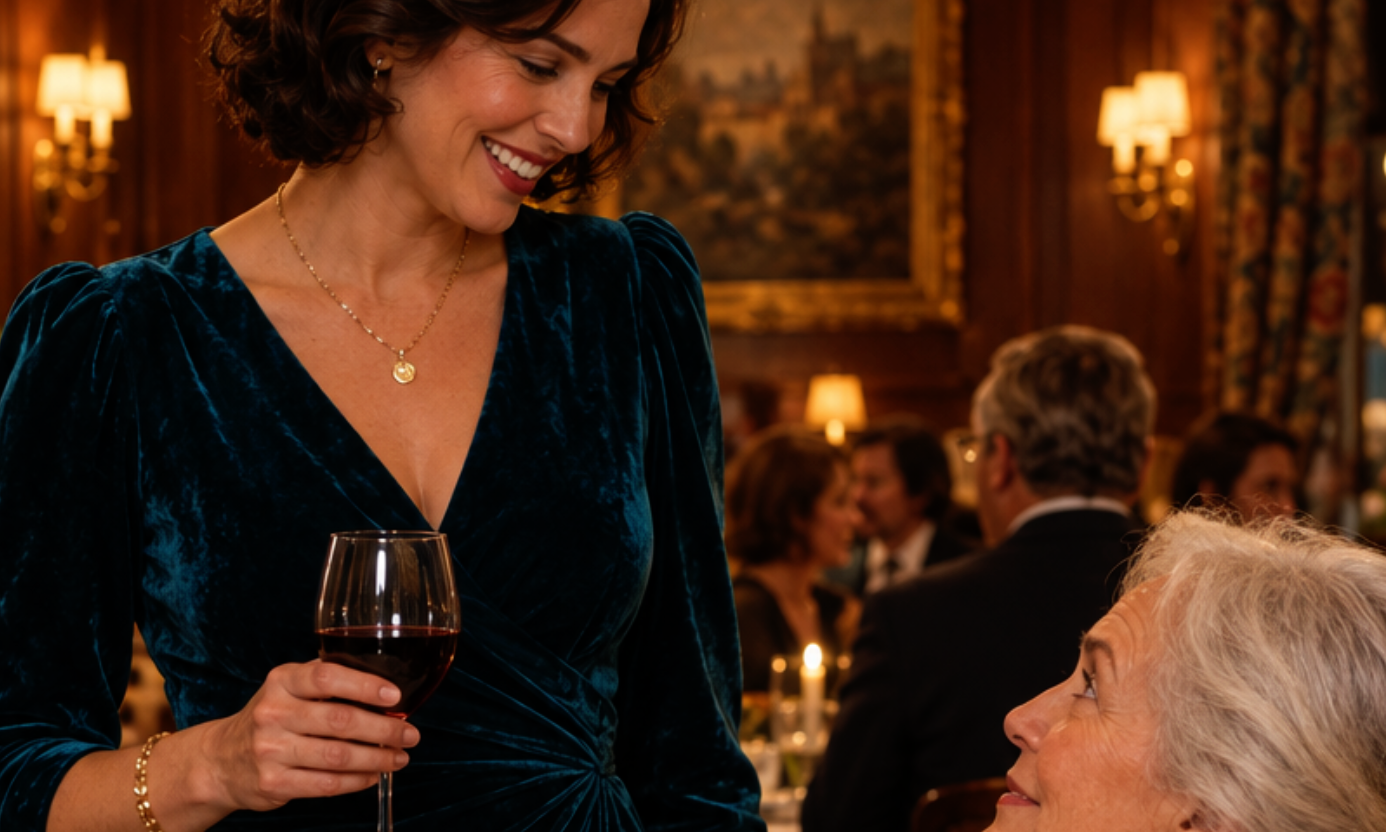
I arrived at the banquet in a new dress. Dark blue, fitted. I felt calm and almost cheerful. You know that feeling when you’re prepared and you know exactly what’s going to happen? Not a nerve in sight.
Zinaida Petrovna met me at the entrance, wrapped in the cashmere shawl we ‘gave’ her for her last birthday. Her sixty-second. That one was ‘a milestone’ too.
Everyone took their seats. The musicians started playing something by Antonov. The waiters brought out appetizers: carpaccio, bruschetta, a prawn salad. Zinaida was beaming, soaking up compliments, hugging her friends, and loudly telling everyone what a wonderful son she had.
Not a word about her daughter-in-law. It didn’t bother me, though. I had bigger things on my mind.
After the main course, when everyone had relaxed and mellowed out, I stood up with my glass.
‘Dear Zinaida Petrovna! I want to say a few special words to you.’
The room fell silent. Kostya looked a bit tense—as if he was reading something in my expression.
‘In my three years in your family, I’ve learned a lot. You’ve shown me what it means to live life to the fullest. Not to cut back on yourself. Not to be shy about asking loved ones for help…’
Zinaida lit up. Her friends nodded in agreement.
‘And today I want to give you a gift that you truly deserve.’
I took a plain white envelope out of my purse and handed it to my mother-in-law.
Zinaida opened it with a smile. The smile lasted just three seconds.
Inside was a printout of the Avito ad. Green cabinets, sunflowers, a ‘Welcome’ mat. Under it, a table of all our transfers over three years, with dates and amounts. Six hundred and fourteen thousand rubles, to be exact.
Kostya reached for the envelope. ‘What’s this?’
I didn’t wait.
‘This, Kostya, is an ad for your mom’s apartment. Twenty-three thousand a month. She’s been renting it out for a year and a half. And all this time, we’ve been covering her meds, her dental work, her furs, and this banquet—because she kept telling us she didn’t have enough money.’
The room fell so silent, you could hear the clinking dishes from the kitchen. The musicians lowered their instruments.
Zinaida clung tightly to the edge of the tablecloth.
“Irochka, you don’t understand… This is temporary… Tamara just asked to stay for a while…”
“Tamara asked you to live at her place for a year and a half, and somehow you managed to make about four hundred thousand just from renting?” I spoke calmly, without raising my voice. “Plus, we sent you six hundred thousand. That’s a million total. Not too bad for someone who’s barely making ends meet.”
My cousin from Ryazan quietly gasped. Tamara, sitting in the corner of the table, suddenly became very interested in her napkin.
Kostya slowly set down his fork. He looked at his mother. Then at me. Then back at his mother.
“Mom, is this true?”
Zinaida tried to look upset, maybe even shed a tear. But it wasn’t convincing. She looked far too put together for a heartbroken pensioner—elegant shawl, manicured nails, a fresh hairstyle.
“Son, I just wanted a little backup! For old age! You never know what can happen!”
“It’s smart to prepare for old age,” I nodded. “But why keep taking money from us? We’re paying off a mortgage. Kostya’s working double shifts. And here you are, with extra income, telling us you can’t even afford your medicine.”
I glanced around the room. Twenty-five people were staring—some at Zinaida, others down at their plates. Nobody was eating.
“So, dear guests, a new toast. Here’s to honesty in the family. And to the person who can actually afford it paying for today’s banquet.”
I set the printed restaurant bill on the table. One hundred thirty-eight thousand. Then I calmly took my seat.
Zinaida Petrovna stared at the bill as if it were a court summons.
On the way home, we rode in silence. Kostya didn’t say a word until we reached our building. Then he sat on the bench outside and stared off toward the playground for about ten minutes.
“I didn’t know,” he finally said.
“I believe you didn’t know. But you also never tried to find out. It was convenient for you: I paid, your mom was happy, no one argued.”
He didn’t argue.
Zinaida paid for the banquet the next day. She transferred the money straight to the restaurant without a single call to me. Turns out her ‘rainy day fund’ was pretty well padded.
A week later, the three of us sat down together. Not in a restaurant, but at our kitchen table, with casserole and tea. The conversation was tough, but honest. We agreed: no more money transfers without a clear reason and receipts. No more urgent calls for ‘just five thousand until the pension comes in.’ And if Mom needs help, she’ll come right out and tell us what she wants and how much.
To her credit, Zinaida Petrovna didn’t stay offended forever. Turns out she’s got a stronger spirit than a habit for scheming. A month later, she called me herself, without Kostya. She said: “Irka, I was angry with you for two weeks. But you did the right thing. I got carried away.”
That was the first time my mother-in-law called me just by my name. No sweet ‘Irochka.’ No sour smile. Just ‘Irka.’ Like I was one of her own.
After that banquet, Kostya started to change, too. He stopped looking guilty every time his mom called. He began checking where our money was going. And one day, when Zinaida asked, ‘Can you send some money for a massage? My back is killing me,’ he calmly replied, ‘Mom, you make twenty-three thousand a month from the apartment. The massage is three. You can handle it.’
I stood in the hallway, grinning so wide my cheeks were starting to hurt.
You know what’s the funniest part? That “Welcome” doormat by Zinaida’s door is still there—she’s never removed it from the apartment. She says it brings luck to her tenants. But I think luck visited someone else that night. It found the person who finally decided to speak up.