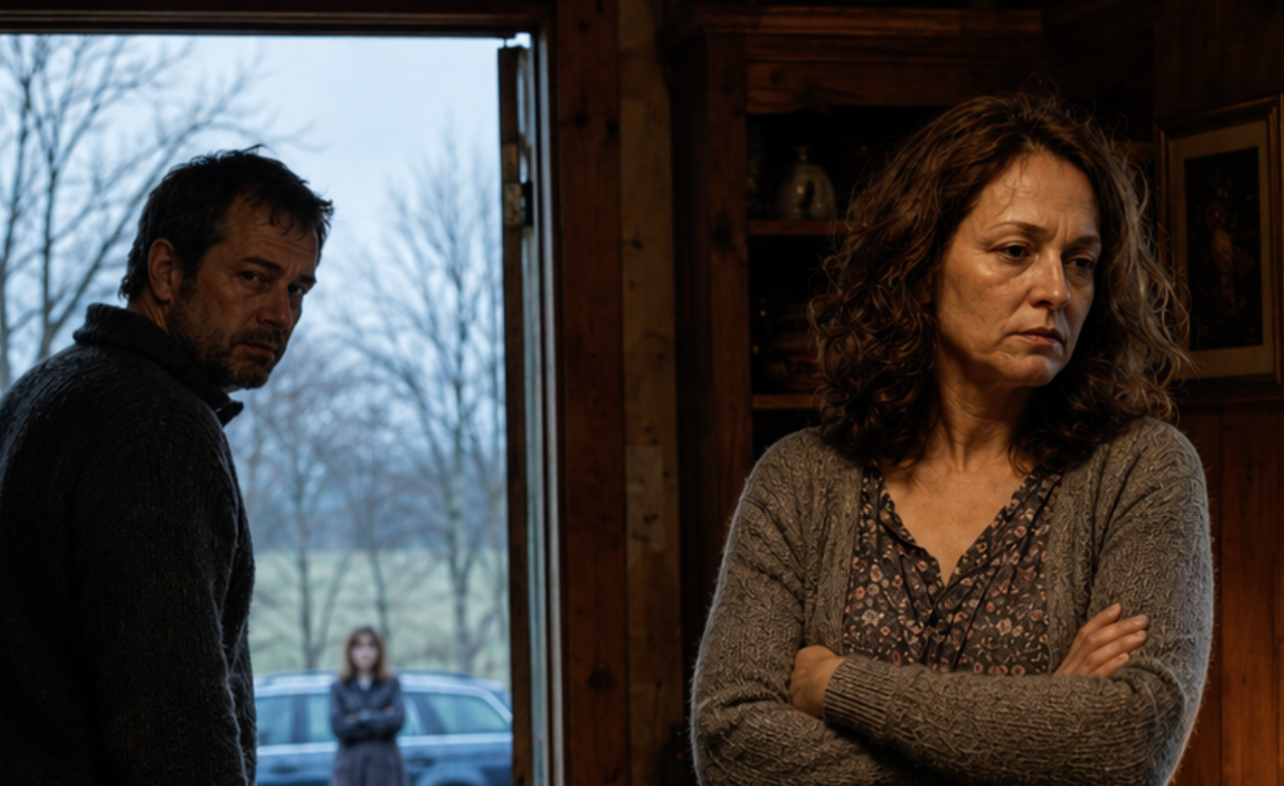
After twenty years of marriage, her husband said, “I’m leaving you for a younger woman.” She silently packed his things — and a year later, he came back and found a new lock on the door.
That morning, Natalia got up earlier than usual — around five, while it was still dark. She lit the stove and started making batter for pancakes. Outside the windows, a gray November dawn was breaking: bare birch trees, frozen ground, the first dusting of snow on the shed roof. She loved this time of day, when the house was still asleep, when everything was quiet and she could be alone for a while.
Igor came into the kitchen at seven. He sat down at the table. She placed a plate of pancakes in front of him, along with sour cream and tea.
“Natalia,” he said. “We need to talk.”
She froze beside the stove. She didn’t turn around. Something in his voice — or maybe the way he hadn’t touched the pancakes — told her everything before he even opened his mouth.
“I’m leaving,” he said. “For someone else.”
She remained silent. Outside, the wind shook a bare birch branch, sending snow drifting from it.
“She’s twenty-eight,” he continued. “She… understands everything. Things are easy with her. Do you understand? With you, everything has become difficult somehow. Routine. Twenty years of routine. And I’m still alive. I still want…”
“Don’t,” Natalia said quietly. “Don’t explain.”
She turned around. Her face was calm, without a single tear. Only her hands trembled slightly. She placed the pancake spatula on the edge of the stove and left the kitchen.
Igor remained sitting there. The pancakes grew cold on his plate.
Fifteen minutes later Natalia returned. She was carrying two suitcases. Old ones, from the days when they used to travel south for vacations. Heavy suitcases. She placed them beside the door.
“I packed your things,” she said. “Everything from the wardrobe. Socks, shirts, sweaters. Your passport is on the bedside table. The documents are in the top drawer. If I forgot anything, you can pick it up later.”
“Natalia…”
“Don’t. You said what you had to say. I heard you.”
She opened the front door. Cold air rushed into the house.
Igor stood up. He walked over to the suitcases. Picked up one, then the other. He hesitated.
“Maybe you want to say something?” he asked. “Scream at me? Accuse me?”
“No,” she said. “I don’t.”
“Why?”
“Because words won’t change anything. You’ve already made your decision. Screaming won’t bring you back. And I’m not going to humiliate myself.”
Igor looked at her as if he were seeing her for the first time. Tall and dignified, with a simple face and gray eyes. Her fair hair, once long, was now cut to her shoulders. She wore a simple house dress and a knitted cardigan. She was forty-four but looked younger.
Suddenly he realized that she was beautiful.
She had always been beautiful.
He had simply grown used to her.
“Natalia, I…”
“Go,” she said. “She’s waiting for you.”
He picked up the suitcases and left.
The door closed.
Natalia stood there for a minute. Then she sat down at the table and took a pancake. She had no appetite, but she ate slowly, mechanically, because she understood that life went on.
And pancakes grew cold.
Their house was solid and well built — a traditional pine house with carved window frames. Igor’s father had built it thirty years earlier. The plot of land was large, about twenty sotkas. There was a bathhouse, a shed, a well, and a vegetable garden filled with potatoes, cucumbers, tomatoes, and herbs.
Natalia loved all of it.
She was one of those women who couldn’t imagine life without soil beneath her feet.
That same morning she walked through the house.
She looked into the bedroom. The empty wardrobe stood with its doors wide open. Half the hangers were bare. On the bedside table lay a forgotten lighter, a car keychain, and an old framed photograph of Natalia and Igor on their wedding day — young, happy, foolish.
She picked up the photograph and looked at it.
Then she put it into a desk drawer.
In the kitchen was his mug. His slippers remained by the doorway. His newspaper lay on the windowsill.
She gathered everything into a bag and carried it to the shed.
Later she would decide what to do with it.
That evening she called their son.
Anton was studying at a university in the regional capital. He was in his second year.
“Mom, what’s wrong?” he asked. “Your voice sounds strange.”
“Your father left,” she said.
Silence.
“For good?”
“For good. For a younger woman.”
“What a bastard,” Anton said.
Then he added:
“Mom, I’m coming home.”
“No. You have exams. I’ll manage.”
“Mom…”
“I’ll manage,” she repeated.
For the first time that day, her voice trembled.
“Really. I’m strong.”
She hung up.
Sat down on a chair.
And suddenly she began to cry — for the first time all day.
Bitterly.
Uncontrollably.
Then she wiped away her tears, washed her face with cold water, and went to bed.
Tomorrow she had to keep living.
The first three days were difficult.
She woke in the middle of the night and instinctively reached her hand toward the place where Igor used to lie.
Empty.
A cold sheet.
She lay awake with her eyes open, listening to the wind howling through the stove chimney.
On the fourth day she got up and traveled to the district center.
She bought a lock.
A new one.
A good one, with three keys.
“Why do you need such a complicated lock?” the salesman asked.
“So that no stranger can enter,” she replied.
Back home, she sat on the porch with a screwdriver and replaced the lock herself.
She removed the old one.
Installed the new one.
Tightened the screws.
Tested it.
Click.
Locked.
She stood on the porch looking at the door.
Now it was her house.
Hers alone.
A month passed.
Then another.
Natalia found a job as a cleaner at the local school. The salary wasn’t much, but it was enough to live on. She also had the vegetable garden and chickens.
Anton helped her, sending part of his student allowance.
She accepted the money but quietly saved it.
He needed it more than she did.
She barely spoke to the neighbors.
She knew they were gossiping.
“Her husband left her for a younger woman. What a disgrace. And she didn’t even shed a tear — just sits there like stone.”
It didn’t bother her.
She had understood something a long time ago: people would always talk.
What mattered wasn’t what they said.
What mattered was what she knew about herself.
She knew she hadn’t broken.
In spring, she redid the flower garden.
She planted marigolds, asters, and calendula.
She painted the shutters green.
She replaced a rotten board on the porch.
The house seemed to come back to life along with her.
One evening she sat on the porch watching the sunset.
Suddenly she realized something.
She felt peaceful.
For the first time in twenty years, truly peaceful.
She didn’t have to wait for him to come home from work.
She didn’t have to wonder what mood he would be in.
She didn’t have to endure his heavy, oppressive silence at dinner.
She didn’t have to pretend everything was fine when nothing had been fine for a long time.
Twenty years.
For twenty years she had lived for him.
She cooked his favorite meals.
Washed his shirts.
Entertained his friends.
Went on vacations wherever he wanted.
Watched the movies he chose.
And now she could do whatever she wanted.
The feeling was light, almost like being set free.
And it was unexpectedly pleasant.
Meanwhile, Igor was living with the younger woman.
Her name was Karina.
She was twenty-eight and worked as a saleswoman in a cosmetics store.
She was beautiful — bright, loud, with gel nails and eyelash extensions.
Nothing like Natalia.
The first two months were intoxicating.
Restaurants.
Trips.
Parties.
Karina was easygoing — exactly the kind of easiness he believed had been missing from his marriage.
No need to think about heating the stove.
No need to repair the fence.
No need to carry firewood.
Just live and enjoy yourself.
But by the third month, something began to go wrong.
Karina didn’t cook.
At all.
“I’m not a cook,” she would say before ordering food delivery.
It was expensive.
Very expensive.
Igor, who had spent years eating homemade soup and cutlets, began longing for normal food.
Karina didn’t understand his silence.
“Why aren’t you talking? I’m bored! Talk to me!”
Sometimes he simply wanted to sit quietly.
With Natalia they could sit beside each other for an hour without saying a word, and it had never been an uncomfortable silence.
It was peaceful.
They were simply together.
Karina wanted entertainment.
After a long shift at work, Igor wanted quiet.
She dragged him to clubs.
He wanted to go to the bathhouse.
She wanted a vacation by the sea.
He wanted to go fishing.
She wanted new shoes every weekend.
He wanted to save money for repairs.
By the fifth month they had started arguing.
“You’re old!” she shouted. “You’re boring! All you need is a television and slippers!”
“And all you need is money and clothes!” he shouted back.
Then Karina found another man.
Younger.
More fun.
She told Igor:
“I’m sorry, but this isn’t going to work. You’re a good man, but… you’re just not for me.”
He packed his belongings — the same things Natalia had packed for him a year earlier.
He went outside.
Got on a bus.
And headed back home.
He arrived in the village at sunset.
He walked down the familiar street — past the well, past the old linden tree where they had once hung a swing for Anton, past the neighbor’s fence where the same dog was still barking.
Everything seemed exactly the same.
Except the house.
The house had changed.
Green shutters.
Flowers in the front garden.
A new board on the porch.
Freshly painted window frames.
Everything was clean, neat, beautiful.
Igor actually stopped for a moment to admire it.
Then he walked to the door.
He pulled out his key — the old one on a gas-station keychain.
He inserted it into the lock. It didn’t fit. He tried again. And again. The key wouldn’t turn. The lock was different. New. Heavy. Complicated. Igor stood beside the door for a moment. Then he knocked. Silence. He knocked louder.
Footsteps.
The door opened.
Natalia stood in the doorway.
She wore a simple cotton dress and a light knitted cardigan.
Her hair had grown slightly longer.
Her face looked calm and refreshed.
She looked at him without surprise, without happiness, without anger.
She simply looked at him.
“Hello, Natalia,” he said.
“Hello, Igor.”
“I… came back.”
“I can see that.”
“Can I come inside?”
She didn’t move.
“This is still home, isn’t it?” he asked.
“My home. But you don’t live here anymore.”
“Natalia, let me explain…”
“You already explained everything. A year ago. I understood everything then, Igor. You left. I didn’t stop you. You made your choice.”
“I made a mistake!” he nearly shouted. “I understand that now! I’m an idiot! She was young. She didn’t need me — she needed my money! She’s empty, Natalia! But you… you’re real. You’re the only one I have. I understand everything now!”
She listened calmly.
Like someone listening to a child who had misbehaved and was now trying to justify himself.
“You see, Igor,” she said quietly, “when you left, I spent three days lying there staring at the ceiling. Then I got up and changed the lock. Not because I was angry. Not because I wanted revenge. I changed it because I understood something: you weren’t my husband anymore. You were a stranger. And I don’t open my door to strangers.”
“Natalia… I’m your husband. Twenty years.”
“Twenty years,” she repeated. “And you crossed them out in one morning. Five minutes. You didn’t even give me a chance to say anything. You didn’t try to tell me what was wrong between us. You simply threw me away like an old thing.”
“I wanted to talk…”
“No. You wanted to leave beautifully. You expected me to cry and beg you to stay, and then you could say, ‘See? You don’t understand me.’ But I didn’t cry. I packed your suitcases. And that confused you. You’re still confused. You thought I would wait for you — for a year, two years, ten years. But I didn’t wait.”
Igor said nothing.
He looked at her.
She stood leaning against the doorframe, and in the light of the setting sun she looked younger than he remembered.
Or perhaps it wasn’t the light.
Perhaps she herself had changed.
The exhausted, worn-down woman he had known had become calm and confident.
Someone he had never truly known.
“So what happens now?” he asked quietly.
“Nothing. You go your way. I go mine. Anton will call you if he wants to. I won’t turn him against you — he’s an adult and can decide for himself. But don’t come here again. This is my house. I live here.”
“It’s my house too,” he said. “I built it.”
“You abandoned it,” she replied. “Along with me. I stayed.”
Something glistened in her eyes.
But she held herself together.
“I loved you, Igor. I loved you for twenty years. And you destroyed that. There’s nothing left to glue back together. Not even the pieces.”
She stepped back and took hold of the door handle.
“Wait,” he said. “What if… what if I don’t leave? What if I wait here? On the porch?”
“You can wait all night if you want,” she said. “You’ll only get cold. The nights are chilly now. Go, Igor. Go.”
And she closed the door.
The click of the lock sounded like a gunshot.
Igor stood on the porch.
Then he sat down on the step.
He took out the old key that no longer fit the lock and turned it slowly in his hands.
Then he placed it on the railing.
He stood up.
And walked toward the bus stop.
Halfway there, he turned around.
The house stood at the edge of the village — strong and beautiful in the sunset.
A light came on in the window.
Behind the new curtains, life continued.
A life in which there was no longer a place for him.
He didn’t cry.
He had forgotten how to cry a long time ago.
He simply walked with his eyes lowered to the road, thinking about how foolishly everything had turned out.
He had traded a living, warm, beloved person for something empty.
He had spent twenty years building a life and destroyed it in a single minute. And now he had nothing. No home. No wife. No family. Only an old key left behind on the porch railing. Inside the house, Natalia sat by the window.
She watched his figure moving down the road — first clear, then smaller and smaller, until he disappeared around the bend.
She sighed.
There was borscht on the stove.
She poured herself a bowl and sat down at the table.
She ate slowly, looking out the window as twilight deepened.
She felt strange — bitter and light at the same time.
She took no pleasure in his humiliation.
She wasn’t gloating.
But she felt that this was right.
Everything was right.
The new lock on the door wasn’t punishment.
It was a boundary.
Between the past and the present.
Between “us” and “me.”
She had drawn that boundary.
And now she would live on her side of it.
She finished her borscht.
Washed the dishes.
Then she stepped onto the porch to make sure the door was locked.
The old key was lying on the railing.
She picked it up.
Held it in her palm.
It was still warm from his hand.
Natalia walked down into the yard and approached the well.
She opened her fingers.
The key fell into the dark water, almost silently, barely making a splash.
Only circles spread across the surface.
She stood there for a minute.
Then she raised her head.
The autumn sky was clear, dotted with the first cold stars.
“That’s it,” she said aloud.
And she went back inside.