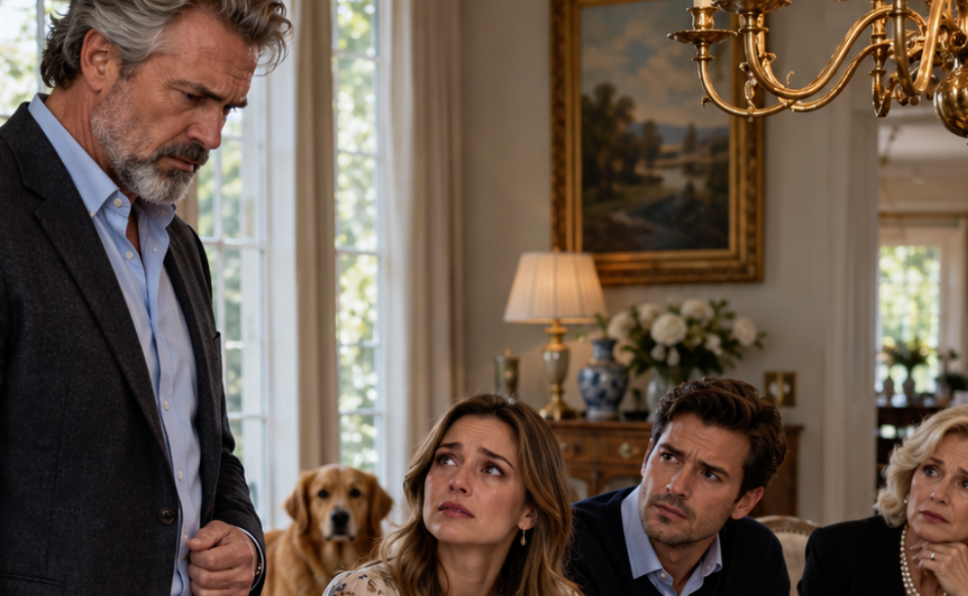
have spent fifty-two years learning the value of quiet strength. In my line of work, the men who shout the loudest on a job site are rarely the ones who know how to square a foundation or carry the heaviest load. I run a small, dependable general contracting business. My body is an honest map of that labor: wide, thick-set shoulders shaped by decades of hauling green lumber, a back that knows the strain of steel beams, and broad, heavily calloused hands that look out of place around delicate glassware. Over the years, people on commercial sites have joked that I look like a retired linebacker who wandered into carpentry by mistake. I never took offense. Those hands put food on our table, put roofs over strangers’ heads, and, most importantly, paved a smooth, unobstructed road for my daughter, Emily.
Emily was twenty-seven, my only child, and the center of gravity in my otherwise straightforward life. When her mother passed away years ago, I swore to myself that Emily would never feel an ounce of lack, whether in affection, security, or opportunity. I will be the first to confess that I spoiled her. When the tuition bills arrived from her university, I wrote the checks without hesitation. When she graduated, I bought her a safe, reliable sedan so she would never be stranded on the side of a highway. And when she and her fiancé, Matt, found an older craftsman home that needed a substantial cash injection for a down payment, I handed over my savings with genuine pride. We were close—or at least, that was the story I told myself every Sunday when she came over for pot roast, or whenever she stopped by my workshop to borrow power tools she never quite remembered to return.
The illusion began to crumble on a humid Tuesday afternoon two months before the wedding.
I was at my shop desk, cross-referencing lumber invoices against supplier receipts, when my phone screen flashed with Emily’s contact photo. With sawdust on my knuckles and both hands holding a ledger, I simply tapped the speakerphone icon.
“Hey, kiddo,” I said, leaning over the desk.
No greeting answered me. Instead, the phone broadcast a wash of ambient noise—the sharp clink of china cups, background chatter, and the rustle of boutique shopping bags. Then, cutting through the background hum, came a distinct, nasal voice. It was Pamela, Matt’s mother—a woman who carried herself with the performative, fragile elegance of old country-club money, despite having married into a fairly ordinary accounting firm.
“Well, I certainly hope he’s not planning to sit in the immediate family row,” Pamela said, her tone dripping with disdain. “There simply isn’t room for a man built like a flatbed truck wedged next to our relatives. It’ll ruin the symmetry of every single processional portrait.”
My breath caught in my throat. I stood frozen over my invoices, waiting for the defense that any loving child would instinctively offer. I waited for Emily to say, *“Mom B, that’s my dad you’re talking about,”* or at least to counter with a sharp, uncomfortable reprimand.
Instead, a bright, familiar giggle fluttered through the speaker. It was not a nervous laugh. It wasn’t the tentative, cornered chuckle of someone trying to de-escalate an awkward situation. It was light, easy, and conspiratorial.
“Your wish is my command,” Emily said.
Pamela clicked her tongue in satisfaction. “Honestly, Emily, think of the aesthetic. It would be utterly mortifying in the formal album.”
“Don’t worry,” Emily replied, her voice floating across the empty workshop like a sentence handed down by a judge. “He won’t be anywhere near the front.”
The silence in my office turned deafening. I stood motionless, staring at an unfinished patch of drywall I had meant to tape and mud for three weeks. The physical sensation was not unlike taking a rogue four-by-eight sheet of plywood directly to the sternum. It knocked the air straight out of my lungs.
A moment later, the rustling subsided. Emily’s voice returned, suddenly direct and clear: “Dad? Oh, shoot, did my purse call you? Hey! I was just looking at floral samples…”
My tongue felt heavy, coated in dry dust. “Yeah,” I managed, keeping my voice stripped of every inflection. “I’m here.”
She chattered on for three minutes about pastel spray roses, linen overlays, and seating arrangements, completely unaware that she had left the door wide open to her true feelings. I did not confront her. I didn’t yell. I simply listened, muttered a noncommittal goodbye, and sat down in my battered leather chair. For nearly an hour, I stared at my hands. Those hands had framed her childhood bedroom, fixed her scraped knees, and paid for every privilege she took for granted. Yet to her, and to the family she was so eager to impress, those hands and the frame that supported them were merely an aesthetic blemish on an otherwise manicured social lawn.
That night, sleep was impossible. My old shepherd mix, Max, lay across my work boots, sensing the heavy, static air in the room. In the days that followed, the wound did not scab over; it festered beneath the surface of my daily routine. Emily sent photos of seating arrangements where my name was jotted down in faint pencil at Table 14—a drafty corner near the kitchen doors—while Matt’s distant cousins were inked in gold script along the central aisle. She stopped by the shop to casually ask if I would “mind throwing in an extra two thousand dollars” for a string quartet because Matt’s mother found the reception DJ to be “a bit pedestrian.”
“I already covered the venue booking, the primary caterer, and the photographer’s package, Emily,” I had pointed out quietly, wiping down a cabinet face.
She had sighed, that theatrical, put-upon sigh she used when the world failed to yield to her wishes. “I know, Dad, but Matt’s parents paid for the imported wine upgrade. I just don’t want them thinking our side of the family is cheap.”
*Our side.* The phrasing was revealing. To Emily, I was not a father to be honored; I was an unruly representative of a lower tax bracket that needed to be managed, polished, and quietly tucked away behind a decorative fern.
The final straw snapped two weeks before the ceremony, during what was billed as a “logistics dinner” at Emily and Matt’s house. I had stopped at the Italian bakery on my way over, picking up a box of the almond biscotti Emily used to love. When I arrived, Pamela was already seated at the head of the dining table, sipping pinot noir like a visiting monarch inspecting a remote province.
After fifteen minutes of superficial conversation about weather and driveway paving, Matt cleared his throat, opened a slim leather portfolio, and slid a spreadsheet across the table.
“Noah, we took another pass at the final vendor balances,” Matt said, avoiding my eyes. “With the linen upgrades, the late-night sliders, and the horse-drawn carriage Emily really has her heart set on, we’re running a bit short. We felt it made the most practical sense for you to absorb these last line items. You have the liquidity, and we really want this to be unforgettable.”
I looked at the number at the bottom of the page. It was an additional eight thousand dollars.
“You already asked me to absorb the quartet last week,” I said, resting my forearms flat against the wood. “Now a carriage? Emily, we agreed on a firm ceiling three months ago.”
Pamela set her wine glass down with a delicate, deliberate click. “Noah, let us not pinch pennies at the finish line. It is about presenting a certain standard to our community. If things appear sparse, people talk. And frankly, while we’re on the subject of appearances, we really must address the processional.”
I looked directly at Pamela. “What about the processional?”
“Well,” she said, folding her manicured hands, “Matt’s father is escorting him down, and given the height and posture discrepancies, having you walk Emily all the way down that narrow central aisle will create a rather severe visual imbalance. We thought it might be much more tasteful if Matt’s father walked Emily down, or perhaps if she walked alone, and you simply stood up from your seat near the back to offer a brief blessing.”
The air left the room. I looked at Matt; he looked intently at his linen napkin. I turned my eyes to Emily. Her cheeks were crimson, her lips parted, but she offered no defiance.
“Emily?” I asked, my voice dangerously calm. “Is this what you want?”
“Dad, please,” she whispered, her eyes pleading not for my dignity, but for my compliance. “Don’t make a scene. Mom B is just thinking about the flow of the ceremony. The symmetry matters for the videographer. It’s only twenty seconds of walking.”
I pushed my chair back. The wooden legs scraped against the oak floor with a sharp, violent shriek. Max, who had been waiting patiently by the front coat rack, sat up immediately.
“It’s not about twenty seconds of walking, Emily,” I said, standing at my full height. For the first time in her life, she looked physically intimidated by the broad shoulders she had mocked over the phone. “And it’s not about symmetry. You think I am an embarrassment to be hidden, but you expect my bank account to remain wide open to the public.”
“Noah, that is entirely uncalled for—” Pamela began, her voice rising in shrill indignation.
“I am not speaking to you,” I said, cutting her off with a single glance that silenced her mid-breath. I turned back to my daughter. “I heard the speakerphone call two months ago, Emily. I heard your future mother-in-law call me a truck, and I heard you promise her that I wouldn’t be in the way. I stayed quiet because I wanted to see if my daughter still lived inside you. Now I have my answer.”
I turned on my heel, walked out into the cool evening air, and drove home with the windows rolled down to drown out the sound of my own pulse.
That night, the hurt transformed into an icy, crystalline resolve. When I arrived at my dark house, I did not reach for a bottle of bourbon, nor did I smash anything against the wall. Instead, I pulled a thick cardboard accordion file from my filing cabinet and dumped its contents onto the kitchen table.
Every contract was there. The historic mill venue, the farm-to-table caterer, the floral designer, the master baker, the boutique lighting crew, and the three-piece acoustic ensemble. Because Emily had been overwhelmed by logistics during the early stages of planning, I had signed every single agreement personally. Every vendor account was registered under *Noah Campbell Construction LLC* or my private name. Every deposit had cleared through my commercial checking account. Legally, artistically, and financially, this wedding was not Pamela’s showcase, nor was it Matt’s production. It was mine.
I took out a legal pad, a red ballpoint pen, and spent three hours studying the termination and modification clauses. I did not intend to ruin the day out of petty malice, but I was done subsidizing my own humiliation. If they wanted a stripped-down, exclusive affair that matched Pamela’s delicate sensibilities, they were about to get an unvarnished lesson in what self-sufficiency actually cost.
Three days before the scheduled Saturday wedding—the exact contractual deadline before non-refundable cancellation penalties kicked in—I went to work.
At 8:00 AM sharp, I called the venue director, a woman named Clara who had worked with my firm on several historical restorations.
“Clara, it’s Noah Campbell,” I said, leaning back in my desk chair with a mug of black coffee. “I need to make immediate administrative amendments to the Saturday booking.”
“Good morning, Noah. What do you need? Adding heaters for the terrace?”
“No,” I replied steadily. “I am exercising my contractual right as the primary licensee to reduce the booked capacity. We are downsizing the floor plan from one hundred and fifty guests to fifty. Remove the mezzanine lounge, strike the extra bar stations, and release the secondary banquet hall.”
Clara paused, her professional veneer dropping for a fraction of a second. “Noah… that is a massive reduction seventy-two hours out. Are you certain?”
“Completely. Furthermore, Clara, I am locking the primary payment ledger today. The balance currently on file covers the revised, fifty-person footprint. If anyone calls to reinstate the grand ballroom or add supplementary staging, inform them that those additions require an immediate, separate payment from a different cardholder. If that payment is not tendered by 5:00 PM today, the extra spaces are released to your waiting list.”
“Understood, Noah,” she said softly, asking no prying questions. “The paperwork will reflect your instructions within the hour.”
Next came Frank, the catering manager. Frank was an old union hand who had supplied food for my commercial job sites for over a decade.
“Frank, we’re trimming the sails,” I told him. “Cancel the raw oyster bar, strike the dry-aged tenderloin, and drop the midnight slider service. Revert the banquet to the base package we discussed back in January: roast chicken, seasonal vegetables, and simple dinner rolls. And cut the plate count to forty-five.”
Frank chuckled over the line. “Man, you’re saving yourself about seven grand on proteins alone. You sure the missus—well, the bride—won’t have my head?”
“My signature is on the check, Frank. If Matt or his mother wants beef tenderloin and imported cheeses, they can wire you the difference by noon.”
By 11:00 AM, I had visited the rental agency and returned the imported French cross-back chairs, replacing them with standard wooden folding chairs. I called the floral designer and instructed her to deliver only the bridal bouquet and modest table greenery, canceling the five-thousand-dollar floral arch Pamela had personally redesigned twice.
Finally, I drove to my credit union. I sat across from my branch manager, withdrew the authorized spending privileges I had granted to Emily’s joint account, and printed out a comprehensive, itemized ledger of every dime I had invested into the wedding over the preceding ten months. The total came to just over forty-two thousand dollars.
At noon, I texted Emily four words: *Come to the shop.*
She arrived forty minutes later, wearing an oversized university sweater and a look of brittle anxiety. She hadn’t slept well either; dark rings bruised the skin beneath her eyes.
“Dad, what’s going on?” she asked, stepping past the table saw into my small back office. “Clara from the venue just sent me a revised floor plan that looks completely wrong. She said you altered the master booking.”
I did not raise my voice. I pointed to the folding chair opposite my desk, waited for her to sit, and slid the ledger across the blotter along with the amended contracts.
“Take a look,” I said.
Emily picked up the pages. As her eyes scanned the numbers, the red ink, and the severe cancellations, all the color drained from her face. Her hands began to tremble.
“You… you canceled the ballroom? You canceled the tenderloin? Dad, the rehearsal is tonight! What did you do?!”
“I brought the wedding into alignment with reality,” I said evenly, looking directly into her eyes. “You and Pamela want an aesthetic production where I am kept out of sight like an unsightly piece of scaffolding. But you expected that scaffolding to hold up the entire roof. That ends today. Every vendor has been paid for a modest, dignified fifty-person ceremony. If you want the champagne towers, the string quartet, the carriage, and the luxury seating for Matt’s social circle, you and his parents have until five o’clock to cover the balances with your own money.”
Tears spilled over her eyelashes, tracing tracks through her foundation. “Dad, how could you do this to me? It’s my wedding day!”
“It was supposed to be a celebration of family, Emily,” I replied, my voice dropping lower, thick with decades of suppressed feeling. “A wedding is a public declaration of honor and loyalty. But you were ready to let a woman who has known you for two years erase the man who built your entire life, just so your photographs would look symmetrical to strangers on the internet. You laughed at me, Emily. You laughed.”
She covered her face with her hands and began to sob—harsh, ragged gasps that echoed against the wooden studs of the office walls. For a moment, the father in me wanted to reach out, pull her head to my shoulder, and tell her I would fix it. But I kept my hands planted flat on my desk. Love that does not demand basic respect is not love; it is merely permission to be used.
“The choice is yours,” I said gently. “You can call Matt’s family and ask them to write the checks they’ve been bragging about. Or you can stand on your own two feet, walk into that hall on Saturday, and get married with what you can afford.”
She took the folder, rose without another word, and fled to her car.
I did not attend the rehearsal dinner that evening. I turned my phone off at 6:00 PM, grilled a simple steak on my back deck, and threw a tennis ball for Max until the stars broke through the purple autumn sky. For the first time in two months, the constriction in my chest was gone. The board was set. The moves had been made.
Saturday arrived under a pale, immaculate blue sky.
I dressed alone in my bedroom, pulling on a well-tailored dark charcoal suit I had bought for the occasion. It was classic, broad-shouldered, and entirely unpretentious. At 1:00 PM, my phone chimed with a message from Emily: *Ceremony is at 2:00. Please come. Please.*
When I pulled my truck into the venue lot at 1:45 PM, the transformation was immediately visible. The luxury SUVs and hired shuttles Pamela had discussed were largely absent; only twenty-five cars dotted the gravel lot.
I stepped into the conservatory. The cavernous, intimidating atmosphere Pamela had curated was gone. In its place was a remarkably warm, sunlit room filled with modest arrangements of white hydrangeas and eucalyptus. The wooden folding chairs were arranged in an intimate semi-circle around a simple rustic arbor. About forty people sat quietly—close friends, my sister, and a small contingent of Matt’s childhood buddies.
Matt’s father sat alone in the front row, staring down at his polished shoes, looking completely shell-shocked. Pamela was nowhere to be seen.
Emily stood near the foyer doors, her veil pulled back. When she saw me, her breath caught, and she stepped forward, gathering the train of her ivory lace gown in her hands.
“You came,” she whispered.
“I told you I would,” I replied, studying her face. The frantic, image-obsessed bride had vanished. In her place was my daughter, pale, sobered, and remarkably grounded. “Where is Pamela?”
Emily let out a small, tired breath that was half laugh, half sigh. “When Matt and I went to their house on Thursday night with the balance sheet, Pamela threw a screaming fit. She told Matt that if he let you dictate terms, our marriage was doomed. She said she refused to attend a ‘bargain-basement spectacle’ that would humiliate her social standing.”
I looked over at Matt’s father. “And him?”
“He told her she was out of line,” Emily said softly, looking down at her bouquet of simple white freesia. “He paid his share of the basic reception fees, packed a suit, and showed up alone. Matt spent all of yesterday throwing up from stress, but… he woke up this morning and told me he didn’t care about the carriage or the quartet. He just wanted to marry me.”
She looked up, her green eyes wet and completely clear.
“Dad… when I listened to you at the shop, I realized how shallow I’d become. I wanted so badly to be accepted by people who only cared about how things looked that I stepped on the only person who ever truly cared about how I lived. I am so sorry. I don’t deserve it, but… will you please walk me down?”
I felt a hard lump rise in my throat. I looked down at my rough, wide hand, then reached out and gently curled my fingers around hers.
“Nothing on this earth could keep me from it, kiddo,” I said.
The violinist began to play—a single, clean acoustic melody that resonated beautifully off the historic timber beams. The double doors swung open.
As we stepped onto the flagstone floor together, nobody was whispering about symmetry. Nobody was critiquing the lack of imported linens. Matt stood at the altar in an ordinary navy suit, tears unashamedly rolling down his face, his posture straight, his eyes locked entirely on my daughter.
I walked Emily slowly down that sunlit aisle, my broad shoulders square, her hand resting securely in the crook of my arm. When we reached the altar, Matt stepped forward and extended his right hand. He didn’t offer a perfunctory, polite grip; he took my hand in both of his, squeezed with genuine reverence, and whispered, “Thank you, Noah. For everything.”
I nodded once, placed Emily’s hand into his, and took my seat in the front row, directly across from the altar, where a father belonged.
The reception that followed was not an exercise in high-society performance. It was a true celebration. We ate Frank’s roasted chicken, drank local draft beer, and laughed until our ribs ached. There were no photographers staging candid moments every three minutes. People actually spoke, danced, and listened to the music.
Late in the evening, as the autumn chill began to settle through the open barn doors, Emily slipped away from the dance floor and sat beside me at the wooden table. Without saying a word, she laid her bridal bouquet across my plate.
“Keep it on your workbench for a while,” she said, resting her head against my shoulder just like she used to do when she was seven years old, watching me cut dovetails into walnut. “To remind you that you built this family, Dad. And nobody gets to redesign the foundation.”
I looked at the simple green stems, wrapped neatly in unbleached twine, and put my heavy arm around her.
Later that night, as Max and I drove home along the quiet, pine-scented roads, the dashboard lights cast a soft, steady glow across the cab. I had not shouted. I had not broken a single promise. But I had drawn a line in the sand with the quiet permanence of poured concrete, and for the first time in a very long time, the road ahead felt completely level.