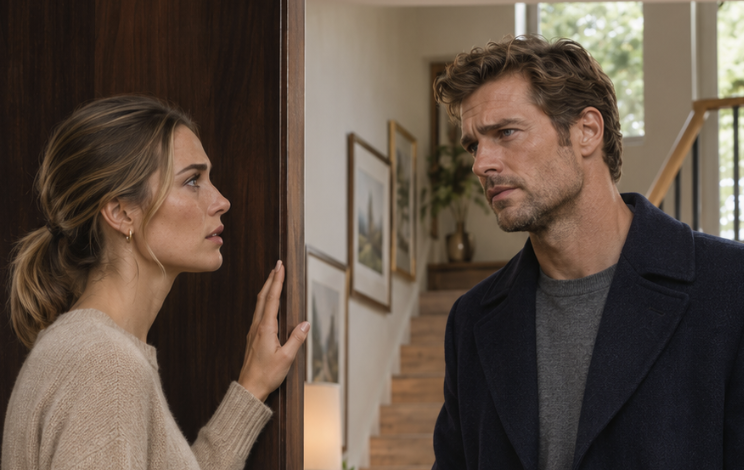
Elena realized her marriage was truly over not when she discovered messages from another woman on her husband’s phone.
Not even when Vladislav packed two duffel bags, muttered something vague about how “this would be fairer,” and moved out.
No, it all came to an end on a Thursday morning.
Elena walked into the kitchen, took a mug from the cupboard, reached for the kettle—and found an empty space.
At first, she automatically glanced at the windowsill. Then at the dining table. She even opened the lower cabinet, although there was absolutely no reason for an electric kettle to be there.
The kettle was gone.
Elena picked up her phone.
“Vlad, did you take the kettle?”
The reply came almost immediately.
“Yes. It’s mine.”
Elena read the message again.
Her mother had bought that kettle four years earlier. Their old one had started leaking, and Elena’s mother happened to stop by an appliance store that day. She’d decided there was no point waiting for her daughter and son-in-law to burn down the kitchen along with the electrical wiring.
Elena had no intention of proving who owned a kettle worth three thousand rubles.
She simply replied:
“Understood.”
Then she called a locksmith.
Before the kettle, Vladislav had already taken the coffee grinder, an extension cord, a folding umbrella, and a small screwdriver set from the hallway.
Elena could understand the screwdrivers. She didn’t care about the umbrella. She hadn’t even noticed the coffee grinder was missing until she’d wanted to grind some coriander.
But the kettle was the final straw.
Not because of its price.
It was simply that she could suddenly picture the immediate future with perfect clarity: today the kettle, tomorrow the microwave, and eventually Vladislav would announce that the refrigerator had always understood him better than anyone else.
The apartment belonged to Elena.
Entirely.
When she was twenty-seven, her parents had helped her buy a three-bedroom apartment in an ordinary nine-story building. Her father had sold a plot of land he’d inherited, her parents contributed their savings, and Elena put in some money of her own. The property had been registered solely in her name from the beginning.
She met Vladislav two years later, when she was twenty-nine.
Another year passed before he moved in. Then they got married. Vladislav remained officially registered at his mother’s apartment, which belonged to Nina Arkadyevna.
Nobody had ever considered that a problem.
Until now.
The locksmith arrived that afternoon.
He examined the door and quoted a price.
“Just replacing the cylinder?”
“Just the cylinder. The lock itself is good.”
“How many keys?”
“Make three.”
The locksmith looked up.
“Always good to have spares.”
Elena smiled.
“In my case, those spare keys are exactly what’s going to put things back in order.”
Forty minutes later, the old apartment keys had become useless pieces of metal.
Elena put one new key in her handbag, left another at home, and gave the third to her parents.
Just as she’d done before getting married.
She sent Vladislav a short message.
“I’ve changed the lock. We agreed that you’re living separately now, so your belongings will stay here until you collect them. Let me know in advance which day you want to come, and I’ll be home.”
He called a minute later.
“What do you mean, you changed the lock?”
“Exactly what I said.”
“What if I need something?”
“Send me a message.”
“Lena, my stuff is still there.”
“That’s why I told you that you can come and collect it.”
“I’m not going to arrange an appointment every time I need a T-shirt.”
Elena glanced at the drying rack, where one of Vladislav’s old house shirts was still hanging among her clothes.
“Perfect. Then collect all your T-shirts at once.”
“You’re deliberately making everything difficult.”
“No. I’m actually simplifying things. Your belongings go to your place. Mine stay at mine.”
Vladislav exhaled irritably.
“Fine. We’ll talk later.”
Elena hung up.
After nine years of knowing him, she understood exactly what her husband’s “we’ll talk later” meant.
Usually, it meant Vladislav hadn’t yet come up with an argument he considered convincing enough.
They hadn’t filed for divorce yet.
Not because either of them hoped to reconcile.
After Elena discovered the messages, Vladislav admitted fairly quickly that he’d been seeing another woman for several months.
Elena hadn’t made a scene or thrown his belongings out the window. She generally disliked doing things that would later require explanations to the local police officer or collecting shirts from the awning above the building entrance.
They agreed to divide their property calmly and file for divorce.
Their most valuable shared possession was a five-year-old crossover they’d bought during the marriage. There was also a television, a laptop, a washing machine, and some other appliances.
At first, Vladislav wanted to keep the car and pay Elena half its value. A few days later, he changed his mind because he didn’t have enough spare cash.
So they decided to sell the vehicle and split the proceeds equally.
Elena assumed the coming weeks would consist of classified ads, paperwork, and occasional messages like, “Have you seen my power drill charger anywhere?”
But Vladislav suddenly developed an unexpected interest in residential registration.
It started innocently enough.
One evening, he texted:
“Listen, does temporary residence registration give someone any rights to an apartment?”
Elena read the message and frowned.
“What do you mean?”
“Well, just generally. If someone gets temporarily registered somewhere.”
“Where?”
“Anywhere. I’m asking theoretically.”
“Vlad, you’ve shown absolutely no interest in residence registration for eight years. What happened?”
He didn’t answer.
The following day, he called again.
“Can a property owner cancel someone’s temporary registration later?”
“Are you planning to open a passport office?”
“Can’t I ask a normal question?”
“You can. But first explain why you’re asking.”
Vladislav fell silent for a moment.
“Milana needs temporary registration.”
That was when Elena realized that the absurdity of family life could continue evolving even after a husband had already left for another woman.
She knew about Milana.
She was thirty-two, worked as an administrator at a private clinic, and had moved to the Leningrad Region from another part of Russia several years earlier.
For the past year, she’d been renting an apartment.
Now Vladislav was living with her in that one-bedroom rental.
Elena also knew another detail Vladislav had revealed two days earlier.
Milana was pregnant.
Surprisingly, Elena had taken the news calmly. Probably because by that point she’d already stopped mentally searching for the exact moment when their marriage had gone wrong.
And now, somehow, it turned out that the unborn baby needed Elena’s apartment.
“And what exactly does Milana’s registration have to do with me?” Elena asked.
“Her landlord refuses to register her.”
“That happens.”
“Lena, she’ll soon need to visit doctors and arrange documents. Things are easier when you’ve got registration.”
“Probably.”
“Exactly.”
Elena waited for him to continue.
The rest came about five seconds later.
“Maybe she could register at your address temporarily?”
Elena looked at her phone to make sure the connection hadn’t dropped.
“Say that again.”
“She wouldn’t actually live there. You’ve misunderstood. It’s just registration.”
“Vlad, you’re suggesting that I register someone at my address when she has no intention of living here. That’s not a formality. That’s fictitious registration, and both parties can be held legally responsible.”
“It’s just paperwork.”
“Then register her at your mother’s place.”
There was a pause.
“Mom doesn’t want to.”
“What a surprise.”
“She has her reasons.”
“And I’m not allowed to have any?”
“You’re making everything personal again.”
Elena actually moved the phone away from her ear.
“Vlad, the pregnant woman my husband left me for needs to register at my apartment. How exactly am I supposed to make that impersonal? Treat it as a business transaction?”
“I’m not saying she’s asking. I suggested it myself.”
“Even better. At least Milana isn’t involved in this yet.”
“She just needs to sort this out.”
“Then sort it out. You’re her partner.”
“We’re renting right now, and the landlord is being stubborn.”
“Rent somewhere else.”
“Easy for you to say.”
“About as easy as offering up my apartment.”
The conversation went nowhere.
Elena decided Vladislav had understood her position.
She was wrong.
Two days later, at around eight in the evening, someone tried turning a key in her front door several times before pulling at the handle.
Elena was in the bedroom with her laptop.
She got up and approached the door.
The doorbell rang.
Vladislav was standing outside.
“Open up.”
Elena opened the door but remained in the doorway.
“Why didn’t you let me know you were coming?”
“I wanted to get my tools.”
“We agreed you’d message me first.”
He raised his old key.
“So you really did change the lock? You didn’t even leave me a new key?”
“That’s right.”
“My belongings are still here!”
“Two boxes of books, a winter jacket, some tools, and a bag of cables whose purpose is unknown to humanity.”
“It’s not up to you to decide what I need.”
“I’m not deciding anything. Take them.”
Vladislav tried to walk past her, but Elena didn’t move.
“Right now?”
“No. I’m working right now. Come on Saturday and take everything.”
“I need a set of keys.”
“To the apartment?”
“What else would I mean?”
“You’re not getting one.”
He stared at her as though she’d just announced she’d abolished electricity.
“So I lived here for eight years, and now I have to ring the doorbell?”
“Exactly.”
“Very nice.”
“At least you won’t get lost on the way back to your new apartment.”
Vladislav opened his mouth to say something, then thought better of it.
“Saturday, then.”
“Message me the time.”
After closing the door, Elena felt something she hadn’t experienced in weeks.
It wasn’t anger.
It wasn’t resentment.
It was an almost ordinary sense of relief.
The lock clicked shut with a perfectly familiar sound.
Only now, her home had once again become a place nobody could enter without her knowledge.
Vladislav didn’t come on Saturday.
But on Sunday, Nina Arkadyevna called.
“Lenochka, are you home today?”
The moment Elena heard the affectionate “Lenochka,” she became suspicious.
For the past three years, her mother-in-law had called her nothing but Lena.
“Yes, I’m home.”
“I’ll stop by for a little while.”
“What for?”
“Oh, just to talk.”
An hour later, Nina Arkadyevna appeared at the door carrying a pie.
A large one.
Elena looked at the pie, then at her mother-in-law.
“Come in.”
Nina Arkadyevna took off her coat and placed the pie on the kitchen table.
“Cabbage filling. You like it.”
Elena really did love cabbage pies.
Especially when they didn’t come with property negotiations attached.
She put the kettle on—the new one she’d bought the day before—and took out some cups.
For a while, Nina Arkadyevna talked about the weather, rising medication prices, and a neighbor who, for some mysterious reason, had decided to get a third Pomeranian.
Elena listened.
By the fifth minute, it was clear that the Pomeranian was merely a diplomatic smokescreen.
“Lena,” her mother-in-law finally began, “I understand things are complicated between you and Vlad right now.”
“Not really. We’re getting divorced.”
“Exactly. That’s why I thought perhaps you could at least avoid turning it into a war.”
“Are we at war?”
Nina Arkadyevna pressed her lips together.
“You changed the lock.”
“In my own apartment.”
“That’s not what I mean. Vlad isn’t exactly a stranger, after all.”
“He’s getting remarkably close to becoming one.”
Her mother-in-law sighed.
“Milana is in a difficult situation right now.”
“You mean her pregnancy?”
Nina Arkadyevna grimaced slightly, as though Elena had said something terribly indelicate.
“The baby hasn’t done anything wrong.”
“I completely agree.”
“Exactly. So we have to think about the child first.”
Elena took a sip of tea.
“Then let’s do that.”
Nina Arkadyevna brightened.
“They need temporary registration. Just for a little while. Milana wouldn’t even be living with you.”
“I know.”
“Vlad told you?”
“He did.”
“Then you understand it’s only paperwork.”
“There’s one thing I don’t understand. Why can’t this paperwork be handled at your apartment?”
Nina Arkadyevna fell silent.
“What do you mean?”
“You have a two-bedroom apartment. You’re the owner. Vlad is registered there. If this is all so safe and purely formal, register Milana at your address.”
Her mother-in-law adjusted the napkin beside her plate.
“No, that would be inconvenient for me.”
“Why?”
“Well, Lena… I simply don’t want to register anyone at my address.”
“Why?”
“Because property ownership is a serious matter.”
Elena nodded.
“Now there’s something we finally agree on completely.”
“You’re deliberately twisting my words.”
“No. I’m trying to understand. In your apartment, Milana’s registration is a serious matter, but in mine it’s just paperwork?”
“You have three bedrooms.”
Elena couldn’t help laughing.
“Does registration somehow multiply according to square footage now?”
“That’s not what I meant.”
“Then what did you mean?”
Nina Arkadyevna frowned.
“You live alone.”
“And?”
“So it wouldn’t inconvenience you.”
“It wouldn’t inconvenience you either. As you said yourself, Milana isn’t actually going to live there.”
Her mother-in-law clearly regretted bringing up that argument.
“I’m getting older. I don’t want to spend my time running between government offices.”
“I’m thirty-eight. I don’t dream of running between government offices either.”
“You could help just this once.”
“You’re right. You could. So go ahead and help them.”
“But you’re divorcing Vlad anyway.”
“Which makes it particularly strange that you expect me to spend the final days of our marriage arranging his new family’s affairs.”
Nina Arkadyevna put down her fork.
“Lena, you’re speaking out of hurt.”
“Of course I’m hurt. But even if you remove my feelings from the equation entirely, one very simple fact remains. Milana is Vlad’s choice. The baby is their responsibility. They’re renting their own accommodation. Where exactly does my apartment fit into that chain?”
“Family should help family.”
Elena looked at her.
“Whose family?”
The question was spoken calmly, but Nina Arkadyevna immediately looked away.
Elena had no intention of humiliating her mother-in-law.
They hadn’t become particularly close over the years, but they’d never been enemies either.
Nina Arkadyevna had helped Elena when she could barely leave the house for two weeks after an operation. Elena, in turn, had driven her to medical appointments after she’d broken her arm.
That was precisely why the present situation seemed so strange.
Her mother-in-law genuinely considered herself a reasonable woman.
It was just that her reasonableness somehow stopped at the boundary of her own apartment.
“Nina Arkadyevna,” Elena said more gently, “I understand that you’re worried about your son and your future grandchild. That’s natural. But you’re asking me to do something you refuse to do yourself. And for people whose relationship is the reason my marriage is ending.”
“I’m not saying you have to love Milana.”
“Thank you.”
“You could simply do the decent thing.”
“That’s exactly what I’m doing. I’m not interfering with their lives. I’m not calling Milana. I’m not confronting anyone. I’m not causing Vlad problems over the car. I’m not withholding his belongings. I’m even packing his books, although half of them have spent ten years sitting on the shelf for the sole purpose of creating an intellectual atmosphere.”
Nina Arkadyevna couldn’t help smiling.
Elena continued.
“But I am not registering Milana at my address.”
“Not even temporarily?”
“Not even for three days.”
“And Vlad says you won’t give him a key anymore either.”
“I won’t.”
“He’s still got a jacket there.”
“A jacket doesn’t require twenty-four-hour access to an apartment.”
Her mother-in-law sighed.
“You really are stubborn.”
“Possibly. But that hasn’t made your pie any less delicious.”
This time, Nina Arkadyevna laughed genuinely.
And she dropped the subject.
Before leaving, Elena transferred the remaining slices of pie onto a plate, while Nina Arkadyevna collected the empty baking dish.
But in the hallway, she couldn’t resist asking one final question.
“What if they can’t sort out this registration at all?”
“Then they’ll find somewhere to live where they can.”
“You make everything sound so simple.”
“It isn’t simple. It just isn’t my responsibility.”
A week later, Vladislav came to collect his belongings.
He warned Elena in advance.
He even arrived on time.
By the time he got there, Elena had packed the rest of his clothes, including that old house shirt, two boxes of books, his tools, jacket, shoes, and various odds and ends.
She’d also placed the mysterious bag of cables separately.
Vladislav looked at it.
“What’s that for?”
“It’s yours.”
“You could’ve thrown it away.”
“And then you’d suddenly remember it contained the only adapter in all of Russia for something absolutely essential.”
He chuckled.
“Possibly.”
They silently carried the boxes to the elevator.
When Vladislav returned for the last one, he stopped in the kitchen.
“By the way, we sorted out the registration issue.”
Elena fastened the toolbox.
“Congratulations.”
“We found another apartment.”
“Good.”
“The landlords agreed to register Milana temporarily. The rent is a little higher, though.”
Elena looked up.
“And that’s it?”
“What else?”
She stared at her husband for several seconds.
“Nothing. It’s just that your mother brought me a pie over a problem that could be solved with one phone call to a landlord.”
Vladislav grimaced.
“I didn’t ask her to come.”
“I believe you.”
“She decided to do it herself.”
“I believe that too.”
He picked up the box.
“Lena…”
“What?”
Vladislav stood there for a moment, as though he wanted to say something important.
But what came out was something else.
“I could give the kettle back.”
Elena glanced at her new kettle.
“Keep it.”
“I’m serious.”
“So am I. At least let you have one thing from our marriage entirely to yourself.”
He laughed first.
Awkwardly, but without resentment.
“Fine.”
“Just don’t ask for the refrigerator.”
“I get it.”
Two weeks later, a married couple from Vyborg bought the car.
After covering all the paperwork expenses, Elena and Vladislav each received an equal share of the proceeds.
They agreed that Elena would keep the television because Vladislav had taken the laptop they’d purchased during the marriage, which was worth roughly the same amount.
The washing machine stayed in the apartment. Neither of them saw any point in hauling around a four-year-old appliance and calculating its remaining value.
Another two weeks later, they filed for divorce.
Without a scandal.
By then, they had almost nothing left to say to each other.
A month later, their marriage was officially dissolved.
On one occasion, Vladislav tried to explain that he hadn’t intended to humiliate Elena by asking about the registration.
“I really thought it was just a formality,” he said.
“I know.”
“Then why did you get so furious?”
Elena considered the question.
“Because in your mind, you still thought of my apartment as a place where you could solve your problems. Even though you’d already chosen a completely different life.”
Vladislav said nothing.
Perhaps, for the first time, he understood that it had never really been about paperwork.
After the divorce, they never saw each other again.
Nina Arkadyevna didn’t visit either.
At New Year, she sent Elena a brief holiday greeting. Elena replied with an equally brief message.
No hard feelings.
And no pies.
Then, in the spring, the lock at Elena’s parents’ country house began sticking.
Her father offered to take it apart himself.
“I’ve got tools.”
“Don’t even start,” Elena said, reaching for her phone.
She’d thoughtfully saved the locksmith’s number.
The man arrived that same day, dismantled the mechanism, replaced a worn-out component, and asked:
“Haven’t we met before?”
“We have. You replaced the lock cylinder in my apartment last autumn.”
“Ah, right. Is everything working properly?”
“Perfectly.”
“Then it was worth replacing.”
Elena glanced at her father, who was examining the old mechanism with the expression of a man who’d just been deprived of his rightful opportunity to spend three hours fixing something that could be repaired in twenty minutes.
“Absolutely worth it.”
Her marriage to Vladislav had left Elena with several useful lessons.
For example, she’d learned that relationships don’t necessarily end with shouting and drama.
Sometimes they end with an empty space on the kitchen countertop.
And she’d discovered something else.
Conversations about personal boundaries can go on for weeks.
But a good locksmith can establish them in about forty minutes.
And hand you three new keys.