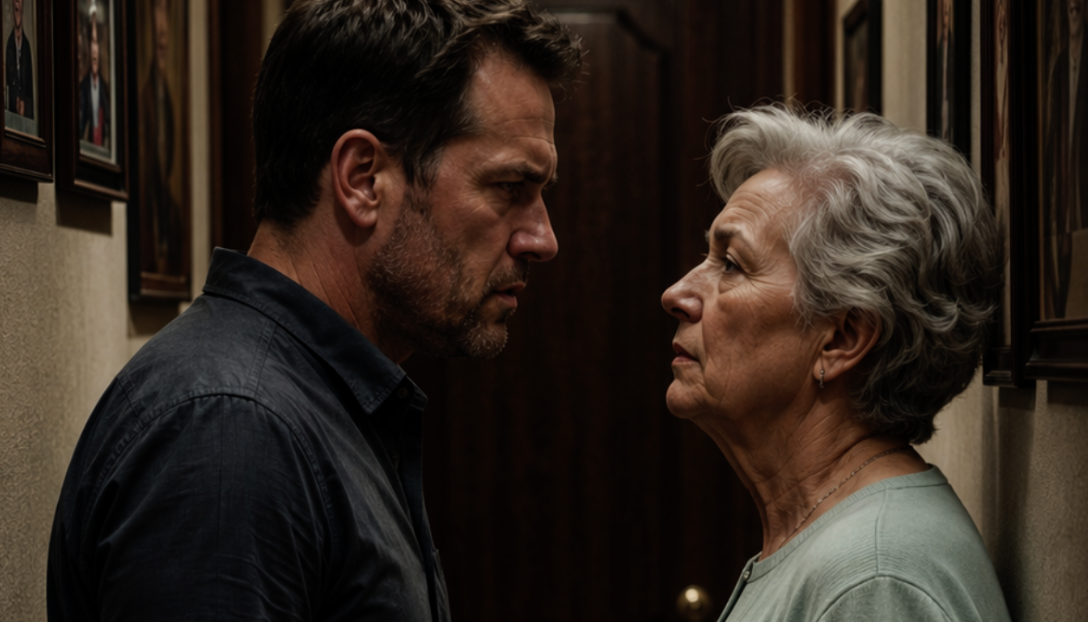
“Only my wife, Mom, will be in charge in my house! So finally shut your mouth and stop bursting in here with your constant yelling!”
“Artem! Where is that woman of yours? Why isn’t she answering me?”
The scrape of metal in the keyhole was a signal Artem knew so well it made his temples ache. He did not flinch. He was not surprised. His body simply tensed, as if preparing for a blow from a blunt object. He was sitting in a deep armchair with a laptop on his knees, trying to finish a report he should have submitted yesterday. His mother’s voice, sharp and metallic, broke into his focused silence and tore it to shreds. She did not enter the apartment so much as pour herself into it with one commanding movement, as though she were its rightful and only owner.
He slowly raised his head. Nina Petrovna stood in the hallway, her small but sturdy figure radiating the energy of an enraged hornet. In one hand she held her own set of keys; in the other, a handbag she gripped like a weapon.
“She’s at work, Mom,” Artem answered dully, without moving. “And please stop calling her ‘that woman.’ Her name is Anya.”
Nina Petrovna snorted, ignoring his request. She marched past him into the living room, her sharp eyes scanning the space with the efficiency of a terminator. She was not looking for anything specific. She was evaluating. Every object, every speck of dust, every corner was either evidence or a reason for accusation. Her route never changed. She always went to the kitchen. That was her inspection zone, her battlefield for launching an attack.
Artem slowly closed the laptop and placed it on the floor. The performance had begun. He was its only audience, but already endlessly exhausted by it. He heard the refrigerator door slam. Then came a short but expressive pause.
“Empty again! Nothing but those stupid yogurts! Has she stopped feeding you altogether? Look at yourself, you’re all thin and gray. A man should eat meat, hot soup! Not this… grass!”
He entered the kitchen and leaned against the doorframe. Nina Petrovna stood in front of the open refrigerator like an investigator at a crime scene. With disgust, she hooked a fingernail under a container of salad Anya had prepared for their dinner.
“Mom, we eat what we want. I like the way she cooks. Close the refrigerator.”
“He likes it!” her voice jumped several notes higher. “What do you understand anyway? Feed you anything and you’ll be happy! I come to see my only son, and his home is in ruins! When were these floors last washed? There’s a cobweb in the corner! Is it so difficult to pick up a rag? Or will her manicure break?”
She spoke without stopping, jumping from one thing to another, weaving a web of small, poisonous complaints. Her daughter-in-law was lazy, sloppy, a bad housewife, a spendthrift. Artem remained silent. He had long ago understood that any answer, any objection, was only fuel for her scandal. He looked at her face twisted with malice, at her sharp, nervous movements, and felt nothing except thick, dull exhaustion. This happened once a week, sometimes more often. This monologue, these accusations. Only the details changed, but the essence remained the same: his wife was a mistake, a foreign element that had to be either “re-educated” or driven out.
He was not listening to the words. He was listening to the music of her voice — aggressive, intrusive, intolerant of objection. And at some point he realized he could not do it anymore. Not physically. Not morally. The very resource of patience in his body had simply run dry, like water in a dried-up well. He looked at her, at this woman who had given birth to him, and saw before him a hostile stranger who had come into his home to destroy it. A cold, calm clarity washed over him. He knew what had to be done.
Nina Petrovna slammed the refrigerator door so hard that several magnets Anya had brought back from trips fell to the floor with a ringing clatter. Artem did not even twitch. He watched as his mother, furious at the whole world, shifted her scorching gaze from the refrigerator to him.
“I don’t understand, Artem, I simply don’t understand!” her voice rang with barely restrained rage. “Who am I trying for? Who do I come here for? To see all this? She’s just sitting on your neck! She’s rude to me, argues with me constantly! Last time I told her soup should be cooked with broth, not water, and do you know what she said to me? ‘Nina Petrovna, we like it that way.’ We! She already decides for you what you like!”
She took a step toward him, closing the distance. Her face was close, and he could see the fire of possessive resentment blazing deep in her dark eyes. She looked like a commander whose fortress had been captured by the enemy, while the garrison had gone over to the other side.
“Are you a man or not?” she spat, lowering her voice to a poisonous whisper. “Why are you mumbling around with her? If you don’t like something, say so! If she doesn’t listen, put her in her place! How did it used to be? Your father said one word, and everyone fell into line. Maybe she simply lacks a firm hand? You should give it to her once so she knows her place! She’d learn to cook soup immediately and stop wagging that tongue of hers!”
That sentence fell into the silence of the kitchen like a stone into still water. But there were no ripples. The stone simply sank to the bottom, and a dead, icy smoothness settled on the surface. For Artem, everything ended in that second. All his exhaustion, all his muted irritation, all his desire to preserve even the appearance of peace — it all evaporated. Only a cold, absolute emptiness remained, and one single decision.
He pushed himself away from the doorframe and slowly, without taking his eyes off her, walked toward her. His movement was so calm and smooth that Nina Petrovna lost her bearings for a moment. She had expected shouting, arguing, excuses. But not this predatory, silent approach. She stepped back and pressed her back against the countertop.
“What?” she asked, uncertainty entering her voice for the first time. “Why are you looking at me like that? I’m telling the truth!”
Artem stopped directly in front of her. He did not say a word. He simply extended his right hand, palm up. The gesture was simple, clear, and left no room for interpretation. He was not asking. He was demanding.
Her face, twisted with anger a moment before, froze for an instant, taking on an expression of complete, almost childish bewilderment.
“What is this? What do you want?”
“The keys,” he said. One word. Quiet, even, emotionless. But there was more threat in it than in the loudest shout.
“What keys? Have you lost your mind?” She tried to regain her former confidence, but her voice trembled. She looked into his eyes and did not recognize her son. Before her stood a stranger — hard, stern, unfamiliar. He did not answer. He simply kept his hand extended, his gaze direct and heavy as a slab of granite. One second passed, then another. The air in the kitchen became dense enough to cut with a knife. Nina Petrovna understood that he would not back down. This was not an impulse. It was not resentment. It was a decision. Final.
Her hand slowly, as if reluctantly, went into her bag. Her fingers rummaged around inside for a long time, catching on the lining, her wallet, anything at all, just to delay the inevitable. Finally, she pulled out the keychain. The key to his and Anya’s apartment hung on the same ring as her own. Awkwardly, with twitching fingers, she tried to remove it. The ring would not give.
“Give it here,” Artem said in the same even tone.
He took the whole keychain from her hand, opened the stiff ring with one precise movement, removed his key, and handed the rest back to her. She mechanically took her own keys. He turned and, without looking back, walked toward the apartment entrance. She heard his heavy footsteps. Then the click of the lock. Then another. He opened the front door. A cool draft blew in from the stairwell.
Artem stood in the doorway, his silhouette dark against the dimly lit landing. He waited. Without turning around. Without saying a word. He simply stood there and held the door open. For her.
The silence, broken only by the draft from the stairwell, did not last long. For Nina Petrovna, it was unbearable, like a vacuum. She lived and breathed through sound, scandal, words. Silence was her son’s weapon, and it struck more accurately than any shout. She looked at his back in the doorway, at the open wound in her world, and her numbness gave way to boiling, crimson rage.
“What are you doing?” her voice, breaking free from its chain, struck him in the back. “Are you throwing me out? Out of your own home? Me?”
Artem did not turn around. He remained motionless, like a stone statue frozen at the border between two worlds — his and hers. His inaction infuriated her even more. She took several quick steps down the hallway, closing the distance, her shoes loudly striking the laminate floor.
“I came to see you, and you’re showing me the door! Because of her! Because of that tramp who can’t even fry an egg properly! You’re blind, Artem! She twists you around her finger, and you’re happy about it! You’ve turned into a rag, her little lapdog! I devoted my life to you, did everything for you, and you… you’re ready to throw your own mother out just so that woman of yours will be satisfied!”
She stopped behind him, breathing against the back of his head. She waited for him to turn around, shout, start defending himself. She wanted the familiar storm, the loud argument where she could pour out everything that had built up and, in the end, as always, emerge victorious by making him feel guilty. But he was silent. And that silence was more frightening than any quarrel.
She stepped around him, standing in the doorway face-to-face with him, looking into his eyes. She wanted to see shame there, doubt, hurt. But she saw only a smooth, cold surface, like a frozen river.
“Look at me, Artem! It’s me, your mother! And you’re standing here like an idol. Do you think I’ll leave and that will be the end of it? Do you think I’ll let her destroy our family, destroy you? Never! The woman in charge of the house should be someone who understands life, not some snot-nosed girl whose head is full of clothes and makeup!”
And then he slowly raised his eyes to her. His gaze passed through her, focusing on something far away. At last he spoke. His voice was quiet, stripped of all emotion, but each word fell into the space with the weight of a stone.
“Only my wife, Mom, will be in charge in my house! So finally shut your mouth and stop bursting in here with your constant yelling! Otherwise you will not come here again!”
It was not a threat. It was a statement of fact. The proclamation of a new law of the universe, one in which there was no longer a place for her. The final sentence was spoken with such final, icy conviction that Nina Petrovna’s breath caught. All her rage, all her righteous anger suddenly drained away, leaving behind a ringing emptiness and cold, sticky fear. She looked at her son and understood that she had lost. Not the argument. Not the battle. The entire war.
“Ungrateful…” she whispered, but the word sounded pitiful and unconvincing even to herself. There was no strength in it, only the bitterness of defeat.
She stepped backward onto the landing. He did not watch her go. He simply waited. When her silhouette disappeared around the turn of the stairs, he stepped back into the apartment. Slowly, with a barely audible click, he turned the key in the lock. Then a second time. He did not slam the door. He locked it. Forever.
A week passed. A week of deafening, unfamiliar silence. For the first time in many years, Artem felt the muscles in his shoulders relax — muscles he had not even realized he had been keeping tense all the time. The air in his own apartment seemed cleaner, lighter. There was no expectation of the sudden turn of a key in the lock, no subconscious fear of another invasion. That evening, he sat with Oleg, an old university friend, in a small, dimly lit bar. They lazily discussed a new project at work while sipping cold beer. For the first time in a long while, Artem felt… normal.
And at that very moment, she appeared. Nina Petrovna did not burst in or run inside. She simply materialized in the doorway like a ghost from the past that someone had forgotten to direct toward the cemetery. She was wearing her best coat, her hair neatly styled. She had not come to make a scene. She had come to pass judgment. Her eyes quickly found him in the semidarkness of the place. She moved toward their table with a straight, unwavering stride, ignoring the puzzled looks of the other customers.
“Artem,” her voice was surprisingly calm, but inside that quiet lay a threat worse than any shout. “I never thought I would live to see the day when my own son would hide from me in taverns.”
Oleg froze with his mug halfway to his mouth, his face showing extreme confusion. Artem slowly placed his own mug on the table. There was neither surprise nor anger on his face. Only deep, deadly exhaustion. He knew this was not the end. This was the final act.
“Oleg, excuse me for a moment,” he said quietly to his friend and stood. He did not argue or defend himself. He simply took his mother by the elbow and led her to a far, empty corner of the bar, away from other people’s ears. Her arm in his hand was stiff and cold as stone.
“What do you want, Mom?” he asked when they stopped by the wall.
“What do I want?” She pulled her arm free. “I want my son! The one I raised! Smart, strong, loving… not this scarecrow you’ve become! A puppet in the hands of a flighty little woman! Do you even understand what she’s doing to you? She took you away from me!”
Her voice began gaining force, but Artem looked at her as if she were made of glass. He saw right through her, and what he saw no longer stirred any feeling in him.
“No one took me away from you,” he answered evenly. “I left on my own.”
“Left? Where did you leave? You betrayed everything we had! I gave you all of myself! Do you remember how I sat with you at night over your drawings at university? How I put aside my last money to buy you a good suit for your thesis defense? I always knew what was best for you!”
He listened to her, and for the first time in his life her words did not awaken even a drop of guilt in him. He looked at this woman who had built her life on the foundation of his gratitude and understood that this foundation had been a lie.
“You did not sit with me over my drawings, Mom. You stood over my soul because you could not tolerate my mistakes and wanted to control everything. You bought me a suit not because it was your last money, but because you could not allow your friend’s son to look better than yours. You never knew what was best for me. You knew what was best for you. So that I would be convenient, predictable, yours.”
Each of his words was quiet, but it struck her like a hammer. She looked at him, and her face slowly changed. The mask of righteous anger slipped from it, exposing confusion and fear. She tried to find something familiar in his eyes — hurt, anger, love, hatred. But there was only emptiness there. Icy, detached indifference.
“You don’t know me, Mom. And you never did,” he took a step back, increasing the distance between them, severing the last invisible thread. “The Artem you supposedly lost is your invention. A convenient boy who was supposed to live according to your script. And I’m tired of playing that role. I am no longer him. I never was.”
She opened her mouth to say something, but no sound came out. He had destroyed her world. Not with shouting, not with a scandal, but with quiet, cruel truth. He had devalued her entire life, all her sacrifices, all her love, showing her that all of it had merely been a form of selfishness.
Artem looked at her one last time — at this suddenly aged, shrunken woman who had become completely alien to him. Then he silently turned around and went back to his table. He sat down, picked up his mug of beer, and took a large sip. Oleg remained silent, not daring to ask anything. And Nina Petrovna stayed standing in the corner of the bar, alone, in the middle of other people’s merriment, crushed not by his anger, but by his final, irrevocable freedom from her.