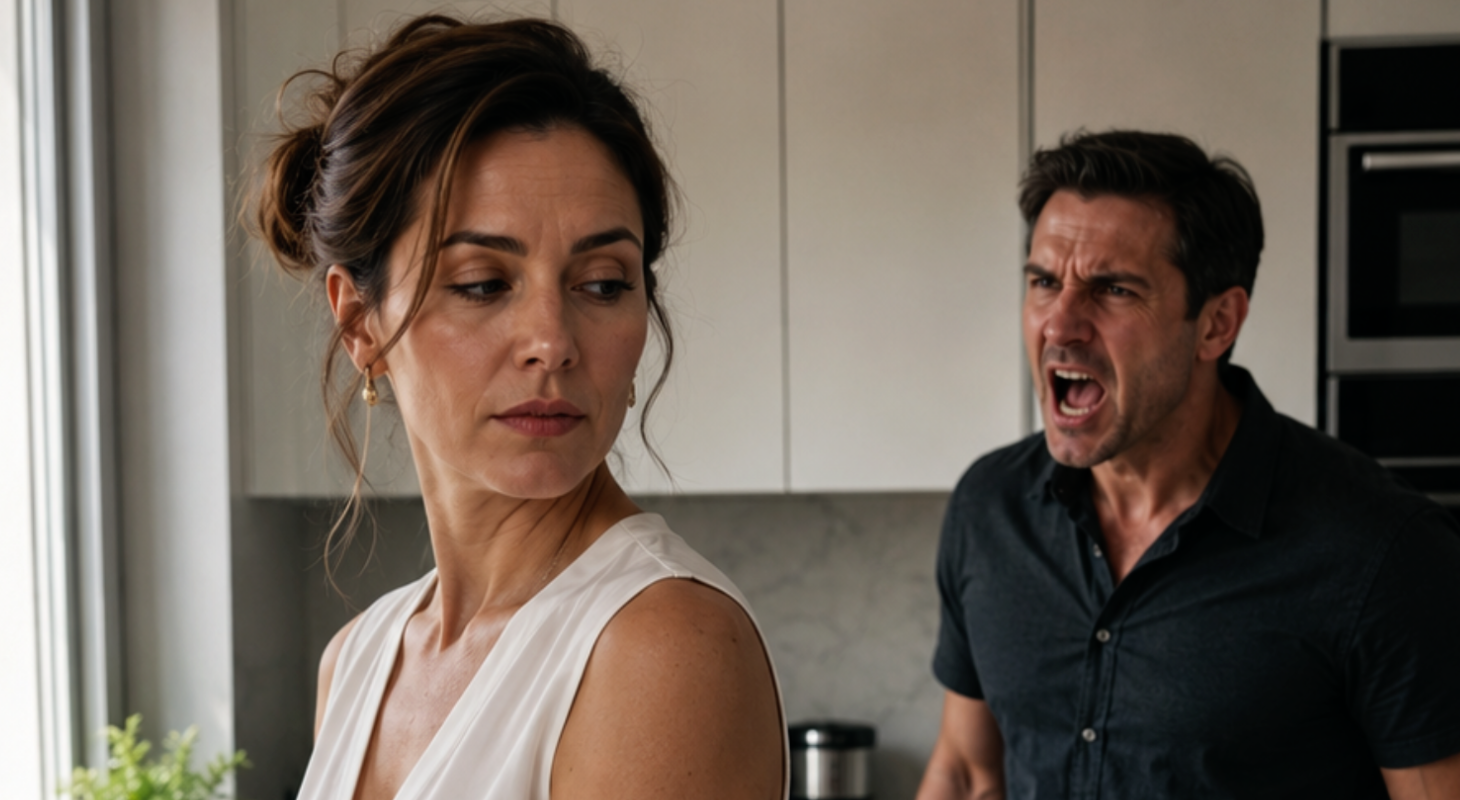
My Husband Was Secretly Preparing a Power of Attorney for My Property. I Had Transferred the Property a Week Earlier
“Where did you put the documents?!” Vadim came out of the study as though someone had just thrown him out of it. His voice was loud and hoarse, like that of a man who had just been robbed before his very eyes. “I’ve searched everywhere! The folder was here. I remember perfectly!”
Svetlana stood at the sink, washing cups. Slowly. One after another.
“What folder?” she asked without turning around.
“Don’t pretend you don’t understand! The blue folder with the documents for the apartment and the country house. It was in the bottom drawer, underneath the papers.”
Svetlana turned off the water. She picked up a towel and dried her hands slowly, finger by finger. Then she turned around.
“Vadim, I cleaned out that drawer a long time ago. It was a mess.”
He stared at her as though she had confessed to something terrible. His gaze was heavy and narrowed. She had known that look for seven years. It was the expression he wore whenever he was calculating something.
“Where did you move them?”
“Somewhere else,” she said simply. “They’re safe.”
Then she walked into the other room. Behind her, there was silence. Only the refrigerator continued humming in the kitchen as though nothing had happened.
It had all begun three weeks earlier with a single accidental moment.
Svetlana had gone to the public services center to renew her passport. It was an ordinary errand: a queue, a numbered ticket, plastic chairs. A woman of about fifty was sitting beside her, talking on the phone. She was not speaking loudly, but Svetlana still overheard her.
“…he arranged everything without her. A power of attorney, and that was it. She didn’t even know until the tax office contacted her…”
At the time, Svetlana had not thought much of it. She took her ticket, waited, submitted her documents, and went home.
But something had caught inside her mind. Like a splinter. It did not hurt, but she could feel it.
That evening, she sat with her phone and, without any particular purpose, began reading about powers of attorney. She read about how they worked. About which documents were required and what could be done through an authorized representative. About the different ways property could be managed or transferred.
She read for a long time. Then she put the phone aside and looked out the window.
Vadim came home late that evening. He said there had been a meeting. She did not ask any questions.
Over the following days, she watched him. Not obviously. She simply paid attention.
She noticed how he spoke on the phone after stepping onto the balcony and closing the door behind him. She noticed how, one day, he quickly turned several papers facedown on his desk when she entered the study. She noticed how he casually asked whether she was planning to visit her mother in another city the following week.
“Maybe you should go,” he said. “Your mother misses you, and you could use a break.”
“We’ll see,” she replied.
She did not go.
Instead, she called her mother simply to talk and mentioned that she wanted to reorganize the documents connected to her property. She wanted everything registered clearly and securely in her own name.
Her mother was silent for a moment.
“It’s about time, Sveta,” she said.
They had never spoken about it directly. But her mother had known Vadim for seven years. She understood everything.
Svetlana acted quickly. She made an appointment with a notary in another district, not the office where she and Vadim usually handled documents. She gathered everything she needed.
The mortgaged apartment had been registered in her name from the beginning. She had insisted on it when they bought it. Vadim had frowned at the time but eventually agreed. The country house had belonged to her grandmother and had passed directly to Svetlana.
She clarified her ownership arrangements, ensured that all relevant records were in order, and added the necessary restrictions and safeguards.
The notary, an older woman with a very calm face, reviewed the documents.
“Are you certain about your decision?” she asked.
“I am,” Svetlana replied.
“Then sign here and here.”
It took less than an hour.
Outside, Svetlana bought coffee from a vending machine near the shopping center, sat on a bench, and drank it while watching people pass.
She felt something strange. It was neither joy nor anxiety. It was something closer to balance. As though she had finally done something simple that should have been done a long time ago.
A week later, Vadim began searching for the folder.
Svetlana looked at him and thought: He doesn’t know.
He did not know that she had already visited the notary. He did not know that things were no longer arranged the way he imagined them to be. He did not know that the blue folder was now in her handbag—not because she was afraid of him, but because that was where it belonged.
“Vadim,” she said calmly. “The documents are safe. If you need something, tell me exactly what it is.”
He stared at her for a long time.
Something in his expression changed. Not immediately, but she noticed it. A tiny crack. Almost invisible.
“Nothing,” he said. “I don’t need anything.”
Then he returned to the study.
Svetlana put the cup on the shelf, picked up her phone, and wrote to her mother:
Everything is fine. I’ll tell you when we meet.
Her mother replied quickly:
I’ll be waiting. Come visit.
Outside the window, the city made its usual noise: minibuses, voices from the playground, music from a passing car. An ordinary evening. An ordinary life.
But something had already changed—quietly and irreversibly.
Like a river changing its course, not through an explosion, but through patience.
Svetlana was not afraid of it.
She had been ready for a long time.
Vadim did not mention the folder for three days.
Svetlana noticed that he had changed. He was not angry. Not exactly. He was focused.
He looked like a man recounting the cards in a game and discovering that one was missing.
He moved quietly around the apartment, kept his phone facedown, and barely appeared in the kitchen.
On the fourth day, his brother Gennady called.
Svetlana had known Gennady for years and had disliked him for just as long. He was one of those people who could smile while calculating the value of everything another person owned.
He worked for some consulting firm, wore expensive watches, and always spoke slightly condescendingly—even when asking for a favor.
Vadim listened to him.
That had always seemed strange to Svetlana. Vadim was the older brother, intelligent and forceful, yet whenever Gennady was around, he became quieter.
The conversation took place in the study with the door partly closed. Svetlana was passing by when she heard a fragment.
“…she sensed something, I’m telling you… we should have done it earlier…”
She did not stop. She continued to the kitchen and switched on the kettle.
Earlier.
An interesting word.
On Saturday, Gennady came in person.
He rang the doorbell at half past eleven and stood there with the expression of a man doing everyone a favor simply by appearing.
Svetlana opened the door.
His eyes moved over her quickly from head to toe, like a scanner. Then he smiled.
“Hello, Svetochka. Is Vadim home?”
“He is,” she said. “Come in.”
She did not offer him tea. She simply went into the other room, took her laptop, and pretended to work.
Sound carried well through the apartment.
The brothers talked for a long time.
Gennady spoke forcefully. Vadim responded with restraint. Then their voices grew quieter, and Svetlana could distinguish only their tones. Gennady was applying pressure. Vadim was resisting.
Or pretending to resist.
When Gennady left, he smiled at her again in the hallway.
“You look good, Svetochka,” he said.
“Thank you,” she answered evenly.
The door closed.
Vadim remained standing in the hallway, looking at her.
“What?” she asked.
“Nothing,” he said. “He just stopped by.”
She nodded and returned to her laptop.
But inside her, something had already shifted—quietly, almost imperceptibly, like the click of a lock.
On Tuesday, she went into the city center to take care of several errands. First the bank, then the pharmacy.
She walked home through the small park beside the old movie theater. It was pleasant there: linden trees, benches, and pigeons marching along the paths with a businesslike air.
She called her mother.
“Gennady came over,” she said.
Her mother paused for a second.
“Why?”
“Officially, I don’t know. Unofficially, I think they’re planning something. Together.”
“Sveta,” her mother said slowly, as she always did when choosing her words carefully, “do you remember Aunt Raisa?”
“I remember.”
“Her husband also started by simply ‘discussing things’ with his brother. Then she ended up with two children in a rented apartment.”
Svetlana watched a pigeon pecking industriously at something near a trash bin.
“Mom, everything is registered properly.”
“I know. But be careful. People like Gennady don’t stop simply because their first plan didn’t work.”
Four days later, those words proved to be true.
Svetlana discovered it by accident.
She opened a dresser drawer to look for an old flash drive and found a sheet of paper. An ordinary white page folded into four.
She unfolded it and stared for several seconds.
It was a draft.
It had been written in her name. It resembled a statement declaring that she, Svetlana Igorevna Krasnova, was voluntarily granting her husband the right to manage her property for a period of three years.
The handwriting was unfamiliar. Neat and even.
It was not Vadim’s. He wrote in large, slanted letters.
Gennady, then.
She photographed the page. Then she folded it exactly as it had been before, returned it to the drawer, and closed it.
Her hands were completely steady.
Surprisingly steady.
That evening, she behaved as usual. She reheated dinner, set the table, and asked Vadim how his day had gone.
He answered briefly, looking at his phone.
Outside, darkness gathered. In the building opposite, windows lit up one by one—yellow squares against the deep blue evening.
“Vadim,” she said as he was getting up from the table, “when was the last time you spoke to a notary?”
He stopped.
Only for a fraction of a second, but she saw it.
“What notary?” he asked.
“No one in particular. I was just thinking that we should update our wills. We haven’t done it for a long time.”
He looked at her.
For a long time.
“We could do that,” he finally said. “I’ll ask around.”
“All right,” she said with a nod. “Ask around.”
He went into the study.
Sveta cleared the plates and wiped the table. Outside, someone was laughing in the courtyard. Young voices, loud and carefree.
She picked up her phone and wrote a message—not to her mother this time, but to her old friend Veronika, whom she had not seen for almost a year.
Veronika worked in the city court archives and knew more about men like Gennady than she ever said aloud.
Hi, Ver. How are you? We haven’t seen each other in ages. Would you like to meet this week?
The reply came a minute later.
Sveta! Of course. Tomorrow evening? Where will you be?
Svetlana smiled quietly to herself.
I’ll be in the center. You choose the place.
Behind her was the silent apartment, the closed study door, and Vadim’s muffled voice. He was speaking on the phone again.
Again on the balcony.
Again with the door locked.
Svetlana switched off the kitchen light and went into the bedroom.
She knew one thing: the draft in the drawer was not the end of their plan.
It was merely the part she had discovered.
What she had not yet found—that was what was truly interesting.
Veronika chose a small place in the city center. It was not fashionable or pretentious. It had old wooden tables and a menu written on a chalkboard.
Svetlana arrived a little early, took a table by the window, and ordered water.
Veronika rushed in ten minutes later, wearing a linen jacket and a short haircut that suited her perfectly.
They hugged and sat down.
“You’ve lost weight,” Veronika said immediately. “Not in a good way.”
“Everything is fine,” Svetlana replied.
“Of course it is. That must be why you contacted me after a year of silence.”
Svetlana smiled.
She told her the story briefly, without unnecessary details. She told her about the folder, the draft, and Gennady with his expensive watch and scanning eyes.
Veronika listened without interrupting.
Then she picked up her cup and held it between her hands.
“Gennady Krasnov,” she repeated slowly. “Consulting?”
“Yes.”
“Sveta, I’m going to tell you something. Just don’t panic.”
“I don’t panic anymore.”
Veronika put down the cup.
“Two years ago, a case passed through our archives. I can’t give you names, you understand. But there was a scheme very similar to what you’ve described. A power of attorney supposedly signed voluntarily. The wife then spent six months proving that the signature wasn’t hers. Gennady wasn’t named directly. But the consulting firm was the same one.”
Svetlana looked at her.
“So this isn’t the first time.”
“It means they know what they’re doing,” Veronika said quietly. “The fact that you secured everything first is very good. That is the most important thing. But you understand that they may not stop?”
Outside the window, people walked along the street. Some carried shopping bags, some walked dogs, and some wore headphones, lost in their own worlds.
An ordinary evening.
Svetlana watched them and thought that only a month earlier, she too had walked through the city exactly like that—with headphones on, enclosed in her own world.
Knowing nothing.
“I understand,” she said.
They remained there for another hour.
Veronika wrote several things on a napkin. Not names, only notes. She said she would make discreet inquiries without attracting attention.
Svetlana went outside at dusk.
The city moved to its summer evening rhythm: open cafés, music from bars, the smell of warm pavement.
She walked toward the metro slowly, thinking.
And then it happened.
A man was standing with his back to her beside the window of a bookstore, leafing through something.
Svetlana almost walked past him, but something made her stop.
Perhaps it was his jacket.
Perhaps the way he held his head.
She stopped, and he turned around.
It was Dmitry.
They had not seen each other in nine years.
Dmitry Larin.
They had studied together and dated for almost two years during their third year at university. It had been quiet and undramatic. They had simply been together.
Then he had moved away. First to another city, then abroad.
She had married Vadim.
Their lives had separated like trains moving onto different tracks.
“Sveta?” He looked at her as though trying to make sure he was not mistaken.
“Dima,” she said. “What are you doing here?”
“I came back six months ago.” He tucked the book under his arm. “Do you still live here?”
“Yes. I never left.”
They stood there for a second.
It was that particular kind of strange pause that occurs only when you meet someone from your past—when you do not know how much to say or whether you should say anything at all.
“Coffee?” he suggested simply.
She almost said no.
Instead, she said, “All right.”
They went into a small café around the corner.
Dmitry had barely changed. There were fine lines around his eyes now, and he looked calmer, without the restless energy he had carried at twenty-two.
They talked about nothing important. Where he worked, why he had returned, how the city had changed.
He asked questions easily, without pressure.
Svetlana answered and realized that she had not spoken to anyone this way for a long time—openly and simply, without searching for a hidden meaning.
Then he asked, “Are you married?”
“Yes,” she said.
After a pause, she added, “For now.”
He did not ask for an explanation.
He merely nodded.
She appreciated that.
As they were leaving, he said, “I’m glad I saw you. Honestly.”
“So am I,” she replied.
And it was true.
Unexpected and slightly confusing, but true.
She returned home shortly before ten.
Vadim was sitting in the study. The door was open for the first time in several days.
He looked at her as she passed.
“Where were you?”
“With a friend,” she said. “I told you.”
He was silent for a moment.
“Sveta,” he began, and there was something different in his voice. Not pressure. Not calculation.
Something almost like exhaustion.
“We need to talk.”
“We do,” she agreed. “But not tonight. I’m tired.”
She went into the bedroom and closed the door. Not sharply. She simply closed it.
She changed her clothes and lay down.
The apartment was silent on the other side of the wall.
She stared at the ceiling and thought about several things at once.
About Veronika and her quiet voice.
About the draft in the drawer.
About what Gennady might try next.
And about Dmitry standing beside the bookstore window—an accidental encounter that somehow seemed to have happened at exactly the right time.
Her phone lay beside her.
She picked it up and opened her contacts.
Dmitry had already sent a message while she was on the metro.
I was glad to see you. Here’s my number, in case you ever feel like talking. No conditions attached.
She read it and placed the phone on the bedside table.
No conditions.
That was something she understood very well now.
The next morning, Svetlana woke before Vadim.
She made coffee and went out onto the balcony.
The city was waking up. Somewhere, a car horn sounded. Below, a street cleaner swept the path with a steady rustling rhythm. The first tram passed in the distance.
She held the cup in both hands and thought.
The apartment, the country house, the documents, the folder in her handbag—none of it was a victory.
It was simply hers.
It had always been hers.
She had merely taken back what no one should ever have tried to take from her.
Vadim came onto the balcony half an hour later.
He stood beside her without speaking.
Then he said quietly, without his usual confidence, “You knew about the power of attorney?”
She did not answer immediately.
She continued looking down at the street.
“Vadim,” she finally said, “I knew enough.”
He did not ask anything else.
He went back inside.
She heard him dialing someone’s number. His voice changed, becoming quieter and almost apologetic.
He was probably calling Gennady.
Or perhaps someone else.
It no longer mattered.
Svetlana finished her coffee.
Ahead of her was an ordinary day: work, errands, phone calls.
And somewhere inside that ordinary day was something new, something that did not yet have a name.
It was not frightening.
It was simply new.
She went inside, picked up her handbag, and checked that the folder was still there.
It was.
She left the apartment, and the door closed behind her easily, without resistance.
Just as it should.
She filed for divorce a month later.
Not impulsively and not after an argument.
One ordinary Tuesday, she gathered the necessary documents, returned to the same public services center where everything had begun—among the plastic chairs and numbered tickets—and submitted the application.
Vadim did not shout.
Perhaps he expected her to change her mind.
Or perhaps he was simply tired of pretending.
Gennady called once, a week after she filed.
His voice was gentle, almost friendly.
“Svetochka, perhaps we should talk? A family is more than documents. It’s—”
“Gennady,” she interrupted calmly. “Don’t.”
Then she ended the call.
He never called again.
She kept the apartment.
Legally and according to the documents, everything was clear.
Vadim moved out in the middle of autumn, silently, carrying two suitcases.
The last thing he said while standing in the doorway was, “You planned everything in advance.”
“No,” she answered honestly. “I was simply in time.”
He left.
The elevator hummed behind the wall and then faded into silence.
Svetlana remained standing in the hallway and looked around.
The same entrance hall.
The same shelves.
Only the air was different, as though someone had opened a window in a room that had not been aired for years.
She met Dmitry again in November.
They simply went for a walk, without making plans.
They walked through the old park, where fallen leaves covered the ground and the air smelled of damp earth.
They talked about books, about the city, and about how strange it was to return to places you remembered completely differently.
Nothing more.
Just two people walking beside each other.
And it felt easy.
As they said goodbye, he told her, “You’ve changed.”
“In what way?” she asked.
“In a good way,” he said simply.
She thought about it and nodded.
Perhaps she had.
Her mother came to visit in December.
She brought jam, winter slippers, and enough conversation to fill three hours at the kitchen table.
She watched her daughter attentively, the way only mothers know how to watch.
“How are you?” she asked near the end of the evening.
Svetlana thought about it.
She truly thought, rather than giving the polite answer.
“I’m all right, Mom. Honestly, I’m all right.”
Her mother covered Svetlana’s hand with her own and said nothing.
Nothing needed to be said.
Outside the window, the first snow was falling quietly and unhurriedly, as though it had all the time in the world.