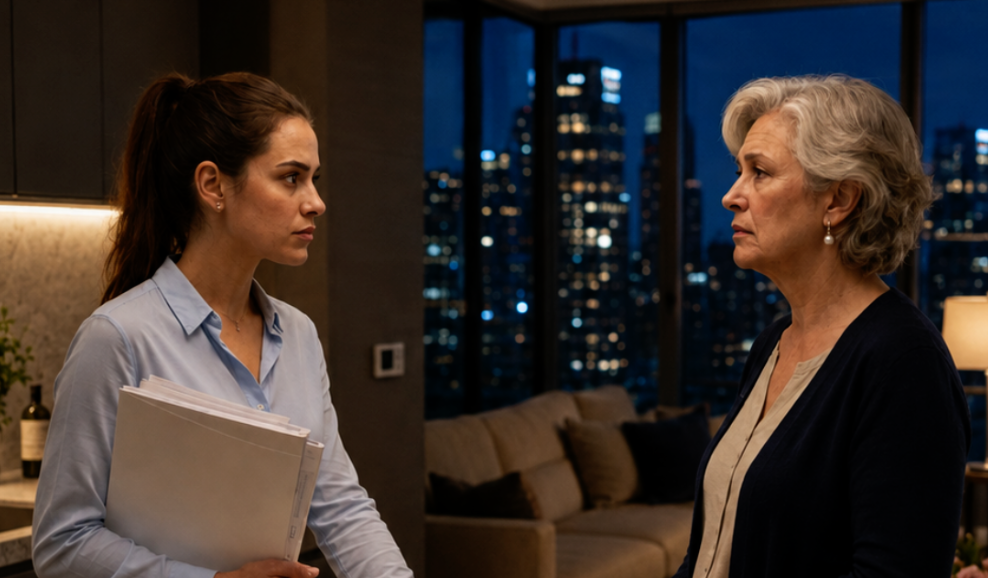
“This is my apartment, and no one is moving in here,” the daughter-in-law said—and for the first time, her mother-in-law was left speechless
Her mother-in-law entered the apartment without knocking, using her own key, and the first thing Marina heard was her voice from the hallway:
“So, we’ll move this wall, and we’ll give the nursery to Kolya and his family.”
Marina froze in the middle of the kitchen, a cup of cold tea in her hands. Kolya was her husband’s younger brother. What nursery? Whose family? What was she even talking about?
She placed the cup on the table so carefully, as though it might explode. Outside, the February evening was slowly growing dark, and the courtyard lights came on all at once, as if on command. Anton wasn’t supposed to be home from work for another hour. Yet his mother, Nina Pavlovna, was already standing in the entryway, taking off her boots and giving orders in someone else’s home—or rather, in Marina’s home.
“Nina Pavlovna, good evening,” Marina said as she walked into the hallway, trying to keep her voice even. “I wasn’t expecting you today.”
“Why should you expect me?” her mother-in-law replied, hanging her puffer jacket over Marina’s coat and crushing it against the wall. “I’m not a guest. I came to see my son. And while I’m here, I’ll take a look at what needs to be changed.”
“Changed?”
“Well, what did you think?” Nina Pavlovna marched down the hallway like the owner, tapping the walls with her finger as though checking how solid they were. “Kolya, Tanya, and the baby are crammed into our two-bedroom apartment with four people. And the two of you are living here in a palace. It isn’t fair.”
Marina said nothing. Something inside her slowly turned cold.
“A palace.”
She had bought this three-bedroom apartment herself. More precisely, she had spent eight years working as an accountant and saving for the down payment—before Anton, before their marriage. She had paid the mortgage herself too, from her own salary. Anton was forever going through a “difficult period”: one project failed, then a business partner let him down.
His mother knew all of this perfectly well.
Yet somehow, in Nina Pavlovna’s version of reality, the apartment was always referred to as “ours.”
“This is my apartment,” Marina said quietly.
“Oh, here we go again,” Nina Pavlovna waved her hand dismissively and headed toward the kitchen. “Mine, mine, mine. You’re a family. What’s yours is Anton’s, and what’s Anton’s belongs to both of you. Put the kettle on instead of just standing there.”
Marina put the kettle on. Her hands trembled slightly—not from fear, but from some new, unfamiliar feeling rising from deep inside her.
She didn’t yet know what to call it.
Her mother-in-law sat down at the table and casually pushed Marina’s papers aside. Marina had been preparing a client’s annual report before she arrived.
“All right, listen carefully,” Nina Pavlovna said, folding her hands over her stomach. “Kolya is moving in with you. Temporarily, of course. A year or two, until they save enough for a place of their own. You’ll give them the nursery—well, that office of yours that you’ve filled with papers. Tanya is pregnant with their second child. She needs space.”
“My office is my workplace,” Marina said, feeling her voice become firmer. “I work from home. That’s how I earn money.”
“You can sit anywhere with that laptop of yours,” her mother-in-law snapped. “A child has nowhere to grow up. You need to understand, Marinka,” she continued suddenly in a sugary voice, reaching across the table and patting Marina’s wrist, “we’re family. We have to help one another. Today you help Kolya, tomorrow someone might help you.”
Marina looked at that plump, ring-covered hand and remembered.
Two years earlier, when Marina had been bedridden with a severe infection and a temperature close to forty degrees Celsius, that same hand hadn’t even brought her a glass of water.
Her mother-in-law had visited for fifteen minutes, complained about her own back, and left after telling Anton not to “keep running to pharmacies—it’ll pass on its own.”
So much for “someone helping you tomorrow.”
“I’ll think about it,” Marina said, simply to end the conversation.
“What’s there to think about?” her mother-in-law frowned. “Anton has already agreed.”
The kettle began to whistle.
And with that sound, something inside Marina snapped.
“Anton agreed?”
“Of course. I spoke to him yesterday. He said, ‘Mom, whatever you say, that’s what we’ll do.’ He’s such a good boy. Obedient. Unlike some people.”
Marina slowly took the kettle off the stove.
The whistling stopped, leaving a deafening silence in the kitchen.
So her husband knew.
He knew and hadn’t said a word to her.
He and his mother had decided everything behind Marina’s back, like a little boy too frightened to admit he had broken a cup.
Eight years.
She had saved for eight years. Alone. Every month, she had set aside part of her salary, denying herself vacations, new clothes, evenings at cafés with friends.
And he had given away her home in one evening without even blinking.
“I see,” Marina said.
“Good, I’m glad you understand,” Nina Pavlovna beamed. “I’ll tell Kolya to bring their things over this weekend. Now pour me some tea. Why are you just standing there?”
Marina poured the tea, placed the cup in front of her mother-in-law, and left the kitchen.
She walked into the hallway and stood by the window, where she could at least be alone for a minute.
Snow drifted across the courtyard. The streetlights swayed in the wind. Somewhere, a dog barked.
Marina pressed her forehead against the cold glass and, for the first time in eight years of marriage, understood something with perfect clarity:
Her opinion meant nothing in this home.
It never had.
She had simply been convenient.
Quiet.
The woman who paid the mortgage and kept her mouth shut.
The daughter-in-law who would tolerate anything.
Except now, she didn’t want to tolerate it anymore.
Anton came home at eight. He tossed his jacket onto a chair, kissed his mother on the cheek, and merely nodded at Marina as if she were a coworker.
“Oh, Mom, you’re here. So? Did you talk about it?”
“We did, we did,” Nina Pavlovna nodded enthusiastically. “Marinochka doesn’t mind. You’ve got a smart wife.”
Anton exhaled in relief and smiled at Marina.
“See? Everything’s fine. I told you, Mom, she’d understand.”
Marina looked at her husband and felt as though she didn’t recognize him.
Although—no.
She did recognize him.
This was the real Anton.
The man who had spent all these years hiding behind his charming smile and promises.
A mama’s boy who had never made a single decision on his own.
“Anton,” she said calmly. “Can we talk? Alone.”
“Why alone?” his mother immediately interrupted. “There are no secrets from a mother.”
“This is a conversation between a husband and wife,” Marina said, looking her mother-in-law directly in the eyes for the first time that evening. “Nina Pavlovna, please leave us.”
The kitchen went silent.
Her mother-in-law’s face turned crimson.
“What kind of tone is that? Anton, do you hear how she’s talking to me?”
Anton shifted awkwardly.
“Marish, what’s gotten into you? Mom’s not a stranger.”
“Anton. Kitchen. Now.”
Marina didn’t raise her voice, but something in it made her husband get up.
His mother snorted, but walked into the living room and deliberately turned the television up loud.
Marina closed the kitchen door.
“You gave away my apartment,” she said. “Without asking me. You decided everything with your mother.”
“What’s the big deal?” Anton spread his hands. “Kolya’s in trouble. We need to help him. We can make room. It’s just an office.”
“It isn’t ‘just an office.’ It’s where I work. It’s how I earn money. Money that, by the way, pays the mortgage on these walls.”
“Oh, the mortgage again,” Anton grimaced. “How long are you going to keep throwing that in my face? I contribute too.”
“With what?” Marina looked at him. “Anton, tell me honestly. How much have you paid toward this apartment over the past year?”
He looked away.
“Well, you know I’ve been going through a difficult period…”
“You’ve been going through a difficult period for eight years. I’m not attacking you. I’m simply stating a fact: this is my apartment. And I will not allow your brother and his family to move in here.”
“How can you not understand?” Anton suddenly raised his voice. “They’re my family! Mom is asking me! I can’t say no to her!”
“But you can say no to me.”
He fell silent.
And that silence contained the entire answer.
He couldn’t refuse his mother.
But he could refuse his wife.
His wife would put up with it.
His wife always had.
“You know,” Marina said slowly, “I really thought we were a team. I thought you were supposed to protect me. Instead, you give pieces of me away just to keep Mommy happy.”
“Don’t twist things,” Anton muttered.
“I’m not twisting anything. I’m finally seeing things clearly.”
His mother’s voice came from the living room.
“Anton! How long are you two going to whisper in there? Come here, there’s an interesting movie on!”
And her husband—a thirty-eight-year-old man—jerked toward the sound like a dog responding to a whistle.
He took a step toward the door.
Stopped.
Turned back.
“Marish, come on. Let’s not fight over this. Kolya will move in, stay for a while. Everyone will be happy.”
“Go,” Marina said. “Your mother is calling.”
He stood there for another second, unsure whether she was mocking him or giving him permission.
Then he went to the living room.
To his mother.
Marina remained alone in the kitchen.
She took a folder out of the cabinet—the folder containing the documents for the apartment.
The ownership certificate in her name.
The purchase agreement signed before their marriage.
Every single mortgage payment receipt bearing her name.
She spread the papers across the table and stared at them for a long time.
Then she took out her phone and opened a conversation with an old acquaintance, Svetlana, a lawyer she had once studied with.
“Sveta, hi. I need a consultation. Urgently. Are you free tomorrow?”
The reply came a minute later.
“Of course. What happened?”
“I’ll explain when we meet. It’s about real estate. And divorce.”
Marina typed that word—“divorce”—and froze, staring at it.
Eight years.
She had spent eight years building this life the way people build a house—brick by brick, patiently, believing that one day it would finally become warm and comfortable.
But it turned out she had been building it alone.
And now the very people she had worked so hard for wanted to take that house away from her.
She pressed Send.
Svetlana listened to the entire story over coffee in a small café near the subway. She nodded, made notes, and occasionally frowned.
“All right, let’s take this step by step,” she finally said. “The apartment was bought before the marriage. With your money. Registered in your name. That means it is your separate property. Neither Anton nor, especially, his relatives have any rights to it. It won’t be divided in a divorce.”
Marina exhaled.
“That’s what I thought. But I wanted to make sure.”
“You can be one hundred percent sure. They cannot move anyone into the apartment without your permission, and they have no claim to a share. Even if Anton were officially registered there—and you said he’s registered at his mother’s place, right?—it still wouldn’t give him ownership rights.”
“He’s registered at his mother’s,” Marina nodded. “We just never got around to registering him at our apartment. Now I’m glad we didn’t.”
“Excellent,” Svetlana smiled. “Then you have complete freedom of action. You can remove unwanted guests, sell the place if you want, or simply live there in peace.”
Marina stirred her cooling cappuccino. Outside, people hurried past while light snow fell.
“And the divorce?”
Svetlana put down her pen.
“The divorce is your decision. Legally, it’s straightforward: you have almost no jointly owned property and no children. It should be quick. But, Marina, that isn’t really a legal question. The question is whether you want to keep living like this.”
Marina looked out the window.
Eight years.
Their wedding in a small restaurant, where her mother-in-law had made a toast:
“I hope my daughter-in-law will take good care of my son.”
Their first New Year’s together, when Nina Pavlovna had arrived “for a couple of days” and stayed for two weeks, rearranging the dishes in Marina’s cupboards.
The day Marina became sick with a fever and Anton went to help his mother at the country house because he had “promised to work in the garden.”
Thousands of little things.
Thousands of times Marina had swallowed her resentment and told herself:
“It’s fine. This is family. You have to be patient.”
“You know,” she said quietly, “I kept waiting for him to grow up. I thought one day he’d take my side. Just once.”
“And did he?” Svetlana asked gently.
“No. And he never will. I finally understand that.”
Svetlana covered Marina’s hand with her own.
“Then you know what to do.”
Marina nodded.
For the first time in a long while, there was no heaviness in her chest.
Only clarity.
Kolya and his family were supposed to move in on Saturday.
On Friday evening, her mother-in-law showed up again to supervise the “arrangements.”
She entered using her own key, and Marina, sitting in the kitchen, calmly waited until the woman had removed her coat and walked into the office.
“All right,” Nina Pavlovna said, looking around. “We’ll move your desk onto the balcony and put the bed here. The wardrobe… well, the wardrobe can stay for now. Tanya can hang her clothes in it.”
“Nina Pavlovna,” Marina said, standing in the doorway. “No one is moving in here.”
Her mother-in-law turned around.
“And why exactly not?”
“Because this is my apartment. And I never gave my consent.”
“But we agreed!”
“We didn’t agree. You presented me with a decision you had already made. And I’m telling you no.”
Nina Pavlovna straightened. Red blotches appeared across her face.
“Anton!” she shouted. “Anton, come here! Your wife is acting up again!”
Anton emerged from the bedroom, sleepy and irritated.
“What now?”
“She won’t let Kolya move in!” his mother exclaimed, pointing at Marina. “Do you hear that? She’s throwing your own family out onto the street!”
Marina turned to her husband.
Calmly.
Without a tremor in her voice.
“Anton. I’ve made my decision. No one except me is going to live in this apartment. It belongs to me. Legally, one hundred percent.”
“Marish, enough already,” Anton grimaced. “Mom just—”
“I haven’t finished.”
For the first time that evening, Marina raised her voice slightly.
Both of them fell silent.
“I filed for divorce.”
Silence crashed into the room like snow sliding from a roof.
Her mother-in-law opened her mouth.
Closed it.
Then opened it again.
“What? What divorce?”
“A normal one. The documents are already with my lawyer,” Marina said evenly, as if reading a financial report. “Anton, you’re registered at your mother’s apartment, so moving out shouldn’t be difficult. You can pack your things this weekend.”
“You… you’re throwing me out?!” Anton finally woke up completely. “Out of my own home?!”
“Out of my home,” Marina corrected him. “Show me one payment receipt with your name on it. Just one.”
He said nothing.
“Exactly,” she nodded.
Her mother-in-law lunged forward, waving her arms.
“How dare you! My son has worked himself to the bone for you for eight years, and now you’re throwing him onto the street? Ungrateful woman!”
“Worked himself to the bone?” Marina gave a short laugh. “Nina Pavlovna, let’s be honest. I paid the mortgage. I worked from home. I cooked, cleaned, paid for the renovations—that was me too. Meanwhile, your son spent eight years going through a ‘difficult period.’ So who exactly was working themselves to the bone for whom?”
“It’s family property! Whatever you earn during a marriage is divided equally!”
“The apartment was bought before the marriage. With my money. My lawyer confirmed everything. So no. It isn’t fifty-fifty. It’s entirely mine.”
Her mother-in-law gasped for air.
Marina could practically see the entire structure inside the woman’s mind collapsing—the version of reality in which her daughter-in-law was merely a voiceless extension of her son.
“Anton! Say something! Do something!”
And then Marina saw the most revealing thing of all.
Anton—a grown man—turned toward his mother and muttered helplessly:
“Mom, what can I do… if the apartment is hers?”
That was it.
Not one word in defense of his wife.
Not one attempt to save the marriage.
Only the fear of a man who could feel the familiar, comfortable ground disappearing beneath his feet.
“You can take him home with you, Nina Pavlovna,” Marina said gently. “You’ve always wanted him closer. Now you can have him. And while you’re at it, you can settle Kolya nearby too.”
“You… you’ll regret this!” her mother-in-law shrieked. “You’ll end up alone, unwanted by anyone! Who would want a woman like you?”
Marina looked at her.
And suddenly she laughed.
Lightly.
Genuinely.
For the first time in many months.
“You know, Nina Pavlovna,” she said, “that’s exactly what I was afraid of for eight years. Being alone. I tolerated all of this because I was terrified of ending up alone. But now I understand: being alone is better than being this unwanted in your own home.”
She walked past her stunned mother-in-law and bewildered husband, opened the hallway cupboard, and removed the spare keys from their hook—the keys she had once, out of kindness, given Nina Pavlovna.
“Your keys, please,” Marina said, holding out her hand. “Your set.”
Her mother-in-law clutched her handbag to her chest.
“I won’t give them back!”
“Then tomorrow I’ll call a locksmith and change the lock. At your expense, by the way. I’m entitled to do that. Your choice.”
The standoff lasted for a full minute.
Then Nina Pavlovna pursed her lips, dug through her handbag, pulled out the keys, and threw them onto the hallway cabinet.
“Choke on them.”
“Thank you,” Marina said calmly.
They left that same evening.
Anton packed a large suitcase. After eight years, he had accumulated plenty of belongings.
His mother stood in the doorway, throwing one final verbal dart after another over her shoulder.
“You’ll come crawling back! You’ll beg us to forgive you!”
Marina didn’t answer.
She simply held the door while they carried their bags out.
Anton turned around when he reached the threshold.
“Marish… maybe we shouldn’t do this? Let’s talk. I’ll find somewhere else for Kolya to live, I’ll—”
“It’s too late, Anton,” she said without anger. “For three years I waited for you to hear me just once. For three years I asked you to be on my side. And you always chose your mother. You chose her today too. I’ve simply stopped waiting.”
“I… I can change.”
“You can. But not for me. For yourself. Grow up at last.” She gave him an almost kind smile. “You’re thirty-eight, Anton. It’s time.”
He stood there, not knowing what to say.
Then his mother tugged at his sleeve.
“Come on! Stop humiliating yourself in front of her!”
And he followed her.
As always.
Responding to his mother’s call.
The door closed.
Marina leaned her back against it and slowly slid down onto the hallway floor.
Not from grief.
From relief.
Enormous, overwhelming relief.
It felt as though someone had removed a heavy sack from her shoulders—a burden she had carried for eight years without realizing how heavy it was until the moment she finally put it down.
She sat on the floor of her—her—apartment and listened to the silence.
Real silence.
No television blaring in another room.
No commanding voice from her mother-in-law.
No guilty mumbling from her husband.
Only Marina.
And her home.
Three months passed.
The office became an office again.
Marina rearranged the furniture and hung a painting on the wall that she had wanted for years, though Anton had always complained that it was “too expensive and impractical.”
She bought a comfortable chair.
In the mornings, she drank coffee by the window and watched the courtyard wake up.
She took on more work and new clients, and her income increased.
It turned out that without her husband’s endless “difficult periods,” there was more than enough money.
Even enough for a vacation.
A vacation she hadn’t taken in five years.
The divorce was finalized quickly. There was nothing to divide.
Anton came to the hearing with his mother, who kept trying to explain something to the judge about her son’s “contribution through labor,” but the judge gently explained that there was no legal basis for any claim.
Her mother-in-law stormed out of the courtroom boiling with indignation.
Anton walked out silently, his eyes lowered.
Svetlana, the lawyer, became Marina’s friend.
They sometimes had dinner together, and one evening Svetlana said:
“You know, I’ve handled hundreds of cases like yours. It’s always the same story. A woman puts up with everything until the very end, believing her husband will change. But he doesn’t. Why would he, when everything is already comfortable for him? You did well to stop it before it went any further.”
“Not before it went any further,” Marina smiled. “Eight years is late. But better late than never.”
In April, for the first time in years, Marina went to the sea.
Alone.
Without having to consider anyone else’s wishes.
She sat on an empty beach in early spring, wrapped in a blanket, drinking coffee from a thermos and thinking about how little a person actually needed to be happy.
Simply not to be used.
Simply for your home to be your own.
Simply not to have someone beside you who chooses everyone else over you, day after day.
One day, a mutual acquaintance called.
She told Marina that Kolya and his family were still crammed into the two-bedroom apartment, that Anton had moved back in with his mother, and that the two of them now “got along wonderfully.”
Marina listened without any satisfaction or spite.
She didn’t care.
She genuinely didn’t care.
And, as it turned out, that was what real freedom felt like.
At one point, her mother-in-law sent her a message.
It was long and full of accusations, ending with the words:
“You destroyed the family.”
Marina read it twice.
Then she deleted it.
And blocked the number.
She hadn’t destroyed the family.
There hadn’t really been a family to destroy.
There had been an illusion, held together by Marina’s patience.
And when her patience finally ran out, the illusion fell apart.
That evening Marina sat in her office beside the window.
A cup of tea rested on the desk, with a half-finished book beside it.
Outside, an apple tree that someone had planted in the courtyard many years ago was in bloom. Petals swirled through the air and settled on the windowsill.
Marina thought about the whole life still waiting ahead of her.
Her own life.
A life where no one would enter without knocking.
Where no one would give pieces of her home away.
Where no one would force her to choose between self-respect and keeping the peace.
The thought was so simple and yet so enormous that Marina smiled.
The daughter-in-law who had tolerated everything had finally stopped tolerating it.
And the world hadn’t collapsed.
On the contrary.
For the first time in many years, everything had finally fallen into its proper place.
She took a sip of tea, opened her book to the page she had marked, and began reading.
Ahead of her was a quiet spring evening.
One of many.
And it belonged entirely to her.