In the lexicon of structural engineering, there is a concept known as “ultimate limit state”—the point at which a structure, under the weight of external pressures and internal flaws, finally ceases to perform its function. For most of my life, I believed my family was a cantilever: bold, extending into the world, supported by a foundation of blue-collar integrity and the steady, rhythmic pulse of my mother’s love. But as I stood on the polished hardwood floor of the Willowbrook Country Club, looking up at the man who had just pushed me—my father—I realized that our structure had been failing for years, eroded by a slow-acting rot that wore cashmere and spoke in practiced, honeyed tones. To understand the magnitude of that night’s collapse, one must understand the foundation. My father, Richard Purcell, was a man of steel and grit, a foreman who viewed the world through the prism of load-bearing capacities. He taught me that the things you cannot see—the pilings driven deep into the earth, the rebar hidden within the concrete—are the things that keep the world standing.
My mother, Linda, was the mortar. An ER nurse who smelled of antiseptic and lavender, she was the warmth in our tiny kitchen. The center of our universe was a hand-carved oak table Dad made the year I was born. It wasn’t just furniture; it was a manifesto. Three chairs. No one extra, no one missing. When pancreatic cancer took her when I was twelve, that table became a shrine. Her chair stayed empty, a silent acknowledgement of a void that could not be filled. For three years, Dad and I lived in a heavy, shared silence, anchored by that oak table. It was a period of “static equilibrium”—stable, but fragile. The equilibrium shattered when Victoria Ashford entered our lives. She was the architectural antithesis of my mother: polished, modern, and relentlessly “aesthetic.” She brought with her a daughter, Brooke, and a systematic plan to redesign our reality.
The erasure began with small, seemingly practical adjustments. The first to go was the oak table, replaced by a cold, marble-topped set that Victoria deemed “more modern.” It was a symbolic strike; by removing the table, she removed the physical site of our family’s history. My mother’s photographs were migrated to the hallway, then the basement, and finally into cardboard boxes in the garage. My bedroom—my sanctuary—was converted into a yoga studio.
Victoria’s genius lay in her framing. She never “stole” anything; she “optimized” our space. She didn’t “replace” my mother; she “helped Dad move forward.” Richard, a man who could spot a structural flaw in a skyscraper from a mile away, was blind to the domestic sabotage happening under his own roof. He was a foreman; he dealt with “real” problems. He didn’t have the bandwidth for the subtle politics of curtains and seating charts.
By the time I left for Clemson to study engineering, I was already a ghost in my own home. Brooke had moved into the guest room, calling my father “Dad” with a calculated ease that made my stomach churn. I was no longer the daughter; I was a “legacy cost” that Victoria was determined to write off. The “ultimate limit state” was reached during a three-year period of absolute silence. After a missed Christmas due to a bridge inspection emergency, I found myself blocked—digitally and emotionally. I called every Sunday. One hundred forty-seven times, I dialed his number. Forty-two times, I sent a text.
The silence was a vacuum. I told myself it was my pride keeping me from driving to the house and causing a scene. In reality, I was terrified that if I pushed past Victoria at the front door, I would find that my father truly didn’t want to see me. It is easier to believe in a villain’s interference than a parent’s indifference.
But Marcus, my husband and a forensic accountant, saw the world differently. He didn’t deal in “feelings” or “pride”; he dealt in audit trails. When an invitation to Dad’s retirement party arrived via a mass company email, Marcus didn’t suggest we go to “make up.” He suggested we go because he had found a discrepancy in the numbers that didn’t just suggest a family rift—it suggested a crime. I chose to wear my mother’s navy-blue silk dress that night. It was a deliberate act of structural restoration. If Victoria had spent sixteen years erasing Linda Purcell, I would bring her back into the room.
The Willowbrook Country Club was a stage designed for Victoria’s crowning achievement. The seating chart was the first clue: I wasn’t at the head table. I wasn’t even at the secondary tables. I was placed at a two-top in the back, near the service corridor, essentially a “non-priority guest” at my own father’s celebration.
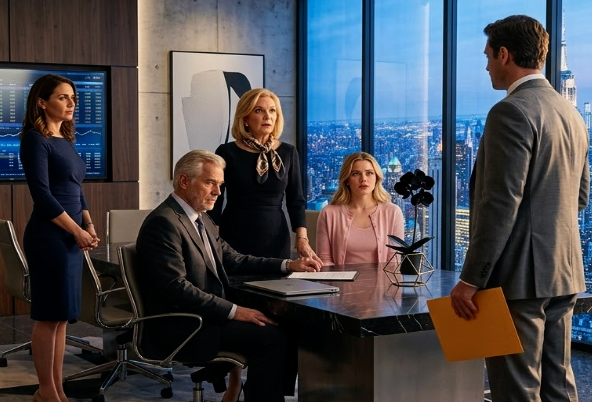
The slideshow was a masterpiece of historical revisionism. Thirty-five years of Richard Purcell’s life, and not a single frame featured me or my mother. It was a digital damnatio memoriae. Victoria stood at the podium and introduced Brooke as Richard’s “pride and joy,” his “only daughter who stayed.”
When I finally approached the head table, the physical manifestation of three years of gaslighting erupted. I asked to talk. I reached for a chair—my chair. And my father, the man who had carried me on his shoulders through construction sites, pushed me.
I hit the floor. The sound of my mother’s dress tearing was a whisper that screamed.
“That seat is for my real daughter,” he said, his voice carrying the cold weight of a man who believed a lie so completely it had become his truth. “Get out.” This was the moment Marcus had been waiting for. In the world of forensic accounting, fraud requires three things: pressure, opportunity, and rationalization. Victoria had all three. She had the pressure of Brooke’s $180,000 startup debt, the opportunity of managing Richard’s paperwork, and the rationalization that she was “protecting” the new family.
Marcus stepped forward not with a shout, but with a manila envelope.
“Mr. Purcell,” Marcus said, his voice cutting through the stunned silence of eighty guests. “When was the last time you personally checked your blocked contacts list?”
The revelation was a tactical dismantling. Marcus laid out the evidence with the precision of a structural report:
The Phone Records: A printout of 147 calls from my number, all timestamped, all blocked on Richard’s phone.
The Beneficiary Forgery: Two documents placed side-by-side on the white linen tablecloth. The original form, naming me as beneficiary, and the new form, signed eight months ago, naming Brooke as the sole heir to a $420,000 retirement fund.
The signature on the second form was a “near-miss.” It looked like Richard’s, but as my father looked at it, he saw the flaw. He was a man of loops and heavy downstrokes. The forgery was too straight, too clinical. It was the handwriting of someone who knew the name but didn’t know the hand.
The arrival of Donna Webb, the company’s benefits coordinator, was the final piling driven into the ground. She confirmed that the change had been submitted electronically—something Richard never did—from an email address linked to Victoria. Victoria’s reaction was the most telling part of the night. She didn’t cry. She didn’t beg. She pivoted from “grieving protector” to “cornered predator” in a heartbeat. She admitted to blocking the calls, framing it as an act of “mercy” to keep Richard from being “confused” by the past.
“Helping me move past my dead wife?” my father asked. The realization was visible; he looked like a man waking up in the middle of a house fire.
The exodus was swift. Brooke, realizing she was the beneficiary of a theft she hadn’t fully understood, left in a cloud of shame. Victoria, stripped of her access to the Purcell “estate,” followed with a look of pure, unadulterated fury. She had spent sixteen years building a marble palace on a foundation of lies, and Marcus had just pulled the permit. Forgiveness is often portrayed as a sudden moment of grace, a “happily ever after.” In reality, for a structural engineer, forgiveness is more like “remediation.” You don’t just paint over the cracks; you have to strip the structure back to the studs and see what is worth saving.
A month later, I sat at the old oak table in my father’s kitchen. He had dragged it out of the garage, sanded away the dust of sixteen years, and refinished it. The grain was darker, seasoned by time, but the wood was still solid.
“Some of the scratches won’t come out,” he told me, gesturing to the grooves where I had once done my homework.
“That’s okay, Dad,” I replied. “Neither will some of mine.”
We are currently in a state of “reconstruction.” It is uncomfortable. It is repetitive. It involves my father learning how to use a smartphone—actually use it—and attending support groups for victims of financial manipulation. He wears a thirty-dollar Timex I bought him when I was sixteen instead of the Cartier Victoria gave him. He says the Timex keeps better time because it reminds him of when we were real. What I learned from the night at the Willowbrook Country Club is that silence is not a shield; it is a vacuum that allows lies to expand. My pride—the very thing I thought was protecting my dignity—was actually the silence that allowed Victoria to operate.
A family is not a matching set of marble furniture or a perfectly curated slideshow. A family is a series of load-bearing commitments. It is the 147th phone call when the first 146 went unanswered. It is the willingness to wear a torn dress and stand on a hardwood floor until the truth is finally told.
My father pushed me, and that is a fact that will always exist in our history. But he also pulled out my chair at the oak table and asked me to stay. In the world of engineering, we don’t discard a bridge because it has a crack; we reinforce it. We build it stronger than it was before the failure.
The oak table has four chairs now. The joints are a little creaky, and the finish isn’t perfect, but it holds the weight. And in the end, that is the only thing a structure is required to do.