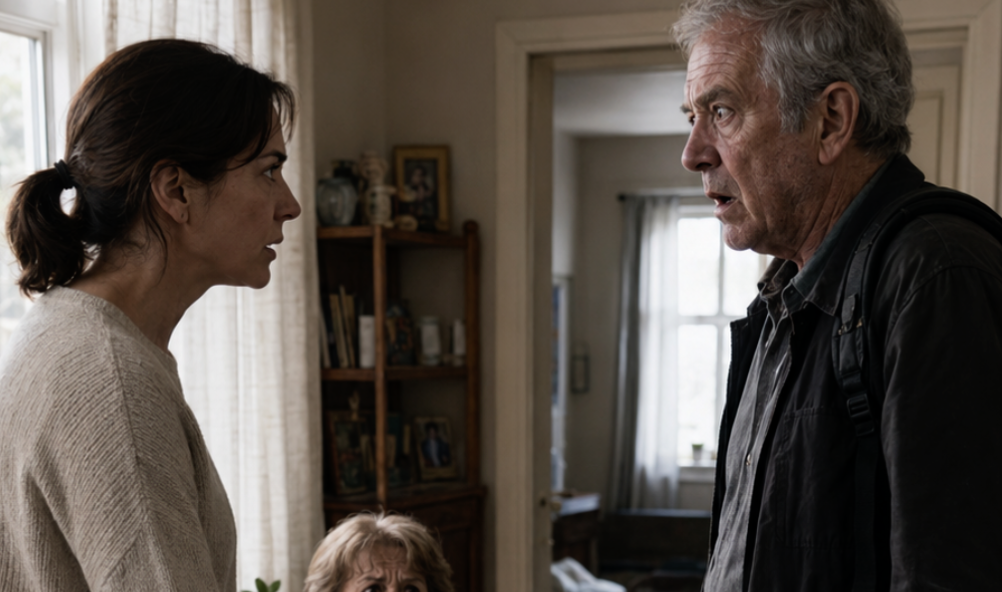
I Helped My Mother-in-Law for Free for Three Years—Until I Accidentally Found a Notebook in Her Dresser Containing a Plan to Divide Up My Apartment
“So you’ve set your sights on someone else’s property, Rimma Nikolayevna?”
The top drawer of the old dresser is always stuck. Svetlana pulled the handle harder. The wood gave an unpleasant creak. The drawer came halfway out with a crash, sending packets of pills, old receipts, and balls of thread flying onto the floor.
She lowered herself heavily into a crouch and began gathering the blister packs. All she had wanted was a bottle of valerian drops for her mother-in-law.
An hour and a half earlier, Rimma Nikolayevna had called her in a weak voice and begged her to come immediately. At the time, Sveta had been busy in the kitchen. She had abandoned the half-shaped meat patties, quickly washed her hands, pulled on her coat, and taken the bus two stops to get there.
And now she was crawling around someone else’s floor, picking up the scattered mess.
Along with the medicine, a school notebook had fallen out of the drawer. It was an ordinary notebook with a thick plastic cover. Svetlana picked it up automatically.
Several scraps of paper were sticking out from between the pages. She opened the notebook merely to put them back inside, but her eyes caught sight of familiar handwriting.
For a moment, the words looked like a meaningless jumble of letters.
Written neatly across the lined page in Rimma Nikolayevna’s careful, teacher-like handwriting were the words:
“Sveta’s two-room apartment. Plan of action.”
Svetlana stopped breathing.
She sank directly onto the rug.
Below the heading was a list of steps that sent an unpleasant chill creeping down her spine.
“Step one. Register Oleg at the apartment. Insist that he needs local registration for the clinic. Not temporary registration—permanent.”
“Step two. Renovate the bathroom. Keep all receipts for the tiles and pipes. Document every major purchase.”
“Step three. In the event of divorce, file a claim stating that the renovations constituted substantial improvements paid for by the husband. Demand a share of the property or force its sale.”
With unsteady fingers, Svetlana turned the page.
Pinned to it were the exact receipts from the hardware store.
Receipts for the tiles, grout, and pipes she and Oleg had bought the previous summer. The receipts that had mysteriously disappeared from the refrigerator door in October.
Three years.
For three years, she had worked herself to exhaustion for this woman without receiving a single thing in return.
She washed her mother-in-law’s floors on weekends because Rimma Nikolayevna had developed an extremely convenient case of “sciatica.”
She carried heavy bags home from the market because “delivery was expensive, and they always sent you poor-quality groceries.”
She sat for hours in the stuffy cloakroom at the clinic while Rimma Nikolayevna visited every doctor on her list.
And all that time, while graciously accepting Svetlana’s help, her mother-in-law had been methodically planning how to seize a piece of her apartment.
The apartment Svetlana had bought herself, long before she married, after working two jobs until she could barely stand.
“Sveta, have you fallen asleep in there?” came a petulant voice from the other room.
Svetlana slowly stood up.
She tucked the notebook under her arm, left the valerian drops on top of the dresser, and walked into the living room.
Rimma Nikolayevna was reclining on the sofa, carefully adjusting her favorite silk scarf around her neck. Her painted lips were twisted into a suffering grimace. A standing fan had been placed beside the sofa, even though it was November outside.
“My heart is pounding so terribly,” she complained when she saw her daughter-in-law standing there empty-handed. “I can’t get a moment’s peace. Where are the drops? I asked you to hurry. At my age, things like this are no joke.”
Svetlana walked closer and dropped the notebook onto the coffee table, directly on top of the lace doily.
“The arithmetic doesn’t add up, Rimma Nikolayevna,” Sveta said evenly.
Her mother-in-law glanced at the table.
Her face instantly fell.
For one brief moment, she looked genuinely ill.
But only for a moment.
The seasoned fighter quickly pulled herself together.
“Why were you rummaging through my things?” Rimma Nikolayevna snapped angrily.
Her voice had suddenly grown strong.
Her weak heart and breathless speech had vanished without a trace.
“Curiosity killed the cat!” she declared, reaching for the notebook.
Svetlana intercepted her hand and gently but firmly pushed the notebook toward the far edge of the table.
“I was looking for valerian drops. Instead, I found a business plan.” Svetlana tapped the plastic cover with her finger. “The bathroom renovation, is it? Substantial improvements?”
“So what?” Her mother-in-law pressed her lips together tightly and glared at her daughter-in-law before finally losing patience. “My son is investing his own money in that apartment!”
“His own money?” Svetlana repeated, feeling a stubborn calm begin to burn inside her. “We bought those tiles with my bonus.”
“He lives there! He hammers nails into the walls! He put up wallpaper!” Rimma Nikolayevna continued. “If something happens, is he supposed to walk out into the street with nothing but the clothes on his back?”
“If something happens?” Sveta slipped her hands into the pockets of her house cardigan. “As far as I knew, we weren’t planning to get divorced.”
“Life is long,” Rimma Nikolayevna drawled sarcastically, leaning back against the cushions.
Her illness had been completely forgotten.
“Today it’s love and romance, and tomorrow you’ll throw him out. He doesn’t have a place of his own. Meanwhile, he’s pouring a fortune into your renovations. There has to be fairness!”
“Fairness?”
Svetlana stared at the woman whose windows she had washed three days earlier.
The woman to whom she had given an expensive blood pressure monitor the previous New Year, taking the money out of the family budget.
“You’re collecting receipts so you can carve off a piece of my home,” Sveta stated. “Behind my back. Calculating how much every hammered nail is worth.”
“My son isn’t an idiot who would transfer all his property to some strange woman! He’s thinking about his future!” her mother-in-law declared proudly.
The floorboard creaked in the hallway.
The front door slammed, followed by the rustle of a jacket.
Oleg looked into the room.
He was wearing a plain T-shirt over his work clothes, with a worn backpack hanging from one shoulder.
Apparently, his mother had managed to call him as well and complain about her blood pressure, pulling him away from the construction site.
“Oh, Sveta, you’re here.” He took off his jacket and walked into the living room, rubbing his tired face. “Mom, how’s your blood pressure? Is there anything to eat? I’m exhausted.”
“Excellent,” Svetlana answered before his mother could speak. “Her blood pressure is normal. So is the takeover plan.”
Oleg blinked in confusion.
He looked from his wife to his mother.
Then he noticed the notebook lying on the table.
His shoulders immediately sagged, and his eyes began darting around the room.
“Oleg, she went through my drawers!” Rimma Nikolayevna wailed, instantly changing tactics and casting herself as the victim. “Without permission! I can’t even have peace in my own home! No respect for her elders!”
Svetlana ignored her mother-in-law and stepped toward her husband.
“Did you know?”
“Know about what?” Oleg tried to move toward the window, avoiding her eyes.
“About this notebook, Oleg. About the receipts your mother carefully pins inside it so she can later prove in court that you paid for the bathroom renovation.”
Oleg said nothing.
He stared at the toes of his boots.
“Well… Mom is just worried,” he muttered under his breath, twisting the strap of his backpack. “She’s getting older. She works herself up. She imagines things.”
“She imagines things?”
Svetlana moved closer.
“The receipts for the tiles, Oleg. How did she get them?”
Oleg shifted from one foot to the other.
“I put them on the refrigerator under a magnet,” Sveta continued methodically. “Then they disappeared. I searched the entire kitchen all evening. You said you had thrown them away with the old advertisements.”
“Sveta, you’re making a mountain out of a molehill,” Oleg began in a conciliatory tone, attempting a smile. “They’re just pieces of paper. They don’t mean anything. Who was ever going to divide up your bathroom? Nobody was planning anything.”
“That’s exactly the point,” Svetlana replied.
Suddenly, she saw the entire picture with perfect clarity.
Without illusions.
Without trying to make excuses for her husband.
There she was, running to the pharmacy after work to buy medicine for Rimma Nikolayevna.
Making time for her.
Saving money on herself.
And meanwhile, Oleg was carefully removing receipts from the refrigerator door.
Putting them in his pocket.
Taking them to his mother so she could add them to her file.
Two women in one household, as the saying went.
Except one of them washed floors and cooked soup, while the other collected evidence against her.
All with the full cooperation of her beloved husband.
“His mother is thinking about his future! As long as my son is alive, I have every right to worry about him!” Rimma Nikolayevna interjected again, sensing that she had support.
Svetlana gave a brief nod.
She walked over to the cabinet beneath the television.
A spare set of keys to her apartment was always kept there in a small crystal bowl.
They were intended for Oleg if he forgot his own keys, and for Rimma Nikolayevna “in case of an emergency”—to water the flowers if they went on vacation.
Svetlana scooped up the keys and slipped them into her pocket.
The metallic jingle sounded surprisingly loud in the silence.
“What are you doing?” her husband asked warily, stepping toward her.
“Ending my charity work,” Svetlana said, adjusting the collar of her coat.
“Sveta, stop this circus,” Oleg grumbled irritably.
The familiar authoritative tone crept into his voice.
“Put the keys back. Stop throwing a tantrum over nothing. Let’s go home. I’m hungry.”
“I’m going home alone.” Sveta pulled the zipper of her coat all the way up. “You can stay here, Oleg. You two have a family business going on—business plans, receipts, future prospects. I wouldn’t want to interrupt your board meeting.”
“You’re throwing me out over some stupid notebook?” her husband protested. “Because of an old woman’s senile nonsense? I haven’t even read what she writes in there!”
“I’m not throwing you out because of the notebook. I’m throwing you out because you personally brought her those receipts. You were preparing for it. Creating an escape route for yourself. So that’s what this was really about.”
Oleg opened his mouth.
Apparently, he wanted to say something forceful and insulting, but he couldn’t find the words.
Svetlana turned to her mother-in-law.
“Serfdom was abolished a long time ago, Rimma Nikolayevna. You’ll wash your own floors next Saturday. And you can take the bus to the clinic. You’re clearly full of energy if you’re capable of arranging such complicated schemes.”
“How dare you!” her mother-in-law shrieked, clutching her chest, this time perhaps genuinely. “Oleg! Do you hear how she’s speaking to your mother?”
“Mom, don’t start,” Oleg groaned, grabbing his head. “Sveta, seriously, enough. You’ve had your little outburst. Now calm down.”
Svetlana didn’t wait for any more excuses.
She turned around and walked into the hallway.
No one stopped her.
Oleg was too accustomed to her always being the first one to give in.
Only as she opened the front door did she hear Rimma Nikolayevna muttering from the living room:
“You’ll see, she’ll come crawling back. Who else would want a woman with a personality like that? It’s her own fault!”
Svetlana simply walked out.
The door slammed behind her, cutting her off from the чужой apartment.
A month passed.
Winter had fully taken hold, covering the city with its first sharp, icy snow.
Svetlana sat in the kitchen of her two-room apartment, slowly drinking her morning coffee.
Oleg had remained at his mother’s place.
During the first week, he called every evening.
At first, he tried to gain her sympathy by complaining about how his mother was driving him crazy with constant criticism.
Then he accused Svetlana of being materialistic and shouted that she had destroyed their family.
He demanded that she reimburse him for the infamous tiles.
Svetlana silently transferred half their cost to his bank card.
No explanation.
She simply wanted to close the matter forever.
After that, the calls stopped.
Rimma Nikolayevna tried a few times to reach her through mutual acquaintances.
She passed pitiful stories through a neighbor about how difficult it was for her to carry groceries over the icy streets and how her blood pressure rose every single day.
But Svetlana had long since blocked every number.
She looked around her kitchen.
Clean.
Bright.
Entirely her own.
She remembered the school notebook with the plastic cover.
Strangely, she no longer felt offended.
She felt only an enormous, almost unbelievable sense of relief.
How fortunate it had been that the top drawer of the old dresser had jammed that day.
Otherwise, she might have continued carrying heavy bags from the market until retirement.
She would have kept cooking soup and scrubbing floors every weekend, never suspecting that she was nothing more than a line in someone else’s plan of action.
Svetlana rinsed her cup, placed it on the drying rack, and began getting ready for work.
After her shift that day, she didn’t have to rush anywhere.
She didn’t have to save anyone.
And that felt wonderful.