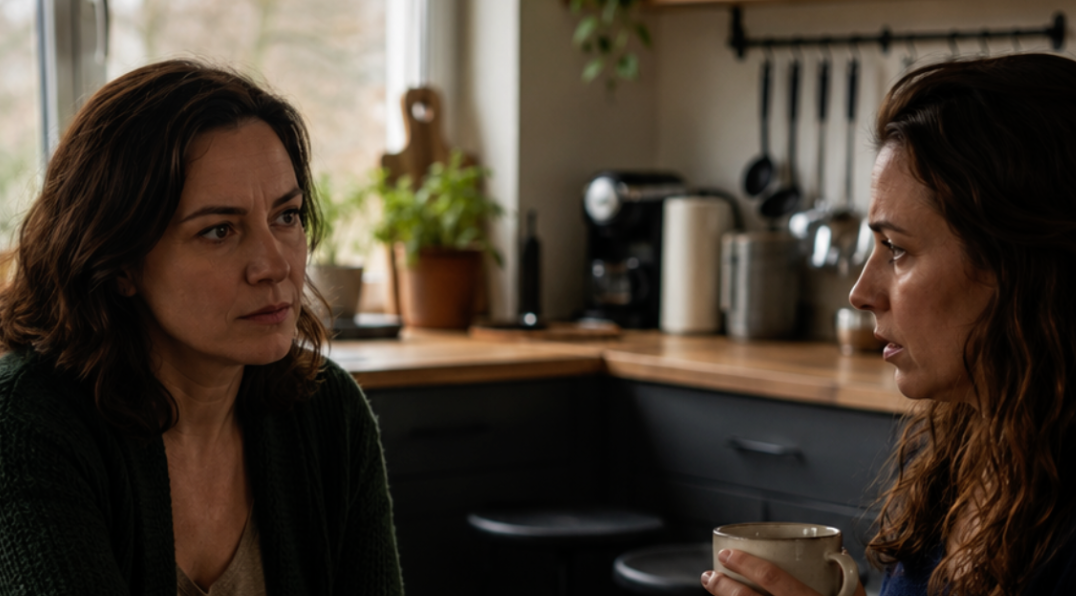
My Sister-in-Law Dictated a List of 80 Wedding Guests. I Handed It Back With One Word: “Pay.”
There were eighty names in the notebook. I counted them twice—an old habit that twenty-eight years in a design bureau had failed to erase—and both times I arrived at the same number.
Zhanna sat across from me at the kitchen table, tapping her rings against the countertop while flipping through a thick planner filled with colored tabs. Pink, green, and yellow sticky notes protruded from the pages as though she were preparing not a wedding guest list, but a full-scale military campaign.
“Well?” Zhanna asked. “What do you think?”
I pointed to the middle of the list.
“Who is Nechayeva?”
“Mom’s friend. They stayed at the same health resort together. Before Mom passed away.”
My mother-in-law had died seven years ago. I didn’t remember any Nechayeva. But Zhanna was already running her fingernail along the next line.
“The Tarasovs, the Kudinovs, the Petrovskys. Mom had been friends with the Petrovskys since her factory days. They’ll be offended if we don’t invite them.”
“And the Belchikovs?”
“The Belchikovs were our neighbors in the old apartment building. They live outside the city now, but Mom corresponded with Vera Belchikova until the day she died.”
“Zhanna.” I placed my palm over the notebook. “This is Artyom and Kristina’s wedding. Their wedding.”
She pushed my hand aside.
“And who do you think I’m doing all this for? He’s my nephew. I’ve known him since he was three. Am I supposed to stand on the sidelines?”
Her rings struck the table with a brief, demanding clink.
Zhanna wore four rings on each hand: three thin silver bands and one wide ring with a turquoise stone. Whenever she wanted something, she tapped them against the nearest hard surface. Over the years, that sound had become a kind of warning signal for me. Once the rings started clinking, Zhanna had made up her mind—and only a tank could argue with her.
Artyom had announced his engagement two days earlier. We had been sitting in this same kitchen: Pavel, me, Artyom, and Kristina.
Kristina had been smiling, holding Artyom’s hand and nervously twisting the edge of a napkin.
“We want to get married in July,” my son had said. “A small wedding. About twenty-five people. Just the people closest to us.”
Pavel nodded. I hugged them both.
Kristina rested her forehead against my shoulder and whispered, “Thank you for not objecting.”
Apparently, she had expected us to argue. We didn’t. What mattered to me was that my son was happy, not how many tables there would be in the restaurant.
Two days later, Zhanna was sitting in my kitchen with her planner and eighty surnames.
“I’ve already called most of them,” she said, turning the page. “The Tarasovs confirmed. So did the Kudinovs. The Belchikovs will drive in from the region. I promised them the restaurant would be respectable, not some cafeteria.”
“When did you manage to call everyone?”
“Last night. Artyom said July. There are only three months until July, Rimma. That’s hardly any time. For this many people, everything has to be booked in advance.”
“Artyom said twenty-five,” I repeated.
“Twenty-five isn’t serious. People will be offended. And I’m the one who’ll have to face them afterward.”
I looked at Pavel.
He was standing by the window, stirring his tea and pretending he wasn’t in the kitchen.
Ignore it, don’t argue, don’t interfere—that was how my husband had spent his entire life around Zhanna. When we were younger, their mother had always supported her, and arguing with both of them had been completely pointless. Their mother was gone, but Pavel’s habit remained.
“Pasha,” I called.
He rubbed the bridge of his nose. He always did that when someone asked him a question he didn’t want to answer.
“Zhanna, maybe you should talk to Artyom,” he said. “It is his wedding, after all.”
“Of course I’ll talk to him. But first we have to decide on the number of guests and reserve a hall.”
Then she immediately turned back to me.
“I’ve looked at The Riverside. It’s on the embankment. The hall seats one hundred and twenty, so we’ll have more than enough room.”
I wanted to say that we didn’t need one hundred and twenty seats. We needed twenty-five chairs and the string lights Artyom had promised to hang himself.
But I said nothing.
It was an old habit—staying silent whenever Zhanna entered organizer mode.
After she left, I washed the cups and thought about how this wasn’t the first time.
It had always been like this.
When Pavel and I renovated our apartment, Zhanna arrived with a wallpaper catalog and chose everything for us.
When Artyom turned eighteen, Zhanna invited twelve people he had never met.
When we bought our country house, Zhanna found a property in another district that cost thirty thousand rubles more.
Every time, there was a notebook, the clinking of rings, and the uncompromising declaration:
“I’m only doing this for the family.”
And every time, I stayed silent.
At first, because my mother-in-law was still alive, and arguing with Zhanna meant arguing with her too.
Then my mother-in-law died, but the habit of giving in had already soaked into me like an ink stain in fabric.
The next day, I went to work and opened the cost-estimation program as usual.
For twenty-eight years, I had calculated other people’s projects: the cost of foundations, the amount of reinforcement steel required, electrical expenses.
Calculating was my job—and also the way I thought.
Whenever I felt anxious, I counted things. It calmed me more effectively than any conversation.
At lunchtime, I checked my phone.
There was a message from Zhanna in the family group chat.
“I reserved The Riverside for July 19. The hall with the terrace. I paid the deposit. Rimma, send me your share later.”
She had attached a photograph from the brochure: white tablecloths, candles on the tables, and a view of the river.
At the bottom was the restaurant’s price list.
Banquet menus started at four thousand rubles per person.
I closed the chat.
Zhanna had reserved a restaurant.
She had paid a deposit.
On our behalf.
Without a single word of agreement from us.
Below her message was another one, from Artyom. No emojis. No exclamation marks.
“Mom, Aunt Zhanna sent Kristina the guest list and pictures of the restaurant. Kris is upset. Please help.”
My son rarely asked for help.
As a child, he had asked when he couldn’t solve a math problem. As a teenager, he never asked at all.
And now, at twenty-six, a grown man, he was writing:
“Mom, please help.”
I put the phone away and remained at work until the end of the day.
My fingers moved across the keyboard, finishing the quarterly report, while my mind calculated something else.
Four thousand multiplied by the number of guests—and that was only the least expensive menu option.
That evening, Kristina called.
Her voice was quiet and cautious, like someone who wasn’t sure she had the right to call.
“Rimma Borisovna, may I speak to you for a minute?”
“Of course, Kristina.”
There was a pause. I heard her take a breath.
“Zhanna Olegovna wrote to me. She sent the guest list and a picture of the restaurant. Then she asked whether we wanted a chocolate fountain. Rimma Borisovna, what fountain? I don’t even know who the Petrovskys are. Or the Belchikovs. Or Nechayeva.”
“They were acquaintances of my late mother-in-law.”
“Exactly. I’ve never met any of them. Artyom and I wanted…”
She fell silent.
“We wanted about twenty-five people. In a small café. With string lights. Artyom promised to hang them himself. We even chose the color—warm white, not cold white. And now there’s a hall for one hundred and twenty people and a chocolate fountain.”
I listened and felt something familiar rising inside me.
Not anger.
Something worse.
Recognition.
Twenty-eight years earlier, I had been twenty-two, and my mother-in-law and Zhanna had made all the same decisions for us.
The wedding would have sixty guests.
They chose the restaurant.
They approved the dress.
Pavel had told his mother, “Mom, we wanted to quietly register the marriage.”
She had replied, “People get married quietly when they have something to be ashamed of. We have nothing to be ashamed of, so we’re celebrating.”
We hadn’t argued.
I had been twenty-two.
I hadn’t known how.
Kristina was twenty-five.
She didn’t know how either.
“Kristina, I’ll take care of it,” I said. “Don’t respond to Zhanna yet. I’ll speak to her myself.”
“Thank you, Rimma Borisovna.”
“Kristina.”
“Yes?”
“Does Artyom know about the list?”
“He does. He said, ‘Mom will handle it.’”
Mom will handle it.
My son believed I could manage this.
His fiancée believed it too.
And I sat in the kitchen, staring at the opposite wall and thinking that I had stayed silent all these years for the sake of peace in the family.
The peace was still there.
But the family was unhappy.
I went to find Pavel.
He was sitting in an armchair, reading something about fishing equipment on his tablet.
“Pasha. Zhanna reserved the restaurant for their wedding without our permission. And she paid the deposit.”
He rubbed the bridge of his nose.
“She doesn’t mean any harm. That’s just how she is.”
“Kristina called. She’s upset. Artyom wrote asking me to help. They don’t want this wedding, Pasha. Not with eighty people.”
“Then Artyom should tell Zhanna.”
“You know Zhanna won’t listen to Artyom. She doesn’t even listen to you.”
Pavel was silent.
Then he said quietly, “She’s been alone since Mom died. Family is all she has. This is how she… holds herself together.”
I knew that.
Zhanna was nearly fifty. She had never married and had no children. After her mother’s death, she was left alone in a one-bedroom apartment.
She filled the emptiness in the only way she knew how.
She organized.
Other people’s birthdays, farewell parties, anniversaries—everything went through her. She chose restaurants, ordered cakes, and sent invitations.
And she added her own acquaintances to every guest list.
Because the more people she surrounded herself with, the less silence there was in her apartment at night.
I understood that.
But my son and his fiancée should not have to pay for her loneliness.
“I’ll handle it,” I said.
Pavel nodded and returned to his tablet.
Handling things was my job.
It always had been.
I waited until he fell asleep.
Then I took my work notebook out of my bag, sat at the kitchen table, and switched on the light above the stove.
I placed Zhanna’s guest list beside the restaurant brochure I had downloaded from the group chat, along with a calculator.
And I began to calculate.
The banquet menu started at four thousand rubles per person.
I multiplied it by the number of guests.
That covered only the food.
Alcohol was listed separately—at least another hundred thousand rubles.
Renting the hall and terrace was another expense.
Decorations, music, and a photographer were separate lines too.
I wrote everything in columns, the way I did at work.
Straight numbers.
Exact totals.
I drew a line underneath the calculation.
Then I underlined the final figure twice.
More than half a million rubles.
I pushed the calculator aside and rubbed my temples.
Half a million.
Pavel and I had been saving for Artyom’s wedding for three years, but we had expected a modest celebration.
What we had saved would cover twenty-five or thirty guests.
It would not cover eighty.
Not even close.
Then I took Zhanna’s list and divided the names into two groups.
The first group was ours: Kristina’s parents, the couple’s friends, my colleagues, Pavel’s friends, and a few cousins.
Twenty-three people.
Everyone else was either Zhanna’s acquaintance or someone our late mother-in-law had once known.
I counted the second group three times because I couldn’t believe the result the first time.
Fifty-seven people.
My mother-in-law’s friends from the health resort.
Zhanna’s neighbors from her apartment building.
Her colleagues from the dental clinic.
Someone’s daughter-in-law.
Someone else’s son-in-law.
A family my mother-in-law had been friendly with before 2004.
People whom neither Pavel nor I had ever met—and whom Artyom and Kristina certainly didn’t know.
Fifty-seven out of eighty.
I took a clean sheet of paper and wrote “Cost Calculation” at the top.
I divided it into rows: total number of guests, total banquet cost, and the amount attributable to each group.
More than half of the expenses came from Zhanna’s acquaintances.
At the bottom, I added a separate line:
“Zhanna’s acquaintances—57 people.”
Beside it, I wrote the amount.
Then I folded the sheet neatly, put it in my work folder, and switched off the light.
On Saturday morning, Zhanna rang the doorbell.
She had not called in advance, as usual.
She removed her shoes in the hallway, walked into the kitchen, and placed her notebook on the table.
There were even more tabs now.
Blue ones had been added to the pink, green, and yellow.
“I updated the list,” she said, opening her planner. “I added the Frolovs. Raisa Frolova was Mom’s classmate. Her husband never likes going anywhere, but I persuaded him.”
“How many now?” I asked.
“Eighty-two. But the Frolovs are only two people, so they hardly count.”
They count, I thought.
They most certainly count.
“Zhanna, sit down.”
She sat.
Her rings made a quiet clink against the table—softer than usual.
She had heard something in my voice.
During all the years we had been relatives, Zhanna had grown accustomed to my surrendering.
This time, I wasn’t going to.
I opened my work folder and took out the sheet.
“I calculated everything.”
I placed the estimate on the table in front of her.
Zhanna looked at the columns of numbers and frowned.
“What is this?”
“The cost of a banquet for eighty people. Without the Frolovs. More than half a million rubles. That is more than Pavel and I earn in several months.”
“We can find a cheaper restaurant.”
“You have already reserved a restaurant. The Riverside, with the terrace. The menu starts at four thousand per person.”
Zhanna opened her mouth.
Then closed it.
“There’s more.”
I turned the sheet toward her.
“I divided the guests into two groups. Ours—twenty-three people. Everyone else is your acquaintance. Fifty-seven people. With the Frolovs, fifty-nine.”
“They’re not mine! They were Mom’s—”
“Mom has been dead for seven years, Zhanna. These people are yours. They aren’t Artyom’s. They aren’t Kristina’s. They aren’t mine or Pavel’s. They are your acquaintances.”
Silence filled the kitchen.
The faucet was dripping. I had meant to replace the washer the previous week.
It was strange what a person thought about at moments like this.
A washer in a leaking faucet, while the entire wedding budget was being decided.
“Here is what I propose,” I said.
I picked up the guest list—the one containing eighty-two surnames—and placed it in front of Zhanna.
Beside it, I placed my calculations.
“Fifty-nine people are yours. Here is the cost per guest. Pay for them yourself, and we will invite them.”
Zhanna looked at the list.
Then at me.
Then back at the list.
The numbers were neat, and every line was underlined.
A proper accountant’s column.
Very convincing.
Numbers don’t get offended.
They don’t shout or apply pressure.
They simply exist.
“Are you serious?” Zhanna asked.
“Completely. You want to invite eighty-two people? Fine. But we are not paying for people my son wouldn’t recognize if he passed them on the street.”
Zhanna straightened in her chair.
“Pavel!” she shouted toward the other room.
Pavel came out of his study.
He rubbed the bridge of his nose.
Then he looked at the table: my estimate, Zhanna’s guest list, and the planner filled with blue tabs.
“Do you hear what your wife is saying to me?” Zhanna demanded.
“I hear her.”
“And what do you have to say?”
He was silent for a moment.
Then he sat beside me, picked up my estimate, scanned the numbers, and placed it back on the table.
“Rimma is right,” he said quietly. “We can’t afford it.”
“You can’t afford it for your own nephew?”
“Zhanna, this is Artyom’s wedding. He wants twenty-five guests. Kristina wants twenty-five. And we want whatever they want.”
“I’m doing this for the family,” Zhanna said.
She looked at me as though she were waiting for me to weaken.
The way I had every previous time.
The way I had at my own wedding, when I was twenty-two and didn’t know how to say no.
I wasn’t twenty-two anymore.
“Then do something for the family,” I replied. “Pay your share.”
Zhanna stood up slowly, pressing both palms against the table.
Her rings didn’t clink because her hands were flattened against the tabletop.
She grabbed her planner.
The tabs fluttered.
She shoved it into her bag, put on her shoes by the door, and left.
The door closed quietly.
Zhanna never slammed doors.
She slammed words.
And today, she had run out of words.
Pavel remained at the table, staring at the empty place where her planner had been.
“She’ll be offended,” he said.
“Maybe.”
“She’s alone, Rimma.”
“I know she’s alone. And I feel sorry for her. But Kristina is a person too. So is Artyom. Their wedding is not a venue for Zhanna’s guest list.”
He nodded.
Then he got up and returned to his study.
I cleared away the estimate, washed the cups, and sat on a stool by the window.
Outside, a boy was kicking a ball across the wet pavement.
The ball hit the curb and bounced away.
The boy ran after it, kicked it again, and it bounced away once more.
Stubborn.
Like Zhanna.
Like me.
Zhanna did not call on Saturday evening.
She did not call during the night either.
I lay in the darkness, listening to Pavel’s steady breathing beside me and wondering whether I had gone too far.
Maybe I should have been gentler.
Maybe I shouldn’t have confronted her with calculations on paper.
Maybe I should have spoken to her like a human being, without numbers and columns.
But I had spoken to her “like a human being” every previous time.
And every time, Zhanna had done what she wanted anyway.
Then I remembered Kristina.
Her quiet voice on the phone.
The pause before she said, “We wanted twenty-five.”
I remembered Artyom’s message:
“Mom, please help.”
And I realized that no, I had not gone too far.
Numbers were a language Zhanna had never heard from me before.
Because until then, I had spoken her language.
The language of surrender.
Around lunchtime on Sunday, the doorbell rang.
Zhanna stood on the landing with her planner in her hands.
But it had changed.
The tabs were gone.
Almost all of them.
Only three pink markers protruded from the worn pages.
Over two days, the planner seemed to have lost half its weight, as though someone had stripped it of its ceremonial uniform.
“May I come in?” Zhanna asked.
She had never asked before.
She had always simply entered.
“Come in.”
She walked into the kitchen.
She sat in her usual place and put the planner on the table.
Her rings remained silent.
She hadn’t removed them.
She simply wasn’t tapping them.
“I revised the list,” she said. “Twenty people. Only the closest people.”
She handed me a sheet of paper.
I took it.
The handwriting was the same—large and forceful—but the letters were smaller and crowded closer together.
It was as though Zhanna were trying to take up less space on the page.
Twenty names.
Kristina’s parents.
Our friends.
Pavel’s friends.
Two cousins.
An aunt.
No Nechayeva.
No Frolova.
No neighbors, colleagues, sons-in-law, or daughters-in-law of someone’s old acquaintance.
I read through the list again.
Then I stopped.
Zhanna had not included Lyuda.
Lyudmila Savelyevna was the only friend who had known Artyom since birth.
She brought him wind-up toy cars when he was five.
She gave him money for his graduation.
She came to every birthday without an invitation because no invitation had ever been necessary.
Lyuda was part of the family.
Not by blood.
Not by documents.
By habit and love.
Zhanna had crossed her out because, technically, Lyuda was Zhanna’s friend.
I looked at my sister-in-law.
She was sitting upright, her hands folded in her lap.
No tapping rings.
No commanding voice.
No battle-ready planner.
Just a woman.
Almost fifty.
Alone in a one-bedroom apartment.
A woman who had torn nearly every page out of her planner because her sister-in-law had told her to pay.
I picked up a pen and added a name to the bottom of the list.
“Lyudmila Savelyevna.”
Zhanna looked up.
“I crossed her out. I didn’t want you to think I was trying to—”
“Lyuda is one of ours,” I said. “She remembers Artyom better than some of his relatives do. She’ll be there.”
Zhanna nodded.
She moved her hands away from the table and turned toward the window.
I didn’t look at her face.
Then I picked up my phone and called Kristina.
“Kristina,” I said. “Twenty-one guests. A small café. String lights. Just as you and Artyom wanted.”
Kristina was silent for a second.
Then she exhaled.
“Thank you, Rimma Borisovna. Thank you.”
I placed the phone on the table.
“From now on, Zhanna, the wedding belongs to Artyom and Kristina. We are helping them. But the decisions are theirs. Not yours. Not mine.”
Zhanna said nothing.
I continued.
“And this isn’t only about the wedding. It applies to everything. Birthdays, holidays, renovations. We decide whom to invite and how much to spend. You may make suggestions. But we make the decisions.”
She remained silent for a long time.
Then she asked quietly, “And me? Where do I belong?”
I reached across the table and placed my hand over hers.
The rings were cold.
“You belong on the list,” I said. “The first line. As always.”
Zhanna turned toward the window.
I removed my hand.
We sat there in silence, in the kitchen where, over two days, more had been resolved than during all the previous years.
When Zhanna left, she forgot her planner on the table.
Three pink tabs.
I opened it without thinking.
Most of the pages had been torn out.
On the remaining ones were a grocery list, several phone numbers, and an apple-cake recipe copied in my mother-in-law’s handwriting.
Small, neat letters, with a little flourish on the Russian letter “d.”
I closed the planner and placed it on top of the refrigerator.
Zhanna would take it the next time she came.
And she would come again.
I knew she would.
Then I returned to the table.
I picked up the list of twenty-one names and attached it to the refrigerator door with a magnet.
Beside the apple-cake recipe and an old photograph of Artyom in his school uniform.
Twenty-one names.
A small café.
String lights.
Warm white, not cold white—just as Artyom and Kristina wanted.
That was how it would be.