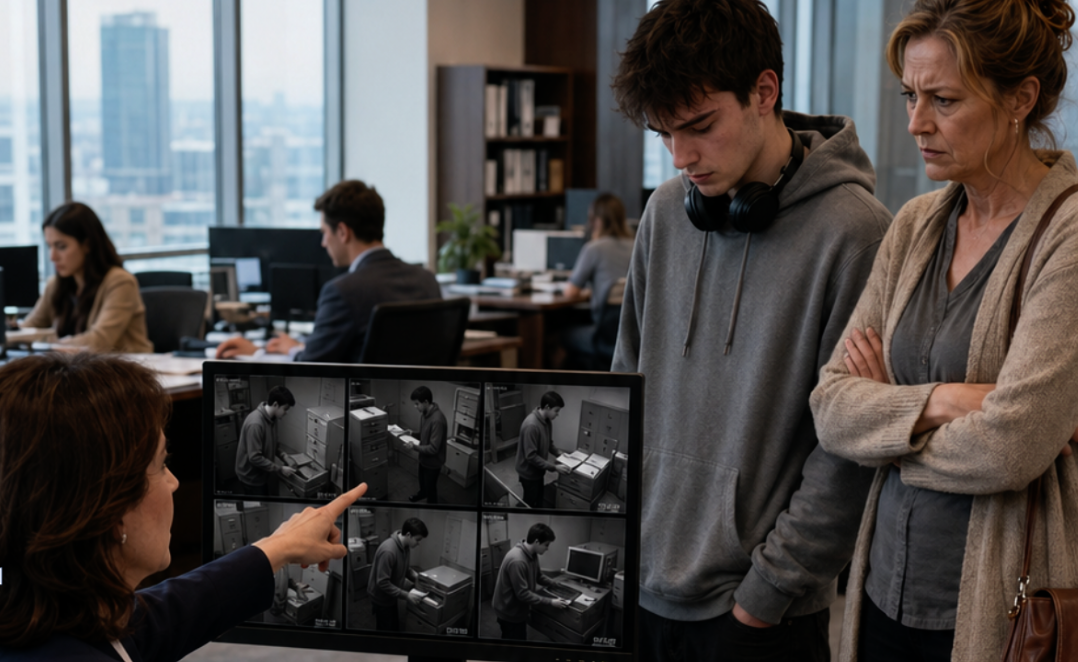
“We’ll Destroy Your Business,” My Best Friend Said After I Fired Her Son. A Week Later, She Came Demanding Money—but Left With a Very Different Bill
“Do you even understand what you’re doing?! My child is eighteen, and you’re exploiting him like a slave! I’m reporting you to the prosecutor’s office, do you hear me? We’ve already filed a complaint with the labor inspectorate!”
Natasha’s voice rose to a shriek. We had been friends since our second year at university. I moved the phone away from my ear while curses continued pouring from the speaker, generously seasoned with legal terminology whose meaning my friend clearly did not fully understand.
A white sheet of paper lay on my desk—a copy of the official complaint. It stated in black and white that sole proprietor Yana V. Smirnova systematically violated labor law, forced an employee to work unpaid overtime, and subjected the young worker to psychological pressure.
The employee was Stepan.
Natasha’s son, whom she had tearfully begged me to hire exactly one month earlier.
Without saying a word, I ended the call and placed the phone facedown.
The office was quiet. Only the muted hum of the air conditioner and the clicking of the chief accountant’s keyboard could be heard through the wall.
Twenty years of friendship had just ended.
There were no tears. My hands were not shaking.
There was only a dull, crushing exhaustion and the bitter taste of bile in my mouth.
A month earlier, Natasha and I had been sitting in my kitchen. She was drinking tea, nervously crumbling a cookie between her fingers, and complaining about her life.
“Yan, you understand how difficult things are for young people these days,” she sighed, sweeping crumbs off the table. “Stepochka finished school, but he didn’t get into university. He says he’s trying to find himself. He sits at the computer all day making some kind of videos. His father stopped paying child support, and I can’t afford to support him alone anymore. Could you hire him at your office? Give him the easiest position you have. He just needs a push, a proper working environment, some discipline. You’re strict. You’ll turn him into a responsible person. I’m asking you as a friend. Please help me.”
I hesitated.
My logistics company was not a daycare center. We dealt with constant shipments, invoices, route sheets, and drivers who needed everything explained clearly and quickly.
But Natasha looked at me with such pleading eyes that I gave in.
After all, an assistant manager’s position did not require advanced mathematics. He would enter information into spreadsheets, answer clients’ calls when all the other lines were busy, and sort documents for the archive.
We discussed the salary immediately.
He would receive the minimum official wage stated in the contract, plus a cash bonus that made up the larger part of his income. Unfortunately, it was a common arrangement among small businesses trying to survive.
Natasha agreed to everything.
Stepan arrived forty minutes late on his first day.
He wore baggy trousers that dragged along the floor and an enormous hooded sweatshirt. Wireless earbuds were stuck in his ears.
He did not greet anyone. He simply dropped into the chair I had assigned him and pulled out his phone.
“Stepan, the working day begins at nine,” I said calmly, approaching his desk.
He slowly removed one earbud.
“I was stuck in traffic. Besides, what difference does it make when I arrive as long as I get the work done? I care about results, not hours.”
I should have sent him home right then.
But I remembered Natasha’s tears.
Instead, I explained his responsibilities and placed a stack of invoices in front of him that needed to be entered into the database.
During the first week, I ignored his strange behavior.
I overlooked the fact that he disappeared for two-hour lunch breaks. I tolerated the way he scrolled through social media for fifteen minutes after entering each document.
Marina, my senior accountant, was a stern and experienced woman. Her patience lasted exactly three days.
“Yana Viktorovna,” she said on Friday, stepping into my office and firmly closing the door behind her, “that boy is going to destroy our database. Today, instead of entering the contractor’s name as StroySnab, he entered StoySam. He made the same mistake in five documents. I spend more time correcting his work than he spends doing it.”
I called Stepan into my office and asked him to be more careful.
He rolled his eyes.
“Yana Viktorovna, those are minor details. Someone mistyped one letter. The system is supposed to be smart enough to understand. You work like people did in the last century. There’s no automation here at all.”
“Stepan, these are financial documents,” I said, struggling to keep my voice even. “There are no minor details. One wrong letter can result in a truckload of goods being sent to the other side of the region.”
He merely snorted and returned to his desk.
The real problems began during his third week.
Stepan was instructed to call clients and confirm their delivery times for the following day.
The task was simple. He had a list, a telephone, and a prepared script.
Around midday, the director of a large construction supply depot—one of our most important clients—called my mobile phone.
“Yana, what the hell is going on over there?” he barked. “Some kid just called me while chewing gum directly into the receiver and said, ‘So, what’s up? You want us to bring your pipes tomorrow or what?’ Is that your new standard of corporate etiquette?”
I apologized for ten minutes and offered him a discount on his next delivery.
After ending the call, I walked into the main office.
Stepan was not at his desk.
“Where is he?” I asked Marina.
She silently nodded toward the archive room.
It was a small, windowless room where we kept folders from previous years. It also contained a large, expensive engineering scanner and copier that the company had leased.
I opened the archive-room door.
Stepan was sitting on the edge of a table.
A telephone had been mounted on a tripod in front of him, and a ring light—apparently brought from home—was switched on.
He was speaking into the camera.
“So basically, this is how I waste my life sitting around in this dump. All the old women here are ancient, and the boss is a total pain. Check out this machine they’ve got—”
I stood in the doorway, feeling a slow, heavy anger beginning to boil inside me.
“Stepan. Come to my office. Right now.”
He jerked in surprise and nearly knocked over the tripod before stopping the recording.
I did not shout at him in my office.
I simply told him that his probationary period was over.
During the month he had worked for us, he had brought the company nothing except problems and damaged relationships with clients.
“You don’t need to come in tomorrow. I’ll sign the dismissal order. You’ll receive only the official salary listed in your contract for the month you worked. You did not earn the bonus. Because of your call, I lost money by giving a client a discount.”
Stepan turned pale.
For one brief moment, his arrogance cracked. Then it was replaced by aggression.
“You don’t have the right! My mother trusted you! You have to pay me everything you promised! I worked!”
“You didn’t work, Stepan. You merely occupied a chair. And you were rude to our clients. This conversation is over. Go and collect your things.”
He stormed out, slamming the door behind him.
That evening, Natasha called.
I expected her to apologize.
Or at least ask what had happened.
Instead, she immediately attacked me.
“How did you speak to him?!” she shouted. “He’s a child! He came home white as a sheet. His blood pressure went through the roof! You humiliated him! And what do you mean he’s not getting the bonus? We were counting on that money! I promised to buy him a new jacket!”
“Natasha, your child does not work. He insults clients and films videos in the archive room. I’m not a charity.”
“Oh, is that how it is? My mother was right when she said your business had ruined you. You’ve become spoiled and arrogant, Yanochka. Don’t worry. We’ll find a way to deal with you.”
I did not take her threat seriously.
A mother was upset because she believed her son had been treated unfairly. It was understandable. She would calm down eventually.
But she did not.
A week later, a letter from the labor inspectorate arrived at my company’s official address.
It was followed by a formal pretrial demand from some lawyer Natasha had apparently hired with the last of her money.
In the complaint, Stepan claimed that he had been forced to carry heavy boxes of documents, although he had spent his time in the archive room sitting with his phone.
He claimed that I had insulted him in front of other employees.
Most importantly, he accused me of fraudulently withholding part of his wages.
The lawyer threatened me with the prosecutor’s office, the tax authorities, and a lawsuit.
Every small-business owner knows that a labor inspection is hell.
Even when you are completely right, inspectors will find something wrong. A vacation schedule may be posted in the wrong place. A workplace-safety log may have been completed incorrectly.
Fines for legal entities can amount to tens or even hundreds of thousands of rubles.
Natasha knew exactly where to strike.
I spent the entire next day in a state of numb confusion.
My thoughts swung between paying them the small amount just to make them disappear and hiring a lawyer to fight them to the bitter end.
Paying would mean admitting weakness.
Going to court would cost an enormous amount of time and energy.
Toward the end of the day, Pasha, our part-time system administrator, looked into my office. He had been setting up a new computer network.
“Yana Viktorovna, I was checking the servers,” he said, shifting awkwardly from foot to foot. “Remember when the scanner in the archive room broke last week? You called a technician, and he said the internal components had been flooded with something sweet. The repair estimate was forty thousand rubles.”
“I remember, Pasha. What about it?”
“You asked me to check the security-camera footage. I forgot at the time because I was busy, but I looked today. The camera in the corridor catches part of the archive-room doorway. The door was often left partly open.”
I sat upright in my chair.
“Show me.”
We sat down in front of my computer.
Pasha started the recording.
The quality was average, but it was easy to understand what had happened.
Stepan entered the archive room carrying a large paper cup of coffee.
The door remained half open.
He placed the cup directly on the glass surface of the expensive scanner.
Then he set up his tripod and began speaking energetically into his camera, waving his arms as he talked.
At one point, he made a sudden movement and knocked over the cup.
Coffee poured directly onto the scanner.
The liquid ran beneath the lid and over the control panel.
Stepan froze.
Then he hurriedly tried to wipe up the spill with the sleeve of his sweatshirt.
He did not call anyone for help.
He did not attempt to unplug the machine.
He simply smeared the sticky syrup around, closed the scanner lid, grabbed his tripod, and hurried out of the archive room, firmly shutting the door behind him.
I stared at the screen.
A cold, calm feeling spread through my chest.
It was the feeling of complete clarity.
Pasha stood beside me.
“Should I copy the footage onto a flash drive, Yana Viktorovna?”
“Yes, Pasha. Do that. And please find the technician’s report—the one stating that the machine was damaged by a sugary liquid and listing the cost of the replacement parts.”
The next morning, I called Natasha.
“We need to meet. Today, at my office. Bring Stepan with you.”
“What, are you scared?” she asked, unable to hide her triumph. “Have you finally realized that we’re not people you can play games with? We’ll come. But understand this: now I’m demanding not only the bonus but compensation for emotional distress. The lawyer said we can easily squeeze another fifty thousand out of you.”
“Come at three,” I replied evenly and ended the call.
They arrived at exactly three o’clock.
Natasha entered first, her chin raised and her lips pressed tightly together. She carried a folder in her hands.
She looked like a furious mother prepared to defend her precious child.
Stepan trailed behind her.
He no longer looked as frightened as he had on the day he was dismissed.
He looked bored.
I did not offer them tea.
I pointed to the chairs across from my desk.
“Well, I’m listening, Yana,” Natasha began, sitting down and placing the folder on the desk. “I hope you’ve prepared the cash. Because once we move forward with this case, your pathetic little company is finished. We have everything documented.”
I looked at her silently.
This was the woman I had supported throughout her divorce.
Now a greedy, embittered stranger sat before me, prepared to destroy my business to satisfy the whims of her lazy son.
“You will not receive any money,” I said quietly but firmly.
Red blotches spread across Natasha’s face.
“Oh, really? Stepa, let’s go. The lawyer was right. There’s no point talking to her. The inspector will be here tomorrow!”
“Sit down.”
My voice rang like metal.
Stepan, who had already started to stand, immediately dropped back into his chair.
“I said you won’t receive any money. In fact, you owe me forty-two thousand rubles.”
Natasha blinked, confused.
“What are you talking about? What forty-two thousand?”
I turned my computer monitor toward them and pressed the space bar.
The video began to play.
There was no sound, but none was needed.
They stared at the screen.
I watched them.
The color rapidly drained from Stepan’s face.
His bored expression vanished.
He sank into his chair, realizing exactly what they were being shown.
Natasha narrowed her eyes, trying to understand what was happening.
“What is this?” she finally asked when the recording showed Stepan frantically smearing the spilled coffee across the scanner.
“That, Natasha, is your son at his workplace—the son you claim I underpaid.”
I placed a sheet of paper in front of her.
“And this is the official report from the service center. The machine was flooded with liquid. There was a short circuit in the control board. The repair cost is forty-two thousand three hundred rubles. The scanner is leased. It belongs to the bank, and I am responsible for damage to it.”
A deathly silence filled the office.
The only sound was a car passing outside the window.
“This… this must be edited somehow,” Natasha muttered uncertainly, looking at her son. “Stepochka, you didn’t break anything, did you?”
Stepan said nothing.
He lowered his head and stared at his sneakers.
His lips were trembling.
All his online bravado disappeared now that he was facing real consequences.
“Article 167 of the Criminal Code,” I continued calmly, looking directly into Natasha’s eyes. “Intentional destruction of or damage to someone else’s property. Although this will most likely be classified as negligent damage to property. Either way, it involves the police. A formal statement. Questioning. And a civil lawsuit for compensation.”
I paused.
“And believe me, I’ll hire a good lawyer. Not one who writes foolish pretrial threats, but one who will have your accounts frozen until the court makes its decision.”
Natasha swallowed hard.
“Yana… Yanochka… wait. Why involve the police?”
Her tone changed instantly.
The confident avenger was gone.
Once again, a frightened woman sat before me—a woman who had just realized she had trapped herself.
“What about the labor inspectorate?” I raised an eyebrow. “You’ve already filed the complaint. So let’s follow everything through to the end. Let them inspect the company. I’ll pay a fine if they find a violation. And you’ll pay for the scanner, the court expenses, and damages for defamation.”
“Mom…” Stepan squeaked quietly. “I didn’t mean to. It fell over by itself.”
“Shut up!” his mother suddenly screamed at him so loudly that he flinched.
She turned back to me.
Her eyes darted around the room, and her hands nervously tugged at the clasp of her handbag.
“Yana… we’ll withdraw the complaint. Tomorrow. No, today. I’ll go there myself and withdraw it.”
“Excellent,” I said, nodding. “And what about the repair? Forty-two thousand rubles, Natasha. I have receipts. I was forced to take that money out of the company’s operating funds—the money I use to pay the salaries of employees who actually work.”
“I don’t have that kind of money right now,” she said, close to tears. “Yana, you know my situation. I don’t receive child support, and my salary is tiny…”
“That is no longer my concern.”
I leaned back in my chair.
I felt no pleasure or triumph.
I was simply disgusted.
“I’m giving you three days. In three days, I want a document on my desk confirming that the complaint has been withdrawn from the labor inspectorate. And within three days, the full repair cost must be transferred to the company’s bank account. Otherwise, the recording and the service-center report will be handed over to the police.”
Natasha opened her mouth to say something.
Perhaps she wanted to appeal to my sympathy, remind me of our university years, or repeat that tired excuse about Stepan still being a child.
Then she looked at my face and stopped.
Silently, she stood, grabbed the stunned Stepan by the arm, and dragged him toward the door.
She stopped in the doorway without turning around.
“I thought you were my friend,” she said bitterly.
“So did I,” I replied to her back. “Goodbye, Natalia.”
The door closed.
They transferred the money on the third day.
Every last kopeck.
A little later, a courier delivered a copy of the request to withdraw the complaint from the labor inspectorate, complete with the office’s blue stamp.
We never spoke again.
I blocked her number and removed her from my social-media contacts.
I deleted her from my life as completely as one deletes a corrupted file.
A month later, Marina entered my office with documents for me to sign and casually mentioned something.
“Yana Viktorovna, I saw your Natalia in a store recently. She was with Stepan.”
“How are they?” I asked indifferently, signing an invoice.
“The same as always. They were arguing right beside the checkout. He wanted money for some new headphones, and she was shouting loudly enough for the entire store to hear that she had gone into credit-card debt because of him and that they would be eating pasta until winter. He threw a tantrum. A pathetic sight, honestly.”
I nodded and handed the folder back to her.
“Thank you, Marina. What do we have scheduled for tomorrow’s shipments?”
She smiled and began turning the pages.
Life continued.
The office was peaceful again. Documents were completed without errors, and clients received their shipments on time.
That evening, I left work.
The weather was warm, and the air smelled of freshly cut grass.
I got into my car, switched on the radio, and took a deep breath.