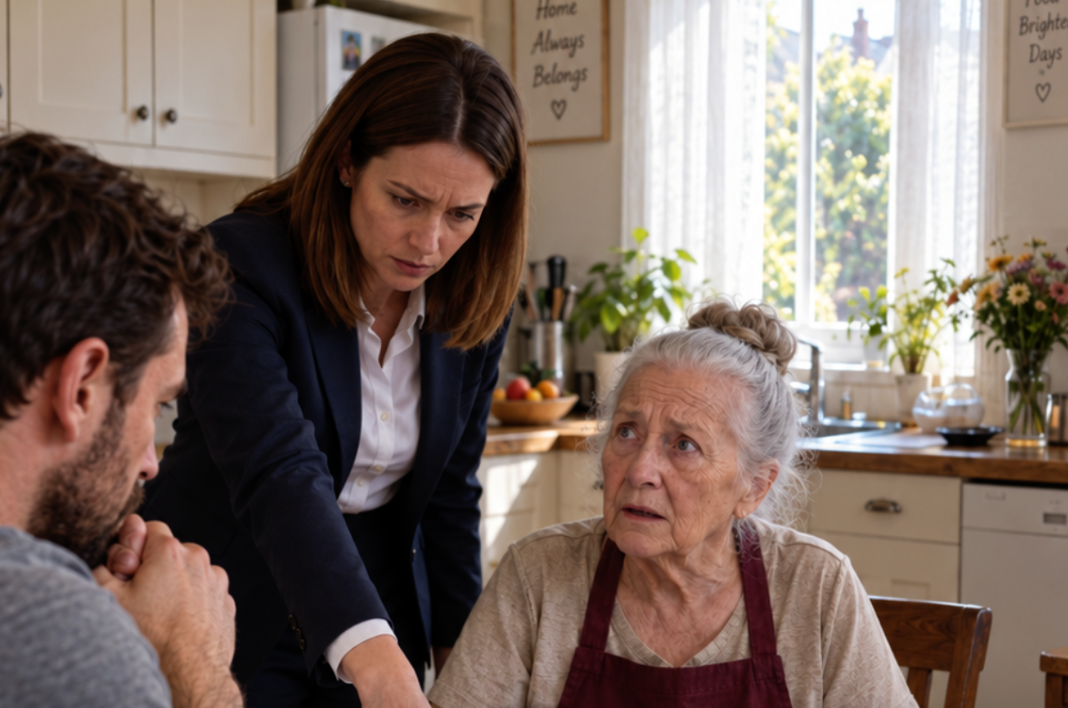
“Pack your things and get out of my apartment. Both of you,” Olga said after discovering what her husband and mother-in-law had secretly been planning behind her back.
“Mom, whose boxes are these?”
Sonya tugged at Olga’s sleeve and pointed toward a tower of cardboard boxes stacked in the hallway.
Olga froze just inside the front door.
She had come home expecting an ordinary evening. Instead, her apartment smelled of fried onions, old paper, and mothballs. A coat she recognized immediately hung beside her own things.
It belonged to her mother-in-law.
“Tamara Pavlovna?”
The older woman appeared from the kitchen wearing Olga’s cherry-red apron.
“Olechka, finally! Dima said you’d be back around seven. I’m making cutlets. Sonya loves them.”
Olga stared at her.
“What are you doing here?”
Tamara Pavlovna looked genuinely surprised by the question.
“Living here. Didn’t Dima tell you?”
He had not.
Olga helped Sonya out of her coat, turned on cartoons for her, then went straight to the bedroom and called her husband.
“Dima, your mother is here.”
“Oh, right,” he replied casually. “I meant to tell you. She rented out her apartment, so she needs somewhere to stay for a while.”
“For a while?”
“A week or two. Maybe longer. We have room.”
Olga sat on the edge of the bed.
“This is my apartment, Dima. You should have asked me first.”
“Olechka, we’ve lived there together for six years. It’s my home too. She’s my mother. What was I supposed to do, leave her on the street?”
“That isn’t the point. The point is that you decided for me.”
“We’ll talk when I get home. Just don’t make a scene.”
That sentence bothered Olga more than almost anything else.
Her apartment had come from her grandmother Zinaida, who had legally gifted it to her years earlier.
“Every woman needs a corner of her own,” her grandmother used to say. “A place nobody enters without her permission.”
When Olga married Dima, he moved in with her. He helped with renovations, bought materials, replaced tiles, and paid for some improvements.
But the apartment remained legally Olga’s.
For years, that had never been a problem.
Until now.
Dima came home late that evening, and Olga confronted him privately.
“How long is she staying?”
“A month. Maybe six weeks.”
Olga took a breath.
“Fine. But she behaves like a guest. She doesn’t rearrange my things, interfere with Sonya, or take over the house.”
“Agreed.”
He answered so quickly that Olga already doubted he meant it.
During the first week, Tamara Pavlovna was polite.
She cooked, cleaned, and helped with Sonya’s clothes.
During the second week, things began to change.
“Olechka,” she said one evening, “can we move the sofa? I have to sit sideways to see the television.”
“I like the sofa where it is.”
“But I’m uncomfortable.”
Olga heard something beneath those simple words.
I live here now. My comfort matters too.
“No,” Olga replied. “We’ll leave it where it is.”
Tamara Pavlovna smiled.
“Fine. I’ll wait.”
Five days later, Olga came home and found the sofa against another wall.
“Dima, who moved it?”
“Mom wanted it moved. I helped her.”
“I asked you not to.”
Dima shrugged.
“It’s just a sofa.”
But Olga knew it wasn’t.
It was territory.
First the sofa.
Then the kitchen.
Then the rules.
Soon Sonya came running to her.
“Mom, Grandma Toma says I can’t watch cartoons after dinner anymore.”
Olga frowned.
“Who decides that?”
“Grandma Toma said things are different now.”
Olga crouched beside her daughter.
“No, sweetheart. Mom decides the rules. Go watch your cartoon.”
Tamara Pavlovna appeared in the doorway.
“I’m only worried about her eyesight.”
“Please don’t change Sonya’s rules without asking me.”
“I’m her grandmother.”
“And you’re a guest in this home.”
Tamara Pavlovna’s face hardened.
She said nothing.
But her silence felt like a warning.
A few days later, Olga received an unexpected call from Aunt Lida, her grandmother’s elderly cousin.
“Olyushka, have you visited a notary recently?”
“No. Why?”
“A friend saw your mother-in-law in a notary’s office. She heard them discussing an apartment, registration, and some kind of ownership share.”
Olga’s stomach tightened.
That evening she confronted Dima.
“Why did your mother go to a notary?”
At first he avoided the question.
Then he finally admitted the truth.
“She wants to register her official residence here temporarily. It’ll make things easier for her pension, clinic appointments, medicine…”
“You want to register her in my apartment?”
“It’s only paperwork.”
“Then why didn’t you tell me?”
Dima hesitated.
“Because I knew you’d react badly.”
“Badly?”
“Hysterically.”
Something inside Olga went cold.
For the first time, she saw the situation clearly.
Whenever there was a choice between his wife and his mother, Dima would choose his mother.
There simply had never been a serious enough choice before.
“I’m not registering her here,” Olga said.
“Don’t be stubborn.”
“My apartment. My decision.”
Dima sighed.
“Fine.”
But the matter wasn’t over.
The very next day, Olga came home early and found three people sitting at her kitchen table.
Dima.
Tamara Pavlovna.
And an unfamiliar man in glasses with a folder of documents.
“This is Viktor Ivanovich,” her mother-in-law explained. “He’s a lawyer. We thought you should join our discussion.”
“What discussion?”
The lawyer placed several documents on the table.
“One is an application to register Tamara Pavlovna at this address,” he explained. “The other concerns recognition of the apartment as partially joint marital property.”
Olga stared at him.
“What?”
The lawyer continued calmly.
“Your husband contributed financially to renovations and improvements. Under certain circumstances, that contribution may be used as part of an argument regarding property rights.”
Olga looked at Dima.
He avoided her eyes.
Then she looked at Tamara Pavlovna.
“Olechka,” the older woman said gently, “Dima invested in this home for six years. Isn’t it fair that he should have some rights?”
“So this is what you’ve been planning?”
“We’re thinking about the family.”
The lawyer offered Olga a pen.
“There’s no rush. You can review everything.”
Olga took the pen, looked at it, and placed it back down.
“Please take your papers and leave.”
The lawyer gathered his documents and left without argument.
Then Olga turned toward her husband.
“When did you start planning this?”
Dima remained silent.
“About two months ago,” Tamara Pavlovna answered.
Two months.
While Olga had been planning a family vacation, her husband and his mother had been discussing how to claim part of the apartment she had inherited from her grandmother.
“You were trying to take part of my apartment.”
“That’s not true!” Dima snapped. “I spent money on this place!”
“You spent money on the home where you lived with your wife and daughter. Did you think every renovation payment secretly bought you ownership?”
“I thought we were a family.”
“A family discusses things together. A husband doesn’t visit lawyers with his mother behind his wife’s back.”
Tamara Pavlovna shook her head.
“You’re emotional. Calm down and we’ll talk later.”
But Olga had never felt calmer.
“No. We’re not talking later.”
She looked at both of them.
“Pack your things and leave my apartment.”
Dima stared at her.
“Both of us?”
“Both.”
“I’m your husband.”
“Not for much longer. I’ll file for divorce.”
“You can’t destroy a family over this!”
Olga met his eyes.
“I didn’t destroy it. You two did. I’m just refusing to pretend the pieces are still together.”
Tamara Pavlovna slowly removed Olga’s cherry-red apron.
She folded it neatly and placed it on the table.
“Well, Dmitry,” she said. “Let’s go.”
Dima stayed behind for a moment.
“Olechka, please. Mom will go home. We’ll forget all of this. I admit I went too far.”
Olga shook her head.
“You didn’t go too far. You spent two months planning how to get a piece of my inheritance without telling me.”
He had no answer.
“Leave, Dima.”
It took them nearly an hour to pack everything.
When Sonya returned from dance class, she looked frightened by the suitcases and boxes.
“Mom, what happened?”
“Dad and Grandma Toma are going to live somewhere else.”
“And me?”
Olga knelt beside her.
“You’re with me. You’ll still see Dad. He’s still your father.”
Sonya thought for a moment.
“Grandma Toma won’t tell me I can’t watch cartoons anymore?”
“No, sweetheart.”
“Okay.”
When the door finally closed behind Dima and his mother, the apartment became quiet.
Not empty.
Quiet.
Olga moved the sofa back to its old place beside the window.
She folded Tamara Pavlovna’s blanket.
Then she took her cherry-red apron and hung it back on its usual hook beside the stove.
“Mom, I’m hungry,” Sonya called.
“What should we make?”
“Potatoes and cutlets!”
They cooked dinner together.
Later, after Sonya fell asleep, Olga sat alone in the kitchen with a cup of tea.
A divorce lay ahead.
Lawyers.
Difficult conversations.
Questions from friends and relatives.
But none of that frightened her as much as the alternative.
Staying.
Signing the papers.
Accepting the “temporary” registration.
Pretending the moved sofa meant nothing.
Her grandmother’s words returned to her.
“A woman needs a corner of her own. Somewhere nobody enters without permission.”
Only now did Olga understand.
Her grandmother had never really been talking about property.
She had been talking about boundaries.
About the invisible line around a person’s dignity, choices, and life—a line nobody, not even family, has the right to cross without permission.
Olga finished her tea and switched off the kitchen light.
That night, for the first time in weeks, she slept peacefully in her own home.